Finomel
PolandTable of Contents
- Package leaflet: Information for the user
- 1. What Finomel is and what it is used for
- 2. Important information before using Finomel
- 3. How to use Finomel
- 4. Possible adverse reactions
- 5. How to store Finomel
- 6. Contents of the package and other information
- Information intended exclusively for healthcare professionals:
Package leaflet: Information for the user
Finomel, infusion emulsion
Please read all of this leaflet carefully before the medicine is administered because it contains important information for the patient.
- Keep this leaflet, as you may need to read it again.
- If you have any questions, please consult your doctor or nurse.
- This medicine has been prescribed for a specific individual. Do not pass it on to others. The medicine may harm other people, even if their symptoms are the same.
- If the patient experiences any adverse reactions, including any adverse reactions not listed in this leaflet, inform the doctor or nurse immediately. See section 4.
Table of contents
- What Finomel is and what it is used for
- Important information before using Finomel
- How to use Finomel
- Possible side effects
- How to store Finomel
- Contents of the pack and other information
1. What Finomel is and what it is used for
Finomel contains amino acids (components used in protein synthesis), glucose (carbohydrates), lipids (fats), and salts (electrolytes).
Finomel is used for nutritional support in adults when normal oral nutrition is insufficient or inappropriate.
2. Important information before using Finomel
When not to use Finomel:
- if the patient is allergic to fish, eggs, soy, peanut proteins, or corn/corn-containing products (see also section "Warnings and precautions" below), or to any of the other ingredients of this medicine (listed in section 6);
- if the patient has high levels of fats in the blood;
- if the patient has severe liver disease;
- if the patient has blood clotting disorders;
- if the patient has a disorder preventing the body from processing amino acids;
- if the patient has severe kidney disease;
- if the patient has excessively high blood sugar levels;
- if the patient has abnormally high levels of any electrolytes (sodium, potassium, magnesium, calcium, and/or phosphorus) in the blood;
- if the patient has complications related to receiving large volumes of intravenous fluids, such as acute pulmonary edema, fluid overload, or uncompensated heart failure;
- if the patient has any acute and severe medical condition, such as severe trauma, uncompensated diabetes, acute myocardial infarction, stroke, embolism, metabolic acidosis, severe sepsis (bacteria in the blood), hypotonic dehydration, or hyperosmolar coma.
In each case, the physician will decide whether to administer the medicine based on factors such as the patient's age, body weight, and clinical condition, including test results.
Warnings and precautions
Before starting treatment with Finomel, discuss with a doctor or nurse if the patient has:
- severe kidney disease. Also inform the doctor if the patient is undergoing dialysis (artificial kidney) or other blood purification methods;
- severe liver disease;
- blood clotting disorders;
- adrenal gland dysfunction (adrenal insufficiency). The adrenal glands are triangular-shaped glands located on top of the kidneys;
- heart failure;
- lung disease;
- fluid accumulation in the body (fluid overload);
- insufficient body water (dehydration);
- untreated high blood sugar levels (diabetes);
- heart attack or shock due to acute heart failure;
- severe metabolic acidosis (excessively acidic blood);
- severe infection (sepsis).
If any unusual signs or symptoms of an allergic reaction occur, such as fever, chills, skin rash, or difficulty breathing, the infusion must be stopped immediately. The medicine contains fish oil, soybean oil, egg protein phosphatides, and glucose derived from corn, which may cause hypersensitivity reactions. Cross-allergic reactions between soy and peanut proteins have been observed.
Difficulty in breathing may also indicate the formation of small particles blocking blood vessels in the lungs (pulmonary vessel deposits). If any breathing difficulties occur, inform the doctor or nurse, who will decide on appropriate action.
If pain, burning, stiffness, swelling, skin discoloration at the infusion site, or leakage of the infused fluid occurs during infusion, inform the doctor or nurse immediately. Administration of the medicine will be stopped immediately and may be resumed through another vein.
There is an increased risk of infection or sepsis (presence of bacteria or their toxins in the blood) after insertion of a tube (intravenous catheter) into the patient's vein. The doctor will closely monitor the patient for signs of infection. Using aseptic technique ("microorganism-free") during catheter insertion and maintenance, as well as during preparation of the feeding solution, may reduce the risk of infection.
When similar medicines were used, cases of fat overload syndrome have been reported. Reduced or limited ability of the body to clear the fats contained in Finomel may lead to the so-called "fat overload syndrome" (see section 4 – Possible side effects).
If the patient is severely malnourished and requires intravenous feeding, it is recommended to start parenteral nutrition slowly and cautiously.
Additional monitoring tests
Before starting the infusion, any disturbances in water-electrolyte balance and metabolic disorders should be corrected. The doctor may perform clinical and laboratory tests during administration of this medicine to continuously monitor its efficacy and safety. The doctor will monitor the patient and may adjust the dosage or administer additional medication.
Children and adolescents
There is no experience with the use of Finomel in children and adolescents.
Finomel with other medicines
Inform the doctor or nurse about all medicines the patient is currently taking or has recently taken, as well as any medicines the patient plans to take.
Finomel contains calcium. It should not be administered simultaneously or through the same tube with the antibiotic ceftriaxone, as particles may form. If these medicines are administered consecutively using the same device, it should be thoroughly flushed.
The olive oil and soybean oil present in Finomel contain vitamin K. This usually does not affect the action of blood-thinning (anticoagulant) medicines such as coumarin. However, if the patient is taking anticoagulant medicines, they should inform their doctor.
The fats contained in the emulsion may interfere with the results of certain laboratory tests if blood samples are taken before the fats have been cleared from the patient's bloodstream (fats are cleared from blood within 5 to 6 hours after administration).
Pregnancy, breastfeeding, and fertility
If the patient is pregnant or breastfeeding, suspects she may be pregnant, or is planning to have a child, she should consult a doctor before using this medicine. There are no data on the use of Finomel during pregnancy and breastfeeding. This medicine may be considered during pregnancy and breastfeeding if the doctor deems it necessary.
Driving and operating machinery
Not applicable, as this medicine is administered in a hospital setting.
3. How to use Finomel
This medicine should always be used as directed by the physician. If in doubt, consult your doctor.
This medicine is administered as an intravenous infusion (drip) through a small tube directly into a vein.
The physician will determine the individual dose for each patient depending on body weight and body function. Finomel will be administered by trained medical personnel.
Use in children
The safety and efficacy of this medicine have not been established in children and adolescents under 18 years of age.
Use of a higher than recommended dose of Finomel
It is unlikely that a patient would receive too high a dose of this medicine, as Finomel is administered by trained medical personnel.
4. Possible adverse reactions
Like all medicines, this medicine can cause adverse reactions, although not everyone will experience them.
The following adverse reactions have been reported with unknown frequency:
- hypersensitivity reactions (with symptoms such as swelling, fever, hypotension, skin rashes, blisters (raised red areas), sudden redness of the skin, headache)
- refeeding syndrome (a condition occurring after feeding following prolonged starvation)
- increased blood sugar levels (hyperglycaemia)
- dizziness
- headache
- inflammation of the veins (thrombophlebitis)
- pulmonary embolism
- breathing difficulties
- nausea
- vomiting
- slight increase in body temperature
- elevated blood (plasma) levels of substances originating from the liver
- fat overload syndrome
- leakage of infusion into surrounding tissues (extravasation)
Reporting of adverse reactions
If any adverse reactions occur, including any adverse reactions not listed in
this leaflet, inform your doctor or nurse. Adverse reactions can be reported
directly to the Department of Monitoring Adverse Drug Reactions of the Office for Registration of Medicinal Products, Medical Devices and Biocidal Products
Al. Jerozolimskie 181C
PL 02-222 Warsaw
Tel.: + 48 22 49 21 301
Fax: + 48 22 49 21 309
e-mail: [email protected]
Adverse reactions can also be reported to the marketing authorization holder.
Reporting adverse reactions enables better assessment of the medicine's safety.
5. How to store Finomel
Keep this medicine out of sight and reach of children.
Store in protective bags. Do not freeze.
Do not use this medicine after the expiry date stated on the bag label and the carton.
The expiry date refers to the last day of the stated month.
Do not use this medicine if visible particles are observed in the solution or if the bag is damaged.
Medicines must not be disposed of via wastewater or household waste. Ask your pharmacist how to dispose of medicines no longer required. This helps protect the environment.
6. Contents of the package and other information
What Finomel contains
-
The active substances are g per 1000 ml:
Alanine 10.52
Arginine 5.84
Glycine 5.23
Histidine 2.44
Isoleucine 3.05
Leucine 3.71
Lysine (as lysine hydrochloride) 3.68
Methionine 2.03
Phenylalanine 2.84
Proline 3.45
Serine 2.54
Threonine 2.13
Tryptophan 0.91
Tyrosine 0.20
Valine 2.95
Sodium acetate trihydrate 2.85
Potassium chloride 2.28
Calcium chloride dihydrate 0.38
Magnesium sulfate heptahydrate 1.25
Sodium glycerophosphate hydrate 3.01
Zinc sulfate heptahydrate 0.012
Glucose (as glucose monohydrate) 139.5
Refined soybean oil 11.40
Refined olive oil 9.50
Medium-chain triglycerides 9.50
Refined fish oil rich in omega-3 fatty acids 7.60 -
Other components: glacial acetic acid, hydrochloric acid, egg phospholipids, glycerol, sodium oleate, all-rac-α-tocopherol, sodium hydroxide, water for injections.
What Finomel looks like and contents of the pack
Glucose and amino acid solutions are clear and colourless to slightly yellow and contain no solid particles.
The lipid emulsion is white and homogeneous.
After mixing the contents of the 3 compartments, the medicinal product is a white emulsion.
Pack sizes:
4 x 1085 ml
4 x 1435 ml
4 x 1820 ml
Marketing Authorisation Holder and Importer
Marketing Authorisation Holder:
Baxter Polska Sp. z o.o.
Ul. Kruczkowskiego 8
00-380 Warsaw
Poland
Importer:
Baxter SA
Boulevard René Branquart 80
7860 Lessines
Belgium
This medicinal product is authorised in the Member States of the European Economic Area under the following names:
| Austria, Czech Republic, Germany, Greece, Ireland, Poland, Spain, United Kingdom | FINOMEL |
| Belgium, Luxembourg, Netherlands | Omegomel |
| Denmark, Finland, Iceland, Italy, Norway, Sweden | Finomel |
| France | FOSOMEL |
Information intended exclusively for healthcare professionals:
A. QUALITATIVE AND QUANTITATIVE COMPOSITION
Finomel is packed in three-compartment plastic bags. Each bag contains a sterile, non-pyrogenic
42% glucose solution, 10% amino acid solution with electrolytes, and 20% lipid emulsion.
The composition of the final emulsion after mixing the contents of the three compartments is given in the table below:
| Active substances | 1085 ml | 1435 ml | 1820 ml |
| Omega-3 fatty acid-rich fish oil | 8.24 g | 10.92 g | 13.84 g |
| Refined olive oil | 10.30 g | 13.65 g | 17.30 g |
| Refined soybean oil | 12.36 g | 16.38 g | 20.76 g |
| Medium-chain saturated fatty acid triglycerides | 10.30 g | 13.65 g | 17.30 g |
| Alanine | 11.41 g | 15.09 g | 19.13 g |
| Arginine | 6.34 g | 8.38 g | 10.63 g |
| Glycine | 5.68 g | 7.51 g | 9.52 g |
| Histidine | 2.64 g | 3.50 g | 4.44 g |
| Isoleucine | 3.31 g | 4.37 g | 5.54 g |
| Leucine | 4.02 g | 5.32 g | 6.75 g |
| Lysine (as lysine hydrochloride) | 3.20 g (3.99 g) | 4.23 g (5.29 g) | 5.36 g (6.70 g) |
| Methionine | 2.20 g | 2.92 g | 3.70 g |
| Phenylalanine | 3.09 g | 4.08 g | 5.17 g |
| Proline | 3.75 g | 4.96 g | 6.28 g |
| Serine | 2.76 g | 3.65 g | 4.62 g |
| Threonine | 2.31 g | 3.06 g | 3.88 g |
| Tryptophan | 0.99 g | 1.31 g | 1.66 g |
| Tyrosine | 0.22 g | 0.29 g | 0.37 g |
| Valine | 3.20 g | 4.23 g | 5.36 g |
| Sodium acetate trihydrate | 3.10 g | 4.10 g | 5.19 g |
| Potassium chloride | 2.47 g | 3.27 g | 4.14 g |
| Calcium chloride dihydrate | 0.41 g | 0.54 g | 0.68 g |
| Magnesium sulfate heptahydrate | 1.36 g | 1.80 g | 2.28 g |
| Sodium glycerophosphate monohydrate | 3.26 g | 4.32 g | 5.47 g |
| Zinc sulfate heptahydrate | 0.013 g | 0.017 g | 0.021 g |
| Glucose (as monohydrate glucose) | 137.8 g (151.5 g) | 181.9 g (200.0 g) | 231.0 g (254.1 g) |
B. DOSAGE AND ADMINISTRATION
Dosage
Dosage should be individually adjusted according to the patient's energy expenditure, clinical condition, body weight, and ability to metabolize the components of Finomel, as well as the amount of energy or protein additionally administered orally/enterally. Therefore, the appropriate bag size should be selected.
Average daily requirements for adult patients are:
- in patients with normal nutritional status or under conditions of mild catabolic stress: 0.6 – 0.9 g amino acids/kg body weight/day (0.10 – 0.15 g nitrogen/kg body weight/day);
- in patients with moderate or severe metabolic stress, with or without malnutrition: 0.9 – 1.6 g amino acids/kg body weight/day (0.15 – 0.25 g nitrogen/kg body weight/day);
- in patients under special conditions (e.g., burns or significant anabolism), nitrogen requirements may be even higher.
The maximum daily dose varies depending on the patient's clinical condition and may change from day to day.
The infusion rate should be gradually increased during the first hour.
The administration rate must be adjusted according to the dose administered, total daily volume, and duration of infusion.
The recommended duration of infusion is 14 to 24 hours.
A dosage range of 13–31 ml/kg body weight/day corresponds to 0.7–1.6 g amino acids/kg body weight/day (equivalent to 0.11–0.26 g nitrogen/kg body weight/day) and 14–33 kcal/kg body weight/day total energy value (11–27 kcal/kg body weight/day non-protein energy value).
The maximum glucose infusion rate is 0.25 g/kg body weight/hour, amino acids 0.1 g/kg body weight/hour, and lipids 0.15 g/kg body weight/hour.
The infusion rate should not exceed 2.0 ml/kg body weight/hour (equivalent to 0.10 g amino acids, 0.25 g glucose, and 0.08 g lipids/kg body weight/hour).
The recommended maximum daily dose is 35 ml/kg body weight/day, providing 1.8 g amino acids/kg body weight/day (equivalent to 0.29 g nitrogen/kg body weight/day), 4.5 g glucose/kg body weight/day, 1.40 g lipids/kg body weight/day, and a total energy value of 38 kcal/kg body weight/day (equivalent to 30 kcal/kg body weight/day non-protein energy value).
Children and adolescents
Finomel has not been studied in children and adolescents.
Patients with renal/hepatic impairment
Caution should be exercised when administering to patients with impaired liver function, including cholestasis and/or elevated liver enzymes. Liver function parameters should be closely monitored.
Administration method
Intravenous administration, infusion into a central vein.
Instructions for reconstitution of the medicinal product prior to administration, see section E. Special precautions for disposal and preparation of the medicinal product for use.
Information regarding mixing with other infusion fluids/blood before or during administration, see section C. Pharmaceutical incompatibilities.
C. PHARMACEUTICAL INCOMPATIBILITIES
This medicinal product must not be mixed with other medicinal products with which its compatibility has not been established.
Ceftriaxone must not be mixed or administered simultaneously with intravenous solutions containing calcium, including Finomel.
Finomel must not be administered simultaneously with blood through the same infusion set.
D. OVERDOSAGE
In case of overdose, symptoms such as nausea, vomiting, chills, hyperglycemia, electrolyte disturbances, and signs of hypervolemia or acidosis may occur. In such cases, the infusion must be immediately discontinued.
If hyperglycemia occurs, appropriate treatment should be initiated according to the clinical situation, including administration of insulin and/or adjustment of the infusion rate. Additionally, overdose may lead to fluid overload, electrolyte disturbances, and hyperosmolality.
If symptoms persist after discontinuation of the infusion, hemodialysis, hemofiltration, or hemodiafiltration may be considered.
E. SPECIAL PRECAUTIONS FOR DISPOSAL AND PREPARATION OF THE MEDICINAL PRODUCT FOR USE
Opening:
- Remove the outer protective bag.
- Discard the sachet containing the oxygen absorber.
- Use only if the bag is undamaged, the seals are intact (i.e., the contents of the three compartments have not been mixed), the amino acid and glucose solutions are clear, colorless or slightly yellow, free from visible particles, and the fat emulsion is homogeneous with a milky appearance.
Mixing the compartment contents:
- Before breaking the seals, ensure the product is at room temperature.
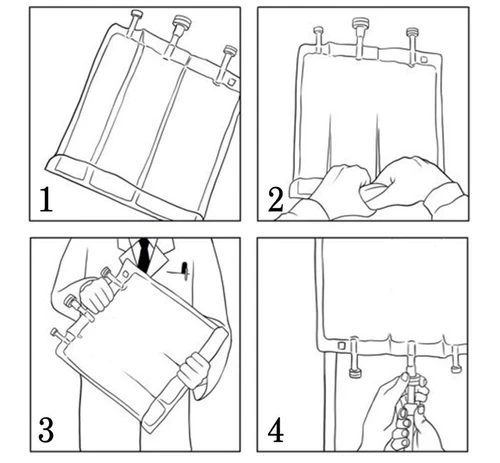
- Starting from the top of the bag (at the handle), roll the bag with both hands (Figure 1). The seals will break progressively from the port side. Continue rolling the bag until the seals are broken halfway along their length (Figure 2).
- Mix thoroughly by rotating the bag at least three times (Figure 3).
- After mixing, the product should form a uniform, milky-looking emulsion.
After removing the protective cap from the medication port, compatible additional components may be added via the medication port (see subsection "Addition").
Remove the protective cap from the infusion port and connect the infusion set. Hang the bag on an infusion stand and administer using standard techniques (Figure 4).
After opening the bag, the contents should be used immediately; do not store an opened bag for subsequent infusions.
Do not reconnect partially used bags. To avoid the risk of air embolism, do not connect bags in series.
Addition
Do not add any additional components to the bag without first verifying their compatibility, as precipitation or fat emulsion separation may lead to vascular occlusion.
Additional components should be added under aseptic conditions.
Finomel may be mixed with the following additional components:
- multivitamin preparations
- preparations containing multiple trace elements
- selenium
- zinc
- sodium salts
- potassium salts
- magnesium salts
- calcium salts
- phosphate salts
The illustrative compatibility table below shows the possibility of adding a trace element preparation such as Nutryel, a multivitamin preparation such as Cernevit, and various types of electrolytes and trace elements in specified amounts. When adding clinically necessary electrolytes and trace elements, the amounts already present in the bag should be taken into account.
| Additional component | Total content after addition for all bag sizes of Finomel |
| Nutryelt (Composition per 1 vial: zinc 153 µmol; copper 4.7 µmol; manganese 1.0 µmol; fluoride 50 µmol; iodine 1.0 µmol; selenium 0.9 µmol; molybdenum 0.21 µmol; chromium 0.19 µmol; iron 18 µmol) | 2 vialsa/bag |
| Cernevit (Composition per 1 vial: vit. A (as retinol palmitate) 3500 IU, vit. D3 (cholecalciferol) 220 IU, vit. E (alpha-tocopherol) 11.2 IU, vit. C (ascorbic acid) 125 mg, vit. B1 (thiamine) 3.51 mg, vit. B2 (riboflavin) 4.14 mg, vit. B6 (pyridoxine) 4.53 mg, vit. B12 (cyanocobalamin) 6 µg, vit. B9 (folic acid) 414 µg, vit. B5 (pantothenic acid) 17.25 mg, vit. B8 (biotin) 69 µg, vit. PP (nicotinamide) 46 mg) | 2 vialsb/bag |
| Sodium | 138 mmol/l |
| Potassium | 138 mmol/l |
| Magnesium | 5 mmol/l |
| Calcium | 4.6 mmol/l |
| Phosphates (organic, such as sodium glycerophosphate) or Phosphates (inorganic, such as potassium phosphate) | 18.5 mmol/l 5.5 mmol/l |
| Selenium | 7.6 µmol/l |
| Zinc | 0.31 mmol/l |
Compatibility with various drugs may not be identical, and healthcare professionals should perform appropriate checks when mixing Finomel with other parenteral solutions.
The contents of the bag should be thoroughly mixed and the mixture visually inspected. There should be no signs of emulsion phase separation. The mixture is a milky white, homogeneous emulsion.
When additional components are introduced, the final osmolarity of the mixture must be evaluated.