Fibryga
Poland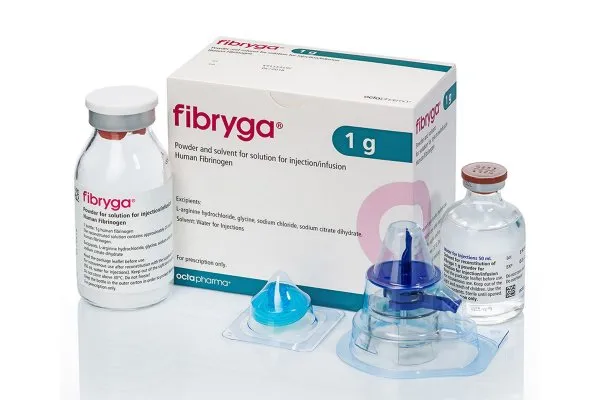
Table of Contents
- Package leaflet: Information for the user
- 1. What Fibryga is and what it is used for
- 2. Important information before using Fibryga
- 3. How to use Fibryga
- 4. Possible adverse reactions
- 5. How to store Fibryga
- 6. Contents of the package and other information
- Information intended exclusively for medical professionals:
Package leaflet: Information for the user
Fibryga, 1 g
Powder and solvent for solution for injection / infusion
Human fibrinogen
Please read all of this leaflet carefully before this medicine is administered, because it contains
important information for the patient.
- Keep this leaflet, as you may need to read it again.
- If you have any further questions, please ask your doctor or pharmacist.
- This medicine has been prescribed for a specific individual. Do not pass it on to others. This medicine may harm others, even if their symptoms are the same.
- If you experience any adverse reactions, including any not listed in this leaflet, inform your doctor or pharmacist. See section 4.
Leaflet contents
- What Fibryga is and what it is used for
- Important information before using Fibryga
- How to use Fibryga
- Possible side effects
- How to store Fibryga
- Contents of the pack and other information
1. What Fibryga is and what it is used for
What Fibryga is
Fibryga contains human fibrinogen, which is an important protein involved in the blood clotting process. A lack of fibrinogen means that blood does not clot as it should, leading to an increased tendency to bleed. Replacing the missing fibrinogen with Fibryga corrects this clotting defect.
What Fibryga is used for
Fibryga is used:
- For the treatment of bleeding episodes and prophylaxis during surgical procedures in patients with congenital fibrinogen deficiency (hypo- or afibrinogenemia) associated with a bleeding tendency.
- For fibrinogen supplementation in patients with uncontrolled severe bleeding associated with acquired fibrinogen deficiency during surgical procedures.
2. Important information before using Fibryga
When not to use Fibryga:
- if the patient is allergic to human fibrinogen or to any of the other components of this medicine (listed in section 6).
- if the patient has previously experienced an allergic reaction to Fibryga. The doctor should be informed if the patient is allergic to any medicine.
Warnings and precautions
Before starting treatment with Fibryga, discuss this with the doctor or pharmacist.
Risk of blood clots in blood vessels
The doctor should assess the benefits of using this medicine against the risk of clot formation in blood vessels, especially if:
- the patient has received a high dose or multiple doses of this medicine,
- the patient has a history of heart attack (coronary artery disease or myocardial infarction),
- the patient has liver disease,
- the patient has recently undergone surgery (postoperative patient),
- the patient is undergoing surgical procedure (perioperative patient),
- in newborns,
- if the patient has a high risk of developing blood clots or coagulation disorders in blood vessels (patients at risk of thromboembolic events or disseminated intravascular coagulation). The doctor may order additional coagulation tests to monitor the risk.
Allergic and anaphylactoid reactions
Any medicine such as Fibryga, which is produced from human blood (containing proteins) and administered intravenously, may cause allergic reactions. If the patient has previously experienced allergic reactions to Fibryga, the doctor will decide whether an antiallergic medication is necessary.
The doctor will explain to the patient the warning signs of an allergic or anaphylactoid reaction.
Early signs of hypersensitivity (allergic) reaction should be carefully observed, such as:
- urticaria,
- rash,
- feeling of tightness in the chest,
- wheezing,
- low blood pressure,
- or anaphylactic reaction (if any or all of the above symptoms occur suddenly and severely). If such symptoms occur, administration of Fibryga by injection/infusion must be stopped immediately.
Virological safety
When medicines are manufactured from human blood or plasma, certain precautions are taken to prevent transmission of infections to patients. These include:
- careful selection of blood and plasma donors to exclude those who may carry infections,
- testing of each donation and pooled plasma for the presence of viruses/infections,
- inclusion of steps in the manufacturing process to inactivate or remove viruses. Despite these precautions, when administering medicines prepared from human blood or plasma, it is not possible to completely exclude the risk of transmitting infection. This also applies to unknown or newly emerging viruses or other types of infections. The measures taken are considered effective against enveloped viruses such as human immunodeficiency virus (HIV), hepatitis B virus (HBV), and hepatitis C virus (HCV), as well as non-enveloped hepatitis A virus (HAV). The precautions taken may have limited effectiveness against non-enveloped viruses such as parvovirus B19. Parvovirus B19 infection may be serious in pregnant women (risk of fetal infection) and in individuals with immunodeficiency or certain types of anemia (e.g. sickle cell anemia or pathological breakdown of red blood cells). It is strongly recommended that every time Fibryga is administered to a patient, the product name and batch number be recorded to allow traceability of the patient to the specific batch of medicinal product used. If the patient receives fibrinogen-containing products derived from human plasma regularly or repeatedly, the doctor may recommend that the patient consider vaccination against hepatitis A and B.
Elder children and adolescents
There are no specific or additional warnings or precautions regarding children and adolescents.
Fibryga with other medicines
Inform the doctor or pharmacist about all medicines currently used or recently used, as well as any medicines the patient plans to use.
Fibryga must not be mixed with any other medicines except those mentioned in the section "Information intended exclusively for healthcare professionals / Reconstitution".
Pregnancy, breastfeeding and fertility
If the patient is pregnant or breastfeeding, suspects she may be pregnant, or is planning to have a child, she should consult her doctor or pharmacist before using this medicine. This medicine should be used during pregnancy or breastfeeding only after consultation with a doctor or pharmacist.
Driving and operating machinery
Fibryga has no influence on the ability to drive or operate machinery.
Fibryga contains sodium
This medicine contains sodium (the main component of table salt) in the amount of up to 132 mg per vial.
This corresponds to 6.6% of the recommended maximum daily sodium intake for adults. This should be taken into account if the patient is on a low-sodium diet.
3. How to use Fibryga
This medicine should always be used as directed by a physician. In case of doubt, consult your
doctor.
Fibryga is administered as an intravenous infusion (drip) by medical personnel.
The dose and dosing regimen depend on:
- the patient's body weight,
- severity of the disease,
- site of bleeding,
- type of surgical procedure,
- overall health condition.
Use in children and adolescents
The method of administering Fibryga to children and adolescents (intravenously) does not differ from that in
adults.
Administration of a higher than recommended dose of Fibryga
The doctor will regularly perform blood tests to measure fibrinogen levels in order to
minimize the risk of overdose.
In case of overdose, the risk of developing pathological blood clots in blood vessels increases.
If you have any further questions regarding the use of this medicine, consult your
doctor or pharmacist.
Method of administration
This medicine should be administered by injection or infusion (drip) into a vein after reconstitution
using the solvent provided. If you have any further questions regarding the use of this medicine, consult your
doctor or pharmacist.
4. Possible adverse reactions
Like all medicines, this medicine can cause adverse reactions, although not everyone will experience them.
You should contact your doctor immediately:
- if any adverse reaction occurs,
- if any adverse reaction not listed in this leaflet occurs. The following adverse reactions have been reported with the use of Fibryga and other fibrinogen-containing products (the frequency of the adverse reactions listed below is unknown):
- allergic or anaphylactic-type reactions: skin reactions such as skin rash or redness of the skin (see section 2 "Warnings and precautions").
- cardiovascular disorders: inflammation of veins and formation of blood clots (see section 2 "Warnings and precautions").
- increased body temperature (fever).
If any of the above symptoms occur in the patient, contact a doctor.
Reporting of adverse reactions
If any adverse symptoms occur in the patient, including any adverse symptoms not listed in this leaflet, inform a doctor or pharmacist. Adverse reactions can be reported directly to the Department of Monitoring Adverse Drug Reactions of the Office for Registration of Medicinal Products, Medical Devices and Biocidal Products:
Al. Jerozolimskie 181C
02-222 Warsaw
Phone: +48 22 49 21 301
Fax: +48 22 49 21 309
Website: https://smz.ezdrowie.gov.pl
Adverse reactions can also be reported to the marketing authorization holder.
Reporting adverse reactions helps to provide more information on the safety of the medicine.
5. How to store Fibryga
Keep this medicine out of sight and reach of children.
Do not use this medicine after the expiry date stated on the label and the outer carton.
The expiry date refers to the last day of the stated month.
Do not store above 25°C. Do not freeze. Store the vial in the outer packaging to protect from light.
The powder should only be reconstituted immediately before injection/infusion. The reconstituted solution has been shown to be stable for 24 hours at room temperature (maximum 25°C). However, the solution should be used immediately and only once to prevent contamination. The prepared solution must not be stored in a refrigerator or freezer.
Medicines must not be disposed of via wastewater or household waste. Ask your pharmacist how to dispose of medicines no longer required. This will help protect the environment.
6. Contents of the package and other information
What Fibryga contains
- The active substance is human fibrinogen.
Fibryga contains 1 g of human fibrinogen per vial or 20 mg of human fibrinogen per ml after reconstitution in the provided solvent (50 ml of water for injections).
- The other ingredients are L-arginine hydrochloride, glycine, sodium chloride, and disodium citrate dihydrate.
Solvent: water for injections.
What Fibryga looks like and contents of the pack
Fibryga is a powder and solvent for solution for injection/infusion, available in glass vials.
White or pale yellow hygroscopic powder or brittle, solid mass.
The solvent is a colourless and clear liquid.
The prepared solution should be almost colourless and slightly opalescent.
Fibryga is supplied in a cardboard carton containing:
- 1 vial of powder for solution for injection/infusion,
- 1 vial containing 50 ml of solvent (water for injections),
- 1 nextaro reconstitution device.
Marketing Authorisation Holder
Octapharma (IP) SPRL
Allée de la Recherche 65
1070 Anderlecht
Belgium
Manufacturer
Octapharma Pharmazeutika Produktionsges.m.b.H.
Oberlaaer Strasse 235, 1100 Vienna, Austria
Octapharma AB
Lars Forssells gata 23, 112 75 Stockholm, Sweden
Octapharma GmbH
Elisabeth-Selbert-Strasse 11
40764 Langenfeld, Germany
This medicinal product is authorised for sale in the European Economic Area and the United Kingdom (Northern Ireland) under the following names:
Fibryga: Austria, Belgium, Bulgaria, Croatia, Cyprus, Czech Republic, Denmark, Estonia, Finland, France, Spain, Netherlands, Ireland, Iceland, Lithuania, Luxembourg, Latvia, Malta, Germany, Norway, Poland, Portugal, Romania, Slovakia, Sweden, Hungary, Italy, United Kingdom (Northern Ireland)
Fibrema: Slovenia
Information intended exclusively for medical professionals:
Dosage
The dosage and duration of replacement therapy depend on the severity of the deficiency, the location and intensity of bleeding, and the patient's clinical condition.
Fibrinogen (functional) concentration should be measured to calculate individualized dosing, as well as the amount and frequency of administered doses for each patient, through regular measurements of plasma fibrinogen concentration and continuous monitoring of the patient's clinical status and other replacement therapies used.
In the case of major surgical procedures, close monitoring of replacement therapy is required by assessing coagulation parameters.
- Prophylaxis in patients with congenital fibrinogen deficiency or afibrinogenemia and a known tendency to bleed
To prevent excessive bleeding during surgical procedures, prophylactic administration is recommended to increase fibrinogen concentration to 1 g/L and maintain it at this level until hemostasis is achieved, and above 0.5 g/L until wound healing is complete. For surgical procedures or treatment of bleeding episodes, the dose should be calculated as follows:
Dose (mg/kg body weight) = [Target concentration (g/L) – measured concentration (g/L)] / 0.018 (g/L per mg/kg body weight)
Further dosing (doses and frequency of injections) should be adjusted according to the patient's clinical condition and laboratory test results.
The biological half-life of fibrinogen is 3–4 days. Therefore, in the absence of consumption, re-treatment with human fibrinogen is usually not required. Due to accumulation that may occur with repeated administration for prophylactic purposes, the dose and frequency should be determined based on therapeutic goals established by the physician for the individual patient.
Children and adolescents
For surgical procedures or treatment of bleeding episodes, the dose for adolescents should be calculated using the formula provided above for adults. The dose for children under 12 years of age should be calculated as follows:
Dose (mg/kg body weight) = [Target concentration (g/L) – measured concentration (g/L)] / 0.014 (g/L per mg/kg body weight)
Further dosing should be adjusted according to the patient's clinical condition and laboratory test results.
Elderly patients
Clinical studies of Fibryga did not include patients aged 65 years and older to provide conclusive evidence whether their response to treatment differs from that of younger patients.
- Treatment of bleeding
Bleeding in patients with congenital fibrinogen deficiency or afibrinogenemia
Treatment of bleeding episodes should follow the formulas provided above for adults/adolescents and children, aiming to achieve the recommended target plasma fibrinogen concentration of 1 g/L. This level should be maintained until hemostasis is achieved.
Bleeding in patients with acquired fibrinogen deficiency
Adults
An initial dose of 1–2 g is usually administered, with additional infusions given as needed. In cases of severe hemorrhage, e.g., during major surgical procedures, higher amounts of fibrinogen (4–8 g) may be required.
Children and adolescents
Dosing should be based on body weight and clinical indications, but typically ranges from 20–30 mg/kg.
Preparation and administration instructions
General instructions
- The prepared solution should be almost colorless and slightly opalescent. Do not use solutions that are cloudy or contain particulate matter.
- The medicinal product Fibryga is intended for single use only. Do not reuse any components.
- To ensure microbiological safety, the solution should be administered immediately after reconstitution. Chemical and physical stability of the prepared solution has been demonstrated for 24 hours when stored at room temperature (up to 25°C). Do not refrigerate or freeze the medicinal product Fibryga after reconstitution.
Reconstitution
- Ensure that the vial containing the powder (Fibryga) and the vial containing the solvent are at room temperature. Maintain this temperature throughout the reconstitution process. If a water bath is used for warming, take care to avoid contact of water with the rubber stoppers or flip-off caps. The water bath temperature must not exceed +37°C.
- Remove the flip-off caps from the vial containing the powder (Fibryga) and the solvent vial to expose the central part of the infusion stopper. Wipe the rubber stoppers with an alcohol swab and allow to dry.
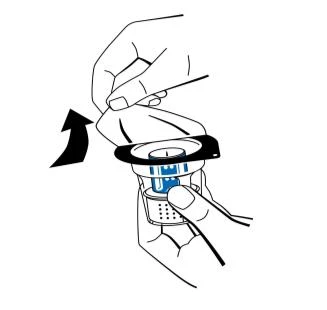
- Open the reconstitution device (nextaro) packaging by pulling off the cover (Fig. 1). To maintain sterility, leave the reconstitution device in the transparent blister packaging. Do not touch the spike.
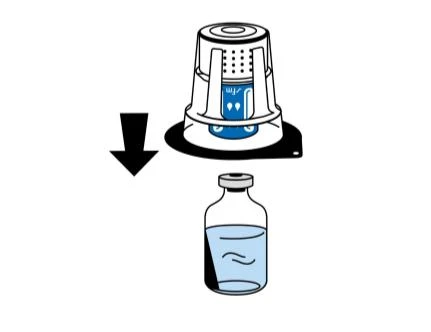
- Place the solvent vial on a flat, clean surface and hold firmly. Without removing the blister packaging, place the blue part of the reconstitution device onto the top of the solvent vial. Press straight down firmly until it clicks into place (Fig. 2). Do not twist when attaching.
Note:
The reconstitution device must first be attached to the solvent vial and then to the vial containing the lyophilized powder. Otherwise, vacuum will be lost and solvent transfer will not occur.
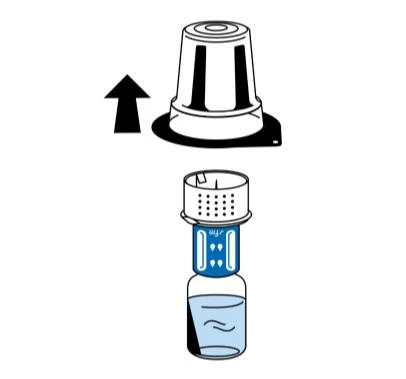
- Holding the solvent vial, carefully remove the blister packaging from the reconstitution device (nextaro) by pulling vertically upward. Ensure that the reconstitution device is securely attached to the solvent vial (Fig. 3).
- Place the vial containing the powder (Fibryga) on a flat, clean surface and hold firmly. Take the solvent vial with the attached reconstitution device and turn it upside down. Place the white part of the connector of the reconstitution device onto the top of the vial containing the powder (Fibryga) and press down firmly until it clicks into place (Fig. 4). Do not twist when attaching. The solvent will automatically transfer into the vial containing the powder (Fibryga).
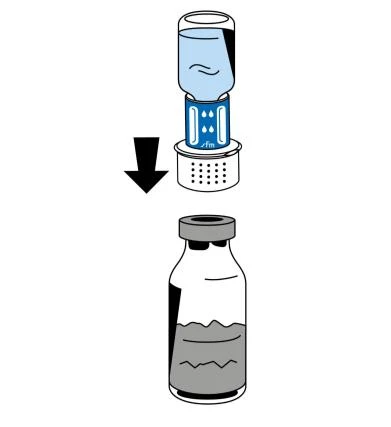
- With the solvent vial still attached, gently rotate the Fibryga medicinal product vial until the powder is completely dissolved. To avoid foaming, do not shake the vial. The powder should completely dissolve within approximately 5 minutes.
The dissolution process should not take longer than 20 minutes. If the powder does not dissolve within 20 minutes, the product must be discarded.
- In rare cases, if unreconstituted product is observed floating on the surface during transfer to syringes or if reconstitution time unexpectedly increases, the dissolution process may be accelerated by more vigorous horizontal mixing of the vial.
- After reconstitution is complete, unscrew the reconstitution device (blue part) counterclockwise into two parts (Fig. 5). Do not touch the luer lock connector on the white part of the reconstitution device.
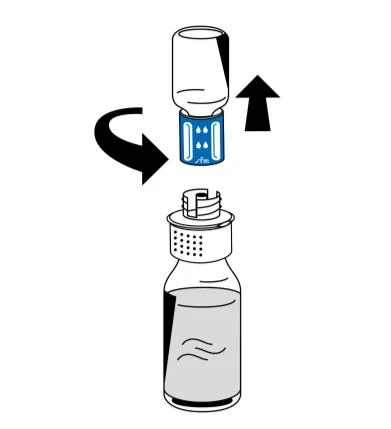
- Discard the empty solvent vial together with the attached blue part of the reconstitution device.
Administration
- Carefully attach a syringe to the luer lock connector on the white part of the reconstitution device (Fig. 6).
- Turn the Fibryga vial upside down and draw the solution into the syringe (Fig. 7).
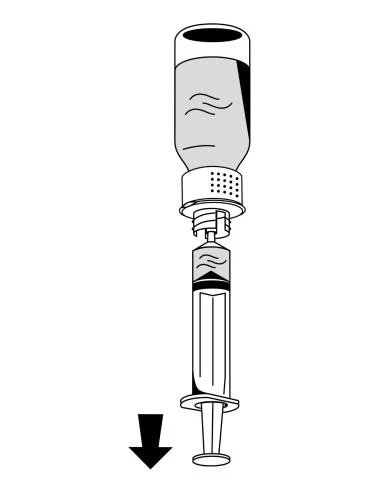
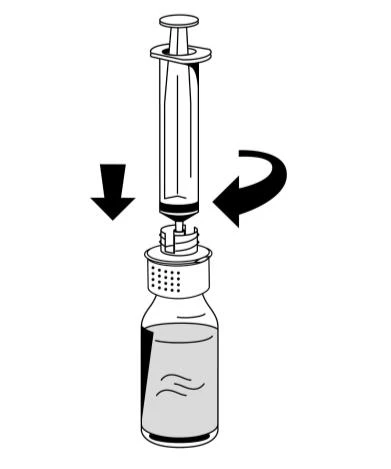
- After transferring the solution, firmly hold the syringe plunger (keeping the plunger pointing downward) and remove the syringe from the reconstitution device (Fig. 8).
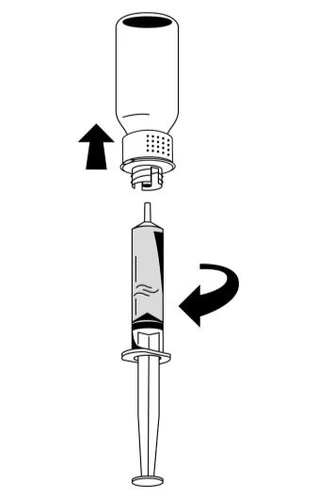
- Discard the white part of the reconstitution device together with the empty Fibryga vial.
The reconstituted solution should be administered intravenously at room temperature using a standard infusion set.
Any unused portions of the medicinal product or waste materials should be disposed of in accordance with local regulations.
Route of administration
Intravenous infusion or injection.
Fibryga should be administered slowly by intravenous infusion at a recommended maximum rate of 5 mL per minute in patients with congenital hypo- or afibrinogenemia, and at a recommended maximum rate of 10 mL per minute in patients with acquired fibrinogen deficiency.
Pharmaceutical incompatibilities
Do not mix the medicinal product with other medicinal products.