Ferrum-lek
Poland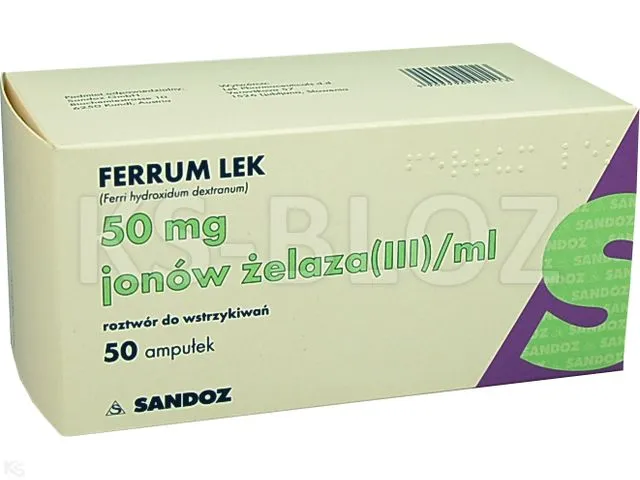
Table of Contents
Package leaflet: Information for the patient
Ferrum-Lek, 50 mg of iron(III) ions/ml, solution for injection
Ferri hydroxidum dextranum
Please read all of this leaflet carefully before using this medicine because it contains
important information for you.
- Keep this leaflet. You may need to read it again.
- If you have any further questions, please ask your doctor, pharmacist or nurse.
- This medicine has been prescribed for a specific individual. Do not pass it on to others. It may harm them even if their symptoms are the same.
- If you experience any side effects, including any not listed in this leaflet, tell your doctor, pharmacist or nurse. See section 4.
Contents of the leaflet:
- What Ferrum-Lek is and what it is used for
- Important information before using Ferrum-Lek
- How to use Ferrum-Lek
- Possible side effects
- How to store Ferrum-Lek
- Contents of the pack and other information
1. What Ferrum-Lek is and what it is used for
Ferrum-Lek is a solution for intramuscular injection containing iron. Iron is used, among other things, in the bone marrow for the production of haemoglobin (Hb).
Ferrum-Lek is used to treat cases of iron deficiency that require rapid replenishment. The medicine is particularly used:
in significant iron deficiency following blood loss;
in active inflammatory bowel disease where oral iron preparations are ineffective;
in cases of poor tolerance to oral iron preparations or lack of improvement after using oral iron preparations.
2. Important information before using Ferrum-Lek
When not to use Ferrum-Lek
Do not use this medicine if:
you are allergic (hypersensitive) to iron or to any of the other ingredients of this medicine (listed in section 6);
you have been diagnosed with a serious hypersensitivity to other parenteral iron-containing preparations;
you have anaemia caused by reasons other than iron deficiency;
you have excessive iron stores in the body or disorders in iron utilization;
you have disorders in iron incorporation into haemoglobin structure (e.g. due to lead poisoning);
you have severe coagulation disorders caused by developing haematomas;
you are in the first trimester of pregnancy.
Warnings and precautions
Parenterally administered iron may cause allergic or pseudoanaphylactic reactions, which may be fatal.
The risk of allergic reactions is increased in patients with diagnosed allergies, including drug allergies, especially those with severe asthma, eczema or other atopic allergies.
The risk of allergic reactions to other parenteral iron preparations is also increased in patients with Crohn's disease, advanced chronic polyarthritis, systemic lupus erythematosus, rheumatoid arthritis, and in patients with reduced iron-binding capacity and/or folic acid deficiency.
Management in case of severe allergic or pseudoanaphylactic reaction – see information for healthcare professionals at the end of this leaflet.
Patients with impaired kidney or liver function will receive Ferrum-Lek under strict medical supervision.
In patients with heart failure and cardiovascular diseases, treatment with iron preparations may cause circulatory complications.
Please inform your doctor if any of the above warnings apply to your current or past medical conditions.
Children and adolescents
Ferrum-Lek is not recommended for use in children under 4 months of age.
Ferrum-Lek and other medicines
Tell your doctor about all medicines you are currently taking or have recently taken, as well as any medicines you plan to take. This especially includes:
- angiotensin-converting enzyme (ACE) inhibitors (medicines used to treat high blood pressure, e.g. enalapril), as they enhance the effect of parenterally administered iron;
- oral iron preparations, as Ferrum-Lek may reduce their absorption. Treatment with oral iron preparations may be started no earlier than 5 days after the last iron injection.
Pregnancy and breastfeeding
If you are pregnant or breastfeeding, think you may be pregnant, or are planning to have a baby, consult your doctor or pharmacist before using this medicine.
Pregnancy
Use during pregnancy is possible only if clearly needed, and only when, in the opinion of the doctor, the expected benefit to the mother outweighs the potential risk to the fetus.
Breastfeeding
It is not known whether the drug passes into breast milk; therefore, its use during breastfeeding is not recommended.
Driving and using machines
The effect of Ferrum-Lek on the ability to drive and operate machinery is unknown.
Ferrum-Lek contains sodium
This medicine contains less than 1 mmol (23 mg) of sodium per dose, i.e. the medicine is considered "sodium-free".
3. How to use Ferrum-Lek
Ferrum-Lek should always be used as directed by the physician. In case of doubts, consult your doctor.
The doctor determines the dose of Ferrum-Lek individually for each patient. Additional information for medical personnel is provided at the end of this leaflet.
Usual dosage
Adults and elderly patients
1 to 2 ampoules every other day (corresponding to 100 to 200 mg of iron), depending on hemoglobin concentration.
Maximum dose: 4 ml (2 ampoules), corresponding to 200 mg of iron.
Children
0.06 ml/kg body weight every other day (corresponding to 3 mg iron/kg body weight per day). Maximum dose: 0.14 ml/kg body weight per day (corresponding to 7 mg iron/kg body weight per day).
Method of administration
Ferrum-Lek is administered every other day exclusively by deep intramuscular injection (not intravenously), alternately into the left and right gluteal muscle.
After administration, the patient should be observed for approximately 30 minutes for signs of allergic reactions.
Overdose of Ferrum-Lek
If an overdose of Ferrum-Lek is suspected, medical advice should be sought immediately.
To date, there is no reported experience of overdose with iron administered as an injectable complex of iron(III) hydroxide with dextran.
Excessive iron doses may cause acute complications and hemosiderosis (excessive iron deposition in the body).
Missed dose of Ferrum-Lek
Do not administer a double dose to make up for a missed dose.
Stopping Ferrum-Lek treatment
Do not discontinue treatment without prior consultation with your doctor.
If you have any further questions about the use of this medicine, please consult your doctor or nurse.
4. Possible adverse reactions
Like all medicines, this medicine can cause adverse reactions, although not everybody will experience them.
The frequency of adverse reactions is defined as follows:
common (may occur in less than 1 in 10 people)
uncommon (may occur in less than 1 in 100 people)
rare (may occur in less than 1 in 1,000 people)
very rare (may occur in less than 1 in 10,000 people)
frequency not known (cannot be estimated from the available data)
Uncommon: blurred vision, lethargy, collapse, hot flushes, bronchospasm, dyspnoea,
nausea, vomiting, abdominal pain, pruritus, urticaria, rash, skin eruptions, erythema, muscle cramps,
feeling of warmth, inflammation and haematoma at the injection site.
Rare: pseudoallergic reactions, with dyspnoea, urticaria, rash, pruritus, nausea,
chills, peripheral oedema, feeling of fatigue, weakness, malaise, seizures,
dizziness, restlessness (mainly motor), tremor, cardiac arrhythmias, increased heart rate (tachycardia),
chest pain and tightness, hypotension, collapse, diarrhoea, angioedema, sweating, pain and brownish discolouration of the skin at the injection site, myalgia, altered mental state, anaphylactic reactions (which rarely include joint pain), fatigue, general malaise.
Very rare: haemolysis (destruction of red blood cells), lymphadenopathy, severe pseudoallergic reactions (sudden respiratory disturbances and/or circulatory collapse), which have also been fatal, headache, tingling sensation (paraesthesia), transient deafness, fetal bradycardia, palpitations, hypertension.
Frequency not known: leukocytosis, hypersensitivity reactions (including delayed reactions with joint pain, muscle pain, fever, sometimes severe), transient taste disturbances (especially metallic taste in the mouth), loss of consciousness, fainting, seizures, hypoglycaemia, somnolence, disturbances of consciousness, confusion, anxiety, slowed heart rate (bradycardia), Kounis syndrome, sudden redness of the skin, especially of the face, phlebitis, circulatory collapse, thrombophlebitis, respiratory arrest, constipation, purpura, excessive sweating, arthralgia, arthritis, limb pain, back pain, change in urine colour, confusion, injection site reactions (irritation, skin discolouration, pruritus, bleeding, formation of sterile abscesses, tissue necrosis or atrophy, pain), cold sweats, weakness, peripheral oedema, malaise, pallor, fever, chills, increased activity of AlAT, AspAT, GGT, LDH enzymes in blood tests, increased ferritin concentration, influenza-like symptoms which may occur within several hours to several days after injection (typical symptoms include high body temperature and muscle and joint pain).
Allergic reactions
If any of the symptoms listed above occur, which may indicate a severe allergic reaction, the physician should be informed immediately. These include, among others: dyspnoea, urticaria, rash, pruritus, peripheral oedema, sudden breathing difficulties, circulatory collapse, joint pain, muscle pain, fever, and chest pain, which may be symptoms of a sometimes severe allergic reaction called Kounis syndrome.
Reporting of adverse reactions
If any adverse reactions occur, including any adverse reactions not listed in this leaflet, inform your doctor, pharmacist, or nurse. Adverse reactions can be reported directly to the Department of Monitoring Adverse Drug Reactions of the Office for Registration of Medicinal Products, Medical Devices and Biocidal Products: Al. Jerozolimskie 181C, 02-222 Warsaw
tel.: + 48 22 49 21 301, fax: + 48 22 49 21 309, website: https://smz.ezdrowie.gov.pl
Adverse reactions can also be reported to the responsible entity.
Reporting adverse reactions helps to provide more information on the safety of the medicine.
5. How to store Ferrum-Lek
Keep this medicine out of sight and reach of children.
Store below 25°C. Do not freeze. Keep in the original packaging.
Do not use this medicine after the expiry date stated on the packaging after EXP.
The expiry date refers to the last day of the stated month.
Medicines must not be disposed of via wastewater or household waste. Ask your pharmacist how to dispose of medicines no longer required. These measures will help protect the environment.
6. Contents of the pack and other information
What Ferrum-Lek contains
1 ampoule (2 ml of injection solution) contains 100 mg of iron as iron(III) hydroxide complex with dextran.
1 ml of injection solution contains 50 mg of iron as iron(III) hydroxide complex with dextran.
The other ingredients are sodium hydroxide and hydrochloric acid (for pH adjustment), water for injections.
What Ferrum-Lek looks like and contents of the pack
Brown, opaque solution.
50 ampoules with 2 ml each.
Marketing Authorisation Holder
Sandoz GmbH
Biochemiestrasse 10
6250 Kundl, Austria
Manufacturer
Lek Pharmaceuticals d.d.
Verovškova 57
1526 Ljubljana, Slovenia
For further information, please contact:
Sandoz Polska Sp. z o.o.
ul. Domaniewska 50 C
02-672 Warsaw, Poland
tel. 22 209 70 00
The following information is intended for healthcare professionals:
Instructions for the use of Ferrum-Lek
Improper storage of ampoules may cause precipitation. Before administration,
inspect the contents of the ampoule. Only ampoules free from precipitate and containing a homogeneous solution should be used. Ampoules showing visible precipitate or those beyond the expiry date must be discarded.
The contents of the ampoule should be used immediately after opening.
Ferrum-Lek must not be mixed with other medicinal products.
To avoid pain and skin discoloration, Ferrum-Lek must be administered carefully and correctly:
the drug should be injected intramuscularly using a 5–6 cm needle into the upper outer quadrant of the gluteal muscle. Before injection, clean the skin and firmly press the subcutaneous tissue to a depth of 2 cm to minimize potential leakage of the administered drug. After injection, the injection site should be compressed for one minute.
Calculation of the dose to be administered to the patient:
Dose determination
The physician determines the dose of Ferrum-Lek individually for each patient using the following formula:
Total amount of iron the patient should receive (total iron deficit) [mg] =
body weight [kg] × (target Hb concentration [g/L] – current Hb concentration [g/L]) × 0.24 + tissue iron stores [mg].
| Body weight | < 35 kg | > 35 kg |
| Target Hb concentration | 130 g/l | 150 g/l |
| Tissue iron stores | 15 mg/kg b.w. | 500 mg |
Total iron deficiency [mg]
Number of Ferrum-Lek vials =
100 mg
Table 1. Number of Ferrum-Lek vials to be administered depending on the patient's current
hemoglobin concentration and body weight.
| Body weight [kg] | Number of vials for the entire therapy | |||
| Hb 60 g/l | Hb 75 g/l | Hb 90 g/l | Hb 105 g/l | |
| 5 | 1.5 | 1.5 | 1.5 | 1.0 |
| 10 | 3.0 | 3.0 | 2.0 | 2.0 |
| 15 | 5.0 | 4.5 | 3.5 | 3.0 |
| 20 | 6.5 | 5.5 | 5.0 | 4.0 |
| 25 | 8.0 | 7.0 | 6.0 | 5.5 |
| 30 | 9.5 | 8.5 | 7.5 | 6.5 |
| 35 | 12.5 | 11.5 | 10.0 | 9.0 |
| 40 | 13.5 | 12.0 | 11.0 | 9.5 |
| 45 | 15.0 | 13.0 | 11.5 | 10.0 |
| 50 | 16.0 | 14.0 | 12.0 | 10.5 |
| 55 | 17.0 | 15.0 | 13.0 | 11.0 |
| 60 | 18.0 | 16.0 | 13.5 | 11.5 |
| 65 | 19.0 | 16.5 | 14.5 | 12.0 |
| 70 | 20.0 | 17.5 | 15.0 | 12.5 |
| 75 | 21.0 | 18.5 | 16.0 | 13.0 |
| 80 | 22.5 | 19.5 | 16.5 | 13.5 |
| 85 | 23.5 | 20.5 | 17.0 | 14.0 |
| 90 | 24.5 | 21.5 | 18.0 | 14.5 |
If the calculated number of vials is higher than the recommended maximum daily dose, the physician will precisely define the administration schedule of the drug.
Total dose in iron deficiency caused by blood loss:
If the amount of lost blood is known:
Intramuscular administration of 200 mg of iron (2 vials) increases Hb concentration equivalent to transfusion of 1 unit of blood.
Total iron dose to be administered [mg] = number of lost blood units × 200
Number of Ferrum Lek vials = number of lost blood units × 2
If the Hb deficit is known (assuming no need to replenish tissue iron stores):
Total iron dose to be administered [mg] =
body weight [kg] × (target Hb concentration [g/l] – current Hb concentration [g/l]) × 0.24
Anaphylactic/pseudoallergic reactions
Ferrum Lek must be administered only under direct supervision of medical personnel trained in recognition and treatment of anaphylactic reactions, in a facility fully equipped with resuscitation equipment. The patient should be observed for at least 30 minutes after each administration of the medicinal product. If hypersensitivity reactions or intolerance symptoms occur during administration, treatment must be immediately discontinued. Equipment for cardiopulmonary resuscitation and treatment of acute anaphylactic or pseudoallergic reactions (including 1:1000 adrenaline solution for injection) must be readily available. Antihistamines and/or corticosteroids should also be administered if indicated.
Administration of a dose higher than recommended of Ferrum Lek
If a patient has received an overdose of Ferrum Lek, supportive treatment should be applied and, if necessary, a chelating agent (e.g. deferoxamine at a maximum dose of 15 mg/kg body weight/hour) should be administered.
Stability and compatibility
Ferrum Lek must not be mixed with other medicinal products.