Fenistil
Poland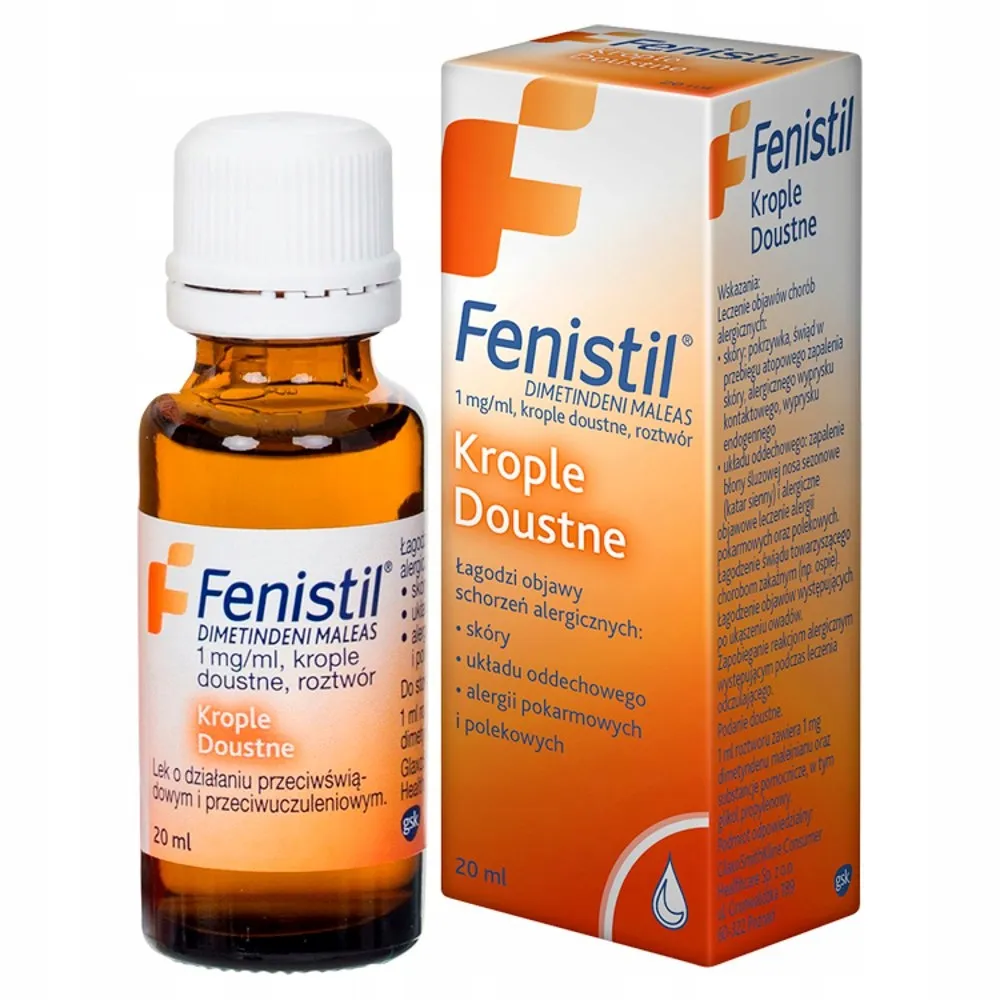
Table of Contents
Patient Information Leaflet
Warning! Keep this leaflet! The packaging information in a foreign language.
Fenistil, 1 mg/ml (0.1%), oral drops, solution
Dimetindene maleate
Please read this leaflet carefully before using the medicine, as it contains important information for the patient.
This medicine should always be used exactly as described in this patient leaflet or as directed by a doctor or pharmacist.
- Keep this leaflet so that you can read it again if necessary.
- If you need advice or further information, please consult your pharmacist.
- If you experience any adverse reactions, including any not listed in this leaflet, inform your doctor, pharmacist, or nurse. See section 4.
- If there is no improvement after 7 days, or if you feel worse, consult your doctor.
Table of contents:
- What Fenistil is and what it is used for
- Important information before taking Fenistil
- How to take Fenistil
- Possible side effects
- How to store Fenistil
- Contents of the pack and other information
1. What Fenistil is and what it is used for
Fenistil contains dimetindene maleate, which belongs to a group of medicines called antihistamines.
It blocks the effects of histamine, a substance responsible for allergic reactions. It relieves itching and irritation caused by skin rashes, reduces swelling, and also alleviates symptoms of allergic rhinitis such as watery nasal discharge (runny nose), sneezing, nasal itching, and eye itching and watering.
After oral administration, the effect of the medicine begins within 30–60 minutes and lasts for 8 to 12 hours.
Fenistil is used to treat symptoms of allergic conditions:
- of the skin: urticaria, itching in atopic dermatitis, allergic contact dermatitis, endogenous eczema,
- of the respiratory tract: seasonal allergic rhinitis (hay fever) and chronic allergic rhinitis (e.g. allergy to house dust, animal fur, feathers). The medicine is used for symptomatic treatment of food and drug allergies, and also relieves itching associated with infectious diseases (e.g. chickenpox). It may be used to relieve symptoms following insect bites and to prevent allergic reactions during desensitization therapy. If there is no improvement after 7 days, or if you feel worse, consult your doctor.
2. Information before using Fenistil
When not to use Fenistil oral drops:
- if the patient is allergic to dimethindene maleate or any of the other ingredients of this medicine (listed in section 6),
- in newborns during the first month of life, especially in premature infants.
Warnings and precautions
Before starting to use Fenistil, discuss it with your doctor, pharmacist, or nurse.
Consult a doctor before using this medicine in patients:
- with glaucoma,
- with urinary retention, e.g. due to enlarged prostate,
- with epilepsy,
- in elderly patients.
Elderly patients should consult a doctor before using this medicine, as they are more susceptible to adverse effects of this medicine, such as excitation and fatigue.
This medicine should not be used in elderly patients with disorientation.
Children and adolescents
Antihistamines may cause excitation in young children.
The use of Fenistil in infants aged from 1 month to 1 year and in children under 6 years of age should be under medical advice.
Do not exceed the recommended dose.
Keep the medicine out of sight and reach of children.
Fenistil and other medicines
Tell your doctor about all medicines currently taken or recently used, including those obtained without a prescription.
Do not use Fenistil without medical advice if you are taking any of the following medicines:
- antidepressants,
- anticholinergic medicines, such as: bronchodilators (medicines used in the treatment of asthma and bronchospasm), medicines used for spasm in the abdominal cavity (medicines used to prevent stomach and intestinal spasms), mydriatics (pupil-dilating medicines), urological antispasmodics (medicines used in the treatment of urinary incontinence and overactive bladder symptoms),
- sleeping medicines, sedatives,
- anticonvulsants (medicines used in the treatment of epilepsy),
- opioid analgesics,
- antihistamines (medicines used in the treatment of common cold, cough, or other allergies),
- antiemetics,
- procarbazine (a medicine used in the treatment of certain types of cancer),
- scopolamine (a medicine used to prevent motion sickness),
- alcohol.
Using Fenistil with alcohol
Like other antihistamines, Fenistil may enhance the effects of alcohol.
Pregnancy, breastfeeding and fertility
If the patient is pregnant or breastfeeding, suspects she may be pregnant, or is planning to become pregnant, she should consult a doctor or pharmacist before using this medicine.
Fenistil should not be used during pregnancy unless the benefits to the mother outweigh the potential risks to the fetus. The medicine may be used only under medical supervision.
Fenistil should not be used in breastfeeding women.
Driving and operating machinery
As with other antihistamines, Fenistil may impair psycho-physical performance in some patients. Therefore, individuals taking Fenistil oral drops should exercise caution when driving motor vehicles or performing other activities requiring concentration (e.g. operating machinery).
Fenistil contains benzoic acid, propylene glycol, and sodium.
The medicine contains 2 mg of benzoic acid per dose (40 drops), equivalent to 1 mg/ml.
Benzoic acid may increase the risk of jaundice (yellowing of the skin and whites of the eyes) in newborns (up to 4 weeks of age).
The medicine contains 200 mg of propylene glycol per dose (40 drops), equivalent to 100 mg/ml.
Before administering the medicine to a child under 4 weeks of age, consult a doctor or pharmacist, especially if the child is taking other medicines containing propylene glycol or alcohol.
The medicine contains less than 1 mmol (23 mg) of sodium per dose (40 drops), meaning the medicine is considered "sodium-free".
3. How to use Fenistil
This medicine should always be taken exactly as described in this patient leaflet or as directed by your
doctor, pharmacist, or nurse. If in doubt, consult your doctor, pharmacist, or nurse.
Do not exceed the recommended dose.
Use of this medicine in infants aged 1 month to 1 year and in children under 6 years of age should be
undertaken only on the advice of a doctor. This medicine must not be used in children under 1 month of age.
Adults and children over 6 years of age:
This medicine should not be used for longer than 7 days.
If there is no improvement after 7 days, or if the patient feels worse, consult a doctor.
Adults and children over 12 years of age:
The daily dose is 3–6 mg of dimetindene, given in 3 divided doses.
It is recommended to take 20 to 40 drops 3 times daily.
In patients prone to drowsiness, it is recommended to take 40 drops at bedtime and 20 drops in the morning with breakfast.
Children under 12 years of age:
The recommended daily dose is 0.1 mg/kg body weight/day, i.e. 2 drops per kg of body weight per day, administered in 3 divided doses, for example:
6 drops 3 times daily for a 8-month-old infant weighing 9 kg.
8 drops 3 times daily for a 2-year-old child weighing 12 kg.
The maximum daily dose must not be exceeded, which is as follows:
Age Maximum daily dose
1 month – 1 year 1.5 mg (30 drops)
1 – 3 years 2.25 mg (45 drops)
3 – 12 years 3 mg (60 drops)
20 drops = 1 ml = 1 mg dimetindene
Infants aged 1 month to 1 year and children under 6 years of age:
Use in infants aged 1 month to 1 year and in children under 6 years of age should be undertaken only on the advice of a doctor.
Fenistil should not be exposed to high temperatures. If the infant is bottle-fed, add the medicine to the bottle with warm food immediately before feeding. If the infant is fed with a spoon, the drops may be given undiluted on a small teaspoon.
Elderly patients
Elderly patients should consult a doctor before using this medicine.
Taking more Fenistil than recommended
If more Fenistil than recommended has been taken, seek immediate advice from a doctor or pharmacist.
Symptoms of overdose include: drowsiness (mainly in adults), central nervous system stimulation (mainly in children and elderly patients), including agitation, impaired motor coordination, hallucinations, tremors, convulsions, as well as urinary retention and fever. A drop in blood pressure, coma, and circulatory-respiratory collapse may also occur.
If you forget to take Fenistil
If you miss a dose, take it as soon as possible, provided that less than 2 hours remain until the next scheduled dose. Otherwise, take the medicine at the usual time. Do not take a double dose to make up for a missed dose.
If you have any further questions about the use of this medicine, consult your doctor or pharmacist.
4. Possible adverse reactions
Like all medicines, Fenistil may cause adverse reactions, although not everyone experiences them.
You should STOP taking the medicine and contact your doctor immediately if any of the following symptoms occur, as they may be signs of an allergic reaction:
- difficulty breathing or swallowing,
- swelling of the face, lips, tongue or throat,
- severe skin itching with red rash or enlarging blisters, muscle cramps.
These symptoms occur very rarely ( may occur in fewer than 1 in 10,000 people ).
Other adverse reactions that may occur are usually mild and transient. The most common ones appear especially at the beginning of treatment.
Very common ( may affect more than 1 in 10 people taking the medicine ): fatigue.
Common ( affect fewer than 1 in 10 people taking the medicine ): drowsiness, nervousness.
Rare ( may affect fewer than 1 in 1,000 people taking the medicine ): restlessness, headache, dizziness, gastrointestinal discomfort, nausea, dry mouth, sore throat.
If any of the adverse symptoms worsen or if any adverse reactions not listed in this leaflet occur, inform your doctor or pharmacist.
Reporting adverse reactions
If any adverse reactions occur, including those not listed in this leaflet, tell your doctor, pharmacist or nurse. Adverse reactions can be reported directly to the Department of Monitoring Adverse Drug Reactions of the Office for Registration of Medicinal Products, Medical Devices and Biocidal Products, Al. Jerozolimskie 181C, 02-222 Warsaw, tel.: + 48 22 49 21 301, fax: + 48 22 49 21 309, website: https://smz.ezdrowie.gov.pl.
Reporting adverse reactions helps to provide more information on the safety of the medicine.
5. How to store Fenistil
Do not store above 25°C. Keep in the original packaging to protect from light.
Keep the medicine out of the sight and reach of children.
Do not use this medicine after the expiry date stated on the packaging. The expiry date refers to the last day of the stated month.
Medicines must not be disposed of via wastewater or household waste. Ask your pharmacist how to dispose of medicines no longer in use. Such measures help protect the environment.
6. Contents of the packaging and other information
What Fenistil contains
- The active substance is dimetindene maleate. One millilitre of Fenistil contains 1 mg of dimetindene maleate.
- Other ingredients of the medicine are: propylene glycol, benzoic acid, disodium edetate, disodium phosphate dodecahydrate, citric acid monohydrate, sodium saccharin, purified water.
What Fenistil looks like and contents of the pack
Fenistil is a solution, clear, colourless to slightly yellowish-brown, in a type III glass bottle with a polyethylene dropper and a white polypropylene child-resistant cap, packed in a cardboard box.
Pack size available: 20 ml.
For further information, please contact the responsible party or the parallel importer.
Marketing Authorisation Holder in Belgium, country of export:
Haleon Belgium
Da Vincilaan 5
B-1930 Zaventem, Belgium
Manufacturer:
Haleon Belgium
Da Vincilaan 5
B-1930 Zaventem, Belgium
Parallel importer:
InPharm Sp. z o.o.
ul. Strumykowa 28/11
03-138 Warsaw, Poland
Repackaged in:
InPharm Sp. z o.o. Services sp. k.
ul. Chełmżyńska 249
04-458 Warsaw, Poland
Marketing Authorisation Number in Belgium, country of export: BE051563
Parallel Import Authorisation Number: 323/22