Febrisan zatoki
Poland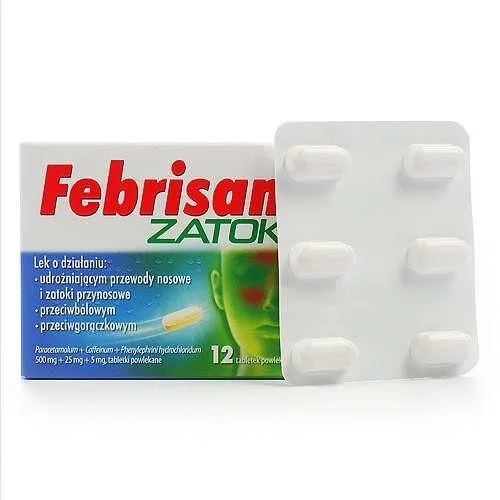
Table of Contents
Package leaflet: information for the patient
Febrisan Zatoki, 500 mg + 25 mg + 5 mg, coated tablets
Paracetamolum + Coffeinum + Phenylephrini hydrochloridum
Read the following information carefully before using the medicine, as it contains
important information for the patient.
This medicine should always be used exactly as described in this patient leaflet or as directed by
the doctor or pharmacist.
- Keep this leaflet for future reference.
- If you need advice or further information, consult your pharmacist.
- If you experience any adverse reactions, including any possible side effects not listed in this leaflet, inform your doctor or pharmacist. See section 4.
- If there is no improvement after 3 days of treatment for fever or after 5 days for pain, or if you feel worse, consult your doctor.
Table of contents
- What Febrisan Zatoki is and what it is used for
- Important information before taking Febrisan Zatoki
- How to take Febrisan Zatoki
- Possible side effects
- How to store Febrisan Zatoki
- Contents of the pack and other information
1. What Febrisan Zatoki is and what it is used for
This medicine contains three active substances: paracetamol, phenylephrine, and caffeine. Paracetamol has antipyretic and analgesic effects. Phenylephrine reduces congestion and swelling of the nasal mucosa, helping to clear the nasal passages. Caffeine exerts a stimulating effect on the central nervous system and enhances the analgesic effect of paracetamol.
Febrisan Zatoki is used for the short-term treatment of cold and flu symptoms such as:
fever, chills, headache, muscle pain, sore throat, nasal discharge, and swelling of the nasal and paranasal sinus mucosa.
2. Important information before using Febrisan Zatoki
When not to use Febrisan Zatoki
- If the patient is allergic to the active substances or any of the other ingredients of this medicine (listed in section 6).
- If the patient has:
- hypertension;
- heart disease;
- severe hepatic insufficiency.
- During treatment with MAO inhibitors and within 2 weeks after their discontinuation.
- During pregnancy.
- In children under 12 years of age.
Warnings and precautions
Before starting treatment with Febrisan Zatoki, consult a doctor or pharmacist.
Do not exceed the recommended dose. Taking higher than recommended doses may cause severe liver damage.
1/6
Prolonged use of this product without medical supervision may be harmful (see section 3).
During prolonged use or treatment with high doses of painkillers, headaches may occur, which should not be treated with higher doses of paracetamol.
Due to the risk of overdose, do not use simultaneously with other medicines containing paracetamol.
Caution is advised in patients:
- with chronic malnutrition;
- with alcoholic liver disease;
- with severe renal insufficiency;
- with benign prostatic hyperplasia;
- with vascular occlusion (Raynaud's syndrome);
- with pheochromocytoma;
- with untreated or active hyperthyroidism;
- with hypersensitivity to acetylsalicylic acid and patients with aspirin-sensitive asthma, as mild bronchospasm has been reported after paracetamol administration in patients sensitive to acetylsalicylic acid (cross-reaction);
- treated with sedatives and other sympathomimetic drugs (e.g. decongestants), appetite suppressants, or psychostimulants similar to amphetamines;
- using anticoagulant drugs;
- with diabetes;
- with narrow-angle glaucoma.
Use of the medicine in patients with hepatic insufficiency, alcohol abusers, and fasting individuals increases the risk of liver damage.
Do not drink alcohol during treatment.
Consult a doctor even if the above warnings refer to conditions that occurred in the past.
Children and adolescents
Do not use the medicine in children under 12 years of age.
Patients with renal and/or hepatic impairment
Exercise special caution in patients with kidney or liver disorders.
The medicine is contraindicated in patients with severe hepatic insufficiency.
Elderly patients
Exercise caution when using Febrisan Zatoki.
Febrisan Zatoki and other medicines
Tell your doctor or pharmacist about all medicines you are currently taking or have recently taken, as well as any medicines you plan to take.
Interactions of Febrisan Zatoki with other medicines result from the interactions of the active substances contained in the medicine.
Paracetamol
May enhance the effect of oral anticoagulants of the coumarin group (e.g. warfarin, phenprocoumon) and increase the risk of bleeding. Therefore, monitoring is recommended.
Concomitant use with drugs that increase the metabolism of paracetamol in the liver (e.g. rifampicin – used in the treatment of tuberculosis, acne, staphylococcal infections; certain hypnotics and antiepileptic drugs
- carbamazepine, phenytoin, phenobarbital) increases the risk of liver damage. 2/6
Concomitant use of antiemetic drugs (e.g. metoclopramide) accelerates the absorption of paracetamol from the gastrointestinal tract.
Cholestyramine reduces the absorption of paracetamol; therefore, this medicine should not be administered within one hour after paracetamol administration.
Drinking alcohol during paracetamol treatment leads to the formation of a toxic metabolite causing necrosis of liver cells, which may subsequently lead to liver failure.
Due to the risk of overdose, the medicine should not be used simultaneously with other medicines containing paracetamol.
Phenylephrine
Concomitant use with MAO inhibitors may enhance the effect of phenylephrine.
Indomethacin (a medicine used in rheumatoid arthritis), beta-blockers [medicines used in the treatment of hypertension, cardiac arrhythmias (e.g. propranolol)] or methyldopa (a medicine used in the treatment of hypertension) used simultaneously with phenylephrine may cause hypertensive crisis (sudden increase in blood pressure, a life-threatening condition).
Pregnancy, breastfeeding and fertility
Due to the presence of phenylephrine, do not use the medicine during pregnancy (see section 2).
Paracetamol passes into human milk. Caution is advised in breastfeeding women.
Avoid using phenylephrine during lactation. Phenylephrine may be excreted in breast milk.
Driving and operating machinery
Febrisan Zatoki has no effect on the ability to drive or operate machinery.
3. How to use Febrisan Zatoki
This medicine should always be used exactly as described in the patient leaflet or as advised by
your doctor or pharmacist. If in doubt, consult your doctor or pharmacist.
Recommended dose
Adults and adolescents over 12 years of age:
1 or 2 coated tablets (500 or 1000 mg paracetamol, 25 or 50 mg caffeine and 5 or 10 mg
phenylephrine hydrochloride) every 4-6 hours. Do not exceed 8 coated tablets per day,
i.e. 4 g paracetamol, 200 mg caffeine and 40 mg phenylephrine hydrochloride.
Do not use for longer than 3 days for fever or 5 days for pain without medical advice.
Method of administration
Oral use.
The coated tablet should be taken after a meal, with a large amount of water.
Use of a higher than recommended dose of Febrisan Zatoki
If you take more than the recommended dose, seek immediate medical advice from a doctor or
pharmacist.
The medicine contains three active substances; symptoms of overdose may result from the effect of one or
all of these substances.
3/6
Paracetamol
Paracetamol overdose may lead to liver damage, which may result in liver transplantation or death.
Cases of acute pancreatitis have been observed, usually associated with liver function disorders (including
acute liver failure) and toxic liver damage.
Paracetamol overdose may cause symptoms within a few to several hours, such as:
nausea, vomiting, excessive sweating, drowsiness and general weakness. These symptoms may subside
the next day despite ongoing liver damage, which subsequently manifests as upper abdominal discomfort,
recurrence of nausea and jaundice.
Overdose may lead to acute kidney failure and (or) liver failure.
Liver failure may lead to encephalopathy (central nervous system dysfunction), bleeding, hypoglycaemia
(low blood glucose levels), brain oedema, coma and death.
Other non-liver-related symptoms reported after paracetamol overdose include cardiac function disorders.
Phenylephrine
Symptoms of phenylephrine overdose: tremor, restlessness, insomnia, tachycardia (increased heart rate),
supraventricular extrasystoles, headache, tingling in the limbs, increased blood pressure.
Dyspnoea, hallucinations and seizures may also occur. In some individuals, phenylephrine may cause
paradoxical reactions: drowsiness, respiratory depression (inhibition of breathing), cardiac arrhythmias,
hypotension, circulatory collapse.
In cases of severe poisoning, monitoring of vital functions is required, with respiratory and circulatory
support.
Caffeine
Acute caffeine poisoning is very rare and manifests as abdominal pain, insomnia, increased diuresis,
dehydration and fever. More severe poisoning presents with tonic-clonic seizures and cardiac arrhythmia.
In every case of single intake of paracetamol in a dose of 5 g or more, vomiting should be induced if
less than 1 hour has passed since ingestion.
In case of overdose, empty the stomach by inducing vomiting or gastric lavage; activated charcoal may be administered. In some cases, antidotes may be necessary: N-acetylcysteine and (or) methionine.
Treatment of poisoning should be carried out in hospital under intensive care conditions.
Missed dose of Febrisan Zatoki
This medicine is intended for temporary relief of cold and flu symptoms. If a dose is missed and symptoms persist, take the next dose as scheduled.
Do not take a double dose to make up for a missed dose.
4. Possible adverse reactions
Like all medicines, this medicine can cause adverse reactions, although not everybody will get them.
The following adverse reactions may occur during treatment with Febrisan Zatoki:
Uncommon (occurs more frequently than in 1 to 10 out of 10,000 patients):
- symptoms of liver damage;
- skin hypersensitivity reactions, including urticaria and rash;
- hypersensitivity.
Very rare (occurs less frequently than in 1 out of 10,000 patients):
- thrombocytopenia (low platelet count) and agranulocytosis (lack of granulocytes in the blood);
- bronchospasm;
- liver failure;
- anaphylactic reaction.
Very rare cases of severe skin reactions have been reported (manifesting as acute blistering rash over the entire body or blisters and erosions on the skin, in the mouth, eyes, and genital organs, fever, joint pain, or peeling of large sheets of the epidermis).
Frequency not known (cannot be estimated from available data):
- arrhythmia (too fast, too slow, or irregular heartbeat), bradycardia (too slow heartbeat);
- asthma;
- urinary retention, especially in patients with benign prostatic hyperplasia;
- increased blood pressure.
Reporting of adverse reactions
If any adverse reactions occur, including any adverse reactions not listed in this leaflet, inform your doctor, pharmacist, or nurse. Adverse reactions can be reported directly to the Department of Monitoring Adverse Drug Reactions of the Office for Registration of Medicinal Products, Medical Devices and Biocidal Products:
Al. Jerozolimskie 181C, 02-222 Warsaw, tel.: +48 22 49 21 301, fax: +48 22 49 21 309
website: https://smz.ezdrowie.gov.pl .
Adverse reactions can also be reported to the marketing authorization holder.
Reporting adverse reactions helps to provide more information on the safety of the medicine.
5. How to store Febrisan Zatoki
Store below 25°C in a dry place.
Keep the medicine out of sight and reach of children.
Do not use this medicine after the expiry date stated on the blister and carton. The expiry date refers to the last day of the stated month.
Medicines should not be disposed of via wastewater or household waste. Ask your pharmacist how to dispose of medicines no longer required. This will help protect the environment.
6. Contents of the pack and other information
What Febrisan Zatoki contains
- The active substances are paracetamol, caffeine, and phenylephrine hydrochloride. Each film-coated tablet contains 500 mg of paracetamol, 25 mg of caffeine, and 5 mg of phenylephrine hydrochloride.
- The other ingredients are: povidone, crospovidone, pregelatinized corn starch, stearic acid, microcrystalline cellulose, colloidal anhydrous silica, sodium carboxymethyl starch (type A), sodium stearyl fumarate; coating: Opadry II Yellow [hypromellose, polidextrose, titanium dioxide (E171), talc, maltodextrin, medium-chain triglycerides of unsaturated fatty acids, iron oxide yellow (E172), quinoline yellow (E104)]; Opadry Fx Yellow [sodium carmellose, maltodextrin, monohydrate glucose, potassium aluminium silicate (E555), titanium dioxide (E171), iron oxide red (E172), soy lecithin]. 5/6
What Febrisan Zatoki looks like and contents of the pack
The cardboard box contains 12 or 24 film-coated tablets in blisters made of heat-sealed aluminum foil and white milky PVC/PVDC foil.
Marketing Authorisation Holder
Orifarm Healthcare A/S
Energivej 15
5260 Odense S
Denmark
For further information on this medicinal product, please contact the local representative of the Marketing Authorisation Holder:
Orifarm Healthcare Sp. z o.o.
Przyokopowa Street 31
01-208 Warsaw
Poland
[email protected]
Manufacturer
Orifarm Manufacturing Poland Sp. z o.o.
Księstwa Łowickiego Street 12
99-420 Łyszkowice
Poland
6/6