Febrisan
Poland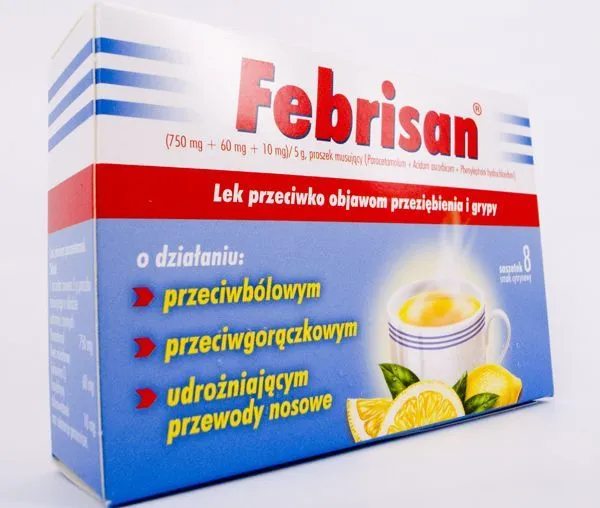
Table of Contents
Package leaflet: Information for the patient
Febrisan, (750 mg + 60 mg + 10 mg)/5 g, effervescent powder
Paracetamolum + Acidum ascorbicum + Phenylephrini hydrochloridum
Please read the entire leaflet carefully before using the medicine, as it contains
important information for the patient.
This medicine should always be used exactly as described in this patient leaflet or as directed by a
physician or pharmacist.
- Keep this leaflet for future reference.
- If you need advice or additional information, please consult your pharmacist.
- If you experience any adverse reactions, including any possible side effects not listed in this leaflet, inform your doctor or pharmacist. See section 4.
- If there is no improvement after 5 days, or if symptoms worsen, or if fever persists beyond 3 days, consult your doctor.
Table of contents of the leaflet
- What Febrisan is and what it is used for
- Important information before taking Febrisan
- How to take Febrisan
- Possible side effects
- How to store Febrisan
- Contents of the pack and other information
1. What Febrisan is and what it is used for
The medicine contains three active substances: paracetamol, phenylephrine, and ascorbic acid (vitamin C).
Paracetamol has antipyretic and analgesic effects. Phenylephrine reduces congestion and swelling of the nasal mucosa, helping to clear nasal passages. Ascorbic acid helps meet the increased requirement for vitamin C occurring during colds and influenza.
Febrisan is used for the short-term treatment of cold and flu symptoms such as: fever, chills, headache, muscle pain, sore throat, nasal discharge, and sinus pain.
2. Important information before using Febrisan
When not to use Febrisan
- If the patient is allergic to the active substances or to any of the other ingredients of this medicine (listed in section 6).
- If the patient has:
- arterial hypertension;
- heart disease;
- severe liver failure;
- phenylketonuria.
- During treatment with MAO inhibitors and within 2 weeks after their discontinuation.
- During pregnancy.
- In children under 12 years of age.
Warnings and precautions
Before starting treatment with Febrisan, consult a doctor or pharmacist.
The medicine contains paracetamol. To avoid the risk of overdose, check whether other medicines being taken also contain paracetamol. Do not exceed the recommended dose. Taking higher than recommended doses may cause severe liver damage.
1/7
During treatment with Febrisan, inform a doctor immediately if the patient has severe medical conditions, including severe kidney dysfunction or sepsis (when bacteria and their toxins circulate in the blood, leading to organ damage) or malnutrition, chronic alcoholism, or if the patient is also taking flucloxacillin (an antibiotic).
In these situations, patients have been reported to develop a serious condition called metabolic acidosis (an abnormality in blood and body fluids) when taking paracetamol regularly over a prolonged period or when taking paracetamol together with flucloxacillin.
Symptoms of metabolic acidosis may include: severe breathing difficulties, including rapid deep breathing, drowsiness, nausea and vomiting.
Severe skin reactions, including cases of Stevens-Johnson syndrome, toxic epidermal necrolysis, and acute generalized exanthematous pustulosis, have been reported in patients using medicinal products containing paracetamol. Patients should be informed about the symptoms of these skin reactions. If such symptoms occur, the product must be discontinued immediately, symptomatic treatment provided, and the patient closely monitored (see section 4).
Long-term use of this product without medical supervision may be harmful (see section 3).
Prolonged use or treatment with high doses of analgesics may lead to headache, which should not be treated with higher doses of paracetamol.
Due to the risk of overdose, do not take simultaneously with other medicines containing paracetamol.
Special caution is required in patients:
- with chronic malnutrition;
- with alcoholic liver disease;
- with severe renal impairment;
- with benign prostatic hyperplasia;
- with pheochromocytoma;
- with untreated or active hyperthyroidism;
- with vascular occlusion (Raynaud’s syndrome);
- with hypersensitivity to acetylsalicylic acid and patients with aspirin-sensitive asthma, as mild bronchospasm has been reported after paracetamol administration in aspirin-sensitive patients (cross-reaction);
- undergoing treatment with sedatives and other sympathomimetic drugs (i.e. drugs reducing mucosal congestion), appetite suppressants, or psychostimulants similar to amphetamines;
- taking anticoagulant medicines;
- with diabetes;
- with narrow-angle glaucoma.
Use in patients with liver impairment, alcohol abuse, or starvation increases the risk of liver damage.
Alcohol should not be consumed during treatment.
Consult a doctor even if the above warnings relate to conditions that occurred in the past.
Children and adolescents
Do not use in children under 12 years of age.
Patients with renal and/or hepatic impairment
Exercise special caution in patients with kidney and/or liver disorders.
The medicine is contraindicated in patients with severe liver failure.
2/7
Elderly patients
Exercise caution when using Febrisan in elderly patients.
Febrisan with other medicines
Inform the doctor or pharmacist about all medicines currently used or recently taken, as well as any medicines the patient plans to take.
The interaction of Febrisan with other medicines results from the effects of its active ingredients.
Paracetamol
May enhance the effect of oral anticoagulants of the coumarin group (e.g. warfarin, phenprocoumon) and increase the risk of bleeding. Therefore, monitoring is recommended.
Concomitant use with drugs that increase the metabolism of paracetamol in the liver (e.g. rifampicin, certain sedatives and antiepileptics – carbamazepine, phenytoin, phenobarbital) increases the risk of liver damage.
Concomitant use of antiemetics (e.g. metoclopramide) accelerates the absorption of paracetamol from the gastrointestinal tract.
Cholestyramine reduces the absorption of paracetamol; therefore, this medicine should not be administered within one hour after taking paracetamol.
Consumption of alcohol during paracetamol treatment leads to the formation of a toxic metabolite causing necrosis of liver cells, which may subsequently lead to liver failure.
Due to the risk of overdose, do not take this medicine simultaneously with other medicines containing paracetamol.
Inform the doctor or pharmacist if the patient is taking:
- flucloxacillin (antibiotic) due to the serious risk of blood and body fluid disorders (called metabolic acidosis), which require urgent treatment (see section 2).
Phenylephrine
Concomitant use with MAO inhibitors may enhance the effect of phenylephrine.
Pregnancy, breastfeeding and fertility
Due to the presence of phenylephrine, use of this medicine during pregnancy is contraindicated (see section 2).
Paracetamol passes into human milk. Caution should be exercised in breastfeeding women.
Avoid using phenylephrine during lactation. Phenylephrine may be excreted in breast milk.
The decision on breastfeeding should be made taking into account the benefits of breastfeeding for the child and the benefits of treatment for the mother.
Driving and operating machinery
Febrisan has no effect on the ability to drive or operate machinery.
Warnings concerning excipients
Febrisan contains sucrose, aspartame (E 951), glucose (flavour component), and sodium.
Sucrose
The medicine contains 2.458 g of sucrose per sachet and 9.832 g in the maximum daily dose (4 sachets). This should be taken into account in patients with diabetes.
3/7
If the patient has previously been diagnosed with intolerance to certain sugars, the patient should consult a doctor before taking the medicine.
Aspartame (E 951)
The medicine contains 110 mg of aspartame per sachet. Aspartame is a source of phenylalanine. It may be harmful to patients with phenylketonuria (see section 2). This is a rare genetic disorder in which phenylalanine accumulates in the body due to its abnormal excretion.
Glucose (flavour component)
The medicine contains 85 mg of glucose per sachet.
If the patient has previously been diagnosed with intolerance to certain sugars, the patient should consult a doctor before taking the medicine.
Sodium
The medicine contains 166 mg of sodium (main component of table salt) per sachet. This corresponds to 8.2% of the maximum recommended daily sodium intake in the diet of adults. This should be taken into account in patients with impaired kidney function and in patients controlling sodium intake in their diet.
3. How to use Febrisan
This medicine should always be used exactly as described in this patient leaflet or as directed by a doctor or pharmacist. If in doubt, consult a doctor or pharmacist.
Recommended dose
Adults and adolescents over 12 years of age:
1 sachet every 4-6 hours. Do not use more than 4 sachets per day, corresponding to 3 g of paracetamol, 240 mg of ascorbic acid, and 40 mg of phenylephrine hydrochloride.
Without medical advice, do not use for longer than 3 days for fever or 5 days for pain relief.
Method of administration
For oral use.
Before use, dissolve the powder in a glass of hot water.
Use of a higher than recommended dose of Febrisan
If more than the recommended dose is taken, seek immediate medical advice from a doctor or pharmacist.
The medicine contains three active substances; symptoms of overdose may result from one or all of these substances.
Paracetamol
Paracetamol overdose can lead to liver damage, which may result in liver transplantation or death. Cases of acute pancreatitis have been observed, usually associated with liver function disorders (including acute liver failure) and toxic liver injury.
Overdose of paracetamol may cause symptoms within a few to several hours, such as: nausea, vomiting, excessive sweating, drowsiness, and general weakness. These symptoms may subside the next day, despite ongoing liver damage, which may then manifest as upper abdominal discomfort, recurrence of nausea, and jaundice.
Overdose may lead to acute kidney failure and/or liver failure.
Liver failure may result in encephalopathy (impaired function of the central nervous system), hemorrhage, hypoglycemia (low blood glucose levels), cerebral edema, coma, and death.
Other non-liver-related symptoms reported after paracetamol overdose include cardiac function disturbances.
In every case where a single intake of paracetamol equals or exceeds 5 g, vomiting should be induced if less than 1 hour has passed since ingestion.
Oral activated charcoal, 60–100 g, preferably mixed with water, should be administered.
In certain cases, antidotes such as N-acetylcysteine and/or methionine may be required. Treatment of paracetamol poisoning should be carried out in a hospital, preferably in an intensive care unit.
Phenylephrine
Symptoms of phenylephrine overdose: tremor, restlessness, insomnia, tachycardia (increased heart rate), supraventricular extrasystoles, headache, tingling in the extremities, and elevated arterial blood pressure. Dyspnea (difficulty breathing), hallucinations, and seizures may also occur. In some individuals, phenylephrine may cause paradoxical reactions: drowsiness, respiratory depression (inhibition of breathing), cardiac arrhythmias, hypotension, and circulatory collapse. Management includes gastric lavage.
In cases of severe poisoning, vital functions must be monitored, and respiratory and circulatory support provided.
Ascorbic acid
Symptoms of overdose typically occur only after prolonged use of very high doses; therefore, the likelihood of overdose symptoms occurring after taking Febrisan is low.
Missed dose of Febrisan
This medicine is intended for short-term relief of cold and flu symptoms. If a dose is missed and symptoms persist, take the next dose as scheduled.
Do not take a double dose to make up for a missed dose.
4. Possible adverse reactions
Like all medicines, this medicine can cause adverse reactions, although not everyone will experience them.
The following adverse reactions may occur during treatment with Febrisan:
Rare (more frequent than in 1 to 10 out of 10,000 patients):
- symptoms of liver damage;
- skin hypersensitivity reactions, including urticaria and rash;
- hypersensitivity.
Very rare (less frequent than in 1 out of 10,000 patients):
- thrombocytopenia (reduced number of blood platelets) and agranulocytosis (absence of granulocytes in blood);
- bronchospasm;
- liver failure;
- anaphylactic reaction.
Frequency unknown (frequency cannot be estimated from available data):
- severe condition which may cause blood acidification (so-called metabolic acidosis) in patients with severe disease taking paracetamol (see section 2);
- arrhythmia (too fast, too slow or irregular heartbeat), bradycardia (too slow heartbeat);
- asthma;
- urinary retention, particularly in patients with benign prostatic hyperplasia;
- hypothermia (especially in patients without fever);
- increased blood pressure;
- Stevens-Johnson syndrome, toxic epidermal necrolysis, and acute generalized exanthematous pustulosis (severe skin reactions characterized by acute pustular rash over the entire body or
5/7
blisters and erosions on the skin, in the oral cavity, eyes and genital organs, fever
and joint pain or peeling of large sheets of epidermis).
Reporting of adverse reactions
If any adverse reactions occur, including any adverse reactions not listed
in this leaflet, inform your doctor, pharmacist, or nurse. Adverse reactions can be reported directly to the Department of Monitoring Adverse Drug Reactions of the Office for Registration of Medicinal Products, Medical Devices
and Biocidal Products:
Al. Jerozolimskie 181 C, 02-222 Warsaw, tel.: +48 22 49 21 301, fax: +48 22 49 21 309, website: https://smz.ezdrowie.gov.pl .
Adverse reactions can also be reported to the marketing authorization holder.
Reporting adverse reactions helps to provide more information on the safety of the medicine.
5. How to store Febrisan
Store below 25°C in a dry place.
Keep the medicine out of sight and reach of children.
Do not use this medicine after the expiry date stated on the carton and sachet. The expiry date refers to the last day of the stated month.
Medicines must not be disposed of via wastewater or household waste. Ask your pharmacist how to dispose of medicines no longer required. This will help protect the environment.
6. Contents of the pack and other information
What Febrisan contains
- The active substances in this medicine are paracetamol, ascorbic acid, and phenylephrine hydrochloride. One sachet (5 g of effervescent powder) contains 750 mg of paracetamol, 60 mg of ascorbic acid (vitamin C), and 10 mg of phenylephrine hydrochloride.
- Other ingredients are: sucrose, citric acid, aspartame (E 951), quinoline yellow 70 (E 104), natural lemon powder flavour 213 841 (containing, among others, maltodextrin, which contains glucose; sucrose, sulphites, d-limonene, citral, geraniol, linalool, citronellol, farnesol), Contramarum flavour (Contramarum Trockenaroma 201 227) (containing, among others, glucose, ethanol, propylene glycol, benzyl alcohol, sulphites), sodium hydrogen carbonate.
What Febrisan looks like and contents of the pack
Febrisan is a slightly yellow effervescent powder with a lemon flavour.
The cardboard box contains 8, 12, or 16 sachets made of three-layer foil: paper/aluminium/PE.
Not all pack sizes may be marketed.
Marketing Authorisation Holder
Orifarm Healthcare A/S
Energivej 15
5260 Odense S
Denmark
For more detailed information about this medicine, please contact the local representative of the marketing authorisation holder:
6/7
Orifarm Healthcare Sp. z o.o.
ul. Przyokopowa 31
01-208 Warsaw
Poland
[email protected]
Manufacturer
Orifarm Manufacturing Poland Sp. z o.o.
ul. Księstwa Łowickiego 12
99-420 Łyszkowice
Poland
7/7