Faringan
Poland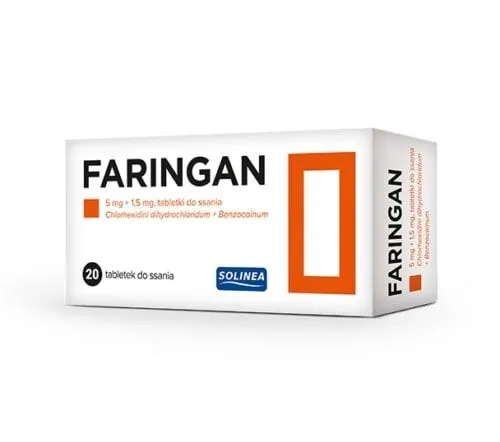
Table of Contents
Package leaflet: Information for the patient
Faringan, 5 mg + 1.5 mg, lozenges for sucking
Chlorhexidini dihydrochloridum + Benzocainum
Please read this leaflet carefully before using the medicine, as it contains
important information for the patient.
This medicine should always be taken exactly as described in this patient leaflet or
as directed by the doctor, pharmacist, or nurse.
- Keep this leaflet, as you may need to read it again.
- If you need advice or further information, please consult your pharmacist.
- If you experience any adverse reactions, including any not listed in this leaflet, inform your doctor, pharmacist, or nurse. See section 4.
- If there is no improvement after 5 days, or if you feel worse, consult your doctor.
Table of contents
- What Faringan is and what it is used for
- Important information before using Faringan
- How to use Faringan
- Possible side effects
- How to store Faringan
- Contents of the pack and other information
1. What Faringan is and what it is used for
Faringan contains as active substances chlorhexidine and benzocaine.
Chlorhexidine has antibacterial properties. Benzocaine acts as a local anesthetic.
Faringan is indicated for local treatment of inflammatory conditions of the mucous membranes of the oral cavity (stomatitis, gingivitis, aphthae) and the throat (pharyngitis) in adults and adolescents over 12 years of age.
If symptoms of sore throat or sore gums worsen, persist for more than 5 days, or if high fever, headache, nausea, or vomiting occur, medical advice should be sought.
2. Important information before using Faringan
When not to use Faringan:
- if the patient is allergic to chlorhexidine, benzocaine, or any of the other ingredients of this medicine (listed in section 6).
- in patients with the rare inherited fructose intolerance.
- in patients with methemoglobinemia (a blood disorder involving the formation of abnormal hemoglobin, unable to bind and transport oxygen. The most common symptom is cyanosis, caused by tissue hypoxia).
- if the patient has wounds or ulcers in the oral cavity or throat.
- if the patient has low plasma cholinesterase levels.
- in children under 12 years of age.
Warnings and precautions
Before starting to use Faringan, consult a doctor or pharmacist.
Special caution is required in patients:
- with hypersensitivity to ester local anesthetics (especially para-aminobenzoic acid (PABA) derivatives), parabens, or p-phenylenediamine, as they may exhibit hypersensitivity to benzocaine.
If the patient has erosive lesions or desquamation of the oral mucosa,
the medicine should be used with caution under medical supervision. During prolonged use
(longer than 7 days), reversible discoloration of teeth and the surface of the tongue may occur.
Children
Do not use in children under 12 years of age.
Faringan and other medicines
Inform your doctor or pharmacist about all medicines the patient is currently using, has recently used, or plans to use.
Avoid simultaneous use of this medicine with other locally applied medicines.
Do not use Faringan together with:
- other medicines containing bactericidal substances (e.g., sulfonamides);
- cholinesterase inhibitors (medicines used in the treatment of cognitive disorders).
Food, drink, and alcohol
Do not eat or drink for 30 minutes after using the medicine.
Pregnancy and breastfeeding
If the patient is pregnant, breastfeeding, suspects she may be pregnant, or is planning to have a child, she should consult a doctor or pharmacist before using this medicine.
Faringan should not be used in pregnant or breastfeeding women.
Driving and operating machinery
Faringan has no effect or has a negligible effect on the ability to drive motor vehicles or operate mechanical equipment.
Faringan contains aspartame (E 951), isomalt (E 953), and sodium.
Faringan contains aspartame (E 951) – 4 mg in each lozenge. Aspartame is a source of phenylalanine. It may be harmful to patients with phenylketonuria. This is a rare genetic disorder in which phenylalanine accumulates in the body due to improper excretion.
The medicine contains isomalt (E 953) – 656.5 mg of isomalt (E 953) in each lozenge. If the patient has previously been diagnosed with intolerance to certain sugars, he or she should consult a doctor before taking the medicine.
The medicine contains less than 1 mmol (23 mg) of sodium per lozenge, meaning the medicine is considered "sodium-free".
3. How to use Faringan
This medicine should always be taken exactly as described in this patient information leaflet or
as directed by your doctor, pharmacist, or nurse. If in doubt, consult your doctor, pharmacist, or nurse.
Recommended dose
Adults and adolescents over 12 years of age
Suck one tablet several times a day. If necessary, suck one tablet every 1–2 hours, without exceeding
8 tablets per day.
Method of administration
Treatment should be started at the first sign of symptoms.
The tablets should be sucked until completely dissolved in the mouth. Do not swallow or chew them.
For 30 minutes after taking the medicine, eating or drinking is not recommended. The medicine should
be taken at least 30 minutes after a meal and at least 30 minutes after tooth brushing, preferably before bedtime.
Chlorhexidine may increase tartar formation; therefore, during treatment with this medicine, special
attention to oral hygiene is recommended, and consideration should be given to using a toothpaste
that helps prevent tartar buildup.
If symptoms worsen or do not improve within 5 days of using Faringan, or if high fever, headache,
nausea, or vomiting occur, consult your doctor.
If you feel the effect of the medicine is too strong or too weak, consult your doctor.
Use in children
Faringan should not be used in children under 12 years of age.
Overdose of Faringan
In case of having taken more than the recommended dose, seek immediate advice from your doctor
or pharmacist.
Missed dose of Faringan
If you miss a dose, do not take a double dose to make up for the missed dose. Instead, take the next
dose at the time specified by the recommended dosing schedule.
If you have any further questions about the use of this medicine, consult your doctor or pharmacist.
4. Possible adverse reactions
Like all medicines, this medicine can cause adverse reactions, although not everyone will experience them.
Treatment should be discontinued and immediate medical attention sought from a doctor or the emergency department of the nearest hospital if hypersensitivity reactions and/or anaphylactic shock occur. Symptoms may include: rash, itching, fainting, swelling of the lips, face, throat or tongue, difficulty swallowing or breathing.
Adverse reactions that may occur during the use of Faringan are listed below:
Rare (may affect fewer than 1 in 1,000 people): allergic reactions, local irritation
Very rare (may affect fewer than 1 in 10,000 people): hypersensitivity reactions, anaphylactic shock
Frequency not known (cannot be estimated from available data):
methemoglobinemia (a blood disorder associated with formation of abnormal hemoglobin), tooth discoloration, tongue discoloration, burning sensation of the tongue, tingling of the tongue and/or taste disturbances during prolonged use (over one week).
Reporting of adverse reactions
If any adverse effects occur, including any adverse effects not listed in this leaflet, inform your doctor, pharmacist or nurse. Adverse reactions can be reported directly to the Department of Monitoring Adverse Drug Reactions of the Office for Registration of Medicinal Products, Medical Devices and Biocidal Products: Al. Jerozolimskie 181C, 02-222 Warsaw,
tel.: 22 49-21-301, fax: 22 49-21-309, website: https://smz.ezdrowie.gov.pl.
Adverse reactions can also be reported to the marketing authorization holder.
Reporting adverse reactions helps provide more information on the safety of this medicine.
5. How to store Faringan
Keep this medicine out of sight and reach of children.
No special storage conditions are required for this medicine.
Do not use this medicine after the expiry date stated on the packaging following “Expiry date (EXP):” or “EXP:”. The expiry date refers to the last day of the stated month.
Medicines must not be disposed of via the sewage system or household waste. Ask your pharmacist how to dispose of medicines no longer required. Such measures will help protect the environment.
6. Contents of the pack and other information
What Faringan contains
- The active substances in Faringan are: chlorhexidine dihydrochloride and benzocaine. Each lozenge contains 5 mg of chlorhexidine dihydrochloride and 1.5 mg of benzocaine.
- Other components (excipients) are: isomalt (E953), macrogol 6000, peppermint flavour (menthol, menthone, peppermint oil, maltodextrin, sodium octenyl succinate starch (E 1450)), aspartame (E 951), magnesium stearate.
What Faringan looks like and contents of the pack
Faringan is a white or almost white, flat, round lozenge with a minty odour and a score line on one side.
The score line is intended only to facilitate breaking the tablet, not for dividing it into equal doses.
PVC/Aluminium blister pack containing 9 or 10 lozenges in a cardboard box.
Pack sizes: 10, 18, 20, 27 lozenges.
Not all pack sizes may be marketed.
Marketing Authorisation Holder and Manufacturer
Marketing Authorisation Holder
Solinea Sp. z o.o. Sp.K.
Elizówka 65
21-003 Ciecierzyn, Poland
Tel. 81 463-48-82
{logo of the marketing authorisation holder}
Manufacturer:
Mako Pharma Sp. z o.o.
ul. Kolejowa 231A,
05-092 Dziekanów Polski
Poland