Famotidine ranigast
Poland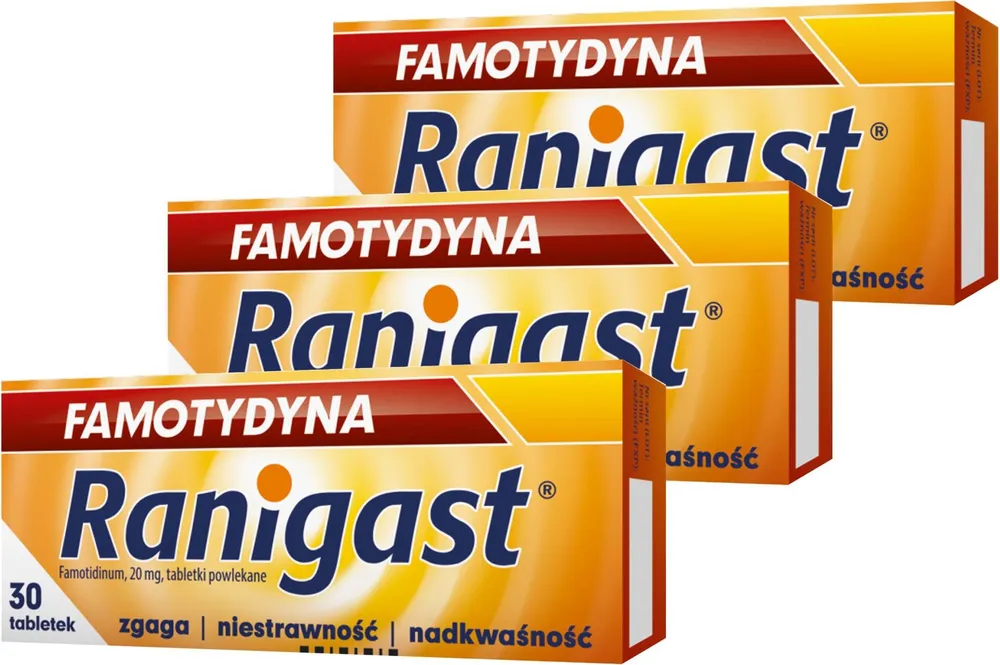
Table of Contents
Package leaflet: Information for the patient
FAMOTYDINE Ranigast
20 mg, coated tablets
Famotidinum
Please read all of this leaflet carefully before taking this medicine, because it contains
important information for the patient.
This medicine should always be used exactly as described in this patient leaflet or as directed by the
physician or pharmacist.
- Keep this leaflet, as you may need to read it again.
- If you need advice or further information, please consult your pharmacist.
- If you experience any adverse reactions, including any not listed in this leaflet, inform your doctor or pharmacist. See section 4.
- If there is no improvement after 14 days, or if you feel worse, contact your doctor.
Table of contents
- What Famotydine Ranigast is and what it is used for
- Important information before taking Famotydine Ranigast
- How to take Famotydine Ranigast
- Possible side effects
- How to store Famotydine Ranigast
- Contents of the pack and other information
1. What Famotydine Ranigast is and what it is used for
Famotydine Ranigast contains famotidine, which belongs to a group of medicines called H\ receptor antagonists. It inhibits the secretion of hydrochloric acid in the stomach. The medicine is indicated for short-term symptomatic treatment of gastric discomfort not associated with organic gastrointestinal disease, such as: indigestion (dyspepsia), heartburn, hyperacidity. The effect of the medicine lasts for 10 to 12 hours.
2. Important information before taking Famotydine Ranigast
When not to take Famotydine Ranigast
- if the patient is allergic to famotidine or to any of the other ingredients of this medicine (listed in section 6);
- if the patient has a history of allergy to other H\ receptor antagonists;
- if the patient has renal insufficiency.
Warnings and precautions
Before starting treatment with Famotydine Ranigast, discuss with your doctor or pharmacist:
- if the patient has impaired kidney function.
Famotydine Ranigast may mask symptoms of other diseases, including stomach cancer. Therefore, if any of the following conditions occur before or during treatment, contact your doctor immediately:
- recurrent vomiting,
- vomiting of food or blood,
- passage of black stools (blood-stained faeces),
- if the patient experiences weight loss, difficulty swallowing, or persistent abdominal pain along with indigestion,
- if the patient has not previously experienced gastric discomfort (dyspeptic symptoms), or if existing symptoms have recently changed – particularly in middle-aged or elderly individuals. If symptoms do not resolve after 14 days of treatment, contact your doctor promptly to reassess the diagnosis.
Children and adolescents
The safety and efficacy of this medicine in children have not been established. This medicine should not be used in children and adolescents.
Famotydine Ranigast with other medicines
Inform your doctor or pharmacist about all medicines currently or recently taken, as well as any medicines you plan to take.
- Famotidine does not interact with warfarin (a medicine that reduces blood clotting), theophylline (a medicine used in the treatment of asthma and other respiratory disorders), phenytoin (an anticonvulsant), diazepam (an anxiolytic and sedative), propranolol (a beta-blocker), aminophenazone, or phenazone (analgesics).
- Changes in gastric pH may affect the bioavailability of certain medicines (e.g., reduced absorption of atazanavir (an antiviral medicine used in the treatment of HIV infection)).
- Famotidine may reduce the absorption of ketoconazole and itraconazole (antifungal medicines). Ketoconazole should be administered at least two hours before famotidine.
- Antacids may reduce the absorption of famotidine and lead to lower serum concentrations of famotidine. Therefore, famotidine should be taken 1–2 hours before antacids.
- Concomitant administration of probenecid (a medicine used in gout) may delay the elimination of famotidine. Concomitant use of famotidine and probenecid should be avoided.
- Avoid concomitant administration of sucralfate (a protective agent used in peptic ulcer disease) within two hours of famotidine administration.
- There is a risk of reduced efficacy of calcium carbonate, used in dialysis patients to reduce elevated blood phosphate levels (hyperphosphatemia), when administered simultaneously with famotidine.
- Particular caution is required when famotidine is used concomitantly with rilpivirine. In such cases, famotidine should be administered once daily. A strict dosing schedule must be followed, with famotidine administered at least 12 hours before or 4 hours after rilpivirine.
- The use of Famotydine Ranigast may reduce the effectiveness of posaconazole oral suspension (a medicine used for the prevention and treatment of certain fungal infections).
- The use of Famotydine Ranigast may reduce the effectiveness of dazatinib, erlotinib, gefitinib, and pazopanib (medicines used in cancer treatment).
Pregnancy and breastfeeding
If the patient is pregnant or breastfeeding, suspects she may be pregnant, or is planning to have a child, she should consult her doctor or pharmacist before using this medicine.
Pregnancy
Famotydine Ranigast may be used during pregnancy only when, in the opinion of the physician, it is absolutely necessary.
Breastfeeding
Women who are breastfeeding should discontinue either the use of Famotydine Ranigast or breastfeeding, as famotidine passes into breast milk.
Taking this medicine with food and drink
This medicine may be taken regardless of meals.
Driving and using machines
There are no data on contraindications to driving or operating machinery during famotidine treatment. However, in some patients, adverse reactions such as dizziness have been observed, which may impair psychomotor performance. If such adverse effects occur, do not drive or operate machinery.
Famotydine Ranigast contains carmine (E124)
This medicine may cause allergic reactions.
3. How to use Famotydyna Ranigast
This medicine should always be taken exactly as described in this patient information leaflet or as directed by your doctor or pharmacist. If in doubt, consult your doctor or pharmacist again.
Adults
When symptoms occur, the usual dose is 1 tablet of 20 mg once daily. If symptoms recur, 1 tablet of 20 mg twice daily may be taken. The daily dose should not exceed 40 mg (2 tablets).
The tablet should be swallowed whole with a small amount of water.
Do not use this medicine for longer than 2 weeks without consulting a doctor. If symptoms do not improve after 2 weeks of treatment, seek medical advice immediately.
Use in patients with renal function impairment
Since this medicine is primarily eliminated by the kidneys, caution should be exercised in patients with impaired renal function. Patients with renal impairment should consult their doctor before taking this medicine, as it may be necessary to reduce the dose by half or extend the dosing interval to 36–48 hours.
This medicine is contraindicated in patients with renal failure.
Use in elderly patients
No dose adjustment is required for elderly patients.
Use in children and adolescents
This medicine should not be used in children and adolescents.
Missed dose of Famotydyna Ranigast
If you miss a dose, take it as soon as possible. However, if it is almost time for the next dose, do not take the missed dose. Do not take a double dose to make up for a missed dose.
Taking more than the recommended dose of Famotydyna Ranigast
If you take more than the recommended dose, contact your doctor immediately. In case of overdose, the doctor will decide on symptomatic treatment, which may include removal of unabsorbed drug from the gastrointestinal tract, monitoring of clinical status, and supportive therapy.
If you have any further questions about the use of this medicine, consult your doctor or pharmacist.
4. Possible adverse reactions
Like all medicines, this medicine can cause adverse reactions, although not everyone experiences them.
If you notice any of the following very rare but serious adverse reactions, stop taking Famotydyna Ranigast immediately and contact your doctor without delay:
- Sudden wheezing, swelling of the lips, tongue or throat or body, rash, redness, fainting or difficulty swallowing (severe allergic reaction).
- Skin redness with blistering or peeling. Large blisters and bleeding around the lips, eyes, mouth, nose and genital organs may also occur, or extensive peeling of the outer layer of skin. This may be Stevens-Johnson syndrome or toxic epidermal necrolysis.
- Yellowing of the skin, dark urine and fatigue, which may indicate liver problems (hepatitis, cholestatic jaundice).
Other adverse reactions include:
Common (affects less than 1 in 10 people)
- headache, dizziness
- constipation, diarrhoea
Uncommon (affects less than 1 in 100 people)
- anorexia
- taste disturbances
- dry mouth, nausea and (or) vomiting, feeling of discomfort or fullness in the abdomen, bloating
- rash, itching, urticaria
- fatigue
Very rare (affects less than 1 in 10,000 people)
- deficiency of all normal blood cells: red blood cells, white blood cells and platelets
- transient mental disorders including depression, anxiety, agitation, disorientation, confusion and hallucinations, decreased libido, insomnia
- seizures, epileptic seizures accompanied by loss of consciousness, convulsions, salivation, jaw clenching, sometimes rapid eye movements (especially in patients with impaired kidney function), paraesthesia, somnolence
- interstitial lung disease, sometimes leading to death
- disturbances in liver enzyme activity
- excessive hair loss
- joint pain, muscle cramps
- atrioventricular block, QT interval prolongation (especially in patients with impaired kidney function)
- impotence
- chest tightness
Rare cases of gynaecomastia were observed in controlled clinical trials, but these cases were not more frequent than with placebo.
Reporting of adverse reactions
If any adverse symptoms occur, including any adverse symptoms not listed in this leaflet, inform your doctor or pharmacist. Adverse reactions can be reported directly to the Department of Monitoring Adverse Drug Reactions, Office for Registration of Medicinal Products, Medical Devices and Biocidal Products
Al. Jerozolimskie 181C
02-222 Warszawa
Tel.: + 48 22 49 21 301
Fax: + 48 22 49 21 309
Website: https://smz.ezdrowie.gov.pl
Adverse reactions can also be reported to the marketing authorisation holder.
Reporting adverse reactions helps provide more information on the safety of this medicine.
5. How to store the medicine Famotydyna Ranigast
Keep this medicine out of sight and reach of children.
Store at a temperature not exceeding 25°C.
Do not use this medicine after the expiry date stated on the packaging. The expiry date refers to the last day of the month indicated.
Medicines must not be disposed of via wastewater or household waste. Ask your pharmacist how to dispose of medicines no longer required. This will help protect the environment.
6. Contents of the pack and other information
What Famotydyna Ranigast contains
- The active substance is famotidine. Each tablet contains 20 mg of famotidine.
- The other ingredients are:
Core of the tablet: pregelatinized starch, powdered cellulose, magnesium stearate, talc.
Tablet coating: hypromellose, titanium dioxide, macrogol 6000, talc, carmine lake (E124).
What Famotydyna Ranigast looks like and contents of the pack
Film-coated tablets, pink in colour, round and biconvex.
Aluminium/PVC blisters in a cardboard box.
The pack contains 10, 20 or 30 film-coated tablets.
Not all pack sizes may be marketed.
Marketing Authorisation Holder and Manufacturer
Zakłady Farmaceutyczne POLPHARMA S.A.
ul. Pelplińska 19, 83-200 Starogard Gdański
tel. 22 364 61 01