Falcimar
Poland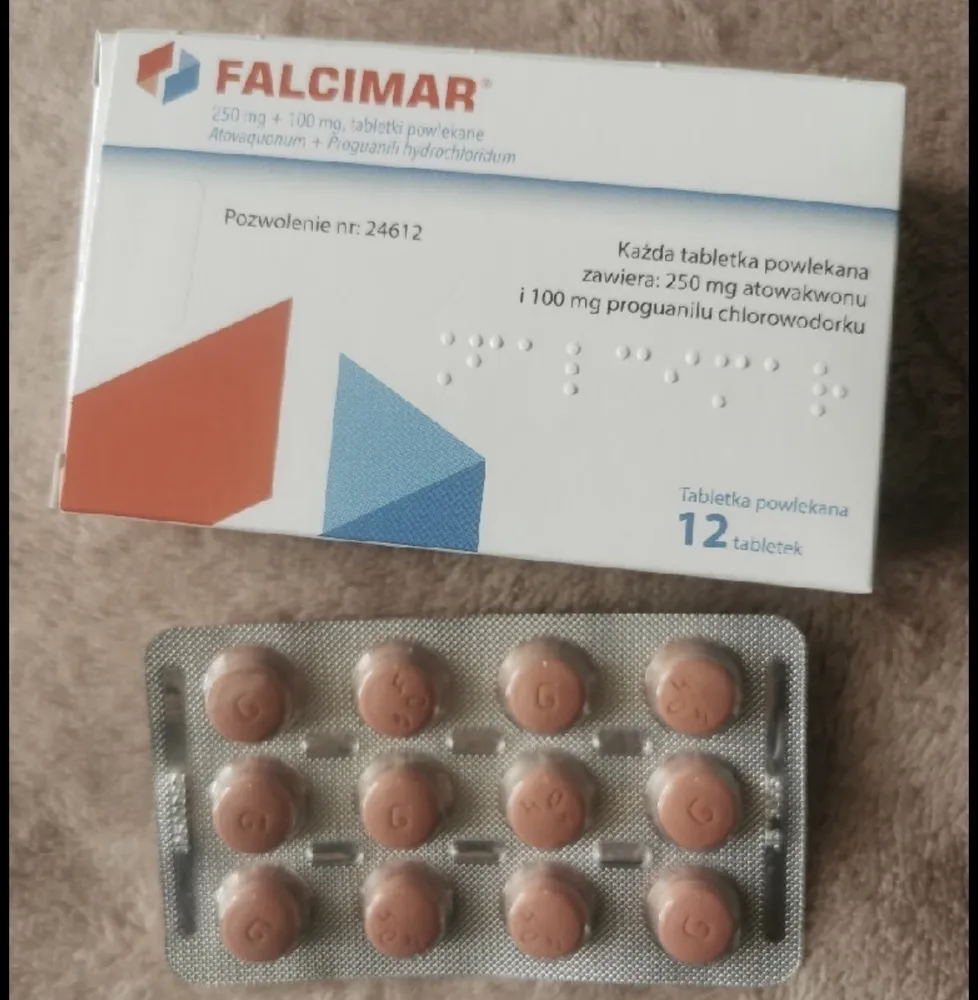
Table of Contents
Package leaflet: Information for the user
Falcimar, 250 mg + 100 mg, film-coated tablets
Atovaquone + Proguanil hydrochloride
Please read all of this leaflet carefully before taking this medicine, because it contains
important information for you.
- Keep this leaflet. You may need to read it again.
- If you have any further questions, please ask your doctor or pharmacist.
- This medicine has been prescribed for you only. Do not pass it on to others. It may harm them, even if their symptoms are the same as yours.
- If you experience any side effects, including any not listed in this leaflet, tell your doctor or pharmacist. See section 4.
Contents of the leaflet
- What Falcimar is and what it is used for
- What you need to know before you take Falcimar
- How to take Falcimar
- Possible side effects
- How to store Falcimar
- Contents of the pack and other information
1. What Falcimar is and what it is used for
Falcimar belongs to a group of medicines called antimalarials. This medicine contains two active substances – atovaquone and proguanil hydrochloride.
Falcimar is used:
for the prevention of malaria in adults and children weighing over 40 kg
for the treatment of malaria in adults and children weighing more than 11 kg
Malaria is spread by the bite of an infected mosquito, which transmits the malaria parasite (Plasmodium falciparum) into the bloodstream. Falcimar prevents malaria by killing this parasite. It also kills these parasites in people already infected with malaria.
You should protect yourself from malaria infection.
Malaria can affect people of any age. It is a serious illness, but it can be prevented. In addition to taking Falcimar, it is important to take measures to avoid mosquito bites.
- Use an insect repellent on exposed areas of skin.
- Wear light-coloured clothing that covers most of the body, especially after sunset, when mosquitoes are most active.
- Sleep in an enclosed room or under an insecticide-impregnated mosquito net.
- Close windows and doors at sunset, if they are not protected by mesh screens.
- Consider using insecticides (mats, sprays, mosquito coils) to clear the room of insects or to prevent mosquitoes from entering.
If you have any further questions, please contact your doctor or pharmacist.
You can still contract malaria even if you have taken all necessary precautions.
Some symptoms of malaria infection may appear only after a delay, so the disease may manifest several days, weeks, or even months after returning from a malaria-endemic area.
If you develop symptoms such as high fever, headache, chills, and fatigue after returning home, you should contact your doctor immediately.
2. Important information before using Falcimar
When not to use Falcimar:
If the patient is allergic to atovaquone or proguanil hydrochloride or to any of the
other components of this medicine (listed in section 6).
For malaria prevention, if the patient has chronic kidney disease.
Warnings and precautions
Malaria prevention:
If the patient is ill (vomits) within 1 hour after taking a Falcimar tablet,
another dose should be taken immediately.
It is important to complete the entire prescribed course of Falcimar treatment. If additional tablets
need to be taken due to vomiting, the patient will likely require another prescription.
If the patient vomits, it is especially important to use additional protective measures,
such as repellents or mosquito nets hung over the bed. Falcimar may be less effective,
as the amount absorbed by the body will be reduced.
Treatment of malaria:
If the patient vomits and also develops diarrhoea, the doctor should be informed, as regular blood tests
may then be necessary. Falcimar may be less effective because the amount absorbed by the body will be reduced.
These tests will help determine whether the malaria parasite has been cleared from the patient's bloodstream.
If the patient has chronic kidney disease, the doctor may prescribe an alternative medicine.
If a specific infection symptom occurs during treatment with Falcimar, the doctor may prescribe a different medicine instead.
If malaria is being treated but has recurred multiple times, or if malaria is caused by a specific type of parasite,
the doctor may prescribe another medicine in addition to Falcimar.
Falcimar and other medicines
Tell your doctor or pharmacist about all medicines the patient is currently taking or has recently taken,
as well as any medicines the patient plans to take.
Some medicines may affect the action of Falcimar, or Falcimar may enhance or reduce the effectiveness of other medicines taken simultaneously.
Such medicines include:
metoclopramide, used to treat nausea and vomiting,
antibiotics such as tetracycline, rifampicin, and rifabutin,
efavirenz or certain highly active protease inhibitors, used in the treatment of HIV,
indinavir, used in the treatment of HIV,
warfarin and other medicines that inhibit blood clotting,
etoposide, used in the treatment of cancer.
Inform the doctor if the patient is taking any of these medicines. The doctor may decide that Falcimar is not suitable for the patient or that additional monitoring tests are required during treatment.
REMEMBER to inform the doctor about taking any other medicines while using Falcimar.
Taking Falcimar with food and drink
If possible, Falcimar should be taken with food or milk-containing drinks. This enables the patient's body to absorb more of the medicine, making the treatment more effective.
Crushing the tablets is not recommended.
Pregnancy and breastfeeding
Falcimar should not be taken if the patient is pregnant or planning to become pregnant, unless advised by a doctor.
Consult a doctor or pharmacist before taking Falcimar.
Breastfeeding should not be undertaken during treatment with Falcimar, as the active substances may pass into breast milk and could harm the infant.
Driving and operating machinery
Do not drive if the patient experiences dizziness. Falcimar may cause dizziness in some people. In such cases, the patient should not drive, operate machinery, or perform any activities where they could endanger themselves or others.
3. How to use Falcimar
This medicine should always be taken exactly as described in the patient leaflet or as directed by your doctor. If in doubt, consult your doctor or pharmacist.
If possible, Falcimar should be taken with food or milk-containing drinks.
It is best to take Falcimar at the same time each day.
Malaria prevention:
The usual dose for adults and adolescents weighing more than 40 kg is one tablet once daily, taken as described below.
For use in children, consult your doctor.
The use of Falcimar for malaria prevention is not recommended in children, or in adults and adolescents weighing less than 40 kg.
In some countries, Falcimar may be available in other pharmaceutical forms for use in children.
Malaria prevention in adults:
Start taking Falcimar 1 or 2 days before travel to a malaria-risk area.
Continue taking the medicine daily during your stay and for 7 days after returning to an area free of malaria.
To ensure maximum protection for the patient, the full course of Falcimar treatment must be completed. Since it takes 7 days to ensure all parasites transmitted by mosquitoes are eliminated, stopping treatment early increases the risk of infection.
Treatment of malaria:
For adults, the usual dose is 4 tablets once daily for 3 days.
For children weighing 11 kg or more:
11 to 20 kg – 1 tablet once daily for 3 days
21 to 30 kg – 2 tablets once daily for 3 days
31 to 40 kg – 3 tablets once daily for 3 days
over 40 kg – same dose as for adults
The use of Falcimar for the treatment of malaria is not recommended in children weighing less than 11 kg.
For children weighing less than 11 kg, consult your doctor. In some countries, Falcimar may be available in other pharmaceutical forms.
Taking more Falcimar than recommended
Contact your doctor or pharmacist for advice. If possible, show the Falcimar packaging.
Missing a dose of Falcimar
It is very important to complete the full course of treatment with Falcimar. If a dose is missed, do not be concerned. Take the next dose as soon as possible. Then continue treatment as previously scheduled. Do not take a double dose to make up for a missed dose.
Stopping treatment with Falcimar
Falcimar must be taken for 7 days after returning to an area free of malaria. To ensure maximum protection for the patient, the full prescribed course of treatment must be completed. Since it takes 7 days to ensure all parasites transmitted by mosquitoes are eliminated, stopping treatment prematurely puts the patient at risk of further infection.
If you have any questions, consult your doctor or pharmacist.
If you have any further doubts regarding the use of this medicine, consult your doctor or pharmacist.
4. Possible adverse reactions
Like all medicines, this medicine can cause adverse reactions, although not everybody gets them.
Please pay attention to the serious reactions listed below, which may be caused by this medicine.
They have occurred in a small number of people, but the exact frequency of occurrence is unknown.
Severe allergic reactions – symptoms include:
rash and itching,
sudden wheezing, tightness in the chest or throat, or difficulty breathing,
swelling of the eyelids, face, lips, tongue or other body parts.
If any of these symptoms occur, contact your doctor immediately and stop taking the medicine.
Severe skin reactions:
skin rash which may cause blistering and resemble target-like lesions (dark spots in the centre surrounded by paler, dark rings – erythema multiforme),
severe and widespread rash with blisters, peeling skin, particularly around the mouth, nose, eyes and genital organs (Stevens-Johnson syndrome).
If any of the above symptoms are noticed, contact your doctor immediately.
Most other adverse effects are mild and do not last long.
Very common: affects more than 1 in 10 patients
headache
nausea and vomiting
abdominal pain
diarrhoea
Common: affects 1 to 10 in 100 patients
dizziness
sleep problems (insomnia)
unusual dreams
depression
loss of appetite
fever
rash
cough
allergic reactions
itching (pruritus)
Common adverse reactions that may appear in blood tests:
reduction in red blood cells (anaemia), which may cause fatigue, headache and shortness of breath
reduction in white blood cells (neutropia), increasing the risk of severe infection
low blood sodium levels (hyponatraemia)
increased liver enzyme activity
Uncommon: affects 1 to 10 in 1,000 patients
May occur in 1 in 100 people:
anxiety
awareness of an abnormal heartbeat (palpitations)
swelling and redness of the lips
red blisters on the skin (urticaria)
hair loss
Uncommon adverse reactions that may appear in blood tests:
increased amylase activity (an enzyme produced by the pancreas)
Rare: affects 1 to 10 in 10,000 patients
seeing or hearing things that are not real (hallucinations)
Other adverse reactions: These have occurred in a small number of people, but their exact frequency is unknown.
liver inflammation (hepatitis)
blockage of the bile ducts (cholestasis)
increased heart rate (tachycardia)
inflammation of blood vessels (vasculitis), which may appear as red or purple spots on the skin and may also affect other parts of the body
seizures (convulsions)
panic attacks, crying
nightmares
severe mental problems, causing people to lose touch with reality and be unable to think clearly or make sound judgments
mouth ulcers
blisters
peeling skin
increased sensitivity of the skin to sunlight
gastrointestinal disturbances (food intolerance)
Other adverse reactions that may appear in blood tests:
decrease in all types of blood cells (pancytopenia)
If any of the adverse effects worsen, or if any adverse effects not listed in this leaflet occur, inform your doctor or pharmacist.
Reporting of adverse reactions
If you experience any adverse reactions, including any not listed in this leaflet, tell your doctor or pharmacist. Adverse reactions can be reported directly to:
Department of Monitoring Adverse Drug Reactions
Office for Registration of Medicinal Products, Medical Devices and Biocidal Products
Al. Jerozolimskie 181C, 02-222 Warsaw, tel.: +48 22 49 21 301, fax: +48 22 49 21 309
Website: https://smz.ezdrowie.gov.pl
Reporting adverse reactions helps provide more information on the safety of this medicine.
Adverse reactions can also be reported to the marketing authorisation holder.
5. How to store Falcimar
Keep this medicine out of sight and reach of children.
Do not use this medicine after the expiry date stated on the packaging after: EXP.
The expiry date refers to the last day of the stated month.
No special storage conditions apply for this medicine.
Medicines must not be disposed of via the sewage system or household waste. Ask your pharmacist
how to dispose of medicines no longer required. Such measures help protect the environment.
6. Contents of the pack and other information
What Falcimar contains
- The active substances in this medicine are atovaquone and proguanil hydrochloride. Each tablet contains 250 mg of atovaquone and 100 mg of proguanil hydrochloride.
- The other components of the medicine are:
Tablet core: microcrystalline cellulose PH101, low-substituted hydroxypropylcellulose,
sodium carboxymethyl starch (type A), poloxamer 188, povidone K30, microcrystalline cellulose
PH102, colloidal anhydrous silica, magnesium stearate.
Tablet coating: hypromellose 6cP, titanium dioxide (E171), macrogol 400, iron oxide red (E172), macrogol 8000.
What Falcimar looks like and contents of the pack
Falcimar tablets are pinkish-brown to brown, round, biconvex, film-coated tablets, embossed with "404" on one side and "G" on the other.
The tablets are supplied in PVC/PVDC/aluminium blisters, packed in a cardboard box.
Pack sizes: 12, 24, 36, and 60 tablets.
Not all pack sizes may be marketed.
Marketing Authorisation Holder:
Glenmark Pharmaceuticals s.r.o.
Hvězdova 1716/2b
140 78 Prague 4
Czech Republic
Manufacturer / Importer:
Glenmark Pharmaceuticals s.r.o.
Hvězdova 1716/2b
140 78 Prague 4
Czech Republic
Glenmark Pharmaceuticals s.r.o.
Fibichova 143
566 17 Vysoké Mýto
Czech Republic
For further information, please contact the Marketing Authorisation Holder's representative:
Glenmark Pharmaceuticals Sp. z o.o.
Dziekonskiego 3 Street
00-728 Warsaw
Email: [email protected]
This medicinal product is authorised in the Member States under the following names:
| Denmark | Atovaquone/Proguanil Glenmark 250 mg/100 mg Film-coated tablets |
| Germany | Atovaquone/Proguanil hydrochloride Glenmark 250 mg/100 mg Film-coated tablets |
| France | Atovaquone/Proguanil BGR 250 mg/100 mg film-coated tablets |
| Netherlands | Atovaquone/Proguanil hydrochloride Glenmark 250 mg/100 mg Film-coated tablets |
| Sweden | Atovaquone/Proguanil Glenmark 250/100 mg film-coated tablets |
| Spain | Malaway 250 mg/100 mg Film-coated tablets |
| Ireland | Atovaquone/Proguanil Hydrochloride 250 mg /100 mg Film-coated tablets |
| Poland | Falcimar |
| Norway | Atovaquone/Proguanil Glenmark |
| Austria | Atovaquone/Proguanil hydrochloride Glenmark 250 mg/100 mg Film-coated tablets |