Exacyl
Poland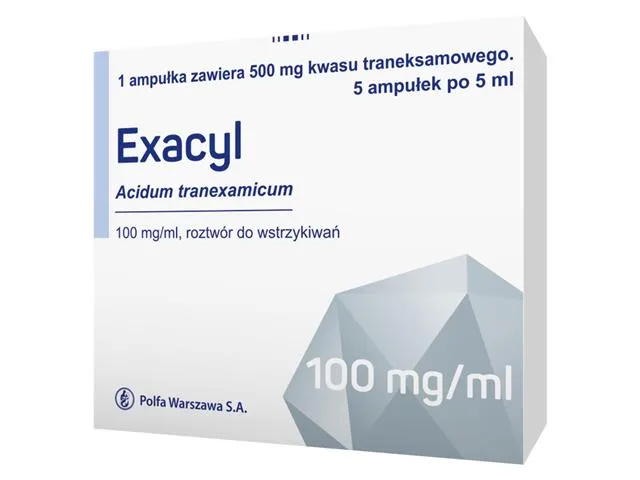
Table of Contents
Package leaflet: Information for the user
EXACYL, 1 g/10 ml, oral solution
Tranexamic acid
Please read all of this leaflet carefully before taking this medicine, because it contains
important information for you.
- Keep this leaflet, as you may need to read it again.
- If you have any further questions, please ask your doctor or pharmacist.
- This medicine has been prescribed for a specific individual. Do not pass it on to others. It may harm someone else, even if their symptoms are the same.
- If you experience any side effects, including any not listed in this leaflet, tell your doctor or pharmacist. See section 4.
Contents of the leaflet
- What Exacyl is and what it is used for
- What you need to know before taking Exacyl
- How to take Exacyl
- Possible side effects
- How to store Exacyl
- Contents of the pack and other information
1. What Exacyl is and what it is used for
Exacyl contains the active substance tranexamic acid. Tranexamic acid belongs to a group of medicines called antifibrinolytics. It works by inhibiting the fibrinolytic activity of plasmin.
Exacyl is used in the treatment of:
- Uterine bleeding:
- due to hormonal disorders
- secondary to trauma, infections, or degenerative changes of the uterus
- Gastrointestinal bleeding
- Haematuria from the lower urinary tract caused by:
- benign prostatic hyperplasia
- malignant tumours of the prostate or urinary bladder
- kidney stones
- postoperative bleeding following surgical procedures on the prostate or urinary tract
- Bleeding associated with otolaryngological surgical procedures (e.g. tonsillectomy)
2. Important information before using Exacyl
When not to use Exacyl
- if the patient is allergic to the active substance or to any of the other ingredients of this medicine (listed in section 6)
- if the patient has acute venous thrombosis (deep vein thrombosis, pulmonary embolism)
- if the patient has arterial thrombosis (angina pectoris, myocardial infarction, stroke)
- if the patient has fibrinolytic states secondary to coagulopathy with consumption of clotting factors (these conditions cause blood clotting throughout the body)
- in patients with severe renal function disorders (risk of drug accumulation)
- in patients with a history of seizures.
Warnings and precautions
Before starting treatment with Exacyl, discuss the following with a doctor or pharmacist:
- if the patient experiences seizures. The doctor will use the lowest possible dose to avoid occurrence of seizures after administration of Exacyl.
- if the patient experiences visual disturbances, including blurred vision, unclear vision, or color vision disturbances. The doctor may decide to discontinue treatment. In case of continuous, long-term use of Exacyl, regular ophthalmological examinations are recommended (eye examinations, including visual acuity, color vision, fundoscopy, visual field, etc.). In the presence of pathological eye changes, especially retinal diseases, the doctor, after consultation with a specialist, will decide individually in each case whether long-term use of Exacyl is necessary.
- if the patient notices blood in the urine. Exacyl may lead to urinary tract obstruction.
- if the patient has a personal or family history of thromboembolic disease. The doctor will assess the risk factors for thromboembolic disease and decide whether administration of this medicine is possible.
- if the patient is using oral contraceptives. There is an increased risk of thrombosis.
- if the patient has mild to moderate renal function impairment. The doctor will reduce the dose according to serum creatinine concentration (see section 3).
- if the patient develops venous or arterial thromboembolic disorders. The doctor should be informed immediately if any of the following symptoms occur: unusual leg pain, muscle weakness in the limbs, chest pain, irregular pulse, sudden shortness of breath, loss of consciousness, disorientation, sudden severe headache, dizziness, visual disturbances, slowed speech, or loss of speech.
Exacyl and other medicines
Inform the doctor or pharmacist about all medicines currently used or recently used, as well as any medicines the patient plans to use, including those available without a prescription. In particular, inform the doctor if the patient is taking:
- other medicines that promote blood clotting, known as antifibrinolytic agents (treatment should be conducted under strict medical supervision)
- medicines that prevent blood clotting, known as thrombolytic agents
- oral contraceptives.
Also inform the doctor if the patient is using:
- Etamsylate (a haemostatic agent)
- Vitamin K1 and thiomonium methylsulphate (an antispasmodic agent)
Exacyl with food and drink
Exacyl can be taken independently of meals.
Pregnancy, breastfeeding and fertility
If the patient is pregnant or breastfeeding, suspects she may be pregnant, or is planning to have a child, she should consult a doctor or pharmacist before using this medicine.
Use of this medicine should be avoided in pregnant women.
Tranexamic acid passes into breast milk. Breastfeeding is not recommended during treatment with this medicine.
Driving and operating machinery
Dizziness and malaise may occur during treatment with Exacyl.
If such symptoms occur, the patient should not drive or operate machinery.
Exacyl contains alcohol and sodium
This medicine contains up to 4.9 mg of alcohol (ethanol) per ml, equivalent to 0.62% by volume.
The amount of alcohol in 20 ml (maximum single dose) of this medicine is equivalent to less than 3 ml of beer or 1 ml of wine.
The small amount of alcohol in this medicine will not cause noticeable effects.
The medicine contains less than 1 mmol (23 mg) of sodium per dose, meaning the medicine is considered "sodium-free".
3. How to use Exacyl
This medicine should always be used according to the instructions given by your doctor or pharmacist. If you have any doubts,
you should consult your doctor or pharmacist.
The recommended dose is:
Adults
2 to 4 g per day in 2 or 3 divided doses (i.e. 2 to 4 ampoules per day).
Children
20 mg/kg body weight per day.
The solution should be taken orally.
How to open ampoules:
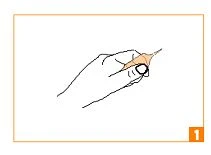 | Hold the ampoule in hand, between thumb and index finger, as shown. |
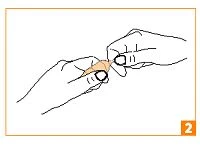 | Grasp the tip between the thumb and index finger of the other hand. |
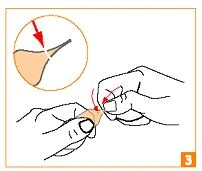 | Gently press with the thumb of that hand on the ring indicating the break point, while simultaneously applying resistance with the index finger of the other hand. Do not twist. |
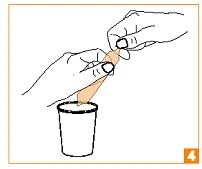 | Repeat the entire procedure to open the other end, taking care to hold the open end over a glass. |
Patients with renal function disorders
In case of renal function impairment, due to the risk of drug accumulation, the dose of tranexamic acid should be reduced according to serum creatinine concentration.
The dosing regimen below applies to EXACYL, injection solution, and therefore only the injection solution should be used.
If serum creatinine concentration is:
between 120 and 250 μmol/l, the dose of tranexamic acid is 10 mg/kg body weight intravenously, twice daily;
between 250 and 500 μmol/l, the dose of tranexamic acid is 10 mg/kg body weight intravenously, once daily (every 24 hours);
above 500 μmol/l, the dose of tranexamic acid is 5 mg/kg body weight intravenously, once daily (every 24 hours).
Administration of a higher than recommended dose of Exacyl
Overdose may result in central nervous system dizziness, headache, hypotension, and seizures. Seizures tend to occur more frequently with increasing dose. If a higher than recommended dose is taken, seek immediate medical advice from a doctor or pharmacist.
Missed dose of Exacyl
If a dose is missed, it should be taken as soon as possible, except when the time for the next dose is approaching.
Do not administer a double dose to make up for a missed dose.
Discontinuation of Exacyl treatment
In case of any further doubts regarding the use of this medicine, consult a doctor or pharmacist.
4. Possible adverse reactions
Like any medicine, this medicine may cause adverse reactions, although not everyone experiences them.
Adverse reactions reported during use of Exacyl.
The following adverse reactions have been observed during use of Exacyl:
Common (may occur in up to 1 in 10 patients):
- nausea, vomiting, diarrhoea. Uncommon (may occur in up to 1 in 100 patients):
- skin allergic reactions. Frequency not known (frequency cannot be estimated from available data):
- hypersensitivity reactions, including anaphylaxis (severe and sudden allergic reaction); in case of occurrence of such adverse reactions, inform a doctor immediately or go to the emergency department of the nearest hospital;
- seizures, especially in patients with risk factors or history of seizures, or also in case of improper use of the drug (see section 2);
- visual disturbances, including colour vision disturbances;
- malaise with hypotension (low blood pressure), with or without loss of consciousness (usually after too rapid intravenous injection, rarely after oral administration);
- venous or arterial thrombosis in various parts of the body;
- allergic reaction which usually recurs at the same site(s) upon re-administration of the drug and may present as round or oval red and swollen skin patches, blisters, and itching (fixed drug eruption). After healing, skin pigmentation at the site of lesions may also occur, which may persist for some time;
- sudden onset of kidney-related symptoms caused by tissue death in the outer part of the kidney (acute cortical necrosis of the kidneys). Reporting of adverse reactions If any adverse reactions occur, including any not listed in this leaflet, inform your doctor, pharmacist, or nurse. Adverse reactions can be reported directly to the Department of Monitoring of Adverse Drug Reactions of the Office for Registration of Medicinal Products, Medical Devices and Biocidal Products: Al. Jerozolimskie 181 C, 02-222 Warsaw, Tel.: +48 22 49 21 301, Fax: +48 22 49 21 309, website: https://smz.ezdrowie.gov.pl Adverse reactions can also be reported to the marketing authorization holder or its representative in Poland. Reporting adverse reactions helps to gather more information on the safety of the medicine.
5. How to store Exacyl
Keep the medicine out of the sight and reach of children.
Store below 25°C and protect from light.
Do not use this medicine after the expiry date stated on the carton. The expiry date refers to the last day of the stated month.
Medicines must not be disposed of via the sewage system or household waste. Ask your pharmacist how to dispose of medicines no longer required. Such measures help protect the environment.
6. Contents of the package and other information
What Exacyl contains
- The active substance is tranexamic acid. 1 ml of oral solution contains 100 mg of tranexamic acid. 1 ampoule (10 ml) contains 1 g of tranexamic acid.
- Other ingredients are: cherry flavour, hydrochloric acid concentrated or concentrated sodium hydroxide solution for pH adjustment, purified water.
What Exacyl looks like and contents of the pack
Ampoules placed in a cardboard box. The pack contains 5 ampoules of 10 ml each.
Marketing Authorisation Holder
CHEPLAPHARM Arzneimittel GmbH
Ziegelhof 24
17489 Greifswald
Germany
Manufacturer
Unither Liquid Manufacturing
1-3 Alèe de la Neste ZI d’en Sigal
31770 Colomiers, France
Cooperation Pharmaceutique Francaise
Place Lucien Auvert
77020 Melun, France