Exacyl
Poland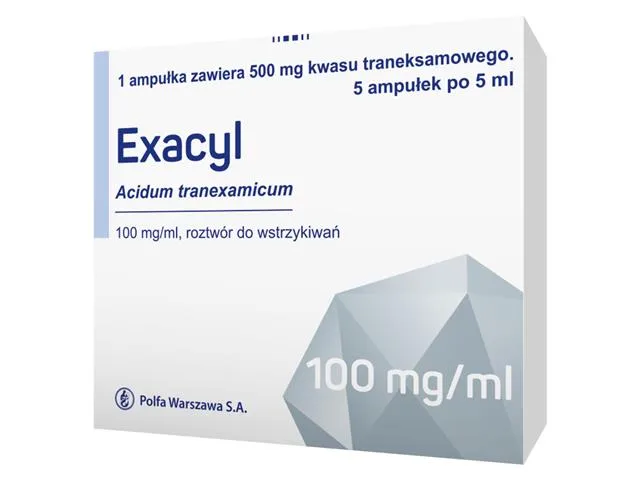
Instructions for Use
Package leaflet: information for the patient
EXACYL, 100 mg/ml, solution for injection
Acidum tranexamicum
Please read all of this leaflet carefully before using this medicine, because it contains
important information for the patient.
- Keep this leaflet, as you may need to read it again.
- If you have any further questions, please ask your doctor or nurse.
- This medicine has been prescribed for a specific individual. Do not pass it on to others. It may harm other people, even if their symptoms are the same.
- If you experience any adverse effects, including any not listed in this leaflet, please inform your doctor or nurse. See section 4.
Contents of the leaflet
- What Exacyl is and what it is used for
- Important information before using Exacyl
- How to use Exacyl
- Possible side effects
- How to store Exacyl
- Contents of the pack and other information
1. What Exacyl is and what it is used for
Exacyl contains tranexamic acid, which belongs to a group of medicines known as haemostatics, antifibrinolytics, and amino acids.
Exacyl is used in adults and children over 1 year of age to prevent and treat bleeding caused by a process that inhibits blood clotting, called fibrinolysis.
Specific indications include:
- Heavy menstrual bleeding in women
- Gastrointestinal bleeding
- Bleeding disorders of the urinary system following prostate surgery or other urological surgical procedures
- Surgical procedures involving the ear, nose, and throat
- Cardiac, abdominal, or gynaecological surgical procedures
- Bleeding following administration of other medicines that dissolve blood clots.
2. Important information before using Exacyl
When not to use Exacyl
- if the patient is allergic to the active substance or to any of the other ingredients of this medicine (listed in section 6)
- if the patient has a disease that leads to blood clots
- if the patient has a condition called "disseminated intravascular coagulation", which causes blood clotting throughout the body
- if the patient has kidney function disorders
- if the patient has experienced seizures.
Due to the risk of cerebral oedema and seizures, intrathecal and intraventricular injections as well as intracerebral administration should not be performed.
If any of the above applies to the patient, or if the patient is unsure whether the above applies, the patient should consult a doctor before taking Exacyl.
Warnings and precautions
Inform the doctor if any of the following apply, to help them decide whether Exacyl is suitable for the patient:
- If the patient has had blood in the urine, Exacyl may lead to urinary tract obstruction.
- If the patient is at risk of blood clots.
- If the patient has excessive blood clotting or bleeding throughout the body (disseminated intravascular coagulation), Exacyl may not be appropriate for the patient, except in cases of acute severe bleeding when blood tests have shown that the process inhibiting blood clotting, called fibrinolysis, has been activated.
- If the patient has experienced seizures, Exacyl should not be used. The doctor should use the lowest possible dose to avoid seizures occurring after administration of Exacyl.
- If the patient is undergoing long-term treatment with Exacyl, possible disturbances in colour vision should be considered, and the doctor may recommend discontinuation of treatment if necessary. During prolonged administration of Exacyl injection solution, regular ophthalmological examinations (eye examinations, including visual acuity, colour vision, fundoscopy, visual field, etc.) are recommended. In case of pathological eye changes, especially retinal diseases, the doctor, after consultation with a specialist, will decide individually in each case whether prolonged use of Exacyl injection solution is necessary.
Exacyl and other medicines
Inform the doctor about all medicines currently taken or recently used by the patient, as well as any medicines the patient plans to use, including those available without prescription, vitamins, minerals, herbal medicines, and dietary supplements.
In particular, inform the doctor if the patient is taking:
- other medicines that promote blood clotting, known as antifibrinolytic agents
- medicines that prevent blood clotting, known as thrombolytic agents
- oral contraceptives.
Pregnancy, breastfeeding and fertility
If the patient is pregnant or breastfeeding, suspects she may be pregnant, or is planning to have a baby, she should consult a doctor or pharmacist before using this medicine.
Tranexamic acid passes into human milk. Therefore, the use of Exacyl is not recommended during breastfeeding.
Driving and operating machinery
No studies have been conducted on the influence of Exacyl on the ability to drive vehicles and operate machinery.
3. How to use Exacyl
This medicine is administered as a slow intravenous injection into one of the patient's veins.
The doctor will decide the appropriate dose for the patient and determine how long it should be administered.
Use in children
If Exacyl solution for intravenous injection is administered to children from 1 year of age, the dose will be calculated based on the child's body weight. The doctor will decide the appropriate dose for the child and determine how long it should be administered.
Use in elderly patients
Dose reduction is not necessary unless there is evidence of renal impairment.
Use in patients with renal function disorders
If renal function impairment is diagnosed in a patient, the dose of tranexamic acid will be reduced according to the results of blood tests (serum creatinine concentration).
Use in patients with hepatic function disorders
Dose reduction is not necessary.
Method of administration
Exacyl must be administered only as a slow intravenous injection.
Exacyl must not be administered by intramuscular injection.
Administration of a higher than recommended dose of Exacyl
If an excessive dose of Exacyl is administered to a patient, symptoms such as dizziness, headache, transient lowering of arterial blood pressure, and seizures may occur. Immediate contact with a doctor or nurse is required.
4. Possible adverse reactions
Like all medicines, this medicine can cause adverse reactions, although not everyone experiences them.
Adverse reactions reported during use of Exacyl
The following adverse reactions have been observed during use of Exacyl:
Common (may occur in up to 1 in 10 patients):
- nausea, vomiting, diarrhoea.
Uncommon (may occur in up to 1 in 100 patients):
- rash.
Frequency not known (frequency cannot be estimated from the available data):
- malaise with hypotension (low arterial blood pressure), usually after too rapid intravenous injection;
- blood clots in various parts of the body;
- seizures;
- visual disturbances, including disturbances of colour vision;
- allergic reactions;
- fixed drug eruption.
Reporting of adverse reactions
If any adverse reactions occur, including any adverse reactions not listed in this leaflet, inform a doctor, pharmacist, or nurse. Adverse reactions can be reported directly to the Department of Monitoring Adverse Reactions to Medicinal Products at the Office for Registration of Medicinal Products, Medical Devices and Biocidal Products:
Al. Jerozolimskie 181 C, 02-222 Warsaw, Tel.: + 48 22 49 21 301, Fax: + 48 22 49 21 309, e-mail: [email protected]
Adverse reactions can also be reported to the marketing authorisation holder or its representative in Poland.
Reporting adverse reactions helps to provide more information on the safety of the medicine.
5. How to store Exacyl
Keep this medicine out of sight and reach of children.
No special storage requirements; protect from light.
Do not use this medicine after the expiry date stated on the carton. The expiry date refers to the last day of the stated month.
Medicines should not be disposed of via wastewater or household waste. Ask your pharmacist how to dispose of medicines no longer in use. This will help protect the environment.
6. Contents of the pack and other information
What Exacyl contains
- The active substance is tranexamic acid.
- The other components are: concentrated hydrochloric acid (for pH adjustment), purified water.
What Exacyl looks like and contents of the pack
Clear type I glass ampoules placed in a cardboard box.
The pack contains 5 ampoules of 5 ml each.
Marketing Authorisation Holder
CHEPLAPHARM Arzneimittel GmbH
Ziegelhof 24
17489 Greifswald
Germany
Manufacturer
Sanofi Winthrop Industrie
1, rue de la Vierge
33440 Ambarès, France
Delpharm Dijon
6, boulevard de l'Europe
21800 Quetigny, France
Similar Medications
-
Tranexamic acid accord
Form: solution for injection
Active substance Dosage tranexamic acid 100 mg/ml Manufacturer: Accord Healthcare B.V. Accord Healthcare Polska Sp. z o.o.
-
Tranexamic acid delfarma
Form: solution for injection
Active substance Dosage tranexamic acid 100 mg/ml Manufacturer: Medochemie Ltd.
-
Tranexamic acid delfarma
Form: solution for injection
Active substance Dosage tranexamic acid 100 mg/ml Manufacturer: Viatris Italia S.r.l.
-
Tranexamic acid eugia
Form: solution for injection
Active substance Dosage tranexamic acid 100 mg/ml Manufacturer: APL Swift Services (Malta) Ltd., Generis Farmacêutica, S.A.
-
Tranexamic acid neupharm
Form: solution for injection
Active substance Dosage tranexamic acid 100 mg/ml Manufacturer: Viatris Italia S.r.l.
-
Tranexamic acid polpharma
Form: solution for injection
Active substance Dosage tranexamic acid 100 mg/ml Manufacturer: Bioindustria Laboratorio Italiano Medicinali S.p.A.
-
Tranexamic acid swiss2care
Form: solution for injection
Active substance Dosage tranexamic acid 100 mg/ml Manufacturer: Viatris Italia S.r.l.
-
Tranexamic acid tillomed
Form: solution for injection
Active substance Dosage tranexamic acid 100 mg/ml Manufacturer: MIAS Pharma Ltd, Tillomed Malta Limited
This page has been machine-translated and may contain inaccuracies. The original data is available in the manufacturing country's language.
Last data check: June 04, 2026 · Data source: Rejestr Produktów Leczniczych (URPL)