Etomidate-lipuro
Poland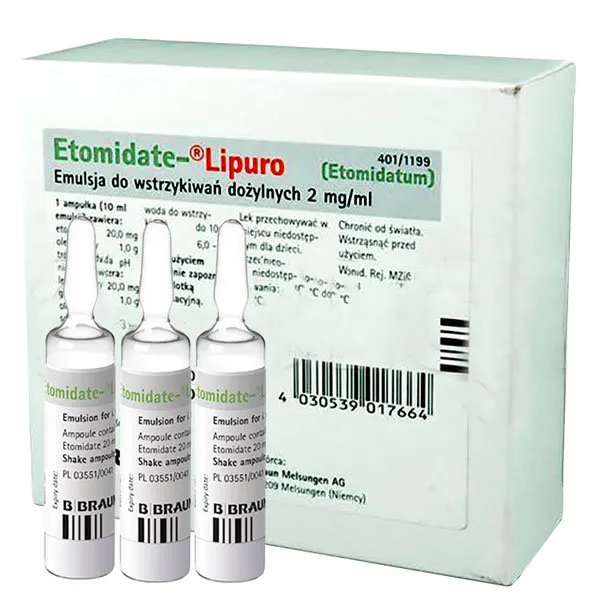
Table of Contents
- Patient Information Leaflet
- 1. What Etomidate-Lipuro is and what it is used for
- 2. Information before using Etomidate-Lipuro
- 3. How to use Etomidate-Lipuro
- 4. Possible adverse reactions
- 5. How to store Etomidate-Lipuro
- 6. Contents of the package and other information
- Information intended exclusively for medical professionals:
Patient Information Leaflet
Etomidate-Lipuro, 2 mg/ml, injection emulsion
Etomidatum
Please read all of this leaflet carefully before the medicine is administered, because it contains
important information for you.
- Keep this leaflet so that you can read it again if necessary.
- If you have any further questions, please ask your doctor or nurse.
- If you experience any side effects, including any not listed in this leaflet, tell your doctor or nurse immediately. See section 4.
Table of contents
- What Etomidate-Lipuro is and what it is used for
- What you need to know before receiving Etomidate-Lipuro
- How to use Etomidate-Lipuro
- Possible side effects
- How to store Etomidate-Lipuro
- Contents of the pack and other information
1. What Etomidate-Lipuro is and what it is used for
The active substance in Etomidate-Lipuro is etomidate, which acts as a hypnotic agent and is used for general anaesthesia. The effect occurs very rapidly, and the hypnotic action is short-acting.
Note:
For short-term anaesthesia, Etomidate-Lipuro should be administered together with an appropriate analgesic agent.
2. Information before using Etomidate-Lipuro
When not to use Etomidate-Lipuro
- if the patient is allergic to etomidate or any of the other ingredients of this medicine, soybean oil or any of the other ingredients of this medicine (listed in section 6).
- in newborns and infants up to the age of six months,
Warnings and precautions
Before starting Etomidate-Lipuro, discuss this with your doctor or nurse.
Single induction doses of etomidate may lead to transient adrenal insufficiency and reduced serum cortisol concentrations.
Etomidate should be used with caution in critically ill patients, including patients with sepsis, as in some studies this has been associated with an increased risk of death in this patient group.
Tell your doctor if any of the following apply to the patient:
- the patient has inherited disorders of heme biosynthesis. Animal studies have shown that Etomidate-Lipuro has porphyrinogenic potential. Therefore, it should not be administered to patients with inherited disorders of heme biosynthesis unless its use is indicated after careful consideration of risks and potential benefits.
- the patient has consumed alcohol or taken medicines that depress the central nervous system, such as sedatives or strong opioid analgesics. Transient apnea may occur after administration of higher doses of etomidate in combination with central nervous system depressants.
- the patient has impaired adrenal cortex function. In cases of impaired adrenal cortex function and during very prolonged surgical procedures, administration of cortisol may be necessary.
- the patient has liver disease.
Etomidate-Lipuro has no analgesic effect. For short-term anesthesia, a potent analgesic such as fentanyl should be administered concomitantly or prior to administration of Etomidate-Lipuro.
Pregnancy
If the patient is pregnant or breastfeeding, suspects she may be pregnant, or is planning to have a baby, she should consult her doctor before using this medicine.
Safety criteria for the use of Etomidate-Lipuro during pregnancy have not been established.
Therefore, Etomidate-Lipuro should be administered to pregnant women only in exceptional cases, when no alternative is available.
Breast-feeding
Before using any medicine, consult your doctor.
Etomidate passes into breast milk. If Etomidate-Lipuro must be administered during lactation, breast-feeding should be discontinued for at least 24 hours after administration of the medicine; milk expressed during this period should be discarded.
Driving and operating machinery
Etomidate-Lipuro impairs psychomotor performance. Do not drive, operate any machinery, or use dangerous tools within 24 hours after administration of Etomidate-Lipuro.
Etomidate-Lipuro and other medicines
Tell your doctor about all medicines the patient is currently taking or has recently taken, as well as any medicines the patient plans to take.
The hypnotic effect of Etomidate-Lipuro is enhanced by: neuroleptics (used in the treatment of psychiatric disorders, mainly schizophrenia and other psychoses), opioids (strong analgesics), and sedatives.
Etomidate-Lipuro and alcohol
Alcohol enhances the hypnotic effect of Etomidate-Lipuro.
Etomidate-Lipuro contains soybean oil and sodium.
This medicine contains soybean oil. Do not use if hypersensitivity to peanuts or soybeans has been diagnosed.
This medicine contains less than 1 mmol (23 mg) of sodium (in the form of sodium oleate) per vial, meaning the medicine is considered "sodium-free".
3. How to use Etomidate-Lipuro
Etomidate-Lipuro must be administered only by a physician skilled in tracheal intubation and equipped with resuscitation devices.
Etomidate-Lipuro is administered intravenously by slow injection only. If necessary, the physician may divide the dose into several portions.
Prior to administration of Etomidate-Lipuro, the physician may administer an intramuscular or intravenous benzodiazepine to prevent uncontrolled muscle movements.
Etomidate-Lipuro has no analgesic effect. The physician may administer an analgesic (e.g., fentanyl) concomitantly or prior to Etomidate-Lipuro.
In case of adrenal cortex dysfunction or during very prolonged surgical procedures, the physician may administer cortisol – an adrenal cortex hormone.
Recommended dose
The physician will adjust the dose according to body weight, age, health status, individual patient response, and the clinical effect of the drug.
Generally: the safe hypnotic dose ranges from 0.15 to 0.3 mg etomidate/kg body weight, corresponding to 0.075 to 0.15 ml of Etomidate-Lipuro/kg body weight.
Children over 6 months of age, adolescents up to 15 years of age, and elderly patients
Single dose: 0.15 to 0.2 mg etomidate/kg body weight, corresponding to 0.075 to 0.1 ml of Etomidate-Lipuro/kg body weight. The dose should be adjusted according to the clinical response.
Patients with liver cirrhosis and patients previously treated with neuroleptic drugs
The dose should be reduced.
When used to terminate an epileptic seizure or a series of seizures, the physician will rapidly inject (within 10 seconds) the appropriate dose of etomidate (0.3 mg/kg body weight, equivalent to 0.15 ml of Etomidate-Lipuro). This dose may be repeated if necessary.
If in doubt, consult a physician or nurse.
In case of administration of a higher than recommended dose of Etomidate-Lipuro
In cases of overdose, especially when etomidate is used concomitantly with inhaled anesthetics, prolonged sleep and a brief period of apnea may occur. When administering Etomidate-Lipuro, the physician will have access to equipment and medicinal products required for the management of general anesthesia (including respiratory support measures).
4. Possible adverse reactions
Like any medicine, Etomidate-Lipuro can cause adverse reactions, although not everyone experiences them.
Like most general anaesthetics, etomidate affects respiratory and cardiovascular system functions. Also, like most other general anaesthetics, etomidate may cause involuntary muscle movements. In addition, etomidate frequently affects adrenal cortex function.
The following adverse reactions of etomidate have been observed:
Very common (occurs in at least 1 out of 10 patients):
Etomidate inhibits steroid synthesis in the adrenal cortex. After administration of a single dose of etomidate, adrenal response to stress factors is significantly reduced for approximately 3–6 hours. See section 2 “Warnings and precautions”.
Following a single dose of etomidate, uncontrolled muscle movements (myoclonus) are sometimes observed in patients. These can be prevented by administering opioids or benzodiazepines to patients prior to anaesthesia.
Reduction in cortisol concentration.
Common (occurs in 1 to 10 out of 100 patients):
Mild, transient decrease in blood pressure may occur as a reaction to reduced peripheral vascular resistance.
Respiratory arrest and apnoea may occur, particularly after administration of large doses of etomidate in combination with central nervous system depressants.
Nausea and vomiting may occur after administration of etomidate, although these are mainly caused by concomitantly administered opioids or opioids administered prior to Etomidate-Lipuro.
Mild pain during injection, occurring mainly when undiluted product is administered into small veins without prior fentanyl administration. To reduce the risk of pain, administration into larger veins is recommended.
Rare (occurs in 1 to 10 out of 10,000 patients):
shivering,
arrhythmia, cough, laryngospasm, hiccup
Very rare (occurs in fewer than 1 out of 10,000 patients):
Allergic reactions have been reported, as well as rare cases of bronchospasm and anaphylactic reactions.
Histamine release following administration of etomidate has been documented. Seizures have been observed.
Reporting of adverse reactions
If any adverse reactions occur, including any adverse reactions not listed in this leaflet, inform your doctor or nurse. Adverse reactions can be reported directly to the Department of Monitoring Adverse Drug Reactions of the Office for Registration of Medicinal Products, Medical Devices and Biocidal Products:
Al. Jerozolimskie 181C, 02-222 Warsaw, tel.: 22 49-21-301, fax: 22 49-21-309, e-mail: [email protected].
Adverse reactions can also be reported to the marketing authorization holder.
Reporting adverse reactions helps to provide more information on the safety of the medicine.
5. How to store Etomidate-Lipuro
Keep this medicine out of sight and reach of children.
Store below 25°C.
Do not freeze.
Store ampoules in the outer packaging to protect from light.
Expiry date
Do not use this medicine after the expiry date stated on the label after the word EXP
("EXP" is used to indicate the expiry date). The expiry date refers to the last day of the stated month.
"Lot" is used to indicate the batch number.
6. Contents of the package and other information
What Etomidate-Lipuro contains
- The active substance in Etomidate-Lipuro is etomidate. 1 ml of injection emulsion contains 2 mg of etomidate. One vial contains 20 mg in 10 ml of injection emulsion.
- The excipients are: soybean oil, medium-chain triglycerides, glycerol, egg phospholipids for injection, sodium oleate, water for injection.
What Etomidate-Lipuro looks like and contents of the pack
Etomidate-Lipuro is a milky white "oil-in-water" type emulsion.
The cardboard box contains 10 vials made of colourless glass, each containing 10 ml of injection emulsion.
Marketing Authorisation Holder Manufacturer
B. Braun Melsungen AG B. Braun Melsungen AG
Carl-Braun-Strasse 1 Carl-Braun-Str. 1
34212 Melsungen 34212 Melsungen
Germany P.O. BOX 11 20
34209 Melsungen
Germany
Information intended exclusively for medical professionals:
Etomidate-Lipuro must be administered only by a physician trained and equipped to perform endotracheal intubation and resuscitation.
Dosage
Dosages must be adjusted according to individual patient response and the clinical effect of the drug.
The following dosage instructions must be observed:
General: The safe induction dose ranges from 0.15 to 0.3 mg etomidate/kg body weight, corresponding to 0.075 to 0.15 mL of Etomidate-Lipuro/kg body weight.
Children over 6 months of age, adolescents up to 15 years of age, and elderly patients should receive a single dose of 0.15 to 0.2 mg etomidate/kg body weight, corresponding to 0.075 to 0.1 mL of Etomidate-Lipuro/kg body weight. For patients in these age groups, the exact dose should be adjusted according to the clinical response.
Dosage should be reduced in patients with hepatic cirrhosis and in those previously treated with neuroleptic drugs.
To avoid excessively slow diffusion of Etomidate-Lipuro into the brain in patients with overt epilepsy or increased seizure susceptibility, Etomidate-Lipuro should be injected rapidly, i.e., within a few seconds. The high bioavailability and rapid distribution of etomidate into the brain help prevent the occurrence of seizures.
When used to terminate status epilepticus or a series of epileptic seizures, the appropriate dose of etomidate (0.3 mg/kg body weight, equivalent to 0.15 mL of Etomidate-Lipuro) should be administered rapidly, i.e., within 10 seconds. This dose may be repeated if necessary.
Route and method of administration
-
Etomidate-Lipuro must be administered intravenously only, generally slowly (single dose over approximately 30 seconds). If necessary, the dose may be divided into several portions. If fentanyl has not been administered previously, mild pain may occur when injecting undiluted Etomidate-Lipuro into small veins. Therefore, the product should be administered into larger veins.
-
Extravascular injection may cause severe pain.
-
Intra-arterial injection must be avoided, as it may lead to tissue necrosis due to etomidate administered intra-arterially.
-
Appropriate premedication should be given prior to Etomidate-Lipuro administration to prevent myoclonus. Benzodiazepines, such as diazepam, are recommended and may be administered intramuscularly about 1 hour or intravenously 10 minutes before Etomidate-Lipuro administration.
-
In cases of adrenal cortical dysfunction or during very prolonged surgical procedures, cortisol supplementation may be necessary, e.g., 50–100 mg hydrocortisone.
-
Etomidate-Lipuro has no analgesic effect. For short-term anesthesia, a potent analgesic such as fentanyl should be administered concomitantly or prior to Etomidate-Lipuro.
Pharmaceutical incompatibilities
Etomidate-Lipuro must not be mixed with other injectable solutions without prior verification of compatibility.
Furthermore, Etomidate-Lipuro must not be administered simultaneously through the same line with other injectable solutions unless compatibility has been confirmed. Concomitantly administered drugs, such as analgesics, should be given sequentially through the same intravenous access or simultaneously through a separate venous access. Etomidate-Lipuro may be injected during a brief interruption of an infusion of isotonic sodium chloride solution.
Instructions for use and handling
Shake the ampoule before use to ensure uniform dispersion.
Do not use if, after shaking, the emulsion appears discolored and/or non-homogeneous.
The product contains no antibacterial preservatives. Since lipid emulsions may support bacterial growth, the emulsion should be drawn aseptically into a syringe immediately after opening the ampoule and administered promptly.
Any unused medicinal product or waste material should be disposed of in accordance with local regulations.