Etibax
Poland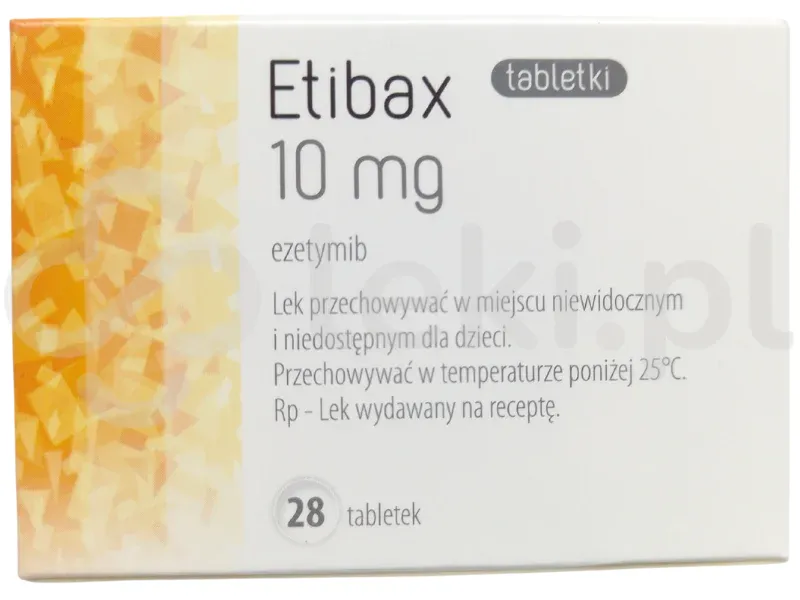
Table of Contents
Patient Information Leaflet
Etibax, 10 mg, tablets
ezetimibe
Please read this leaflet carefully before taking this medicine, as it contains important information for you.
- Keep this leaflet. You may need to read it again.
- If you have any further questions, please ask your doctor or pharmacist.
- This medicine has been prescribed for you personally. Do not pass it on to others. It may harm them, even if their symptoms are the same as yours.
- If you experience any side effects, including any not listed in this leaflet, tell your doctor or pharmacist. See section 4.
Contents of the leaflet
- What Etibax is and what it is used for
- What you need to know before taking Etibax
- How to take Etibax
- Possible side effects
- How to store Etibax
- Contents of the pack and other information
1. What Etibax is and what it is used for
Etibax is a medicine used to lower elevated cholesterol levels.
This medicine reduces blood levels of total cholesterol, "bad" cholesterol (LDL cholesterol), and fatty substances called triglycerides. In addition, Etibax increases levels of "good" cholesterol (HDL cholesterol).
Ezetimibe, the active substance in Etibax, reduces cholesterol absorption in the gastrointestinal tract.
Etibax enhances the effect of statins, a group of medicines that reduce cholesterol produced in the body.
Cholesterol is one of several fatty substances present in the blood. Total cholesterol consists mainly of LDL and HDL cholesterol fractions.
LDL cholesterol is often called "bad" cholesterol because it can deposit in the walls of arteries as atherosclerotic plaques. The accumulation of these plaques may eventually lead to narrowing of the arteries, slowing blood flow or blocking blood supply to vital organs such as the heart and brain. Blocked blood flow may result in heart attack or stroke.
HDL cholesterol is often called "good" cholesterol because it helps prevent the buildup of "bad" cholesterol in the arteries and protects against heart disease.
Triglycerides are another type of fat in the blood that may contribute to increased risk of heart disease.
This medicine is used in patients in whom diet alone is not sufficient to control blood cholesterol levels. While taking this medicine, you should continue to follow a cholesterol-lowering diet.
Etibax is used as an addition to a cholesterol-lowering diet in the following cases:
- elevated blood cholesterol levels (primary hypercholesterolemia [heterozygous familial or non-familial])
- in combination with a statin when cholesterol levels are not adequately controlled with statin therapy alone
- as monotherapy (single-drug treatment) when statin therapy is not appropriate or not well tolerated
- inherited disorder (homozygous familial hypercholesterolemia), which causes increased blood cholesterol levels. A statin will be used and other treatment methods may also be applied.
- inherited disorder (homozygous sitosterolemia, also known as phytosterolemia), which causes increased levels of plant sterols in the blood.
- heart disease. Etibax, taken with cholesterol-lowering medicines called statins, reduces the risk of heart attack, stroke, procedures to improve blood flow to the heart, or hospitalization due to chest pain.
Etibax has no effect on weight loss.
2. Important information before taking Etibax
When using Etibax in combination with a statin, please read the patient information leaflet for
that specific medicine.
When not to take Etibax:
- if the patient is allergic (hypersensitive) to ezetimibe or any of the other ingredients of this medicine (see section 6: Contents of the pack and other information).
When not to take Etibax in combination with a statin:
- if the patient currently has liver problems.
- during pregnancy or breastfeeding.
Warnings and precautions
Before starting to take Etibax, discuss it with your doctor or pharmacist.
- Inform your doctor about all medical conditions, including allergies.
- Before starting Etibax in combination with a statin, your doctor should perform blood tests to assess liver function.
- Your doctor may also perform blood tests to monitor liver function after starting Etibax in combination with a statin.
Etibax is not recommended for use in patients with moderate or severe liver impairment.
If the patient experiences muscle pain or muscle weakness, seek medical advice immediately.
These may be signs of a muscle disorder called rhabdomyolysis.
The safety and efficacy of Etibax used in combination with certain cholesterol-lowering medicines, fibrates, have not been established.
Children and adolescents
This medicine should not be used in children and adolescents (aged 6 to 17 years) unless specifically prescribed by a specialist due to lack of data on safety and efficacy.
This medicine should not be used in children under 6 years of age due to lack of data in this age group.
Etibax and other medicines
Tell your doctor or pharmacist about all medicines the patient is currently taking or has recently taken, as well as any medicines the patient plans to take.
In particular, inform your doctor if the patient is taking medicines containing any of the following active substances:
- cyclosporine (commonly used in patients who have had an organ transplant)
- medicines containing active substances that prevent blood clots, such as warfarin, phenprocoumon, acenocoumarol or fluindione (anticoagulants)
- cholestyramine (also used to reduce cholesterol levels), as it may affect the action of Etibax
- fibrates (also used to reduce cholesterol levels)
Pregnancy, breastfeeding and fertility
Do not take Etibax in combination with a statin if the patient is pregnant, planning to become pregnant, or suspects she may be pregnant. If pregnancy occurs while taking Etibax in combination with a statin, the patient must stop taking both medicines immediately and contact her doctor.
There are no clinical data on the use of Etibax without a statin during pregnancy.
If the patient is pregnant, she should consult her doctor before using this medicine.
Do not take Etibax in combination with a statin during breastfeeding, as it is unknown whether the medicine passes into breast milk.
Etibax, even without combination with a statin, should not be used in patients who are breastfeeding.
The patient should consult her doctor for advice.
The patient should consult her doctor or pharmacist before using any medicine.
Driving and operating machinery
Etibax is not expected to affect the ability to drive or operate machinery.
However, it should be noted that dizziness may occur in some individuals after taking this medicine.
Etibax contains lactose and sodium
Etibax tablets contain a sugar called lactose. If the patient has been previously diagnosed with intolerance to certain sugars, the patient should consult their doctor before taking this medicine.
This medicine contains less than 1 mmol of sodium (23 mg) per tablet, meaning the medicine is considered "sodium-free".
3. How to take Etibax
This medicine should always be taken as directed by your doctor. Unless otherwise advised by your doctor,
you should continue taking any cholesterol-lowering medicines you were previously using. If in doubt,
consult your doctor or pharmacist.
- Before starting to take Etibax, a cholesterol-lowering diet should be followed.
- While taking this medicine, a cholesterol-lowering diet should be maintained.
The recommended dose is one tablet taken orally once daily.
Etibax can be taken at any time of day, with or without food.
Taking Etibax and a statin
If your doctor has prescribed Etibax and a statin, both medicines may be taken at the same time. In this
case, refer to the dosing information provided in the package leaflet for the respective medicine.
Taking Etibax and another medicine containing a bile acid sequestrant (e.g.
cholestyramine)
If your doctor has prescribed Etibax and another cholesterol-lowering medicine containing the active
substance cholestyramine or any other medicine containing a bile acid sequestrant, Etibax should be
taken at least 2 hours before or 4 hours after taking the bile acid sequestrant.
Taking more Etibax than prescribed
Contact your doctor or pharmacist.
Missing a dose of Etibax
Do not take a double dose to make up for a missed tablet. Take the next dose at the usual time on the
following day.
Stopping Etibax
Discuss this with your doctor or pharmacist, as cholesterol levels may rise again.
If you have any further doubts about using this medicine, consult your doctor or pharmacist.
4. Possible adverse reactions
Like all medicines, this medicine can cause adverse reactions, although not everybody will experience them.
You should contact your doctor immediately if any of the following occur:
- Unexplained muscle pain, tenderness or weakness. In rare cases, muscle-related disorders, including rhabdomyolysis leading to kidney damage, may be severe and progress to a potentially life-threatening condition.
- Allergic reactions, including swelling of the face, lips, tongue and/or throat, which may cause difficulty in breathing or swallowing (requiring immediate treatment). Such reactions reported during regular use include hypersensitivity reactions, anaphylaxis and angioedema.
- Raised, red rash, sometimes with target-shaped lesions (erythema multiforme).
Other adverse reactions
When ezetimibe was used alone, the following adverse reactions were observed:
Common (may affect up to 1 in 10 patients)
- Abdominal pain;
- Diarrhoea;
- Flatulence;
- Feeling of fatigue.
Uncommon (may affect up to 1 in 100 patients)
- Increased parameters in certain liver function tests (aminotransferases) or muscle tests (CK);
- Cough;
- Dyspepsia;
- Heartburn, nausea;
- Joint pain;
- Muscle cramps;
- Neck pain;
- Decreased appetite;
- Pain;
- Chest pain;
- Sudden flushing of the face;
- High blood pressure.
Additionally, when used in combination with a statin, the following adverse reactions were observed:
Common (may affect up to 1 in 10 patients)
- Increased parameters in certain liver function tests (aminotransferases);
- Headache, muscle pain.
Uncommon (may affect up to 1 in 100 patients)
- Tingling sensation;
- Dry mouth;
- Itching, rash, urticaria;
- Back pain;
- Muscle weakness, pain in arms and legs;
- Unexplained tiredness or weakness; swelling, particularly of hands and feet;
- Pain, nausea, vomiting, vomiting blood, blood in stool (gastritis).
When used in combination with fenofibrate, the following adverse reaction was reported:
Common (may affect up to 1 in 10 patients)
- Abdominal pain.
Additionally, during regular use, the following adverse reactions have been reported:
- Dizziness;
- Muscle pain;
- Liver problems;
- Allergic reactions including rash and urticaria;
- Muscle pain, tenderness or weakness, rhabdomyolysis;
- Gallstones or cholecystitis (which may cause abdominal pain, nausea, vomiting);
- Pancreatitis, often with severe abdominal pain;
- Constipation;
- Decreased blood cell counts, which may lead to bruising/bleeding (thrombocytopenia);
- Tingling sensation;
- Depression;
- Unexplained tiredness or weakness;
- Shortness of breath.
Additionally, the following adverse reactions have been observed in patients taking ezetimibe
with simvastatin or medicinal products containing ezetimibe or simvastatin as active substances:
- Hair loss; red, raised rash, sometimes with target-shaped lesions (erythema multiforme);
- Blurred vision and visual disturbances (each of these symptoms may occur in up to 1 in 1,000 people);
- Rash affecting the skin or oral mucosal ulcerations (lichenoid mucocutaneous lesions) (each of these symptoms may occur in up to 1 in 10,000 people);
- Muscle pain, tenderness to touch, weakness or cramps; rhabdomyolysis; muscle damage (which may occur in up to 1 in 10,000 people); tendon disorders, sometimes complicated by tendon rupture;
- Gynaecomastia (enlargement of breast tissue in men) (which may occur in up to 1 in 10,000 people).
Reporting of adverse reactions
If you experience any adverse reactions, including any not listed in this leaflet, tell your doctor, pharmacist or nurse. Adverse reactions can be reported directly to the Department of Monitoring Adverse Drug Reactions of the Office for Registration of Medicinal Products, Medical Devices and Biocidal Products:
Al. Jerozolimskie 181C, 02-222 Warsaw, tel.: + 48 22 49-21-301, fax: + 48 22 49-21-309,
website: https://smz.ezdrowie.gov.pl
Adverse reactions can also be reported to the marketing authorisation holder.
Reporting adverse reactions helps provide more information on the safety of this medicine.
5. How to store Etibax
Keep this medicine out of sight and reach of children.
Do not use this medicine after the expiry date stated on the carton or packaging.
The expiry date refers to the last day of the stated month.
Store below 25°C.
Medicines must not be disposed of via the sewage system or household waste. Ask your pharmacist
how to dispose of medicines no longer required. This will help protect the environment.
6. Contents of the pack and other information
What Etibax contains
- The active substance is ezetimibe. Each tablet contains 10 mg of ezetimibe.
- Other ingredients are: lactose monohydrate, sodium croscarmellose, povidone K30, sodium lauryl sulfate, pregelatinized starch (corn), magnesium stearate.
What Etibax looks like and contents of the pack
Uncoated, capsule-shaped tablets, 7.9–8.5 mm in length, white or off-white in colour,
with the imprint “E 10” on one side and smooth on the other side.
The following pack sizes are available:
- Aclar-coated blisters containing 28 or 90 tablets in a cardboard box,
- Cold-formed blister packs containing 28 or 90 tablets in a cardboard box,
- HDPE bottle containing 100 tablets.
Not all pack sizes may be marketed.
Marketing Authorisation Holder
Ranbaxy (Poland) Sp. z o.o.
Idzikowskiego Street 16
00-710 Warsaw
Manufacturer/Importer
Terapia S.A., Fabricii Street No. 124, 400632 Cluj Napoca, Romania
Sun Pharmaceutical Industries Europe B.V., Polarisavenue 87, 2132 JH Hoofddorp, Noord-Holland,
The Netherlands
For information on the product names in other European Economic Area countries, please contact the representative of the Marketing Authorisation Holder.