Esmocard 100 mg/10 ml
Poland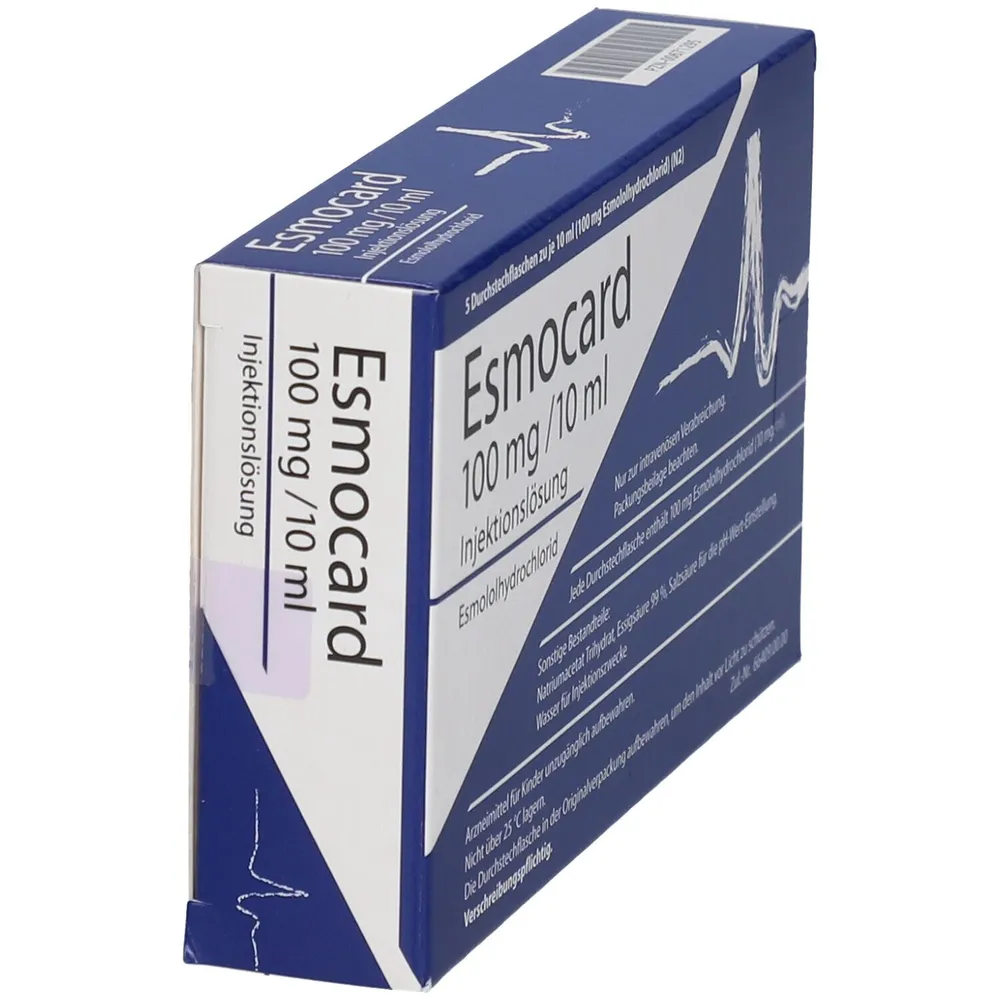
Table of Contents
- Package leaflet: information for the patient
- 2. Important information before using ESMOCARD 100 mg/10 ml
- 3. How to use ESMOCARD 100 mg/10 ml
- 4. Possible adverse reactions
- 5. How to store Esmocard 100 mg/10 ml injection solution
- 6. Contents of the Package and Other Information
- The following information is intended for healthcare professionals only:
Package leaflet: information for the patient
ESMOCARD 100 mg/10 ml, solution for injection
Esmolol hydrochloride
Please read the entire leaflet before use, as it contains important information for the patient.
- Keep this leaflet, as you may need to read it again.
- If you have any questions, please consult your doctor or nurse.
- This medicine has been prescribed for a specific individual. Do not pass it on to others. The medicine may harm another person, even if their symptoms are the same.
- If the patient experiences any adverse reactions, including any not listed in this leaflet, inform the doctor. See section 4.
Table of contents of the leaflet
-
What is ESMOCARD 100 mg/10 ml and what is it used for?
-
Important information before using ESMOCARD 100 mg/10 ml
-
How to use ESMOCARD 100 mg/10 ml
-
Possible side effects
-
How to store ESMOCARD 100 mg/10 ml
-
Contents of the pack and other information
-
What is ESMOCARD 100 mg/10 ml solution for injection and what is it used for?
ESMOCARD 100 mg/10 ml belongs to a group of medicines called beta-blockers. These medicines slow down heart function and reduce blood pressure.
ESMOCARD 100 mg/10 ml is used for the short-term treatment of rapid heart rate.
ESMOCARD 100 mg/10 ml is also used during or immediately after surgery if the patient has high blood pressure and/or rapid heart rate.
2. Important information before using ESMOCARD 100 mg/10 ml
The doctor will not administer ESMOCARD 100 mg/10 ml to the patient if:
- the patient is allergic to esmolol hydrochloride – symptoms of an allergic reaction include shortness of breath, wheezing, rash, itching, or swelling of the face and lips;
- the patient has a very slow heart rate (below 50 beats per minute);
- the patient has a fast or irregularly fast and slow heart rhythm;
- the patient has a condition known as high-degree heart block – heart block refers to disturbances in the conduction of electrical impulses controlling heart function;
- the patient has low blood pressure;
- the patient has circulatory disorders related to blood flow to the heart;
- the patient has severe symptoms of heart failure;
- the patient is receiving or has recently received verapamil – ESMOCARD 100 mg/10 ml must not be administered within 48 hours after the end of verapamil treatment;
- the patient has an untreated adrenal gland disorder called phaeochromocytoma (a tumour that may cause sudden high blood pressure, severe headache, excessive sweating, and rapid heartbeat);
- the patient has high blood pressure in the lungs (pulmonary hypertension);
- the patient experiences a sudden worsening of asthma symptoms;
- the patient has increased blood acid levels (a condition called metabolic acidosis).
If any of the above conditions apply to the patient, the doctor will not administer ESMOCARD 100 mg/10 ml. If in doubt, speak to your doctor or nurse before receiving ESMOCARD 100 mg/10 ml.
Warnings and precautions
Before starting treatment with ESMOCARD 100 mg/10 ml, discuss it with your doctor or nurse.
The doctor will exercise particular caution when using this medicine:
- If the patient is being treated for certain heart rhythm disorders called supraventricular arrhythmias, and:
- has other heart conditions,
- is taking other heart medications. In such cases, using ESMOCARD 100 mg/10 ml may lead to serious reactions, including fatal outcomes such as:
- loss of consciousness,
- shock (a condition in which the heart does not pump enough blood),
- myocardial infarction (heart attack).
- If hypotension (excessively low blood pressure) occurs, with symptoms such as dizziness or lightheadedness, especially when standing up. These symptoms usually resolve quickly after reducing the dose or discontinuing the medicine. During treatment with ESMOCARD 100 mg/10 ml, blood pressure and ECG are usually monitored. Low blood pressure typically normalizes within 30 minutes after stopping ESMOCARD 100 mg/10 ml.
- If the patient has a slow heart rate before administration.
- If the heart rate drops below 50–55 beats per minute – in such a case, the doctor may recommend a lower dose or discontinuation of ESMOCARD 100 mg/10 ml.
- If the patient has heart failure.
- If the patient has disturbances in the conduction of electrical impulses controlling heart function (atrioventricular block).
- If the patient has an adrenal gland disorder called phaeochromocytoma, which is being treated with medicines called alpha-blockers.
- If the patient is being treated for high blood pressure (hypertension) caused by low body temperature (hypothermia).
- If the patient has airway narrowing or wheezing, as in asthma.
- If the patient has diabetes or low blood sugar (hypoglycaemia) – special monitoring is required, as esmolol may mask symptoms of low blood sugar and may enhance the effects of antidiabetic medicines.
- If skin changes occur at the injection site. These may be caused by leakage of the solution around the injection site. In such a case, the doctor will administer the injection into another vein.
- If the patient has a specific type of angina (chest pain) called Prinzmetal's angina.
- If the patient has low blood volume (with low blood pressure), as circulatory collapse may occur more easily.
- If the patient has circulatory disorders such as pale fingers (Raynaud's disease) or leg pain, fatigue, and sometimes burning pain in the legs.
- If the patient has kidney function disorders. In case of kidney disease or dialysis, high potassium levels in the blood (hyperkalaemia) may occur, which can cause serious heart disturbances.
- If the patient has an allergy or is at risk of anaphylactic reaction (severe allergic reaction), as ESMOCARD 100 mg/10 ml may worsen the allergy and make it harder to treat.
- If the patient or a family member has a history of psoriasis (a condition where scaly patches appear on the skin).
- If the patient has hyperthyroidism.
Dosage adjustment is usually not necessary in case of liver function disorders.
If any of the above points apply to the patient (or if in doubt), speak to your doctor or nurse before administration of this medicine. The doctor may perform a thorough examination and adjust the treatment.
ESMOCARD 100 mg/10 ml and other medicines
Inform your doctor or nurse about all medicines currently or recently taken, as well as any medicines you plan to take, including over-the-counter medicines, herbal remedies, or natural products.
The doctor will assess whether the medicines taken may affect the action of ESMOCARD 100 mg/10 ml.
In particular, inform your doctor or nurse if the patient is taking any of the following medicines:
- medicines that lower blood pressure or slow heart rate;
- medicines used to treat heart rhythm disorders or chest pain (angina), such as verapamil and diltiazem – the patient will not receive ESMOCARD 100 mg/10 ml within 48 hours after stopping verapamil;
- nifedipine, used to treat chest pain (angina), high blood pressure, and Raynaud's disease;
- medicines used to treat both heart rhythm disorders (such as quinidine, disopyramide, amiodarone) and heart failure (such as digoxin, digitoxin, cardiac glycosides);
- medicines used to treat diabetes, including insulin and oral antidiabetic medicines;
- so-called ganglion-blocking agents (e.g. trimethaphan);
- painkillers such as non-steroidal anti-inflammatory drugs (NSAIDs);
- floctafenic acid (a painkiller);
- amisulpride, a medicine used for psychiatric disorders;
- tricyclic antidepressants (such as imipramine and amitriptyline) or other medicines used for psychiatric disorders;
- barbiturates (such as phenobarbital, used to treat epilepsy) or phenothiazines (such as chlorpromazine, used to treat psychiatric disorders);
- clozapine, used to treat psychiatric disorders;
- epinephrine, used to treat allergic reactions;
- medicines used to treat asthma;
- medicines used to treat colds or nasal congestion, which constrict nasal mucosa;
- reserpine, used to treat high blood pressure;
- clonidine, used to treat high blood pressure and migraine;
- moxonidine, used to treat high blood pressure;
- ergot derivatives, mainly used to treat Parkinson's disease;
- warfarin, used as an anticoagulant;
- morphine, a strong painkiller;
- suxamethonium chloride (also known as succinylcholine or scoline) or mivacurium, used to relax muscles, usually during surgery – the doctor will exercise particular caution when administering ESMOCARD 100 mg/10 ml during surgery, together with anaesthetics and other medicines.
If in doubt whether any of the above points apply to the patient, consult your doctor or nurse before receiving ESMOCARD 100 mg/10 ml.
Tests that may be performed during treatment with ESMOCARD 100 mg/10 ml
Long-term use of medicines such as ESMOCARD 100 mg/10 ml may reduce the strength of heart contractions. Since ESMOCARD 100 mg/10 ml is used only for a limited time, such an effect is unlikely.
During administration, the doctor will monitor the patient's condition and may reduce the dose or discontinue ESMOCARD 100 mg/10 ml if reduced heart contraction strength occurs.
During administration of ESMOCARD 100 mg/10 ml, the doctor will also recommend regular blood pressure measurements.
Pregnancy and breastfeeding
If the patient is pregnant, breastfeeding, suspects she may be pregnant, or plans to have a child, she should consult her doctor before using this medicine.
There is insufficient data on the safety of esmolol use in pregnant women. However, there is no evidence of an increased risk of congenital malformations in humans.
The use of ESMOCARD 100 mg/10 ml during pregnancy is not recommended due to lack of experience in this area.
Inform the doctor if breastfeeding. ESMOCARD 100 mg/10 ml may pass into breast milk; therefore, ESMOCARD 100 mg/10 ml must not be administered to breastfeeding patients.
Before taking any medicine, consult your doctor.
ESMOCARD 100 mg/10 ml contains sodium
The medicine contains less than 1 mmol (23 mg) of sodium per vial, meaning the medicine is considered "sodium-free".
3. How to use ESMOCARD 100 mg/10 ml
The doctor will individually adjust the dose for each patient—determining the initial dose and subsequently the maintenance dose. The doctor will establish the dosing regimen and may modify the dose if adverse reactions occur.
Esmocard 100 mg/10 ml will be administered as an intravenous injection by a physician or nurse.
The duration of treatment depends on the therapeutic effect and possible occurrence of adverse reactions. The doctor will determine how long the treatment should last.
Dose adjustment of Esmocard 100 mg/10 ml is usually not necessary in patients with impaired liver function.
If the patient has impaired kidney function, the doctor will exercise special caution.
Elderly patients
The doctor will initiate treatment with a lower dose.
Use in children and adolescents
The safety and efficacy of Esmocard 100 mg/10 ml in children and adolescents have not been established. Esmocard 100 mg/10 ml should not be used in children and adolescents under 18 years of age.
Use of a higher than recommended dose of Esmocard 100 mg/10 ml
Since Esmocard 100 mg/10 ml is administered by trained and qualified personnel, overdose is unlikely. However, if it does occur, the doctor will discontinue administration of Esmocard 100 mg/10 ml and initiate additional treatment if necessary.
Missed dose of Esmocard 100 mg/10 ml
Since Esmocard 100 mg/10 ml is administered by trained and qualified personnel, a missed dose is unlikely. However, if the patient has any doubts whether a dose was missed, they should consult the doctor or nurse as soon as possible.
Stopping Esmocard 100 mg/10 ml
Abruptly stopping Esmocard 100 mg/10 ml may cause recurrence of symptoms such as rapid heart rate (tachycardia) or high blood pressure (hypertension).
To avoid this, the doctor will gradually discontinue the medication. In patients with coronary heart disease (e.g. angina pectoris or history of myocardial infarction), the doctor will exercise particular caution when discontinuing Esmocard 100 mg/10 ml.
If you have any further questions about the use of this medicine, consult your doctor or nurse.
4. Possible adverse reactions
Like all medicines, this medicine can cause adverse reactions, although not everyone will experience them.
Most adverse reactions resolve within 30 minutes after discontinuation of ESMOCARD 100 mg/10 ml.
The following adverse reactions have been reported during treatment with ESMOCARD 100 mg/10 ml:
If any of the following adverse symptoms occur (which may be severe), inform your doctor or nurse immediately. It may be necessary to stop the infusion.
Very common (may affect at least 1 in 10 people):
- decrease in blood pressure (can be quickly corrected by reducing the dose of ESMOCARD 100 mg/10 ml or by stopping administration) – your doctor will recommend frequent blood pressure monitoring during treatment
- excessive sweating
Common (may affect less than 1 in 10 people):
- loss of appetite
- feeling of anxiety or depression
- dizziness
- drowsiness
- headache
- tingling or numbness sensation
- concentration disturbances
- feeling of disorientation or agitation
- nausea or vomiting
- feeling of weakness
- feeling of fatigue (tiredness)
- irritation and hardening of the skin at the injection site
Uncommon (may affect less than 1 in 100 people):
- unusual thoughts
- sudden loss of consciousness
- feeling faint or fainting
- seizures (convulsive fits)
- speech disturbances
- visual disturbances
- slow heart rate
- disturbances in electrical conduction controlling heart function
- increased pulmonary arterial pressure
- heart failure (a condition in which the heart does not pump enough blood)
- heart rhythm disorders, sometimes described as palpitations (extra ventricular contractions)
- heart rhythm disorders (nodal rhythm)
- heart disorders caused by poor blood flow through the coronary blood vessels (angina pectoris)
- poor circulation in the upper or lower limbs
- pallor or sudden reddening (especially of the face and neck)
- fluid in the lungs
- shortness of breath or chest tightness making breathing difficult
- wheezing
- nasal congestion
- crackling or rattling sounds during breathing, audible during medical examination
- taste disturbances
- indigestion
- constipation
- dryness of the oral mucous membrane
- epigastric pain
- skin discoloration
- skin redness
- muscle or tendon pain, including around shoulders, shoulder blades, and ribs
- difficulty in urinating (urinary retention)
- chest pain
- feeling of cold or high body temperature (fever)
- pain and swelling (edema) of the vein at the injection site
- burning sensation at the injection site
Very rare (may affect less than 1 in 10,000 people):
- significant decrease in heart rate (sinus arrest)
- absence of electrical activity in the heart (asystole)
- vascular fragility with an area of hot red skin (thrombophlebitis)
- skin necrosis caused by leakage of the solution around the administration site
Unknown (frequency cannot be estimated from available data):
- increased potassium levels in the blood (hyperkalemia)
- increased levels of acids in the body (metabolic acidosis)
- increased frequency of heart contractions (accelerated ventricular rhythm)
- coronary artery spasm
- absence of blood circulation (cardiac arrest)
- psoriasis (scaly patches on the skin)
- swelling of the face, limbs, tongue, or throat (angioedema)
- urticaria
- inflammation of the vein or blisters at the infusion site
Reporting of adverse reactions
If any adverse reactions occur, including any not listed in this leaflet, inform your doctor or nurse. Adverse reactions can be reported directly to the Department of Monitoring of Adverse Drug Reactions of the Office for Registration of Medicinal Products, Medical Devices and Biocidal Products
Al. Jerozolimskie 181C, 02-222 Warsaw
Tel. +48 22 49 21 301, Fax: +48 22 49 21 309, Website: https://smz.ezdrowie.gov.pl
Adverse reactions can also be reported to the marketing authorization holder.
Reporting adverse reactions helps provide more information on the safety of this medicine.
5. How to store Esmocard 100 mg/10 ml injection solution
Store below 25°C.
Keep in the original outer packaging to protect from light.
Keep the medicine out of the sight and reach of children.
Do not use this medicine after the expiry date stated on the carton and label following EXP.
The expiry date refers to the last day of the stated month.
The opened product is stable for 24 hours at a temperature of 2 to 8°C. However, the product should be used
immediately after opening. If not used immediately, the responsibility for storage conditions and duration lies
with the user. Under proper conditions, storage should not exceed 24 hours at a temperature of 2 to 8°C, unless
opening was performed under controlled and validated aseptic conditions.
Do not use ESMOCARD 100 mg/10 ml if particles or discoloration of the solution are visible.
Medicines must not be disposed of via wastewater or household waste. Ask your doctor how to dispose of
medicines no longer required. This will help protect the environment.
6. Contents of the Package and Other Information
What ESMOCARD 100 mg/10 ml Contains
- The active substance is esmolol hydrochloride.
- Each 10 ml vial of infusion solution contains 100 mg of esmolol hydrochloride. 1 ml of aqueous solution contains 10 mg of esmolol hydrochloride.
- Other ingredients: sodium acetate trihydrate, acetic acid 99%, hydrochloric acid, water for injections.
What ESMOCARD 100 mg/10 ml Looks Like and Contents of the Pack
Each 10 ml vial contains 100 mg of esmolol hydrochloride (10 mg/ml).
The vial made of colourless glass with a chlorobutyl rubber stopper contains 10 ml of injection solution.
Vials are packed in cardboard boxes.
Marketing Authorisation Holder
Orpha-Devel Handels und Vertriebs GmbH
Wintergasse 85/1B
A-3002 Purkersdorf
Austria
Manufacturer
AOP Orphan Pharmaceuticals GmbH
Leopold-Ungar-Platz 2
A-1190 Vienna
Austria
This medicinal product is authorised for sale in the Member States of the European Economic Area under the following names:
Czech Republic: ESMOCARD 10mg/ml injekčni roztok
France: ESMOCARD 100 mg/10 ml, solution injectable
Germany: ESMOCARD 100 mg/10 ml Injektionslösung
Hungary: ESMOCARD 10 mg/ml oldatos injekció
Ireland: ESMOCARD 100 mg/10 ml solution for injection
Italy: ESMOCARD 100 mg/ 10 ml soluzione iniettabile
Netherlands: Esmolol HCl Orpha 100 mg/10 ml oplossing voor injectie
Poland: Esmocard 100 mg/10 ml, roztwór do wstrzykiwań
Slovakia: Esmocard 100 mg/10 ml injekčný roztok
Slovenia: Esmocard 10 mg/ml raztopina za injiciranje
United Kingdom: Esmolol hydrochloride 10 mg/ml solution for injection
Date of Revision of the Leaflet: 09/2021
The following information is intended for healthcare professionals only:
This section contains practical information on administration. Please refer to the Summary of Product Characteristics for complete information on dosage and administration, contraindications, warnings, etc.
ESMOCARD 100 mg/10 ml, solution for injection contained in a 10 ml vial, is a clear solution ready for intravenous administration. The concentration of this product is 10 mg/ml of esmolol hydrochloride.
Supraventricular tachyarrhythmia
The dose of ESMOCARD 100 mg/10 ml should be individually adjusted. A loading dose followed by a maintenance dose is required.
The effective dose of ESMOCARD 100 mg/10 ml ranges from 50 to 200 micrograms/kg/min, although higher doses such as 300 micrograms/kg/min have also been used. In some patients, the mean effective dose was 25 micrograms/kg/min.
Initiation and maintenance dosing regimen
Loading dose, infusion:
500 micrograms/kg/min for 1 minute,
THEN 50 micrograms/kg/min for 4 minutes
Response:
Maintain infusion at
50 micrograms/kg/min
Inadequate response within 5 minutes:
Repeat 500 micrograms/kg/min for 1 minute
Increase maintenance infusion to 100 micrograms/kg/min for 4 minutes
Response:
Maintain infusion at
100 micrograms/kg/min
Inadequate response within 5 minutes:
Repeat 500 micrograms/kg/min for 1 minute
Increase maintenance infusion to 150 micrograms/kg/min for 4 minutes
Response:
Maintain infusion at
150 micrograms/kg/min
Inadequate response:
Repeat 500 micrograms/kg/min for 1 minute
Increase maintenance infusion to 200 micrograms/kg/min and continue
When the desired heart rate or a safety endpoint (e.g. low blood pressure) is achieved, SKIP the loading dose and increase the maintenance infusion dose by 25 micrograms/kg/min or less, instead of 50 micrograms/kg/min. If necessary, the interval between dose increases may be extended from 5 to 10 minutes.
Note: Maintenance doses higher than 200 micrograms/kg/min have not shown significant additional benefit, and the safety of doses exceeding 300 micrograms/kg/min has not been studied.
In case of adverse reactions, the dose of ESMOCARD 100 mg/10 ml may be reduced or the product discontinued. Adverse pharmacological effects should resolve within 30 minutes.
If a local reaction develops at the infusion site, an alternative infusion site should be used, and care should be taken to avoid extravasation.
No studies have been conducted on the administration of ESMOCARD 100 mg/10 ml infusion for longer than 24 hours. Infusions longer than 24 hours should be used with caution.
| Conversion Table: microgram/kg/min → ml/min (esmolol diluted to concentration 10 mg/ml) | |||||||
| 500 micrograms/ kg/min | 50 micrograms/ kg/min | 100 micrograms/ kg/min | 150 micrograms/ kg/min | 200 micrograms/ kg/min | 250 micrograms/ kg/min | 300 micrograms/ kg/min | |
| first minute only | |||||||
| kg | ml/min | ml/min | ml/min | ml/min | ml/min | ml/min | ml/min |
| 40 | 2 | 0.2 | 0.4 | 0.6 | 0.8 | 1 | 1.2 |
| 45 | 2.25 | 0.225 | 0.45 | 0.675 | 0.9 | 1.125 | 1.35 |
| 50 | 2.5 | 0.25 | 0.5 | 0.75 | 1 | 1.25 | 1.5 |
| 55 | 2.75 | 0.275 | 0.55 | 0.825 | 1.1 | 1.375 | 1.65 |
| 60 | 3 | 0.3 | 0.6 | 0.9 | 1.2 | 1.5 | 1.8 |
| 65 | 3.25 | 0.325 | 0.65 | 0.975 | 1.3 | 1.625 | 1.95 |
| 70 | 3.5 | 0.35 | 0.7 | 1.05 | 1.4 | 1.75 | 2.1 |
| 75 | 3.75 | 0.375 | 0.75 | 1.125 | 1.5 | 1.875 | 2.25 |
| 80 | 4 | 0.4 | 0.8 | 1.2 | 1.6 | 2 | 2.4 |
| 85 | 4.25 | 0.425 | 0.85 | 1.275 | 1.7 | 2.125 | 2.55 |
| 90 | 4.5 | 0.45 | 0.9 | 1.35 | 1.8 | 2.25 | 2.7 |
| 95 | 4.75 | 0.475 | 0.95 | 1.425 | 1.9 | 2.375 | 2.85 |
| 100 | 5 | 0.5 | 1 | 1.5 | 2 | 2.5 | 3 |
| 105 | 5.25 | 0.525 | 1.05 | 1.575 | 2.1 | 2.625 | 3.15 |
| 110 | 5.5 | 0.55 | 1.1 | 1.65 | 2.2 | 2.75 | 3.3 |
| 115 | 5.75 | 0.575 | 1.15 | 1.725 | 2.3 | 2.875 | 3.45 |
| 120 | 6 | 0.6 | 1.2 | 1.8 | 2.4 | 3 | 3.6 |
| Conversion Table: microgram/kg/min → ml/h (esmolol diluted to concentration 10 mg/ml) | |||||||
| 500 micrograms/ kg/min | 50 micrograms/ kg/min | 100 micrograms/ kg/min | 150 micrograms/ kg/min | 200 micrograms/ kg/min | 250 micrograms/ kg/min | 300 micrograms/ kg/min | |
| first minute only | |||||||
| kg | ml/h | ml/h | ml/h | ml/h | ml/h | ml/h | ml/h |
| 40 | 120 | 12 | 24 | 36 | 48 | 60 | 72 |
| 45 | 135 | 13.5 | 27 | 40.5 | 54 | 67.5 | 81 |
| 50 | 150 | 15 | 30 | 45 | 60 | 75 | 90 |
| 55 | 165 | 16.5 | 33 | 49.5 | 66 | 82.5 | 99 |
| 60 | 180 | 18 | 36 | 54 | 72 | 90 | 108 |
| 65 | 195 | 19.5 | 39 | 58.5 | 78 | 97.5 | 117 |
| 70 | 210 | 21 | 42 | 63 | 84 | 105 | 126 |
| 75 | 225 | 22.5 | 45 | 67.5 | 90 | 112.5 | 135 |
| 80 | 240 | 24 | 48 | 72 | 96 | 120 | 144 |
| 85 | 255 | 25.5 | 51 | 76.5 | 102 | 127.5 | 153 |
| 90 | 270 | 27 | 54 | 81 | 108 | 135 | 162 |
| 95 | 285 | 28.5 | 57 | 85.5 | 114 | 142.5 | 171 |
| 100 | 300 | 30 | 60 | 90 | 120 | 150 | 180 |
| 105 | 315 | 31.5 | 63 | 94.5 | 126 | 157.5 | 189 |
| 110 | 330 | 33 | 66 | 99 | 132 | 165 | 198 |
| 115 | 345 | 34.5 | 69 | 103.5 | 138 | 172.5 | 207 |
| 120 | 360 | 36 | 72 | 108 | 144 | 180 | 216 |
After abrupt discontinuation of ESMOCARD 100 mg/10 ml, withdrawal symptoms typically observed after abrupt cessation of long-term beta-blockers in patients with ischemic heart disease have not been reported. However, caution should be exercised when abruptly discontinuing the infusion of ESMOCARD 100 mg/10 ml in patients with ischemic heart disease.
Perioperative tachycardia and arterial hypertension
In cases of tachycardia and arterial hypertension during the perioperative period, dosing regimens may be adjusted as follows:
a) For intraoperative treatment – during anesthesia, when immediate control is required: an 80 mg bolus injection administered over 15 to 30 seconds, followed by an infusion of 150 micrograms/kg body weight/min. Adjust the infusion rate according to need up to 300 micrograms/kg body weight/min.
b) After emergence from anesthesia, administer an infusion of 500 micrograms/kg body weight/min for a maximum of 4 minutes, followed by an infusion of 300 micrograms/kg body weight/min.
c) In the postoperative period, when there is time to titrate the dose, administer 500 micrograms/kg body weight/min as a loading dose over one minute prior to each dose increase to achieve a rapid onset of action. Doses should be increased as follows: 50, 100, 150, 200, 250, and 300 micrograms/kg body weight/min, each maintained for four minutes, using the dose that achieves the desired therapeutic effect.
Switching therapy from ESMOCARD 100 mg/10 ml to alternative medications
Once adequate control of heart rate and stable clinical condition have been achieved in the patient, therapy may be switched to alternative medications (such as antiarrhythmic drugs or calcium antagonists).
Dose reduction:
When switching from ESMOCARD 100 mg/10 ml to alternative medications, the physician should consult the Summary of Product Characteristics for the selected alternative medication and reduce the dose of ESMOCARD 100 mg/10 ml as follows:
-
During the first hour after administration of the first dose of the alternative medication, reduce the infusion rate of ESMOCARD 100 mg/10 ml by half (50%).
-
After administration of the second dose of the alternative medication, monitor the patient's response; if satisfactory control is maintained for the first hour, discontinue the ESMOCARD 100 mg/10 ml infusion.
Additional dosing information:
After achieving the desired therapeutic effect or a safety endpoint (e.g., reduction in blood pressure), omit the loading dose and increase the maintenance infusion rate only by 12.5–25 micrograms/kg body weight/min. If necessary, the interval between dose increases may be extended from five to ten minutes.
ESMOCARD 100 mg/10 ml should be discontinued if heart rate and arterial blood pressure rapidly approach or exceed the safety range. After heart rate and blood pressure have returned to acceptable values, reinitiate administration at a lower dose without a loading infusion.
Special populations
Elderly patients
Caution should be exercised in elderly patients, and treatment should be initiated at a lower dose. Specific studies in elderly patients have not been conducted. However, analysis of data from 252 patients aged over 65 years did not reveal differences in pharmacodynamic effects compared to patients under 65 years of age.
Patients with renal impairment
Caution is required when administering ESMOCARD 100 mg/10 ml by infusion in patients with renal impairment, as the acidic metabolite of ESMOCARD 100 mg/10 ml is eliminated via the kidneys. Elimination of the acidic metabolite is markedly reduced in patients with impaired renal function, with an approximately tenfold prolonged elimination half-life and significantly increased plasma concentrations compared to normal conditions.
Patients with hepatic impairment
No special precautions are necessary in hepatic impairment, as esterases in red blood cells play the primary role in the metabolism of ESMOCARD 100 mg/10 ml.
Children and adolescents (under 18 years of age)
The safety and efficacy of ESMOCARD 100 mg/10 ml have not been established in children under 18 years of age. Therefore, ESMOCARD 100 mg/10 ml should not be used in this age group (see section 4.1).