Ertapenem fresenius kabi
Poland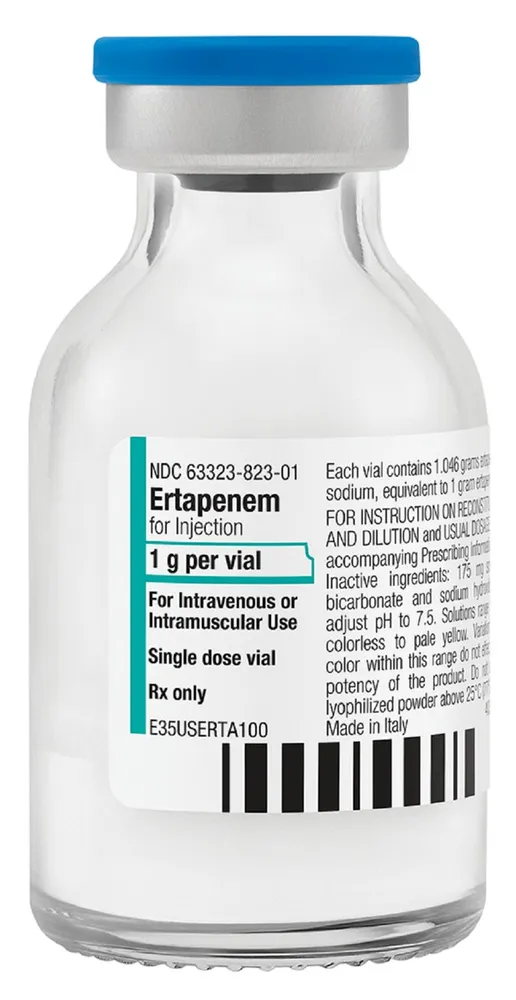
Table of Contents
- Package leaflet: Information for the user
- 1. What Ertapenem Fresenius Kabi is and what it is used for
- 2. Important information before using Ertapenem Fresenius Kabi
- 3. How to use Ertapenem Fresenius Kabi
- 4. Possible side effects
- 5. How to store Ertapenem Fresenius Kabi
- 6. Contents of the pack and other information
- Information intended exclusively for medical professionals:
Package leaflet: Information for the user
Ertapenem Fresenius Kabi, 1 g, powder for solution for infusion
Ertapenemum
Please read all of this leaflet carefully before using this medicine because it contains important information for you.
Keep this leaflet. You may need to read it again.
If you have any further questions, ask your doctor, nurse, or pharmacist.
If you get any side effects, including any not listed in this leaflet, tell your doctor, nurse, or pharmacist. See section 4.
Contents of the leaflet
- What Ertapenem Fresenius Kabi is and what it is used for
- What you need to know before you use Ertapenem Fresenius Kabi
- How to use Ertapenem Fresenius Kabi
- Possible side effects
- How to store Ertapenem Fresenius Kabi
- Contents of the pack and other information
1. What Ertapenem Fresenius Kabi is and what it is used for
Ertapenem Fresenius Kabi contains ertapenem, which is an antibiotic belonging to the beta-lactam group. It is a medicine that kills many types of bacteria (microorganisms) causing infections in various parts of the body.
Ertapenem Fresenius Kabi may be given to patients aged 3 months and older.
Treatment:
Your doctor has prescribed Ertapenem Fresenius Kabi because you or your child has been diagnosed with one or more of the following infections:
- Intra-abdominal infection;
- Lung infection (pneumonia);
- Gynaecological infection;
- Skin and soft tissue infections of the foot in diabetic patients.
Prophylaxis:
- Prevention of surgical site infections in adult patients undergoing surgical procedures on the colon or rectum.
2. Important information before using Ertapenem Fresenius Kabi
When not to use Ertapenem Fresenius Kabi
- if the patient is allergic to the active substance (ertapenem) or to any of the other ingredients of this medicine (listed in section 6);
- if the patient is allergic to antibiotics such as penicillins, cephalosporins or carbapenems (used in the treatment of various types of infections).
Warnings and precautions
Before starting treatment with Ertapenem Fresenius Kabi, discuss this with your doctor,
nurse or pharmacist.
If allergic reactions occur during treatment (such as swelling of the face, tongue or throat,
difficulty breathing or swallowing, skin rash), seek medical advice immediately,
as immediate medical assistance may be necessary.
Although antibiotics such as Ertapenem Fresenius Kabi kill certain types of bacteria, other
bacteria and fungi may continue to multiply excessively. Your doctor will closely monitor
the patient in this regard and modify treatment if necessary.
If diarrhoea occurs before, during or after treatment with Ertapenem Fresenius Kabi,
you must inform your doctor, as this may indicate a condition called colitis (an inflammatory disease of the large intestine). Do not take any anti-diarrhoeal medicines before consulting your doctor.
Inform your doctor if you are taking medicines containing valproic acid or sodium valproate (see below: Ertapenem Fresenius Kabi and other medicines).
Inform your doctor about any previous illnesses and current health problems, including:
- kidney diseases. It is especially important to inform your doctor about existing kidney problems or if you are undergoing dialysis;
- allergies to any medicines, including antibiotics;
- disorders of the central nervous system, such as tremors or seizures.
Children and adolescents (aged 3 months to 17 years)
Experience with the use of Ertapenem Fresenius Kabi in children under 2 years of age is limited. The doctor will decide whether to use the medicine in this age group, taking into account the expected benefits. There is no experience with the use of the medicine in children under 3 months of age.
Ertapenem Fresenius Kabi and other medicines
Tell your doctor about all medicines currently being taken by the patient, as well as any medicines the patient plans to take, including those available without a prescription.
Inform your doctor, nurse or pharmacist if you are taking medicines containing valproic acid or sodium valproate (used in the treatment of epilepsy, bipolar disorder, migraine or schizophrenia), because Ertapenem Fresenius Kabi may affect the way some medicines work. The doctor will decide whether Ertapenem Fresenius Kabi should be used concomitantly with these medicines.
Pregnancy and breastfeeding
If the patient is pregnant, suspects she may be pregnant, or is planning to become pregnant, she should consult her doctor before using Ertapenem Fresenius Kabi.
Studies on the use of Ertapenem Fresenius Kabi in pregnant women have not been conducted. Ertapenem Fresenius Kabi should not be used during pregnancy unless the doctor considers that the expected benefit justifies the potential risk to the fetus.
It is important that the patient informs the doctor if she is breastfeeding or intends to breastfeed before starting treatment with Ertapenem Fresenius Kabi.
Women who are using Ertapenem Fresenius Kabi should not breastfeed, as the medicine passes into human milk and may have an adverse effect on the infant.
Driving and operating machinery
Do not drive or operate machinery until your individual response to the medicine has been determined. During treatment with Ertapenem Fresenius Kabi, adverse effects such as dizziness and somnolence have been reported. These may affect the ability to drive and operate machinery in some patients.
Ertapenem Fresenius Kabi contains sodium
The medicine contains 137 mg of sodium (the main component of table salt) per vial. This corresponds to 6.9% of the maximum recommended daily dietary sodium intake for adults.
3. How to use Ertapenem Fresenius Kabi
Ertapenem Fresenius Kabi is always prepared and administered intravenously by a doctor or other healthcare professional.
The recommended dose of Ertapenem Fresenius Kabi in adults and adolescents aged 13 years and older is 1 g once daily. The recommended dose in children aged 3 months to 12 years is 15 mg/kg body weight twice daily (not exceeding 1 g per day). The duration of treatment will be determined by the doctor.
To prevent surgical site infections following surgery of the colon or rectum, the recommended dose of Ertapenem Fresenius Kabi is 1 g, given as a single intravenous dose administered 1 hour before the surgical procedure.
It is very important that the patient receives Ertapenem Fresenius Kabi for as long as the doctor has prescribed.
Use of a higher than recommended dose of Ertapenem Fresenius Kabi
If there is concern that a higher than recommended dose of Ertapenem Fresenius Kabi has been administered, inform the doctor or another healthcare professional immediately.
Missed dose of Ertapenem Fresenius Kabi
If there is concern that a dose has been missed, inform the doctor or another healthcare professional immediately.
4. Possible side effects
Like all medicines, this medicine can cause side effects, although not everybody gets them.
Adult patients aged 18 years and older:
Since the medicine was introduced to the market, severe allergic reactions (anaphylactic reactions) and hypersensitivity syndromes (allergic reactions presenting with rash, fever, and abnormal blood test results) have been reported. Initial symptoms of a severe allergic reaction may include swelling of the face and (or) throat. If such symptoms occur, seek immediate medical advice, as immediate medical assistance may be required.
Common side effects (may affect up to 1 in 10 patients):
- headache;
- diarrhoea, nausea, vomiting;
- rash, itching;
- complications at the vein into which the medicine was administered (including inflammation, formation of lumps, swelling at the injection site, or leakage of fluid into the surrounding skin and tissues);
- increased platelet count;
- changes in liver function test results.
Uncommon side effects (may affect up to 1 in 100 patients):
- dizziness, drowsiness, insomnia, confusion, seizure;
- low blood pressure, slowed heart rate;
- shortness of breath, sore throat;
- constipation, fungal infections of the mouth, antibiotic-associated diarrhoea, gastroesophageal reflux, dry mouth, dyspepsia, loss of appetite;
- redness of the skin;
- vaginal discharge and irritation;
- abdominal pain, fatigue, fungal infection, fever, swelling and (or) puffiness, chest pain, taste disturbances;
- changes in results of certain blood and urine laboratory tests.
Rare side effects (may affect up to 1 in 1000 patients):
- decreased number of white blood cells, decreased platelet count;
- low blood glucose levels;
- restlessness, anxiety, depression, tremor;
- heart rhythm disorders, elevated blood pressure, bleeding, rapid heartbeat;
- nasal congestion, cough, nosebleeds, pneumonia, abnormal breath sounds, wheezing;
- cholecystitis, difficulty swallowing, faecal incontinence, jaundice, liver function disorders;
- skin inflammation, fungal skin infections, skin peeling, postoperative wound infections;
- muscle spasms, shoulder pain;
- urinary tract infections, kidney function disorders;
- miscarriage, genital bleeding;
- hypersensitivity, general malaise, pelvic peritonitis, changes in the sclera of the eye, fainting;
- skin at the injection site may become hardened;
- swelling of blood vessels in the skin.
Frequency unknown (frequency cannot be estimated from available data):
- hallucinations;
- disturbances of consciousness;
- changes in mental status (including aggressive behaviour, delirium, disorientation, other mental changes);
- abnormal movements;
- muscle weakness;
- unsteady gait;
- tooth discoloration.
Changes in results of certain blood laboratory tests have also been reported.
If blistering or fluid-filled lesions appear over a large area of the body, inform your doctor or nurse immediately.
Children and adolescents (aged 3 months to 17 years):
Common side effects (may affect up to 1 in 10 patients):
- diarrhoea;
- diaper dermatitis;
- pain at infusion site;
- changes in white blood cell count;
- changes in liver function test results.
Uncommon side effects (may affect up to 1 in 100 patients):
- headache;
- transient facial flushing, high blood pressure, red or purple flat, tiny skin spots (petechiae);
- altered stool colour, tarry stools;
- redness of the skin, skin rash;
- burning, itching, redness, and warmth at infusion site, redness at injection site;
- increased platelet count;
- changes in results of certain blood laboratory tests.
Frequency unknown (frequency cannot be estimated from available data):
- hallucinations;
- changes in mental status (including aggressive behaviour).
Reporting of side effects
If any adverse reactions occur, including any not listed in this leaflet, tell your doctor, pharmacist, or nurse. Side effects can be reported directly to the Department of Monitoring of Adverse Drug Reactions, Office for Registration of Medicinal Products, Medical Devices and Biocidal Products
Al. Jerozolimskie 181C
02-222 Warsaw
Phone: +48 22 49 21 301
Fax: +48 22 49 21 309
Website: https://smz.ezdrowie.gov.pl
Side effects can also be reported to the marketing authorisation holder.
Reporting side effects helps provide more information on the safety of this medicine.
5. How to store Ertapenem Fresenius Kabi
Keep this medicine out of the sight and reach of children.
Do not use this medicine after the expiry date stated on the vial after: EXP. The expiry date refers to the last day of the stated month.
Do not store above 25°C.
After reconstitution
The solution should be used immediately.
After dilution
Chemical and physical in-use stability has been demonstrated for diluted solutions (approximately 20 mg/ml) for 6 hours at 25°C or for 24 hours at 2–8°C (refrigerated). After removal from the refrigerator, the solution should be administered no later than 4 hours.
Solutions of Ertapenem Fresenius Kabi must not be frozen.
From a microbiological point of view, the medicine should be used immediately. If the medicine is not used immediately, the responsibility for the storage conditions and duration prior to administration lies with the user. The storage period should not exceed 24 hours at 2–8°C, unless reconstitution and dilution have been carried out under controlled and validated aseptic conditions.
Do not administer the solution if particulate matter or discoloration is observed.
Medicines must not be disposed of via the sewage system or household waste. Ask your pharmacist how to dispose of medicines no longer required. This will help protect the environment.
6. Contents of the pack and other information
What Ertapenem Fresenius Kabi contains
- The active substance is ertapenem (in the form of ertapenem sodium).
- The other components are sodium hydrogen carbonate, sodium hydroxide.
What Ertapenem Fresenius Kabi looks like and contents of the pack
Ertapenem Fresenius Kabi is a white to yellowish, lyophilized powder for preparation of a concentrate for infusion solution.
The solution of Ertapenem Fresenius Kabi is colourless to pale yellow. A change in colour within the stated range does not affect the efficacy of the medicinal product.
The pack contains 10 vials of 1 g each.
Not all pack sizes may be marketed.
Marketing Authorisation Holder
Fresenius Kabi Polska Sp. z o.o.
Al. Jerozolimskie 134
02-305 Warsaw
Poland
Manufacturer
ACS Dobfar S.p.A.
Nucleo Industriale S. Atto
S. Nicolò a Tordino
64100 TERAMO
Italy
For further information about this medicinal product, please contact the Marketing Authorisation Holder:
Fresenius Kabi Polska Sp. z o.o.
Al. Jerozolimskie 134
02-305 Warsaw
Poland
Tel.: +48 22 345 67 89
This medicinal product is authorised in the European Economic Area and in the United Kingdom (Northern Ireland) under the following names:
Austria, Germany: Ertapenem Fresenius Kabi 1 g Pulver für ein Konzentrat zur Herstellung einer Infusionslösung
Czech Republic: Ertapenem Fresenius Kabi 1g prášek pro koncentrát pro infuzní roztok
Croatia, Denmark, Estonia, Finland, Italy, Norway, Poland, Portugal, Sweden: Ertapenem Fresenius Kabi
France: Ertapenem Fresenius Kabi 1 g, poudre pour solution à diluer pour perfusion
Netherlands: Ertapenem Fresenius Kabi 1 g, poeder voor concentraat voor oplossing voor infusie
Romania: Ertapenem Fresenius Kabi 1 g pulbere pentru concentrat pentru soluţie perfuzabilă
Slovenia: Ertapenem Fresenius Kabi 1 g prašek za koncentrat za raztopino za infundiranje
Slovakia: Ertapenem Fresenius Kabi 1 g
Spain: Ertapenem Fresenius Kabi 1 g polvo para concentrado para solución para perfusión EFG
United Kingdom (Northern Ireland): Ertapenem 1g Powder for Concentrate for Solution for Infusion
Information intended exclusively for medical professionals:
Instructions for reconstitution and dilution of Ertapenem Fresenius Kabi:
After reconstitution
The solution should be used immediately.
After dilution
Chemical and physical stability of diluted solutions (approximately 20 mg of ertapenem/mL) has been demonstrated for 6 hours at 25°C or for 24 hours at 2–8°C (refrigerated storage). After removal from the refrigerator, the solution should be administered no later than within 4 hours. Do not freeze solutions of Ertapenem Fresenius Kabi.
From a microbiological standpoint, the product should be used immediately. If not used immediately, the responsibility for storage conditions and duration prior to use lies with the user. The storage period should not exceed 24 hours at 2–8°C, unless reconstitution and dilution were carried out under controlled and validated aseptic conditions.
For single use only.
The reconstituted solution should be diluted immediately after preparation with 0.9% sodium chloride solution (9 mg/mL).
Preparation of intravenous solution:
Before administration, Ertapenem Fresenius Kabi must be reconstituted and then diluted.
Adults and adolescents (aged 13 to 17 years)
Reconstitution
Reconstitute the contents of the vial containing 1 g of Ertapenem Fresenius Kabi with 10 mL of Water for Injections or 0.9% sodium chloride solution (9 mg/mL) to obtain a concentrate of approximately 100 mg/mL. Shake well to ensure complete dissolution of the powder (see section 6.4 of the SmPC).
Dilution
Bags containing 50 mL diluent
To obtain a 1 g dose, immediately transfer the entire reconstituted solution from the vial into a bag containing 50 mL of 0.9% sodium chloride solution (9 mg/mL).
or
Vials containing 50 mL diluent
To obtain a 1 g dose, remove 10 mL from a 50 mL vial of 0.9% sodium chloride solution (9 mg/mL). Then transfer the entire reconstituted solution from the vial containing 1 g of Ertapenem Fresenius Kabi into the 50 mL vial of 0.9% sodium chloride solution (9 mg/mL).
Infusion
Administer as a 30-minute infusion.
Children (aged 3 months to 12 years)
Reconstitution
Reconstitute the contents of the vial containing 1 g of Ertapenem Fresenius Kabi with 10 mL of Water for Injections or 0.9% sodium chloride solution (9 mg/mL) to obtain a concentrate of approximately 100 mg/mL. Shake well to ensure complete dissolution of the powder.
Dilution
Bag containing diluent
To achieve a final concentration of 20 mg/mL or less, transfer a volume equivalent to 15 mg/kg body weight (not exceeding 1 g per day) into a bag containing 0.9% sodium chloride solution (9 mg/mL).
or
Vial containing diluent
To achieve a final concentration of 20 mg/mL or less, transfer a volume equivalent to 15 mg/kg body weight (not exceeding 1 g per day) into a vial containing 0.9% sodium chloride solution (9 mg/mL).
Infusion
Administer as a 30-minute infusion.
Compatibility has been demonstrated between Ertapenem Fresenius Kabi and intravenous infusion solutions containing sodium heparin and potassium chloride.
Inspect the solutions obtained after reconstitution, if possible through the packaging, for the presence of particulate matter or discoloration. The solution of Ertapenem Fresenius Kabi should be colorless or pale yellow. A color change within this range does not affect the efficacy of the medicinal product.
Any unused portions or waste material should be disposed of in accordance with local regulations.