Entocort
Poland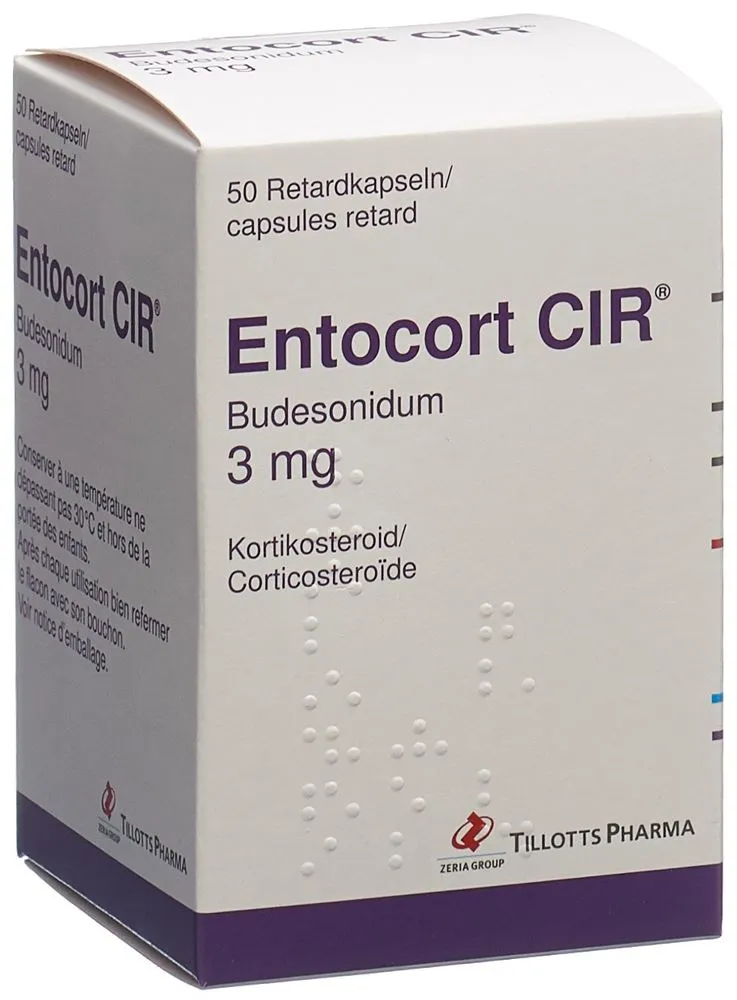
Table of Contents
Package leaflet: Information for the patient
ENTOCORT, 3 mg, prolonged-release hard capsules
Budesonide
Please read all of this leaflet carefully before taking this medicine, as it contains
important information for you.
- Keep this leaflet, as you may need to read it again.
- If you have any further questions, ask your doctor or pharmacist.
- This medicine has been prescribed for you personally. Do not pass it on to others. It may harm other people, even if their symptoms are the same as yours.
- If you experience any side effects, including any not listed in this leaflet, tell your doctor or pharmacist. See section 4.
Contents of the leaflet:
- What Entocort is and what it is used for
- Important information before taking Entocort
- How to take Entocort
- Possible side effects
- How to store Entocort
- Contents of the pack and other information
1. What Entocort is and what it is used for
Budesonide, the active substance in Entocort, belongs to a group of medicines called glucocorticosteroids. Entocort exerts a local effect.
Indications:
- Mild to moderate Crohn's disease affecting the terminal ileum and/or ascending colon. The precise mechanism of action of glucocorticosteroids in the treatment of Crohn's disease is not fully understood, but is likely due to their anti-inflammatory effect.
- Microscopic colitis. Entocort is used for the treatment of acute episodes of microscopic colitis (a chronic inflammatory bowel disease typically presenting with prolonged watery diarrhoea) and for maintenance treatment.
2. Information before using Entocort
When not to use Entocort:
- in patients with bacterial, fungal or viral infections,
- in patients allergic to budesonide or any of the excipients listed in section 6.
You should inform your doctor about any disturbing reactions you have experienced after taking a medicine containing budesonide or any other ingredient listed in section 6.
You should also inform your doctor about any disturbing reactions you have experienced after taking other medicines.
Warnings and precautions
Before starting treatment, inform your doctor about all health problems, especially existing infections (e.g. tuberculosis), arterial hypertension, diabetes, osteoporosis, peptic ulcers, psychosis, heart failure, glaucoma, cataracts, recent intestinal anastomoses, or a family history of diabetes or glaucoma.
Special care is required in patients being switched from systemic glucocorticosteroids with strong general effects to Entocort. In such patients, adrenal cortex function suppression may occur. During withdrawal of prednisolone products and initiation of Entocort treatment, adverse effects may occur (see section 4).
If blurred vision or other visual disturbances occur, contact your doctor.
In case of any inflammatory conditions, inform your doctor. While taking Entocort, avoid contact with persons suffering from measles or chickenpox. These diseases may have a more severe course in patients taking Entocort.
If Entocort has been prescribed to a patient previously treated with other glucocorticosteroid-containing medicines, allergic reactions such as rhinitis or rash that were previously suppressed may reappear when switching medications. In such cases, consult your doctor, who may recommend antihistamines.
Patients taking Entocort should inform their doctor before undergoing surgery or any other stressful situation, as the doctor may recommend additional treatment with glucocorticosteroid-containing medicines.
During long-term administration of high-dose budesonide, general glucocorticosteroid effects may occur, such as elevated serum cortisol (adrenal cortex hormone) levels and adrenal cortex function suppression (see section 4).
Do not abruptly discontinue treatment with Entocort. If stopping treatment is necessary, your doctor may recommend gradually reducing the dose. During dose reduction, some patients may experience worsening health due to symptoms such as muscle and joint pain, fatigue, headache, nausea, and vomiting. In such cases, consult your doctor, who may recommend additional treatment.
Clinical experience with budesonide or other glucocorticosteroids in patients with recurrent Crohn's disease after long-term treatment is limited.
Children and adolescents
Entocort may be used in children above 8 years of age and weighing more than 25 kg.
Exercise caution when using Entocort in patients during periods of growth. Monitoring of growth in children and adolescents during treatment is recommended. If growth retardation occurs, the doctor may reconsider the treatment regimen.
Patients with impaired liver function
Liver function disorders may affect glucocorticosteroid elimination. There is a risk of systemic adverse effects.
In patients with liver impairment, oral budesonide bioavailability is increased.
In diabetic patients treated with insulin, dosage adjustment may be necessary when glucocorticosteroids are administered concomitantly.
Entocort with other medicines
Inform your doctor about all medicines currently used or recently taken, as well as any medicines you plan to take.
You must inform your doctor if you are taking any of the following medicines: ketoconazole and itraconazole (used to treat fungal infections), HIV protease inhibitors (antiviral agents, including ritonavir, cobicistat), carbamazepine (used in epilepsy treatment), cimetidine (used in peptic ulcer disease), estrogens (used in hormonal disorders), hormonal contraceptives, cholestyramine (used to treat elevated blood lipid levels), or antacids.
Some medicines may enhance the effect of Entocort, and your doctor may need to closely monitor your condition (including certain HIV medications: ritonavir, cobicistat). If concomitant use of budesonide with ketoconazole or itraconazole, or an HIV protease inhibitor, cannot be avoided, the interval between doses of these medicines should be as long as possible. Additionally, your doctor may consider reducing the budesonide dose.
You should also inform your doctor about any disturbing reactions experienced after taking other medicines.
Diagnostic tests assessing pituitary gland activity may yield falsely low results due to adrenal suppression.
Entocort with food and drink
See section 3.
Pregnancy and breastfeeding
Before using Entocort, consult your doctor.
During pregnancy and breastfeeding, all medicines should be used cautiously.
If a woman being treated with Entocort becomes pregnant, she should inform her doctor as soon as possible.
Budesonide passes into breast milk. Entocort may be used during breastfeeding only if, in the doctor's opinion, the expected benefit to the mother outweighs the potential risk to the infant.
Driving and operating machinery
Entocort has no influence on psychomotor performance in drivers and machine operators.
Entocort contains sucrose
If the patient has previously been diagnosed with intolerance to certain sugars, the patient should consult a doctor before taking this medicine.
Entocort contains sodium
This medicine contains less than 1 mmol of sodium (23 mg) per maximum daily dose (3 tablets), meaning the medicine is considered "sodium-free".
3. How to use Entocort
This medicine should always be taken exactly as prescribed by your doctor. If in doubt, consult your doctor.
The dose of Entocort is individually determined for each patient.
Entocort capsules should be swallowed whole with water. Do not chew or crush them.
Patients who may have difficulty swallowing the capsule whole may open it, gently mix the contents with a tablespoon of apple juice, and drink it. Grapefruit juice or grapefruit should be avoided during treatment with Entocort. Grapefruit increases the bioavailability of budesonide. Other juices and fruits do not have this effect.
Recommended dosing in adults
Crohn's disease
Treatment during symptom flare-up: the recommended dose is 9 mg (3 capsules) once daily. This dose is usually given for up to 8 weeks. For long-term treatment: the recommended dose is 6 mg daily (2 capsules). Depending on the severity of symptoms, your doctor may adjust the dose of Entocor.
Do not stop taking this medicine without consulting your doctor, even if symptoms improve or subside.
Microscopic colitis
For acute episodes: the dose is 9 mg (3 capsules) once daily, taken in the morning, for 8 weeks. A gradual dose reduction is recommended during the last two weeks of treatment.
Maintenance treatment may be initiated by your doctor only in case of recurrent symptoms of microscopic colitis, not during the first episode.
Recommended dose: 6 mg (2 capsules) once daily, taken in the morning, with the possibility of reducing the dose to 3 mg (1 capsule) in stable, asymptomatic patients.
Treatment may be continued for up to 9 months, with gradual dose reduction.
Use in children and adolescents
The recommended daily dose for mild to moderate Crohn's disease in children aged 8 years or older and weighing more than 25 kg is 9 mg (3 capsules). This dose may be used for no longer than 8 weeks. Full therapeutic effect is usually achieved within 2 to 4 weeks.
There is no experience with use of Entocort for longer than 12 weeks.
Elderly patients
The same doses as in adult patients are recommended. However, clinical experience with Entocort in elderly patients is limited.
Note: If Entocort replaces another glucocorticosteroid previously used (e.g., prednisone, prednisolone or methylprednisolone), symptoms previously experienced may recur, such as rash, muscle pain, or joint pain. If any of these symptoms occur or new symptoms such as headache, fatigue, nausea or vomiting appear, contact your doctor immediately.
To properly replace prednisolone in steroid-dependent patients, a dose of 6 mg (2 capsules) once daily is recommended. After starting Entocort, the prednisolone dose should be gradually reduced until completely discontinued.
Taking more Entocort than recommended
Always strictly follow your doctor's instructions. If Entocort has been taken in a single dose higher than recommended, no alarming symptoms are expected. However, if Entocort is taken long-term (one month or longer) in doses exceeding the recommended ones, adverse effects may occur (see section 4). Acute poisoning or death due to glucocorticosteroid overdose have been rarely reported.
In case of overdose, seek immediate medical advice from your doctor or pharmacist.
Missed dose of Entocort
Entocort should be taken regularly at the same time every day, as directed by your doctor. If a dose is missed, take the next dose at the usual time.
Do not take a double dose to make up for a missed dose.
Entocort should always be taken exactly as prescribed by your doctor.
Stopping Entocort
See "Warnings and precautions" in section 2.
If you have any further questions about the use of this medicine, consult your doctor or pharmacist.
4. Possible adverse effects
Like all medicines, this medicine can cause adverse effects, although not everybody will experience them.
Adverse effects occur with the following frequency:
Common (affects less than 1 in 10 treated patients)
- irregular or rapid heartbeat (palpitations),
- suppression of adrenal cortex hormone secretion (weakness, fatigue, weight loss, menstrual disorders),
- symptoms characteristic of Cushing's syndrome (facial and trunk obesity, pink skin striae),
- symptoms of indigestion,
- decreased blood potassium levels,
- muscle cramps,
- behavioural changes such as nervousness, insomnia, mood changes and depression,
- menstrual disorders,
- skin reactions (urticaria, rash),
- weakened resistance to infections.
Uncommon (affects less than 1 in 100 treated patients)
- tremors,
- anxiety,
- hyperkinesia,
Rare (affects less than 1 in 1,000 treated patients):
- aggression,
- glaucoma (an eye disease involving progressive and irreversible damage to the optic nerve leading to worsening or loss of vision),
- cataract (clouding of the natural lens of the eye, including the posterior part of the lens),
- petechiae (small red, brown or violet spots on the skin or mucous membranes resulting from bleeding under the skin),
- blurred vision.
Very rare (affects less than 1 in 10,000 treated patients):
- growth retardation,
- anaphylactic reactions (severe allergic reactions causing breathing difficulties or dizziness).
Frequency not known (frequency cannot be estimated from available data):
- allergic reactions which may cause swelling of the face, particularly of the eyelids, lips, tongue or throat (angioedema).
In addition, the following may occur: oedema, hypertension, skin atrophy, impaired wound healing,
sodium retention, increased gluconeogenesis, adverse effects related to catabolism,
osteoporosis, muscle atrophy, activation of infections (e.g. tuberculosis), carbohydrate metabolism disturbances,
exacerbation of psychiatric disorders, glaucoma, cataract, thrombosis, mild intracranial hypertension. The occurrence of these effects depends on the dose, duration of treatment, and individual susceptibility.
Most of the adverse effects listed above may also be expected during treatment with other glucocorticosteroids.
Reporting of adverse effects
If any adverse effects occur, including any not listed in this leaflet, patients should inform their doctor or pharmacist.
Adverse effects can be reported directly to the Department of Monitoring Adverse Drug Reactions, Office for Registration of Medicinal Products, Medical Devices and Biocidal Products, Al. Jerozolimskie 181C, 02-222 Warsaw,
Tel.: +48 22 49 21 301, Fax: +48 22 49 21 309,
Website: https://smz.ezdrowie.gov.pl
Reporting adverse effects helps to gather more information on the safety of the medicine.
Adverse effects can also be reported to the marketing authorization holder.
5. How to store Entocort
Keep the medicine out of sight and reach of children.
The medicine should be stored in its original packaging. After removing a capsule, the container should be tightly closed.
Store below 30°C.
Do not use this medicine after the expiry date stated on the packaging after EXP.
Medicines should not be disposed of via the sewage system or household waste. Ask your pharmacist how to dispose of medicines no longer required. This will help protect the environment.
6. Contents of the pack and other information
What Entocort contains
The active substance in this medicine is budesonide. Each capsule contains 3 mg of budesonide.
The other ingredients are: ethyl cellulose, acetyl tributyl citrate, methacrylic acid copolymer type C, triethyl citrate, anti-foaming agent, polysorbate 80, talc, sugar spheres (sucrose + corn starch), gelatin, sodium lauryl sulfate, edible oil, colloidal silicon dioxide, red iron oxide (E 172), black iron oxide (E 172), yellow iron oxide (E 172), titanium dioxide (E 171). Ink composition for printing on capsules: shellac, black iron oxide, potassium hydroxide, ammonium hydroxide.
What Entocort looks like and contents of the pack
Prolonged-release hard capsule with a light grey body and a pink cap. The capsule cap bears a black print: "CIR 3 mg".
The pack consists of a polypropylene container containing 100 capsules, placed in a cardboard box.
Marketing Authorisation Holder
Tillotts Pharma GmbH
Warmbacher Strasse 80
79618 Rheinfelden
Germany
Manufacturer
Astrea Fontaine
Rue des Près Potets
21121 Fontaine-lès-Dijon
France