Emoclot
Poland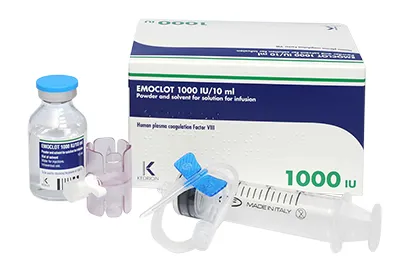
Table of Contents
Patient Information Leaflet
EMOCLOT, 500 IU, powder and solvent for solution for injection and infusion
EMOCLOT, 1000 IU, powder and solvent for solution for injection and infusion
Human Coagulation Factor VIII
Please read all of this leaflet carefully before using this medicine, as it contains important information for you.
- Keep this leaflet. You may need to read it again.
- If you have any further questions, ask your doctor.
- This medicine has been prescribed for a specific individual. Do not pass it on to others. It may harm them, even if their symptoms are the same.
- If you experience any adverse effects, including any not listed in this leaflet, inform your doctor. See section 4.
Leaflet Contents:
- What EMOCLOT is and what it is used for
- Important information before using EMOCLOT
- How to use EMOCLOT
- Possible side effects
- How to store EMOCLOT
- Contents of the pack and other information
1. What EMOCLOT is and what it is used for
EMOCLOT is a highly purified concentrate of coagulation factor VIII derived from human plasma. Factor VIII is a protein with antihemorrhagic activity. EMOCLOT is indicated:
- for the treatment and prophylaxis of bleeding episodes in patients with congenital factor VIII deficiency (hemophilia A);
- for the treatment of bleeding episodes in patients with acquired factor VIII deficiency;
- for the treatment of patients with hemophilia A who have developed inhibitors (antibodies) against factor VIII.
This medicine does not contain a pharmacologically effective amount of von Willebrand factor; therefore, it is not indicated for the treatment of von Willebrand disease.
2. Important information before using EMOCLOT
When not to use EMOCLOT
if the patient is allergic to human factor VIII or to any of the other components of this
medicine (listed in section 6).
Warnings and precautions
Before starting treatment with EMOCLOT, discuss this with your doctor.
Hypersensitivity
Allergic-type hypersensitivity reactions related to EMOCLOT may occur.
EMOCLOT contains trace amounts of human proteins other than factor VIII. Patients should be
informed about early signs of hypersensitivity reactions. Administration of the medicine should be
immediately discontinued if the patient experiences any of the following symptoms indicating an
allergic reaction: rash, generalized urticaria, chest tightness, wheezing, low blood pressure, or acute
allergic reaction.
In case of shock, administration should be stopped immediately and treatment should be managed
according to shock management guidelines.
Antibodies
Development of inhibitors (antibodies) is a known complication that may occur during treatment
with any factor VIII-containing medicines. These inhibitors, especially at high concentrations, may
interfere with effective treatment, and the patient will be closely monitored for their development.
If bleeding is not adequately controlled after administration of Emoclot, inform your doctor immediately.
Cardiovascular events
In patients with existing cardiovascular risk factors, factor VIII replacement therapy may increase
the risk of cardiovascular disorders.
Complications related to central venous access device use
If a central venous access device is required, consider the risks associated with its use, including
local infection, bacteremia, and catheter site thrombosis.
Viral safety
For medicines produced from human blood or plasma, appropriate preventive measures are taken to
reduce the risk of transmission of infectious agents to patients. These include:
- careful selection of blood and plasma donors to ensure exclusion of individuals at risk of carrying infections;
- testing of each donation and plasma pool (a collection of donations) for viruses and infectious agents;
- inclusion in the blood or plasma manufacturing process of steps that inactivate or remove viruses.
Despite these precautions, it cannot be completely excluded that transmission of infectious agents may occur with medicines prepared from human blood or plasma. This also applies to unknown or newly emerging viruses and other pathogens. The preventive measures used are considered effective against enveloped viruses such as human immunodeficiency virus (HIV), hepatitis B virus (HBV), hepatitis C virus (HCV), and non-enveloped viruses such as hepatitis A virus (HAV). These measures may have limited effectiveness against non-enveloped viruses such as parvovirus B19. Parvovirus B19 infection may be harmful to pregnant women (fetal infection) and to patients with immunodeficiency or certain types of anemia (e.g. sickle cell anemia or hemolytic anemia).
It is strongly recommended that each time EMOCLOT is administered to a patient, the
product name and batch number should be recorded to allow identification of which batch was
administered.
For patients receiving regular or repeated factor VIII derived from plasma, appropriate vaccinations
(against hepatitis A and B viruses) should be considered.
Children and adolescents
The above warnings and precautions apply to both adults and children.
More information is provided at the end of this leaflet in the section intended for healthcare professionals.
EMOCLOT with other medicines
Inform your doctor or pharmacist about all medicines currently used, recently used, or planned to be used.
No interactions between factor VIII and other medicines have been reported.
There are no specific data regarding use in children.
Pregnancy and breastfeeding
- If the patient is pregnant or breastfeeding, suspects she may be pregnant, or is planning to have a child, she should consult her doctor before using this medicine.
- Animal reproductive studies with factor VIII have not been conducted. Due to the rarity of hemophilia A in women, there is limited experience with factor VIII use during pregnancy and breastfeeding. Therefore, factor VIII should be used during pregnancy and lactation only if strictly indicated.
Driving and using machines
EMOCLOT has no influence on the ability to drive and use machines.
EMOCLOT contains sodium
The medicine contains up to 41 mg of sodium (main component of table salt) per 10 ml vial. This corresponds to
2.05% of the maximum recommended daily sodium intake in the adult diet.
3. How to use EMOCLOT
This medicine should always be used as prescribed by the doctor. Treatment should be initiated under
the supervision of a physician experienced in the treatment of hemophilia.
Recommended dose
The dosage and duration of replacement therapy depend on the severity of factor VIII deficiency, the
location and extent of bleeding, and the patient's clinical condition.
On-demand treatment
The required amount and frequency of administration should be determined based on clinical efficacy in the individual case.
Prophylaxis
For long-term prophylaxis of bleeding in patients with severe hemophilia A, doses of 20 to 40 IU of
factor VIII per kg body weight are usually administered every 2 to 3 days.
In certain cases, especially in younger patients, more frequent administration or higher doses may be required.
Patients treated with factor VIII should be closely monitored and tested for the development of antibodies.
During treatment, appropriate factor VIII levels should be assessed to adjust dosage and frequency of infusions.
Particularly during major surgical procedures, precise monitoring of replacement therapy using coagulation tests (plasma factor VIII activity) is essential.
Children and adolescents
EMOCLOT is not recommended for use in children under 12 years of age due to insufficient data on safety and efficacy.
More information on dosing and duration of treatment is provided at the end of this leaflet in the section
intended for physicians and healthcare professionals.
Method of administration
The medicine should be administered intravenously as an injection or slow infusion.
For intravenous injection, administration over 3 to 5 minutes is recommended, monitoring the patient's pulse rate and stopping or reducing the infusion rate if the pulse rate increases. The infusion rate should be individually adjusted for each patient.
Only the provided injection or infusion sets should be used, as adsorption of human coagulation factor VIII onto internal surfaces of certain sets may lead to therapeutic failure.
Incompatibilities: due to lack of compatibility studies, this medicine must not be mixed with other medicinal products.
Reconstitution of powder with solvent:
- bring the vial of powder and the vial of solvent to room temperature;
- maintain room temperature throughout the reconstitution process (for up to 10 minutes);
- remove the protective caps from both the powder vial and the solvent vial;
- disinfect the rubber stoppers of both vials with alcohol;
- open the medical reconstitution device package by carefully removing the cover without touching the device inside (Fig. A);
- do not remove the device from the package;
- turn the package upside down and insert the plastic spike through the stopper of the solvent vial, connecting the blue part of the device to the solvent vial (Fig. B);
- holding the edge of the package, carefully remove it from the device without touching the device (Fig. C);
- ensure the powder vial is placed on a stable surface; invert the connected device and solvent vial so that the solvent vial is on top; press the transparent adapter onto the stopper of the powder vial so that the plastic spike passes through the stopper; the solvent will automatically flow into the powder vial (Fig. D);
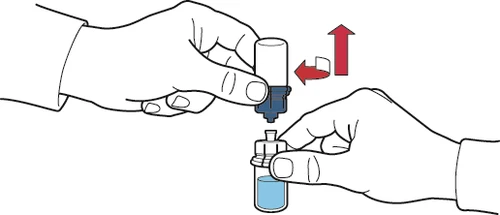
- after the solvent has flowed in, unscrew the blue part of the reconstitution device with the attached solvent vial and discard it (Fig. E);
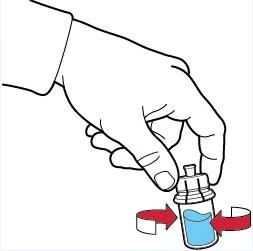
- gently swirl to completely dissolve the powder (Fig. F);
- do not shake vigorously; avoid foaming of the solution.
Fig. A Fig. B
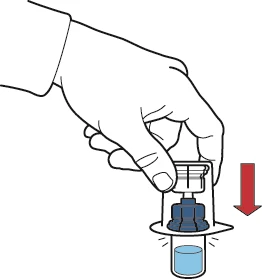
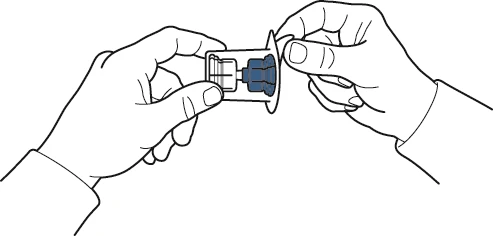
Fig. C Fig. D
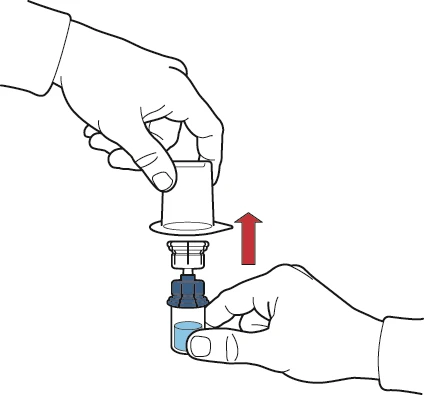
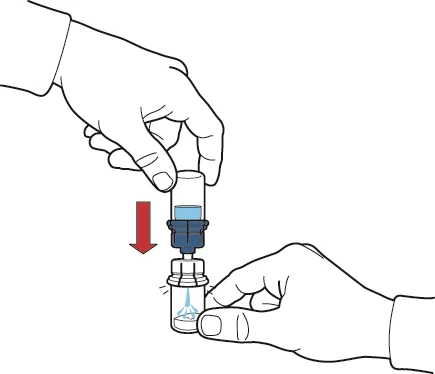
Fig. E Fig. F
Administration of the solution
After reconstitution, the solution may contain a few small flakes or particles.
The reconstituted solution should be visually inspected for the presence of solid particles or discoloration before administration.
The solution should be clear or slightly opalescent. Do not use cloudy solutions or those containing precipitate.
- Fill the syringe with air by pulling back the plunger, connect the syringe to the device, and inject air into the vial containing the reconstituted solution (Fig. G);
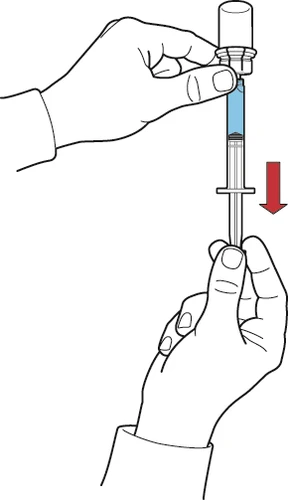
- keeping the plunger stationary, invert the vial and syringe so that the vial is on top, and slowly draw the solution into the syringe (Fig. H);
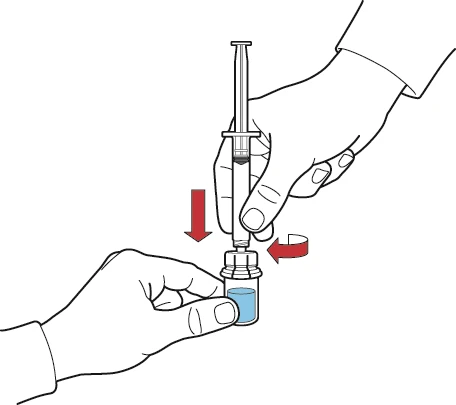
- disconnect the syringe by rotating it counterclockwise;
- inspect the solution in the syringe, which should be clear or slightly opalescent and free from particles;
- attach a butterfly needle to the syringe and administer via infusion or slow intravenous injection.
Fig. G Fig. H
Use of a higher than recommended dose of EMOCLOT
Symptoms of human coagulation factor VIII overdose are unknown.
In case of accidental ingestion or overdose of EMOCLOT, seek immediate medical attention at the nearest hospital.
If you have any further questions about the use of this medicine, consult your doctor.
4. Possible adverse reactions
Like all medicines, this medicine can cause adverse reactions, although not everybody will experience them.
If any of the following adverse symptoms occur, you should immediately inform your doctor or go to the nearest hospital:
- Serious allergic reactions (hypersensitivity): rapidly progressing swelling of the skin and mucous membranes around the mouth and face (angioedema). This reaction has been observed rarely, but in some cases it may progress to an acute allergic reaction, including anaphylactic shock.
- In patients with haemophilia A, neutralizing antibodies (inhibitors) against factor VIII may develop, resulting in a poor clinical response to treatment. In such cases, consultation with a specialized haemophilia treatment centre is recommended.
Other possible adverse reactions:
- Other allergic reactions (hypersensitivity) may include:
- burning and pain at the site of administration;
- chills, sudden flushing of the face, generalized urticaria (hives affecting the skin of the entire body), rash;
- headache;
- drop in blood pressure (hypotension), restlessness, rapid heartbeat (tachycardia), chest tightness, wheezing;
- drowsiness (lethargy);
- nausea, vomiting;
- tingling sensation.
The above adverse reactions have been observed rarely after administration of factor VIII-containing medicines, but in some cases they may progress to acute allergic reactions, including anaphylactic shock.
The frequency of adverse reactions following the introduction of Emoclot to the market is unknown, meaning it cannot be determined based on available data.
Fever has also been observed.
In previously untreated children receiving factor VIII-containing medicines, blocking antibodies (see section 2) may develop very commonly (more than 1 in 10 patients). However, in patients who have previously been treated with factor VIII (more than 150 days of treatment), the risk is uncommon (less than 1 in 100 patients). If this occurs, the medicines may stop working properly and persistent bleeding may occur. If this happens, you should contact your doctor immediately.
Additional adverse reactions in children
Although there are no specific data in the paediatric population, several published efficacy and safety studies have not shown major differences between adults and children suffering from the same disorder.
Reporting of adverse reactions
If any adverse symptoms occur, including any adverse reactions not listed in this leaflet, inform your doctor or nurse. Adverse reactions can be reported directly to the Department of Monitoring Adverse Drug Reactions of the Office for Registration of Medicinal Products, Medical Devices and Biocidal Products:
Al. Jerozolimskie 181C,
02-222 Warsaw,
tel: 22 4921301,
fax: 22 4921309,
Website: https://smz.ezdrowie.gov.pl
Reporting adverse reactions helps to provide more information on the safety of the medicine.
Adverse reactions can also be reported to the marketing authorization holder.
Safety information regarding the transmission of infectious agents, see section 2.
5. How to store EMOCLOT
Keep the medicine out of the sight and reach of children. Do not use the medicine after
the expiry date stated on the package following EXP. The expiry date refers to the last
day of the stated month.
Store in a refrigerator (2°C - 8°C). Do not freeze. Keep in the outer packaging to protect
from light.
Before use and during the medicine's shelf life, the vial with powder may be stored at
room temperature not exceeding 25°C for up to 6 consecutive months. After this
period, the medicine must be discarded. Under no circumstances can the medicine be returned to the refrigerator if it has been stored at room temperature.
The initial date of storage at room temperature should be recorded on the outer packaging (carton).
After opening the vials, the contents should be used immediately. The contents of a vial are intended for single administration only.
Medicines should not be disposed of via wastewater or household waste. Ask your pharmacist how to dispose of medicines no longer in use. This will help protect
the environment.
6. Contents of the packaging and other information
What EMOCLOT contains
The active substance is human blood coagulation factor VIII.
| EMOCLOT 500 IU | EMOCLOT 1000 IU | |
| Human coagulation factor VIII | 500 IU/vial | 1000 IU/vial |
| Human coagulation factor VIII after reconstitution in water for injections | 50 IU/ml (500 IU/10 ml) | 100 IU/ml (1000 IU/10 ml) |
| Solvent (water for injections) | 10 ml | 10 ml |
The potency (IU) of the product was determined by a chromogenic method in accordance with the European Pharmacopoeia.
The specific activity of the medicinal product is approximately 80 IU/mg protein.
The medicinal product is manufactured from human plasma obtained from donors.
The medicinal product contains: human von Willebrand factor: ristocetin cofactor activity (RCO) not less than
10 IU/ml for the 500 IU/10 ml presentation and not less than 20 IU/ml for the 1000 IU/10 ml presentation.
Other components of the medicinal product are sodium citrate, sodium chloride, glycine, calcium chloride.
Solvent: water for injections.
What Emoclot looks like and what the pack contains
Powder and solvent for solution for injection and infusion.
After reconstitution, the solution may contain a few small flakes or particles.
The reconstituted medicinal product (solution) should be inspected visually for particulate matter and discoloration.
The solution should be clear or slightly opalescent. Do not use solutions that are cloudy or contain a precipitate.
The Emoclot pack contains one vial of powder, one vial of solvent for preparing the solution for administration, and a sterile set for reconstitution and administration consisting of a reconstitution device, a single-use syringe, and a butterfly needle with PCV tubing.
Emoclot, 500 IU/10 ml
1 vial of powder + 1 vial of solvent + set for reconstitution and administration.
Emoclot, 1000 IU/10 ml
1 vial of powder + 1 vial of solvent + set for reconstitution and administration.
Marketing Authorisation Holder and Manufacturer
Marketing Authorisation Holder
Kedrion S.p.A. - Loc. Ai Conti, 55051 Castelvecchio Pascoli, Barga (Lucca), Italy
Manufacturer
Kedrion S.p.A. - 55027 Bolognana, Gallicano (Lucca), Italy
For further information, contact the representative of the Marketing Authorisation Holder
MB&S, ul. Chełmska 30/34, Warsaw
Tel/fax: 22 8515210
Information intended exclusively for healthcare professionals:
Treatment Monitoring
During treatment, appropriate factor VIII levels should be assessed to adjust dosing and frequency of infusions. Individual patients may vary in factor VIII half-life and recovery levels. Dose based on body weight may require adjustment in underweight or overweight patients.
Particularly during major surgical procedures, precise monitoring of replacement therapy is essential, including measurement of coagulation factor (factor VIII activity in plasma), to determine accurate dosing and infusion frequency.
When using a one-stage in vitro clotting assay based on activated partial thromboplastin time (aPTT) to measure factor VIII activity in patient blood samples, both the type of aPTT reagent and the reference standard used in the test may significantly influence the results of plasma factor VIII activity measurements.
Significant differences may also occur between results obtained with the one-stage aPTT-based clotting assay and those from chromogenic assays performed according to the European Pharmacopoeia. This is particularly important when changing laboratories and/or reagents used in testing.
Dosing
The dose and duration of replacement therapy depend on the severity of factor VIII deficiency, the location and extent of bleeding, and the patient's clinical condition.
The number of factor VIII units administered is expressed in International Units (IU), corresponding to the current WHO standards for factor VIII products. Factor VIII activity in plasma is expressed either as a percentage (relative to normal human plasma) or in International Units (relative to international standards for factor VIII in plasma).
One International Unit (IU) of factor VIII activity is equivalent to the amount of factor VIII present in 1 ml of normal human plasma.
On-demand treatment
Required factor VIII dosing is based on empirical data showing that 1 IU of factor VIII per kg of body weight increases plasma factor VIII activity by 1.5% to 2%.
The required dose is calculated using the following formula:
Required number of units = body weight [kg] × desired increase in factor VIII activity [%] [IU/dL] × 0.4
When determining the required dose and frequency, clinical efficacy in the individual case should always be the guiding factor.
In the following bleeding situations, factor VIII activity should not fall below the indicated plasma level (expressed as % of normal or IU/dL) at the appropriate time.
The following table may serve as a guide for dosing during bleeding episodes and surgical procedures:
| Bleeding severity / Type of surgical procedure | Required factor VIII level (%) (IU/dL) | Dosing frequency (hours) / Treatment duration (days) | |--------------------------------------------------|------------------------------------------|--------------------------------------------------------| | Bleeding: | | | | Early joint haemarthrosis, muscle haemorrhage, or oral cavity bleeding | 20 – 40 | Repeat infusions every 12 to 24 hours for at least 1 day, until bleeding resolves (assessed by pain relief or wound healing). | | More severe joint haemarthrosis, muscle haemorrhage, or acute haematoma | 30 – 60 | Repeat every 12–24 hours for 3–4 days or longer, until pain or acute disability resolves. | | Life-threatening bleeding | 60 – 100 | Repeat every 8 to 24 hours until the threat resolves. | | Surgical procedures: | | | | Minor surgical procedures, including tooth extraction | 30 – 60 | Repeat infusions every 24 hours for at least 1 day, until wound healing. | | Major surgical procedures (pre- and post-operative) | 80 – 100 | Repeat every 8 to 24 hours until wound healing, followed by at least 7 additional days to maintain factor VIII activity between 30% and 60% (30 IU/dL – 60 IU/dL). |
Prophylaxis
For long-term prophylaxis of bleeding in patients with severe haemophilia A, doses of 20 to 40 IU of factor VIII per kg body weight, administered every 2 to 3 days, are typically used.
In certain cases, especially in younger patients, more frequent administration or higher doses may be necessary.
Children and adolescents
EMOCLOT is not recommended for use in children under 12 years of age due to insufficient data on safety and efficacy. Dosing in adolescents (12–18 years) for each indication is calculated based on body weight.
Method of administration
Administer intravenously by injection or slow infusion.
For intravenous injection, administration over 3 to 5 minutes is recommended, with frequent monitoring of the patient's pulse rate. Administration should be interrupted or the infusion rate reduced if pulse rate increases.
The infusion rate should be individually adjusted for each patient.
For instructions on reconstitution of the medicinal product prior to administration, refer to section 3, "How to use EMOCLOT".
Inhibitors
The clinical significance of developed inhibitors depends on the inhibitor titer. Low-titer inhibitors pose a lower risk of inadequate clinical response compared to high-titer inhibitors.
All patients receiving factor VIII coagulation products should be closely monitored for inhibitor development through clinical observation and laboratory testing. If, despite appropriate dosing, the expected plasma factor VIII activity level is not achieved or bleeding cannot be controlled, testing for the presence of factor VIII inhibitors should be performed.
In patients with high inhibitor activity, treatment with factor VIII may be ineffective, and alternative therapeutic options should be considered. Management of such patients should be supervised by physicians experienced in the treatment of haemophilia and factor VIII inhibitors.