Eligard 7.5 mg
Poland
Table of Contents
- Package leaflet: Information for the user
- 1. What Eligard is and what it is used for
- 2. Important information before using Eligard
- 3. How to use Eligard
- 4. Possible adverse reactions
- 5. How to store Eligard
- 6. Contents of the package and other information
- Information intended exclusively for healthcare professionals:
- 1. Closing on a flat surface
- 2. Closing with the thumb
Package leaflet: Information for the user
Eligard 7.5 mg,
powder and solvent for solution for injection
Leuprorelin acetate
Please read all of this leaflet carefully before using this medicine, because it contains
important information for you.
- Keep this leaflet, you may need to read it again.
- If you have any further questions, ask your doctor, pharmacist or nurse.
- This medicine has been prescribed for a specific individual. Do not pass it on to others. It may harm other people, even if their symptoms are the same.
- If you experience any side effects, including any not listed in this leaflet, tell your doctor, pharmacist or nurse. See section 4.
Contents of the leaflet
- What Eligard is and what it is used for
- What you need to know before you use Eligard
- How to use Eligard
- Possible side effects
- How to store Eligard
- Contents of the pack and other information
1. What Eligard is and what it is used for
The active substance in Eligard belongs to a group of medicines called gonadorelin analogues. These medicines are used to suppress the production of certain sex hormones (testosterone).
Eligard is used in adult men for the treatment of metastatic prostate cancer that is hormone-sensitive, and in combination with radiotherapy – for the treatment of high-risk, non-metastatic prostate cancer that is hormone-sensitive.
2. Important information before using Eligard
When not to use Eligard
- In women and children.
- If the patient is allergic to the active substance - leuprorelin acetate, to any compound acting similarly to the naturally occurring hormone - gonadotropin, or to any of the other ingredients of Eligard (listed in section 6).
- After surgical removal of the testes, since Eligard does not further reduce serum testosterone concentration.
- As the sole treatment if the patient has symptoms related to spinal cord compression or spinal metastases. In such cases, Eligard may be used only in combination with other medications used in the treatment of prostate cancer.
Warnings and precautions
Before starting treatment with Eligard, discuss the following with your doctor, pharmacist, or nurse:
-
If any of the following conditions apply: any heart or blood vessel diseases, including heart rhythm disorders (arrhythmia), or if the patient is taking medications for these conditions. The risk of heart rhythm disturbances may increase during treatment with Eligard.
-
If there are difficulties in passing urine. In such cases, the patient's condition should be monitored during the first weeks of treatment.
-
If symptoms of spinal cord compression or difficulty in passing urine worsen. When medications similar in action to Eligard are used concomitantly, severe cases of spinal cord compression and ureteral narrowing have been observed, which may lead to symptoms resembling paralysis. In such cases, standard treatment must be initiated.
-
If the patient experiences sudden headache, vomiting, change in mental status, or circulatory collapse within two weeks after administration of Eligard. In such cases, contact your doctor or medical personnel immediately. These are symptoms of a rarely occurring condition called pituitary apoplexy, which has been reported in association with the use of OTHER DRUGS with similar action to Eligard.
-
If the patient has diabetes (elevated blood sugar levels). In such cases, the patient's condition should be monitored during treatment.
-
Treatment with Eligard may increase the risk of fractures due to osteoporosis (reduced bone density).
-
There have been reports of depression in patients receiving Eligard. If depressive mood occurs during treatment with Eligard, inform your doctor.
-
There have been reports of cardiovascular diseases in patients receiving drugs similar to Eligard - it is not known whether their occurrence is related to the use of these drugs. If symptoms of cardiovascular disease occur during treatment with Eligard, inform your doctor.
-
There have been reports of seizures in patients receiving Eligard. If seizures occur during treatment with Eligard, inform your doctor.
-
If the patient experiences severe or recurring headaches, vision problems, or ringing or buzzing in the ears, seek medical advice immediately.
-
If the patient has fatty liver
Severe skin reactions, including Stevens-Johnson syndrome and toxic epidermal necrolysis (SJS/TEN), have been reported with the use of leuprorelin. If any symptoms of severe skin reactions described in section 4 are observed, treatment with leuprorelin should be discontinued and medical advice should be sought immediately.
Complications occurring during the initial period of Eligard treatment
During the first week of treatment, a transient increase in blood testosterone levels may occur, which can lead to a temporary worsening of disease symptoms or the appearance of new symptoms not previously present. These symptoms include, in particular: bone pain, urinary disturbances, spinal cord compression, and presence of blood in the urine. These symptoms usually resolve during continued treatment. If symptoms do not resolve, contact your treating physician.
Lack of effect of Eligard
In some patients, tumors are found that are not sensitive to reduced serum testosterone levels. If you feel that Eligard is not providing sufficient effect, inform your treating physician.
Eligard with other medicines
Eligard may affect the action of certain drugs used to treat heart rhythm disorders (e.g., quinidine, procainamide, amiodarone, and sotalol) or may increase the risk of heart rhythm disturbances when used with certain other drugs (e.g., methadone (used for pain relief and detoxification in drug addicts), moxifloxacin (an antibiotic), antipsychotic drugs used in the treatment of severe psychiatric disorders).
Inform your doctor or pharmacist about all medicines currently taken or recently taken by the patient, including those obtained without a prescription.
Pregnancy and breastfeeding
Eligard is contraindicated in women.
Driving and operating machinery
Fatigue, dizziness, and visual disturbances may be side effects of Eligard or may result from the underlying disease. If any of the above-mentioned side effects occur, caution should be exercised when driving or operating machinery.
3. How to use Eligard
Dosage
This medicine should always be used as directed by the physician or pharmacist. If in doubt,
consult the physician or pharmacist.
Unless otherwise directed by the physician, Eligard 7,5 mg is administered once a month.
After injection, the solution forms a depot of the active substance, from which the active substance – leuprorelin acetate – is continuously released over one month.
Additional monitoring
The response to treatment with Eligard should be monitored by the treating physician based on clinical symptoms and blood levels of prostate-specific antigen (PSA).
Method of administration
Eligard must be administered only by a physician or nurse, who will also be responsible for preparing the product.
After preparation, Eligard is administered as a subcutaneous injection (injection into the tissue beneath the skin). Intravascular (into the artery) or intravenous (into the vein) injection must be strictly avoided. As with other active substances administered by subcutaneous injection, the injection site should be rotated periodically.
Use of a higher than recommended dose of Eligard
The medicine is usually administered by a physician or appropriately trained medical personnel; therefore, it is unlikely that an overdose will occur.
However, if a higher than recommended dose is administered, the treating physician will recommend observation of the patient and appropriate treatment, if necessary.
Missed dose of Eligard
If there is a suspicion that a monthly dose has been missed, the treating physician should be informed.
Discontinuation of Eligard treatment
Treatment of advanced prostate cancer requires long-term administration of Eligard.
Therefore, treatment should not be interrupted, even if the patient's condition improves or symptoms of the disease subside.
Premature discontinuation of treatment may result in worsening of disease symptoms.
Treatment must not be stopped prematurely without prior consultation with the physician.
If there are any further doubts regarding the use of this medicine, consult the physician, pharmacist, or nurse.
4. Possible adverse reactions
Like all medicines, Eligard may cause adverse reactions, although not everyone experiences them.
Adverse reactions observed during treatment with Eligard are primarily due to the specific action of leuprorelin acetate, which increases or decreases the levels of certain hormones. The most commonly observed adverse reactions are hot flushes (in approximately 58% of patients), nausea, malaise and fatigue, as well as transient irritation at the injection site.
Adverse reactions during the initial treatment period
During the first weeks of treatment with Eligard, symptoms of the disease may temporarily worsen due to an initial, short-term increase in blood levels of the male sex hormone testosterone. Therefore, your doctor may recommend taking an appropriate antiandrogen (a substance that reduces the effect of testosterone) at the beginning of treatment to minimize this effect of the medicine (see also section 2. Important information before using Eligard; Complications occurring during the initial treatment period).
Local adverse reactions
Local adverse reactions described after injection of Eligard are similar to those commonly observed after subcutaneous injection (injection into the tissue beneath the skin) of similar medicines. A mild burning sensation immediately after injection occurs very frequently. A prickling sensation and pain after injection, as well as bruising at the injection site, occur frequently. Redness at the injection site has been reported frequently. Induration (hardening) of tissue and ulceration at the injection site occur less frequently.
The above-mentioned local adverse reactions following subcutaneous administration are mild and described as transient. They do not recur between subsequent injections.
Very common adverse reactions (may affect more than 1 in 10 people)
- Hot flushes
- Spontaneous bleeding from skin and mucous membranes, skin redness
- Fatigue, injection site adverse reactions (see above: Local adverse reactions)
Common adverse reactions (may affect fewer than 1 in 10 people)
- Nasopharyngitis (cold-like symptoms)
- Nausea, malaise, diarrhoea, gastroenteritis (inflammation of stomach and intestines/colon)
- Itching, night sweats
- Joint pain
- Irregular urination (including at night), difficulty in urinating, painful urination, reduced urine volume
- Breast hypersensitivity, breast swelling, testicular atrophy, testicular pain, infertility, erection disorders, reduction in penis size
- Chills (episodes of shivering with high fever), weakness
- Prolonged bleeding time, changes in blood parameter values, reduced number of red blood cells/anaemia
Uncommon adverse reactions (may affect fewer than 1 in 100 people)
- Urinary tract infections, local skin infections
- Worsening of diabetes symptoms
- Unusual dreams, depression, decreased libido
- Dizziness, headache, skin sensory disturbances, insomnia, taste disturbances, smell disturbances
- Hypertension (high blood pressure), hypotension (low blood pressure)
- Shortness of breath
- Constipation, dry mouth, dyspepsia (impaired digestion with a feeling of fullness in the stomach, stomach pain, belching, nausea, vomiting, burning sensation in the stomach), vomiting
- Increased skin moisture, excessive sweating
- Back pain, muscle cramps
- Haematuria (presence of blood in urine)
- Bladder spasm, increased frequency of urination, inability to urinate
- Breast enlargement in men, impotence
- Lethargy (drowsiness), pain, fever
- Weight gain
- Loss of balance, feeling of emptiness in the head
- Muscle atrophy/loss of muscle tissue with long-term use
Rare adverse reactions (may affect fewer than 1 in 1000 people)
- Involuntary movements
- Sudden loss of consciousness, fainting
- Bloating with flatulence, belching
- Hair loss, skin eruptions (skin pimples)
- Breast pain
- Ulceration at the injection site
Very rare adverse reactions (may affect fewer than 1 in 10,000 people)
- Necrosis at the injection site
Frequency not known (cannot be estimated from the available data)
- Changes in electrocardiogram (ECG) (prolongation of QT interval)
- Pneumonia, lung disease
- Idiopathic intracranial hypertension (increased intracranial pressure around the brain, characterized by headache, double vision and other vision-related symptoms, and ringing or buzzing in one or both ears)
- Red, non-elevated, target-shaped or round spots on the trunk, often with blisters in the center, skin peeling, oral, throat, nasal, genital or eye mucosal ulceration. These severe skin rashes may be preceded by fever and flu-like symptoms (Stevens-Johnson syndrome, toxic epidermal necrolysis)
- Skin redness and itchy rash (toxic skin eruptions)
- Skin reaction causing red spots or patches on the skin, which may resemble a bull's-eye with a dark red center surrounded by lighter red rings (erythema multiforme)
Other adverse reactions
Other adverse reactions described in the literature associated with leuprorelin treatment—the active substance in Eligard—include peripheral oedema (fluid accumulation in tissues, manifesting as swelling of hands and feet), pulmonary embolism (manifesting as shortness of breath, difficulty breathing and chest pain), palpitations (awareness of heartbeats), muscle weakness, chills, rash, memory disturbances and visual disturbances. With long-term treatment with Eligard, an increased incidence of symptoms related to decreased bone density (osteoporosis) may be expected. Due to osteoporosis, the risk of fractures is increased.
Severe allergic reactions causing difficulty in breathing or dizziness have been rarely reported following use of products belonging to the same group as Eligard.
Seizures have been reported following use of products belonging to the same group as Eligard.
Reporting of adverse reactions
If any adverse reactions occur, including any not listed in this leaflet, inform your doctor, pharmacist or nurse.
Adverse reactions can be reported directly to the Department of Monitoring Adverse Reactions of Medicinal Products, Office for Registration of Medicinal Products, Medical Devices and Biocidal Products
Al. Jerozolimskie 181C, 02-222 Warsaw
Tel.: +48 22 49 21 301
Fax: +48 22 49 21 309
Website: https://smz.ezdrowie.gov.pl
Adverse reactions can also be reported to the marketing authorization holder.
Reporting adverse reactions helps provide more information on the safety of this medicine.
5. How to store Eligard
Keep this medicine out of the sight and reach of children.
Do not use this medicine after the expiry date stated on the carton after: EXP.
The expiry date refers to the last day of the stated month.
Storage instructions
Store in a refrigerator (2°C to 8°C).
Store in the original packaging to protect from moisture.
Before injection, the medicinal product must be at room temperature. Remove it from the
refrigerator approximately 30 minutes before preparation. After removal from the refrigerator, the
product may be stored in its original packaging at room temperature (below 25°C) for up to 4
weeks.
After first opening the plastic tray sealed with foil, the solution should be prepared immediately and
administered to the patient as soon as possible. The product is for single use only.
Instructions for disposal of unused or expired Eligard
Medicines must not be disposed of via wastewater or household waste. Ask your pharmacist how to
dispose of medicines no longer required. These measures will help protect the environment.
6. Contents of the package and other information
What Eligard contains
The active substance in Eligard is leuprorelin acetate.
One vial-syringe (Syringe B) contains 7.5 mg of leuprorelin acetate.
Other ingredients in the medicine are poly (DL-lactic-co-glycolic acid) (50:50) and N-methylpyrrolidone, contained in the vial-syringe with solvent for preparation of injection solution (Syringe A).
What Eligard looks like and contents of the pack
Eligard is a powder and solvent for preparation of injection solution.
Eligard 7.5 mg is available in the following pack sizes:
-
A set consisting of a thermoformed tray sealed with foil and containing a sterile 20G needle, in a cardboard box. The tray contains a moisture-absorbing sachet and a connected syringe system comprising:
- Vial-syringe A containing the solvent
- Vial-syringe B containing the powder
- A locking push-button connector for syringes A and B
-
A multipack containing 3 sets, each including one connected syringe system.
Not all pack sizes may be marketed.
Marketing Authorisation Holder and Manufacturer
Recordati Industria Chimica e Farmaceutica S.p.A.
Via Matteo Civitali 1
20148 Milan
Italy
For further information, please contact the local representative of the Marketing Authorisation Holder:
Recordati Polska sp. z o.o.
Al. Armii Ludowej 26
00-609 Warsaw
Tel: +48 22 206 84 50
This medicinal product is authorised in the European Economic Area countries under the following names:
Austria: Eligard Depot 7.5 mg
Belgium: Depo-Eligard 7.5 mg
Cyprus: Eligard
Czech Republic: Eligard
Denmark: Eligard
Estonia: Eligard
Finland: Eligard
France: Eligard 7.5 mg
Germany: Eligard 7.5 mg
Hungary: Eligard 7.5 mg
Iceland: Eligard
Ireland: Eligard 7.5 mg
Italy: Eligard
Latvia: Eligard 7.5 mg
Lithuania: Eligard 7.5 mg
Luxembourg: Depo-Eligard 7.5 mg
Netherlands: Eligard 7.5 mg
Norway: Eligard
Poland: Eligard 7.5 mg
Portugal: Eligard 7.5 mg
Slovakia: Eligard 7.5 mg
Slovenia: Eligard 7.5 mg
Sweden: Eligard
Information intended exclusively for healthcare professionals:
Before opening, allow the medicinal product to reach room temperature by removing it from the refrigerator approximately 30 minutes prior to use.
First prepare the patient for administration of the product, then prepare the solution according to the instructions below. If the solution is not prepared using the correct technique, it must not be administered to the patient, as improper reconstitution of the medicinal product may result in lack of clinical efficacy.
Step 1
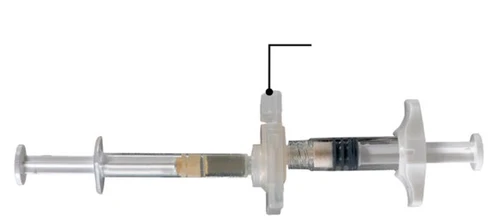
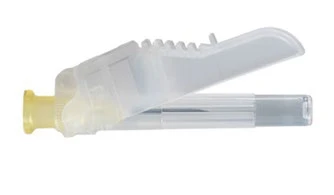
On a clean surface, open the tray by peeling off the foil starting from the corners to remove the contents. Remove the moisture-absorbing pouch. Take out the connected syringe system (Fig. 1.1) from the tray. Open the packaging containing the needle with safety shield (Fig. 1.2) by peeling off the paper part of the packaging.
Note: Syringe A and Syringe B should not yet be aligned in a straight line.
Fig. 1.1 Fig. 1.2
Contents of the tray: connected syringe system Under the tray: Needle with safety shield and adapter
Step 2
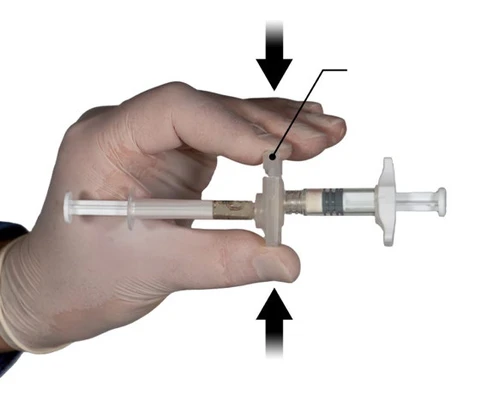
Using your finger and thumb, press the locking button on the connector (Fig. 2) until you hear and feel a click. The two syringes will become aligned in a straight line. Activating the connector does not require any specific positioning of the connected syringe system. Do not bend the connected syringe system (note that this may cause leakage, as the syringes may become partially unscrewed).
Step 3
Holding the syringes horizontally, transfer the liquid contents of Syringe A into the powder form of leuprorelin acetate in Syringe B. Mix thoroughly for 60 cycles by gently moving the contents back and forth between both syringes (one cycle consists of one push of the plunger of Syringe A and one push of the plunger of Syringe B), with the syringes held horizontally, until a uniform, viscous solution is obtained (Fig. 3). Do not bend the connected syringe system (note that this may cause leakage, as the syringes may become partially unscrewed).
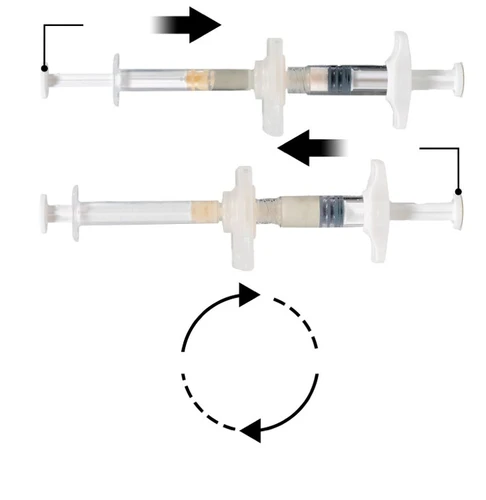
Repeat 60 times
After thorough mixing, the viscous solution should be colorless to white or light brown (shades ranging from white to pale yellow).
Important: Immediately proceed to the next step after mixing, as the viscosity of the product increases over time. Do not freeze the mixed product.
Note: The product must be mixed according to these instructions; shaking will NOT ensure proper mixing.
Step 4
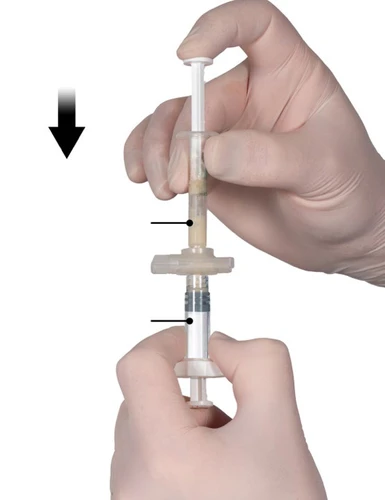
After mixing, hold the syringes vertically with Syringe B at the bottom. The syringes should remain properly connected. Transfer the entire mixed product into Syringe B (the short, wide syringe) by fully depressing the plunger of Syringe A while slightly pulling back the plunger of Syringe B (Fig. 4).
Fig. 4
Step 5
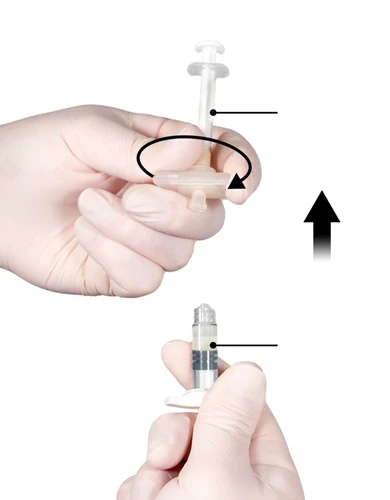
Ensure the plunger of Syringe A is fully depressed. Holding the connector, unscrew it from Syringe B. Syringe A will remain attached to the connector (Fig. 5). Make sure no leakage occurs, as otherwise the needle, once attached, will not be properly secured to the syringe.
Note: One large or several small air bubbles may remain in the mixture—this is normal.
Do NOT remove air bubbles from Syringe B at this stage, as this may result in loss of product!
Fig. 5
Step 6
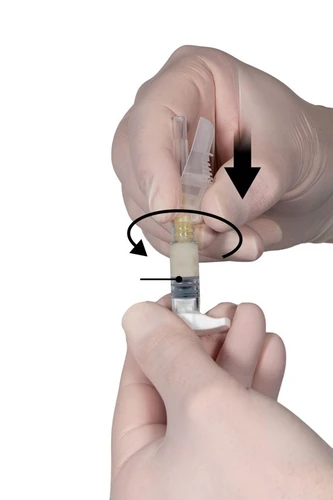
- Hold Syringe B vertically and hold the white plunger to prevent loss of product.
- Attach the needle with safety shield to Syringe B by holding the syringe and gently turning the needle approximately three-quarters of a turn clockwise until securely fastened (Fig. 6). Do NOT overtighten, as this may crack the needle hub and lead to leakage during injection. Excessive force when attaching the needle may also damage the safety shield.
If the needle hub is cracked or appears damaged, or if leakage is observed, do not administer the medicinal product. Do not replace or substitute the damaged needle, and do not inject the product. Dispose of all unused components safely.
If the needle hub is damaged, administer a new medicinal product kit.
Step 7
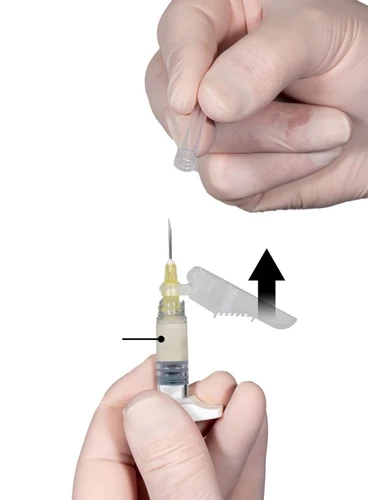
Bend back the safety shield away from the needle and remove the cap covering the needle tip immediately before administering the medicinal product (Fig. 7).
Important: Before administration, do not manipulate the needle safety shield mechanism. If the needle hub appears damaged or leakage is observed, DO NOT use the product. Do NOT replace the damaged needle with another one, and DO NOT administer the product. In case of damage to the needle hub, use a new Eligard medicinal product kit.
Fig. 7
Step 8
Before administering the medicinal product, remove all large air bubbles from Syringe B. Administer this product subcutaneously with the safety shield bent away from the needle.
Administration procedure: Fig. 8
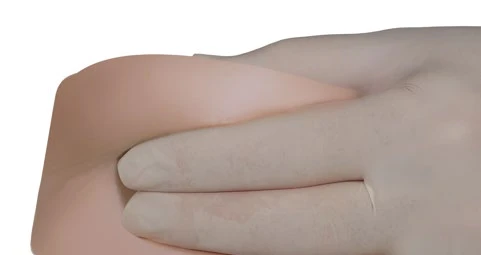
- Select an injection site that has not recently been used, on the abdomen, upper buttock area, or another location with sufficient subcutaneous tissue and free of discoloration, nodules, lesions, or hair.
- Clean the injection site with an alcohol swab (not included).
- Using your thumb and index finger, pinch and hold the skin at the injection site.
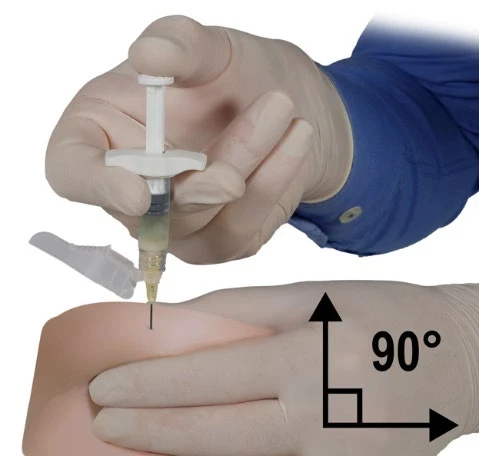
- With your dominant hand, quickly insert the needle at a 90° angle to the skin surface. The depth of penetration will depend on the amount and density of subcutaneous tissue and the needle length. Release the skin after needle insertion.
- Inject the product slowly and evenly by depressing the plunger until the syringe is completely empty. Before removing the needle, ensure that the entire content of Syringe B has been administered.
- While maintaining pressure on the plunger, quickly withdraw the needle at the same 90° angle used for insertion.
Step 9
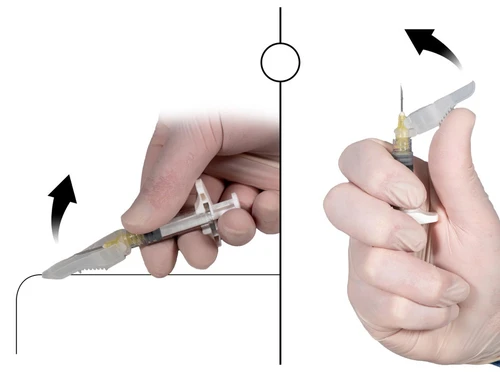
After administering the medicinal product, close the needle safety shield using one of the methods described below.
1. Closing on a flat surface
Press the safety shield, with the lever facing downward, against a flat surface (Fig. 9a) to cover the needle and lock the safety shield.
The shield is closed when a click is both heard and felt. In the closed position, the needle tip will be completely covered.
2. Closing with the thumb
Place your thumb on the safety shield (Fig. 9b), cover the needle tip, and close the safety shield.
The shield is closed when a click is both heard and felt. In the closed position, the needle tip will be completely covered.
Fig. 9a Fig. 9b
Closing on a flat surface Closing with the thumb
After closing the safety shield, immediately dispose of the needle and syringe into a sharps container.