Efudix
Poland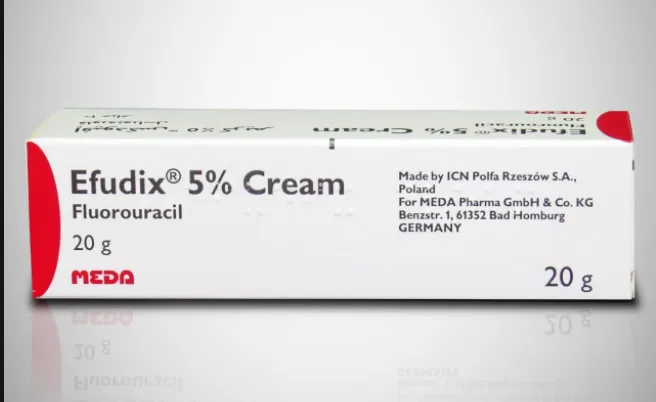
Table of Contents
Package leaflet: Information for the patient
Efudix, 50 mg/g, cream
Fluorouracilum
Please read the entire leaflet before using the medicine, as it contains important information
for the patient.
- Keep this leaflet, as you may need to read it again.
- If you have any questions, please consult your doctor or pharmacist.
- This medicine has been prescribed for a specific individual. Do not pass it on to others. The medicine may harm another person, even if their symptoms are the same.
- If you experience any adverse reactions, including any not listed in this leaflet, inform your doctor or pharmacist. See section 4.
Table of contents:
- What Efudix is and what it is used for
- Important information before using Efudix
- How to use Efudix
- Possible side effects
- How to store Efudix
- Contents of the pack and other information
1. What Efudix is and what it is used for
Efudix is a medicine belonging to the group of so-called antimetabolites, pyrimidine derivatives. It inhibits DNA and RNA synthesis, thereby suppressing cell division. This effect is most pronounced in rapidly dividing cells.
The onset of action of the medicine occurs after 2 to 3 days of use.
Application of the medicine to skin lesions usually causes erythema on their surface, followed by vesicle formation, then desquamation of the epidermis, development of erosion, and finally healing (re-epithelialization).
Efudix is used in the treatment of actinic and senile keratosis, solitary and multiple basal cell carcinoma of the skin located in areas difficult to treat surgically (surgical treatment is recommended whenever possible), Bowen's disease, and precancerous skin conditions.
2. Important information before using Efudix
When not to use Efudix
- if the patient has a known hypersensitivity (allergy) to fluorouracil or any of the other ingredients of Efudix,
- if the patient is taking any antiviral medicine belonging to the nucleoside group (these medicines are usually used to treat herpes infections),
- if the patient is pregnant or breastfeeding.
Warnings and precautions
Before starting treatment with Efudix, discuss this with your doctor or pharmacist.
If the patient has been diagnosed with a deficiency of dihydropyrimidine dehydrogenase (DPD)
(complete DPD deficiency).
If the patient is currently taking or has taken within the last 4 weeks any medication to treat herpes
infection – such medicines may increase the risk of adverse reactions associated with the use of
Efudix. Therefore, discuss this with your doctor before starting treatment with Efudix.
It is very important not to apply too much cream and to avoid applying it to open wounds or skin
with disrupted integrity, as this may lead to absorption of the drug into the bloodstream, which in
very rare cases may result in severe adverse effects.
If treatment of large skin areas is necessary – the total skin area treated with Efudix must not exceed
500 cm² (approx. 23 cm x 23 cm); larger areas should be treated gradually.
Avoid exposure to UV radiation (e.g. natural sunlight, sunbeds).
During treatment and for 1–2 months after its completion, photosensitivity reactions (adverse skin
reactions to sunlight) may occur. During this time, avoid prolonged sun exposure, wear protective
clothing and use sunscreen products.
Covering treated areas with bandages or dressings may intensify inflammatory skin reactions.
Efudix should only be used under medical supervision (among other reasons, because certain tests
may be required during treatment).
Due to the possibility of inflammatory reactions or ulceration, contact of the medicine with mucous
membranes or eyes must be avoided. Hands should be washed thoroughly after application.
Efudix with other medicines
Inform your doctor about all medicines currently or recently taken, as well as any medicines the
patient plans to take.
It is especially important to inform your doctor about the use of antiviral medicines belonging to
the nucleoside group (brivudine, sorivudine and similar medicines), as they may affect the action of
Efudix.
Efudix with food and drink
Efudix can be used regardless of meals.
Pregnancy, breastfeeding and fertility
If the patient is pregnant or breastfeeding, suspects she may be pregnant, or is planning to have a
child, she should consult her doctor before using this medicine.
Pregnancy
Efudix administered during pregnancy may harm the unborn child and is therefore contraindicated
during pregnancy. However, if a woman becomes pregnant during treatment, she should seek
genetic counselling.
Women of childbearing potential / Contraception in women and men
Women of childbearing potential must use an effective method of contraception during treatment
and for six months after completion of treatment.
Men must use an effective method of contraception and should avoid fathering a child during
treatment and for three months after its completion.
Breastfeeding
Do not use Efudix during breastfeeding. Because of the potential risk of serious adverse effects in
breastfed infants, a decision must be made whether to discontinue breastfeeding or to stop the
medicine.
Effect on fertility
Use of Efudix may adversely affect fertility in both women and men. Use of Efudix is not recommended
in men attempting to father a child.
Driving and operating machinery
It is unlikely that treatment with Efudix will have any effect on the ability to drive or operate
machinery.
Efudix contains cetyl alcohol, propylene glycol, methyl parahydroxybenzoate
and propyl parahydroxybenzoate
Efudix contains cetyl alcohol, which may cause local skin reactions (e.g. contact dermatitis).
Efudix contains 115 mg of propylene glycol (E 1520) in one gram of cream. Propylene glycol
(E 1520) may cause skin irritation.
Methyl parahydroxybenzoate (E 218) and propyl parahydroxybenzoate may cause allergic
reactions (delayed-type reactions possible).
3. How to use Efudix
This medicine should always be used exactly as directed by your doctor. If in doubt, consult your doctor.
This medicine is for topical use on the skin only.
The usual dose of Efudix is as follows:
Adults
Actinic (solar) keratosis and senile keratosis – apply the cream twice daily to affected skin areas in sufficient quantity to cover the lesions. Treatment should continue until the erosion stage is reached, at which point the medicine should be discontinued. The treatment period usually lasts from 2 to 4 weeks. Complete healing is usually achieved 1–2 months after stopping the medicine.
Basal cell carcinoma of the skin – apply the cream twice daily to affected skin areas in sufficient quantity to cover the lesions. Treatment should continue for at least 3–6 weeks, although in some cases treatment may need to last up to 10–12 weeks. As with other tumours, patients should remain under medical supervision until complete resolution is achieved.
Use in children
Not recommended.
Use in elderly patients
No dose adjustment is necessary.
Use of a higher than recommended dose of Efudix
There have been no reported cases of overdose with Efudix when applied to the skin.
However, if the medicine is accidentally ingested orally, overdose symptoms may occur, such as nausea, vomiting, diarrhoea, stomatitis, and blood cell abnormalities. In such cases, contact your doctor immediately. The doctor may, if necessary, initiate appropriate management aimed at preventing systemic infections, symptomatic treatment, and daily monitoring of white blood cell counts.
Missed dose of Efudix
If a dose is missed at the scheduled time, apply it as soon as possible. However, if the next dose is due soon, skip the missed dose. Do not apply a double dose to make up for a missed dose.
Stopping treatment with Efudix
Discontinuing treatment with Efudix will result in loss of the beneficial effects of the medicine in the conditions for which it is used.
If you have any further questions about the use of this medicine, consult your doctor or pharmacist.
4. Possible adverse reactions
Like all medicines, this medicine can cause adverse reactions, although not everyone will experience them.
If too much cream is used or if it is applied to an open wound, other adverse symptoms listed below may occur.
If any of the following adverse symptoms occur,
contact a doctor immediately:
- gastrointestinal disorders such as abdominal pain (including cramp-like abdominal pain), diarrhoea, vomiting,
- swelling and soreness of the tongue and oral cavity,
- fever and general malaise.
Very rare adverse reactions (may occur in fewer than 1 in 10,000 people):
Blood and lymphatic system disorders: abnormalities in blood test results related to systemic toxicity of the drug (pancytopenia, neutropenia, thrombocytopenia, leukocytosis).
Immune system disorders: hypersensitivity reactions (rash at the site of application).
Gastrointestinal disorders: haemorrhagic diarrhoea, diarrhoea, vomiting, abdominal pain, stomatitis (associated with systemic toxicity of the drug).
Skin and subcutaneous tissue disorders: erythema multiforme, skin pain, inflammatory or allergic skin reactions (e.g. urticaria, pruritus, skin rash (usually localised but may be generalised if associated with systemic toxicity)), redness and swelling of the skin, contact dermatitis, burning sensation, exudation, skin irritation, erythema, dark skin pigmentation, desquamation (exposure to sunlight or ultraviolet radiation may intensify skin irritation), skin ulceration, photoallergic reaction, blister-like skin eruptions, hair loss.
General disorders and administration site conditions: fever, chills, and mucositis associated with systemic toxicity of the drug.
Adverse reactions occurring with unknown frequency (frequency cannot be estimated from available data):
Nervous system disorders: taste disturbances, headache, dizziness.
Eye disorders: conjunctival irritation, keratitis, increased lacrimation.
Gastrointestinal disorders: nausea.
General disorders and administration site conditions: bleeding at the site of application.
Additionally, adverse reactions have been reported for which a causal relationship with topical application of Efudix has not been fully established:
Skin and subcutaneous tissue disorders: skin suppuration, telangiectasia, herpes simplex.
Blood and lymphatic system disorders: eosinophilia, appearance of toxic granulations in granulocytes.
Psychiatric disorders: insomnia, irritability.
Respiratory, thoracic and mediastinal disorders: irritation of nasal mucosa.
Reporting of adverse reactions
If any adverse reactions occur, including any adverse reactions not listed in the leaflet, inform a doctor, pharmacist, or nurse. Adverse reactions can be reported directly to the Department of Monitoring Adverse Drug Reactions at the Office for Registration of Medicinal Products, Medical Devices and Biocidal Products: Al. Jerozolimskie 181C, 02-222 Warsaw, tel.: 22 49-21-301, fax: 22 49-21-309, website: https://smz.ezdrowie.gov.pl
Adverse reactions can also be reported to the marketing authorisation holder.
Reporting adverse reactions helps to provide more information on the safety of the medicine.
5. How to store Efudix
Keep this medicine out of the sight and reach of children.
Store below 25°C.
Do not use this medicine after the expiry date stated on the cardboard box and on the tube after: EXP. The expiry date refers to the last day of the stated month.
Medicines should not be disposed of via wastewater or household waste. Ask your pharmacist how to dispose of medicines no longer required. These measures will help protect the environment.
6. Contents of the pack and other information
What Efudix contains
The active substance is fluorouracil. Each gram of the medicine contains 50 mg of fluorouracil.
The other ingredients are: white soft paraffin, stearyl alcohol, polysorbate 60, propylene glycol,
methyl parahydroxybenzoate, propyl parahydroxybenzoate, purified water. See also
"Efudix contains stearyl alcohol, propylene glycol, methyl parahydroxybenzoate,
and propyl parahydroxybenzoate" in section 2.
What Efudix looks like and contents of the pack
An aluminium tube with a PP cap and a latex ring, containing 20 g of cream, packed in a cardboard box.
Marketing Authorisation Holder:
Viatris Healthcare Sp. z o.o.
ul. Postępu 21B
02-676 Warsaw
Poland
Manufacturer:
ICN Polfa Rzeszów S.A.
ul. Przemysłowa 2
35-105 Rzeszów
Poland
For further information, contact the Marketing Authorisation Holder:
Viatris Healthcare Sp. z o.o.
tel. 22 546 64 00
[logo of the Marketing Authorisation Holder]