Efracea
Poland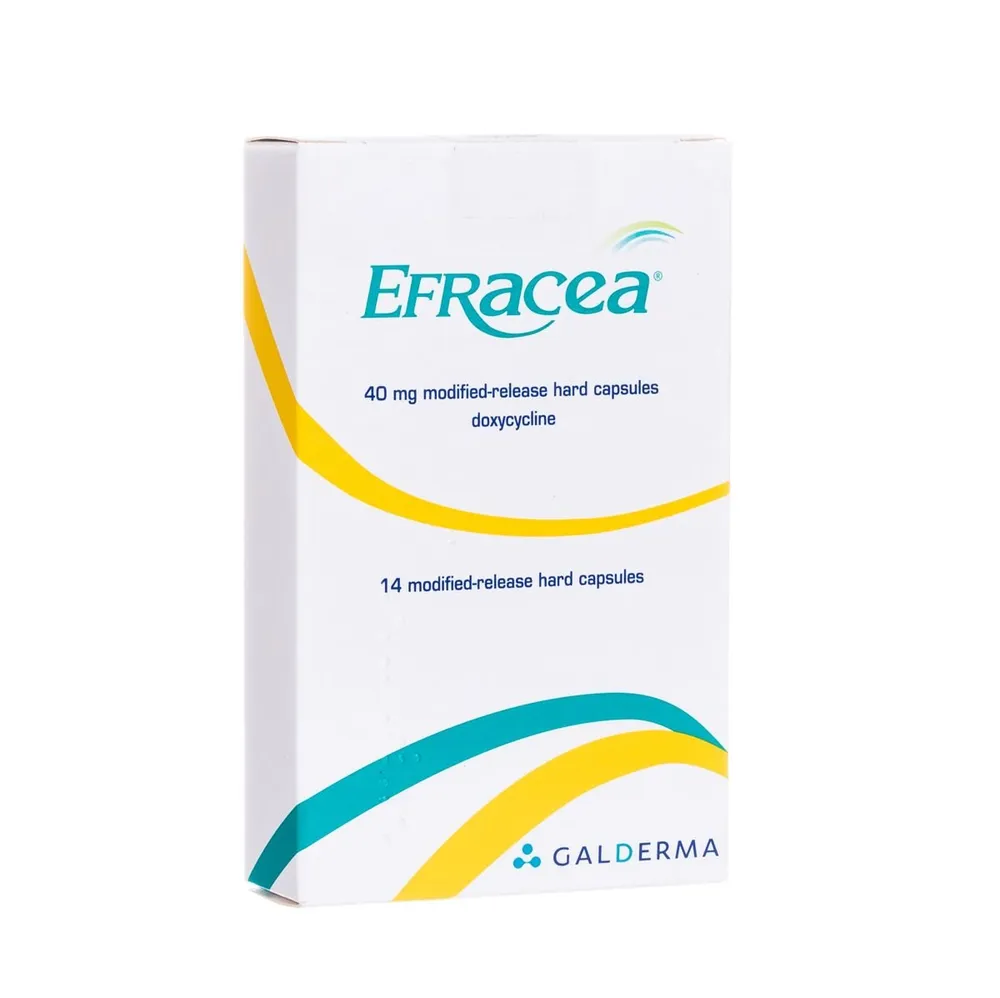
Table of Contents
Patient Information Leaflet
Caution! Keep this leaflet. The information on the immediate packaging is in a foreign language.
Efracea (Oracea), 40 mg, modified-release hard capsules
Doxycycline
Efracea and Oracea are different brand names for the same medicine.
Please read this leaflet carefully before taking this medicine, as it contains
important information for you.
- Keep this leaflet, as you may need to read it again.
- If you have any questions, please consult your doctor or pharmacist.
- This medicine has been prescribed for a specific individual. Do not pass it on to others. It may harm someone else, even if their symptoms are the same.
- If you experience any adverse effects, including any not listed in this leaflet, tell your doctor, pharmacist or nurse. See section 4.
Contents of this leaflet:
- What Efracea is and what it is used for
- Important information before taking Efracea
- How to take Efracea
- Possible side effects
- How to store Efracea
- Contents of the pack and other information
1. What Efracea is and what it is used for
Efracea is a medicine intended for use in adults to reduce papules (small solid bumps) or red pustules caused by a condition called rosacea.
2. Important information before using Efracea
When not to use Efracea
- If the patient is allergic (hypersensitive) to any tetracycline antibiotic, including doxycycline or minocycline, or to any of the other ingredients of Efracea (listed in section 6).
- If the patient is pregnant, she must not use Efracea from the 4th month of pregnancy onwards, as it may cause harm to the unborn child. If a patient suspects or confirms she is pregnant while taking Efracea, she should contact her doctor immediately.
- Concurrently with retinoids (medicines used in certain skin disorders such as severe acne), when administered orally (see section Efracea with other medicines).
- If the patient has absence of stomach acid (achlorhydria) or has undergone surgery on the upper part of the small intestine (called the duodenum).
Do not give Efracea to infants or children under 12 years of age, as it may cause permanent tooth discoloration or disturbances in tooth development.
Warnings and precautions
Efracea must not be used to treat infections caused by bacteria.
Page 1 of 6
Before starting treatment with Efracea, discuss this with your doctor. Inform your doctor if the patient has:
- liver disease,
- a tendency to fungal infections or has an existing oral or vaginal fungal (yeast) infection,
- a muscle disorder called myasthenia gravis,
- colitis,
- irritation or ulceration of the oesophagus,
- rosacea affecting the eye area,
- if the patient's skin is exposed to sunlight or sunbeds, inform the doctor, as people taking doxycycline may sunburn more easily. Consider using protective creams with UV filters or blockers to reduce the risk of sunburn, and discontinue Efracea if the skin becomes excessively sunburned,
- intolerance to certain sugars.
Efracea may cause permanent tooth discoloration.
Contact your doctor or pharmacist if during treatment:
- you experience severe or prolonged or bloody diarrhoea during or after treatment with Efracea. Contact your doctor immediately, as treatment may need to be discontinued. These symptoms may indicate inflammation of the bowel (pseudomembranous colitis), which may require antibiotic treatment.
Take the medicine exactly as prescribed by your doctor. Taking a higher dose than recommended by your doctor may increase the risk of developing bacterial resistance in the intestinal flora to Efracea.
Efracea with other medicines
Tell your doctor about all medicines the patient is currently taking or has recently taken, as well as any medicines the patient plans to take.
Efracea and certain other medicines may not work properly when taken together.
Inform your doctor about any medicines the patient is currently taking or intends to take concurrently with Efracea.
- Efracea must not be taken together with medicines containing isotretinoin, due to the risk of increased intracranial pressure. Isotretinoin is prescribed for severe cases of acne.
- Do not take antacids, multivitamin preparations, or other products containing calcium (such as milk and dairy products and calcium-fortified fruit juices), aluminium, magnesium (including antihypertensive drugs such as chinapril tablets), iron, bismuth, cholestyramine, activated charcoal, or sucralfate within 2 to 3 hours after taking Efracea. If these substances are taken simultaneously with Efracea, its effectiveness may be reduced.
- Other medicines used for peptic ulcer disease or heartburn may also reduce the effectiveness of Efracea and should not be taken less than 2 hours before taking Efracea.
- If the patient is taking anticoagulant medicines (blood thinners), the doctor may need to adjust the dose of such medicine.
- If the patient is taking certain antidiabetic medicines, the doctor may check whether a dosage adjustment is needed.
- Efracea may reduce the effectiveness of certain antibiotics, including penicillin.
- Taking barbiturates (sleeping pills or short-acting painkillers), rifampicin (used in tuberculosis), carbamazepine (used in epilepsy), diphenylhydantoin and phenytoin (used in epileptic seizures), primidone (an anticonvulsant), or cyclosporine (used after organ transplantation) may shorten the duration of action of Efracea in the patient's body.
Page 2 of 6
- Taking Efracea with methoxyflurane (a medicine used in general anaesthesia) may cause severe kidney damage.
Efracea with food and drink
The Efracea capsule should always be taken with a sufficient amount of water, as this reduces the risk of irritation or ulceration of the throat and oesophagus.
Do not consume milk or dairy products at the same time as Efracea, as they contain calcium, which may reduce the effectiveness of Efracea. Wait 2 to 3 hours after taking the daily dose of Efracea before consuming dairy products.
Pregnancy and breastfeeding
Do not use Efracea during pregnancy, as it may cause permanent tooth discoloration in the child.
Do not use Efracea long-term during breastfeeding, as it may cause tooth discoloration and slow down skeletal development in the breastfed infant.
If the patient is pregnant or breastfeeding, suspects she may be pregnant, or is planning to have a baby, she should consult her doctor or pharmacist before using this medicine.
Driving and using machines
Efracea has no effect or negligible effect on the ability to drive and operate machinery.
Efracea contains 102–150 mg of sucrose and 26.6–29.4 μg of Allura Red AC (E 129), lac dye per capsule.
If the patient has previously been diagnosed with intolerance to certain sugars, the patient should consult their doctor before taking this medicinal product.
The ink used to mark the capsules contains Allura Red AC (E 129), lac dye, which may cause allergic reactions.
3. How to take Efracea
This medicine should always be taken exactly as your doctor has told you. If you are not sure, consult your doctor or pharmacist.
The recommended dose is one Efracea capsule every morning, taken on an empty stomach or alternatively one hour before or two hours after a meal. Swallow the capsule whole, without chewing.
Take Efracea with a full glass of water, while sitting or standing, to avoid irritation of the throat.
Taking more Efracea than recommended
If you take more Efracea than you should, there is a risk of liver, kidney, and pancreas damage.
If you have taken more Efracea capsules than prescribed, contact your doctor immediately.
If you forget to take Efracea
Do not take a double dose to make up for a forgotten capsule.
Stopping Efracea
Continue taking Efracea for the length of time prescribed by your doctor.
If you have any further questions about the use of this medicine, consult your doctor or pharmacist.
Page 3 of 6
4. Possible adverse reactions
Like all medicines, this medicine can cause adverse reactions, although not everyone experiences them.
If any of the following adverse reactions occur, contact your doctor as soon as possible:
- Jarisch-Herxheimer reaction, causing fever, chills, headache, muscle pain and skin rash, which is usually self-limiting. This occurs shortly after starting doxycycline treatment for spirochetal infections, such as Lyme disease.
Common adverse reactions
The following adverse reactions occur commonly (in 1 to 10 out of 100 patients) during treatment with Efracea:
- Nasopharyngitis (inflammation of the nose and throat)
- Sinusitis
- Fungal infection
- Anxiety
- Sinus pain
- High or elevated blood pressure
- Diarrhoea
- Upper abdominal pain
- Dry mouth
- Back pain
- Pain
- Changes in results of certain blood tests (blood glucose or liver function tests).
Adverse reactions with unknown frequency (frequency cannot be estimated due to insufficient data). The following adverse reactions may occur during treatment with Efracea:
- Increased intracranial pressure
- Headache
Uncommon adverse reactions
The following adverse reactions occur uncommonly (in 1 to 10 out of 10,000 patients) during treatment with medicines in the same class as Efracea (tetracyclines):
- Systemic allergic (hypersensitivity) reactions*
- Changes in number or types of specific blood cells
- Increased pressure in the brain
- Inflammation of the membrane surrounding the heart (pericarditis)
- Nausea, vomiting, diarrhoea, loss of appetite
- Liver damage
- Skin rash or urticaria
- Abnormal skin reaction to sunlight
- Increased blood urea concentration
Rare adverse reactions
The following adverse reactions occur very rarely (less than 1 in 10,000 patients) during treatment with medicines in the same class as Efracea (tetracyclines):
- Allergic reactions causing swelling of the eyes, lips or tongue*
- Fungal infections in the anal and genital areas
- Breakdown of red blood cells (haemolytic anaemia)
- Brown-black microscopic discoloration of thyroid tissue has been reported with long-term use of tetracyclines. No changes in thyroid function have been observed.
- Increased intracranial pressure in infants
- Inflammation of the tongue
- Difficulty swallowing
- Enteritis (inflammation of the intestine)
- Inflammation or ulceration of the oesophagus
- Skin inflammation causing peeling
- Immune system impairment, known as systemic lupus erythematosus (SLE)
Adverse reactions with unknown frequency (frequency cannot be estimated from available data)
Adverse reactions that may occur during treatment with medicinal products belonging to the same class as Efracea (tetracyclines):
- Weakening of the connection between the nail and the nail bed following exposure to sunlight.
* Immediately inform your doctor if you notice adverse reactions such as swelling of the face, lips, tongue or throat, difficulty breathing, tingling or itching of the skin or eyes, rapid heartbeat (palpitations), or tendency to faint. These may be symptoms of a severe allergic (hypersensitivity) reaction.
Reporting of adverse reactions
If any adverse effects occur, including any not listed in this leaflet, inform your doctor, pharmacist or nurse. Adverse reactions can also be reported directly to the Department of Monitoring Adverse Drug Reactions, Office for Registration of Medicinal Products, Medical Devices and Biocidal Products
Al. Jerozolimskie 181 C, 02-222 Warsaw
Tel.: + 48 22 49 21 301
Fax: + 48 22 49 21 309
Website: https://smz.ezdrowie.gov.pl
Reporting adverse reactions helps to provide more information on the safety of this medicine.
5. How to store Efracea
Keep out of the sight and reach of children.
Do not use this medicine after the expiry date stated on the carton and blister.
The expiry date refers to the last day of the stated month.
Store in the original packaging to protect from light.
Medicines should not be disposed of via wastewater or household waste. Ask your pharmacist
how to dispose of medicines no longer required. This will help protect the environment.
6. Contents of the package and other information
What Efracea contains
Page 5 of 6
The active substance is doxycycline. Each capsule contains 40 mg of doxycycline (as doxycycline monohydrate).
The other ingredients are: hypromellose 2910, methacrylic acid-ethyl acrylate copolymer (1:1), triethyl citrate, talc, Opadry Beige YS-1-17274-A [containing: hypromellose 3cP, hypromellose 6cP, titanium dioxide (E 171), polyethylene glycol 400, yellow iron oxide (E 172), red iron oxide (E 172), polysorbate 80], sucrose, granules (corn starch, sucrose).
Capsule shell (Hard Gelatin Capsule no 2, beige Opaque) containing: black iron oxide (E 172), red iron oxide (E 172), yellow iron oxide (E 172), titanium dioxide (E 171), gelatin.
Printing ink containing: shellac, propylene glycol, black iron oxide, indigotine (E 132), lake, Allura red AC (E 129), lake, brilliant blue FCF (E 133), lake, quinoline yellow.
What Efracea looks like and contents of the pack
Modified-release hard capsules. Beige hard capsules, size no 2, marked “GLD 40”.
Efracea is available in packs containing 14, 28 or 56 capsules (not all pack sizes may be marketed).
For further information, contact the responsible party or parallel importer:
Marketing Authorisation Holder in Greece, country of export:
Galderma International, Tour Europlaza, 20 avenue André Prothin - La Défense 4, 92 927 Paris La Défense Cedex, France
Manufacturer:
Patheon France, 40 boulevard de Champaret, 38300 Bourgoin-Jallieu, France
Laboratoires Galderma, Zone Industrielle Montdésir, 74540 Alby sur Chéran, France
Parallel Importer:
Delfarma Sp. z o.o., ul. Św. Teresy od Dzieciątka Jezus 111, 91-222 Łódź
Repackaged by:
Delfarma Sp. z o.o., ul. Św. Teresy od Dzieciątka Jezus 111, 91-222 Łódź
Marketing Authorisation number in Greece, country of export: 109605/19-09-2019
Parallel Import Authorisation number: 374/25
This medicinal product is authorised in the Member States of the European Economic Area under the following names:
ORACEA 40 mg modified release hard capsules - DK, EL, ES, FI, IS, SE, NO
ORAYCEA 40 mg modified release hard capsules - AT, DE
EFRACEA 40 mg modified release hard capsules - BE, FR, IE, IT, LU, NL, PL, PT, UK
Page 6 of 6