Effox long 75
Poland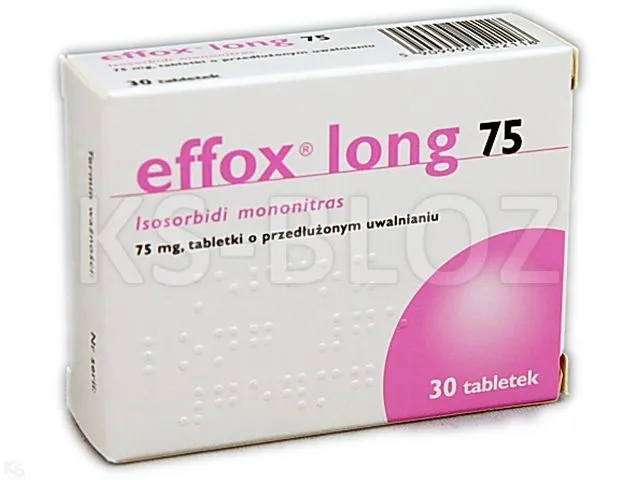
Table of Contents
Package leaflet: Information for the patient
Effox long 75,
75 mg, prolonged-release tablets
Isosorbide mononitrate
Please read the entire leaflet carefully before using this medicine, as it contains
important information for the patient.
- Keep this leaflet so that you can read it again if necessary.
- If you have any further questions, please consult your doctor or pharmacist.
- This medicine has been prescribed for a specific individual. Do not pass it on to others. It may harm someone else, even if their symptoms are the same.
- If you experience any adverse reactions, including any not listed in this leaflet, inform your doctor or pharmacist immediately. See section 4.
Table of contents
- What Effox long 75 is and what it is used for
- Important information before taking Effox long 75
- How to take Effox long 75
- Possible side effects
- How to store Effox long 75
- Contents of the pack and other information
1. What Effox long 75 is and what it is used for
Effox long 75 contains 75 mg of isosorbide mononitrate, which causes dilation of the coronary
vessels of the heart. It also dilates venous and arterial blood vessels. As a result, the heart's workload
is reduced, and consequently, the oxygen demand of the heart muscle decreases. Effox long 75 also
improves blood flow through the heart muscle, thereby reducing myocardial ischemia. As a result,
chest pain symptoms are alleviated.
Effox long 75 is used for the prevention of angina attacks (chest pain caused by restricted blood
flow to the heart muscle).
2. Important information before using Effox long 75
When not to take Effox long 75
- if the patient has:
- hypersensitivity to the active substance, to other nitrates, or to any of the other ingredients of this medicine (listed in section 6);
- cardiogenic shock (except in situations where appropriate management ensures sufficiently high diastolic pressure in the left ventricle of the heart);
- thickened heart muscle with narrowing of the outflow tract from the left ventricle (obstructive hypertrophic cardiomyopathy);
- constrictive pericarditis;
- accumulation of fluid between the heart and the membrane surrounding the heart (cardiac tamponade);
- acute circulatory failure (shock or vascular collapse);
- significant arterial hypotension (systolic blood pressure below 90 mm Hg);
- significantly reduced blood volume in the vessels (severe hypovolemia);
- reduced hemoglobin concentration, hematocrit, and reduced number of red blood cells (severe anemia);
- if the patient is taking a medicine containing riociguat, which is used to treat pulmonary arterial hypertension;
- if the patient is taking medicines belonging to the group of phosphodiesterase type 5 inhibitors, e.g. sildenafil, tadalafil, vardenafil.
During treatment with Effox long 75, phosphodiesterase type 5 inhibitors such as sildenafil, tadalafil, vardenafil must not be taken. Treatment with Effox long 75 must not be discontinued in order to take a medicine containing a phosphodiesterase type 5 inhibitor such as sildenafil, tadalafil, or vardenafil, as this may increase the risk of chest pain (see "Effox long 75 and other medicines").
Warnings and precautions
Before starting treatment with Effox long 75, discuss this with your doctor or pharmacist, even if the warnings below refer to conditions that occurred in the past.
Special caution is advised if the patient has:
- low ventricular filling pressure, e.g. in acute myocardial infarction or impaired left ventricular function (left ventricular failure). Systolic blood pressure below 90 mm Hg should be avoided;
- heart valve stenosis (aortic and/or mitral valve stenosis);
- increased intracranial pressure;
- orthostatic hypotension (low blood pressure associated with rapid change to standing position or prolonged standing);
- lung disease, pulmonary hypertension, or ischemic heart disease. This medicine may cause increased blood flow through lung areas receiving reduced oxygen (hypoxemia);
- lactose intolerance, because this medicine contains lactose (see section "Effox long 75 contains lactose").
It has been shown that organic nitrates may lose their effect or become less effective if administered for prolonged periods at high doses. To avoid this, dosage recommendations must be strictly followed.
Effox long 75 should not be used to terminate an ongoing episode of chest pain (angina attack), due to insufficiently rapid onset of action.
Insoluble remnants of this medicine may be excreted in the stool in undissolved form.
In patients with delayed gastrointestinal transit, reduced release of the active substance from this medicine may occur.
Children and adolescents
The safety and efficacy of this medicine in children and adolescents have not been established.
Effox long 75 and other medicines
Inform your doctor about all medicines currently used, recently taken, or planned to be used, such as:
- medicines that lower blood pressure, such as vasodilators (e.g. prazosin), beta-blockers (e.g. propranolol), calcium antagonists (e.g. verapamil), angiotensin-converting enzyme inhibitors (e.g. captopril), monoamine oxidase inhibitors, and similar medicines;
- neuroleptics (e.g. chlorpromazine) used to treat psychiatric disorders;
- tricyclic antidepressants (e.g. amitriptyline) used to treat depression;
- dihydroergotamine (used to treat migraine), whose use with this medicine may lead to increased blood concentration and enhanced effects;
- sapropterin used in the treatment of phenylketonuria.
Do not take this medicine with phosphodiesterase type 5 inhibitors such as sildenafil, tadalafil, or vardenafil, used to treat erectile dysfunction. Concomitant use of Effox long 75 with these medicines may cause blood pressure to drop to dangerously low levels. Do not discontinue this medicine in order to take phosphodiesterase type 5 inhibitors, as this may increase the risk of chest pain.
During treatment with Effox long 75, medicines containing riociguat, used to treat pulmonary arterial hypertension, must not be taken.
Taking Effox long 75 with food, drink, and alcohol
During treatment with Effox long 75, alcohol consumption should be avoided, as it may enhance the blood pressure-lowering effect of this medicine.
Pregnancy, breastfeeding, and fertility
If the patient is pregnant, breastfeeding, suspects she may be pregnant, or plans to become pregnant, she should consult her doctor before using this medicine.
This medicine may be used during pregnancy only if clearly necessary, when benefit to the mother outweighs potential risk to the fetus, and only under medical supervision.
This medicine may be used during breastfeeding only if clearly necessary and under explicit instruction from a physician. Data indicate that nitrates pass into breast milk and may cause changes in red blood cells (methemoglobinemia) in infants. The extent of nitrate excretion into human breast milk has not been established.
There are no data on the effect of Effox long 75 on fertility in humans.
Driving and operating machinery
Effox long 75 may impair the ability to drive and operate machinery. This effect may be intensified when combined with alcohol.
Effox long 75 contains lactose
If the patient has previously been diagnosed with intolerance to certain sugars, the patient should consult a doctor before taking this medicine.
3. How to use Effox long 75
This medicine should always be used exactly as prescribed by the doctor. If in doubt, consult your
doctor.
The doctor will determine the dose individually for each patient, depending on the patient's clinical
response.
Treatment should be initiated with low doses, which should then be gradually increased until the
desired therapeutic effect is achieved. The lowest effective dose should be used.
The usual dose is 1 tablet once daily (75 mg of isosorbide mononitrate per day).
Tablets should be swallowed whole, without chewing, with water.
The break line on the tablet is not intended for dividing the tablet.
Effox long 75 should be taken regularly every day at the same time, as determined by the doctor.
Your doctor will advise how long you should take Effox long 75. Do not stop treatment suddenly,
as this may increase the risk of angina attacks.
If it becomes necessary to discontinue treatment, your doctor will recommend gradually reducing
the dose over a period of several days.
If you feel that the effect of this medicine is too strong or too weak, consult your doctor.
Elderly patients
Dose adjustment is not required in elderly patients.
Use in children and adolescents
The safety and efficacy of Effox long 75 in children and adolescents have not been established.
Use of a higher than recommended dose of Effox long 75
If a higher than recommended dose of Effox long 75 is taken, contact your doctor or pharmacist
immediately.
Overdose may cause: excessive lowering of arterial blood pressure (systolic pressure below
90 mm Hg), pallor, excessive sweating, bradycardia, tachycardia, dizziness upon postural change,
headache, weakness, dizziness, nausea, vomiting, and diarrhea.
Taking too high a dose of this medicine may cause methemoglobinemia, leading to bluish
discoloration of the skin, which may be accompanied by rapid breathing, restlessness, loss of
consciousness, and cardiac arrest. This is a possible reaction to Effox long 75 and similar medicines,
due to their metabolic pathway upon absorption into the body.
Very high doses of the medicine may increase intracranial pressure, potentially leading to
neurological symptoms.
If overdose is detected early, the doctor may induce vomiting and (or) perform gastric lavage and
administer activated charcoal – provided that no more than one hour has passed since ingestion of
the medicine. In cases where overdose is detected later, treatment consists of maintaining blood
pressure with intravenous fluids and applying specialized shock treatment (in an intensive care
unit), if necessary. In severe cases, mechanical ventilation to support breathing or dialysis to support
kidney function may be required.
Missed dose of Effox long 75
Do not take a double dose to make up for a missed dose.
Stopping treatment with Effox long 75
If treatment is discontinued, there may be an increased risk of angina attacks. If discontinuation of
treatment is necessary, your doctor will recommend gradually reducing the dose over a period of
several days.
If you have any further doubts about using this medicine, consult your doctor or pharmacist.
4. Possible adverse effects
Like all medicines, this medicine can cause adverse effects, although not everyone will experience them.
The following adverse effects have been observed during treatment with this medicine:
Very common (may occur in at least 1 in 10 people):
- headache
Common (may occur in less than 1 in 10 people):
- dizziness (including dizziness related to change in body position)
- drowsiness
- increased heart rate
- low blood pressure related to change in body position
- feeling of weakness
Uncommon (may occur in less than 1 in 100 people):
- worsening of chest pain
- vascular collapse (sometimes with slowed heart rate and loss of consciousness)
- nausea
- vomiting
- skin allergic reactions (e.g. rash)
- sudden flushing of the face with sensation of warmth
Rare (may occur in less than 1 in 10,000 people):
- heartburn
Frequency not known (cannot be estimated from available data):
- low blood pressure
- exfoliative dermatitis
- angioedema – swelling of the skin and mucous membranes which may cause breathing and swallowing difficulties
During treatment with organic nitrates, marked reduction in blood pressure has been reported, accompanied by nausea, vomiting, restlessness, pallor and excessive sweating.
During treatment with this medicine, transient reduction in blood oxygen levels and reduced blood flow to the heart may occur, resulting in insufficient oxygen supply to the heart.
This may lead, especially in patients with coronary artery disease, to myocardial hypoxia.
The occurrence of some of these adverse effects may require immediate medical attention and hospital treatment.
Reporting of adverse effects
If any adverse effects occur, including any not listed in this leaflet, inform your doctor, pharmacist, or nurse. Adverse effects can be reported directly to the Department for Monitoring Adverse Drug Reactions of the Office for Registration of Medicinal Products, Medical Devices and Biocidal Products, Al. Jerozolimskie 181C, 02-222 Warsaw, tel.: +48 22 4921301, fax: +48 22 4921309, website: https://smz.ezdrowie.gov.pl
Adverse effects can also be reported to the marketing authorization holder.
Reporting of adverse effects helps to provide more information on the safety of this medicine.
5. How to store Effox long 75
Keep this medicine out of sight and reach of children.
Store below 25°C.
Do not use this medicine after the expiry date stated on the packaging. The expiry date refers to the last day of the stated month.
Medicines must not be disposed of via wastewater or household waste. Ask your pharmacist how to dispose of medicines no longer required. Such measures help protect the environment.
6. Contents of the pack and other information
What Effox long 75 contains
- The active substance is isosorbide mononitrate. One prolonged-release tablet contains 75 mg of isosorbide mononitrate.
- The other ingredients are: monohydrate lactose, talc, colloidal anhydrous silica, microcrystalline cellulose, magnesium stearate, polyvinylpyrrolidone, glyceryl distearate, hypromellose, calcium hydrogen phosphate dihydrate.
What Effox long 75 looks like and contents of the pack
Effox long 75 is a white, elongated, biconvex tablet. The upper surface has a full-score line across the tablet and an engraving "EL" on one side and "75" on the other side of the score. The lower surface is smooth with a full-score line across the tablet.
The dividing score line is not intended for splitting the prolonged-release tablet into halves.
The pack contains 30, 60 or 100 tablets.
Marketing Authorisation Holder and Manufacturer
Marketing Authorisation Holder
Merus Labs Luxco II S.à.r.l.
208, Val des Bons Malades
L-2121 Luxembourg
Luxembourg
Manufacturer
Astrea Fontaine
Rue des Prés Potets
21121 Fontaine Les Dijon
France