Efferalgan forte
Poland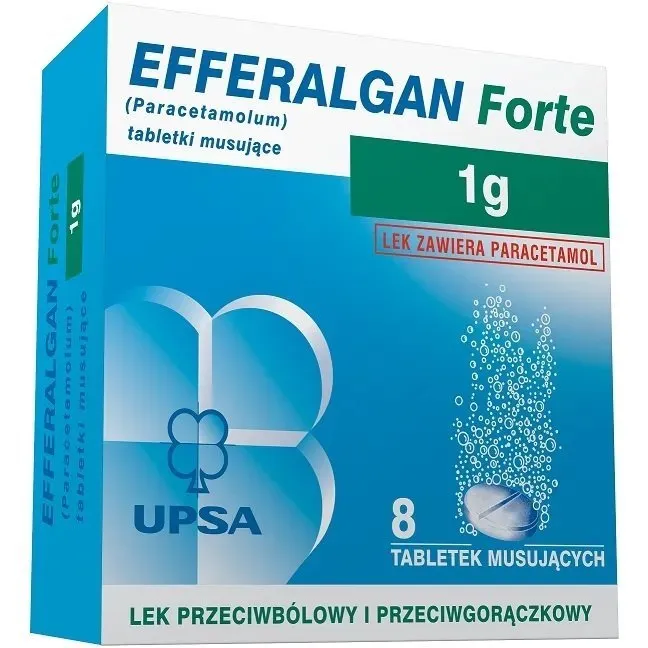
Table of Contents
Package leaflet: Information for the patient
Warning! Keep this leaflet! The information on the immediate packaging is in a foreign language.
Efferalgan Forte (Efferalgan 1 g), 1 g, effervescent tablets
Paracetamolum
Efferalgan Forte and Efferalgan 1 g are different trade names for the same medicine.
Please read this leaflet carefully before using the medicine, as it contains
important information for the patient.
This medicine should always be taken exactly as described in this patient leaflet or as directed by
your doctor, pharmacist, or nurse.
- Keep this leaflet so that you can read it again if necessary.
- If you need advice or further information, please consult your pharmacist.
- If you experience any adverse reactions, including any not listed in this leaflet, inform your doctor, pharmacist, or nurse. See section 4.
- If in adults pain persists beyond 5 days or fever beyond 3 days, and in adolescents if pain or fever persists beyond 3 days, or if the patient feels worse, consult a doctor.
Table of contents:
- What Efferalgan Forte is and what it is used for
- Important information before taking Efferalgan Forte
- How to take Efferalgan Forte
- Possible side effects
- How to store Efferalgan Forte
- Contents of the pack and other information
1. What Efferalgan Forte is and what it is used for
Efferalgan Forte is a medicine with analgesic and antipyretic properties. It reduces elevated body temperature. Paracetamol irritates the gastric mucosa to a lesser extent than salicylates.
Indications:
- Pain of various origins (headaches, toothaches, joint and muscle pain, menstrual pain, neuralgia, and others).
- Fever. This medicine is intended for use in adults and adolescents with body weight above 50 kg (aged over 15 years).
2. Important information before using Efferalgan Forte
When not to use Efferalgan Forte:
- if the patient is allergic to paracetamol, propacetamol hydrochloride (a paracetamol precursor), or any of the other ingredients of this medicine (listed in section 6),
- in individuals with body weight below 50 kg,
- in women during the first trimester of pregnancy,
- in patients with severe hepatic insufficiency or active, uncompensated liver disease,
- in patients with glucose-6-phosphate dehydrogenase deficiency,
- in patients being treated with MAO inhibitors (medicines used e.g. for depression) and within 14 days after discontinuation of such treatment.
Warnings and precautions
Before starting to use Efferalgan Forte, consult your doctor, pharmacist, or nurse.
Due to the content of 1 g paracetamol per effervescent tablet, Efferalgan Forte must not be used in children and adolescents under 15 years of age.
Efferalgan Forte contains paracetamol. When using this medicine, take into account any other medicines containing paracetamol (including those available by prescription or over-the-counter) to avoid exceeding the recommended daily dose (see section 3).
Do not exceed the recommended doses. Taking higher than recommended doses may result in severe liver damage. Symptoms of liver damage usually appear one to two days after paracetamol overdose, with maximum severity typically occurring around days 3–4.
Paracetamol may cause severe skin reactions (see section 4), such as acute generalized exanthematous pustulosis, Stevens-Johnson syndrome, and toxic epidermal necrolysis, which may be fatal. Inform your doctor if any skin reaction occurs and discontinue use of the medicine if a skin rash or any other sign of hypersensitivity appears.
Consult your doctor before using Efferalgan Forte if the patient has any of the following conditions:
- liver function disorders, including Gilbert’s syndrome (familial hyperbilirubinemia),
- kidney function disorders (see section 3),
- alcohol-related disease,
- anorexia, bulimia, or cachexia,
- chronic malnutrition (low hepatic glutathione reserves),
- dehydration,
- hypovolemia (reduced circulating blood volume).
Do not consume alcohol during treatment, nor take medicines containing alcohol.
Prolonged use (over 3 months) of painkillers in patients with chronic headache, taken on alternate days or more frequently, may lead to development or worsening of headache. Medication-overuse headache (MOH) should not be treated by increasing the dose. In such cases, in consultation with a doctor, painkillers should be discontinued.
Efferalgan Forte and other medicines
Inform your doctor or pharmacist about all medicines currently used, recently used, or planned to be used.
Concurrent use of Efferalgan Forte may alter the effect of the following medicines, or the use of the following medicines may alter the effect of Efferalgan Forte:
- MAO inhibitors – concomitant use with MAO inhibitors is contraindicated, as well as within 2 weeks after discontinuation of treatment with these medicines, due to the risk of excitation and high fever.
- Medicines containing salicylamide (analgesic, also used in fever) – concurrent use prolongs paracetamol elimination.
- Medicines increasing hepatic metabolism – concurrent use of paracetamol with medicines such as St. John’s wort, antiepileptic drugs, barbiturates (mainly used in epilepsy), and rifampicin (used in tuberculosis) may lead to liver damage, even when recommended doses of paracetamol are used (see “Use of higher than recommended dose of Efferalgan Forte” in section 3). Exercise caution during concomitant use.
- Isoniazid (used in tuberculosis) and zidovudine (antiviral medicine used in HIV infection) – exercise caution when used concomitantly.
- Non-steroidal anti-inflammatory drugs (NSAIDs) – concurrent use increases the risk of kidney function disorders.
- Oral anticoagulants – concomitant use of paracetamol with anticoagulants of the coumarin group, including warfarin, may lead to slight changes in INR values. In such cases, the doctor will increase the frequency of INR monitoring during concomitant use and for one week after discontinuation of paracetamol.
- Phenytoin (used in epilepsy) – concurrent use may reduce paracetamol efficacy and increase the risk of hepatotoxicity. During phenytoin treatment, avoid high and/or long-term use of paracetamol. Patients should be closely monitored for signs of liver damage.
- Probenecid (used in gout) – reduces paracetamol excretion. During concomitant use, the doctor may consider reducing the paracetamol dose.
- Flucloxacillin – exercise caution when using flucloxacillin concomitantly with paracetamol due to increased risk of developing blood and body fluid disorders (metabolic acidosis with high anion gap), especially in patients with risk factors for glutathione deficiency such as severe kidney dysfunction, sepsis, malnutrition, and chronic alcoholism. Metabolic acidosis with high anion gap is a serious condition requiring urgent treatment.
Inform your doctor that you are taking this medicine if your doctor orders tests for blood uric acid or blood glucose levels.
Use of Efferalgan Forte with alcohol
Do not consume alcohol or take medicines containing alcohol during treatment, due to increased risk of toxic liver damage.
Pregnancy, breastfeeding, and fertility
If the patient is pregnant, breastfeeding, suspects she may be pregnant, or is planning to have a child, she should consult her doctor before using this medicine.
Efferalgan Forte may be given to pregnant women if necessary. The lowest effective dose should be used for the shortest possible duration and as infrequently as possible to relieve pain or reduce fever.
Paracetamol may be used during breastfeeding only with a doctor’s approval and in individual cases. Exercise caution when using this medicine during lactation.
If pain is not relieved or fever does not subside, or if increased frequency of dosing is required, consult a doctor.
There are insufficient available data to demonstrate any effect of paracetamol on fertility.
Driving and operating machinery
Efferalgan Forte does not affect psychomotor performance. There are no contraindications to driving vehicles or operating machinery.
Efferalgan Forte contains sodium, sorbitol (E 420), and sodium benzoate (E 211)
Each effervescent tablet contains 567 mg of sodium (main component of table salt), equivalent to 28% of the maximum recommended daily dietary sodium intake for adults. Patients, especially those monitoring dietary sodium intake, who take 1 or more effervescent tablets daily over a long period, should consult their doctor or pharmacist.
Each effervescent tablet contains 252 mg of sorbitol (E 420). Sorbitol (E 420) is a source of fructose. If the patient (or their child) has previously been diagnosed with intolerance to certain sugars or hereditary fructose intolerance (a rare genetic disorder in which the patient’s body cannot break down fructose), the patient should consult a doctor before taking the medicine or giving it to the child.
Sorbitol (E 420) may cause gastrointestinal discomfort and may have a mild laxative effect.
Efferalgan Forte contains 120 mg of sodium benzoate (E 211), which may increase the risk of jaundice (yellowing of the skin and whites of the eyes) in newborns (up to 4 weeks of age) whose mothers used this medicine during pregnancy.
3. How to use Efferalgan Forte
This medicine should always be taken exactly as described in this patient information leaflet or as directed by a doctor, pharmacist, or nurse. If in doubt, consult a doctor, pharmacist, or nurse.
The dose is based on the patient's body weight. The recommended single dose of paracetamol is 10 to 15 mg/kg body weight (b.w.) every 4 to 6 hours, up to a maximum daily dose of 75 mg/kg b.w.
The total daily dose of paracetamol must not exceed 4 g.
Recommended dose:
Adults and adolescents with body weight above 50 kg (aged over 15 years)
The recommended single dose of Efferalgan Forte is 1 effervescent tablet (1 g paracetamol) every 4 to 6 hours, up to 3 times daily, for a total of no more than 3 effervescent tablets (3 g paracetamol). However, in cases of severe pain, the dose may be increased to the maximum daily dose of 4 g paracetamol (4 effervescent tablets). There must always be at least a 4-hour interval between doses.
Elderly patients
Dose adjustment is not necessary.
Patients with renal impairment
In patients with impaired renal function, the recommended single dose is 500 mg, and the minimum interval between doses should follow the scheme below:
| Creatinine clearance | Interval between doses | |----------------------|-----------------------| | CrCl ≥ 50 ml/min | 4 hours | | CrCl 10–50 ml/min | 6 hours | | CrCl < 10 ml/min | 8 hours |
Efferalgan Forte should not be used in patients with renal impairment because reduced doses are required. Efferalgan 500 mg effervescent tablets are available for such patients.
Patients with hepatic impairment
In patients with impaired liver function, the dose should be reduced or the dosing intervals extended. In the following situations, the maximum daily dose should not exceed 60 mg/kg b.w./day (and should not exceed 2 g/day):
- in patients with body weight below 50 kg,
- chronic or compensated active liver disease, especially mild to moderate liver failure,
- Gilbert’s syndrome (familial non-haemolytic hyperbilirubinaemia),
- chronic alcohol-related disease,
- chronic malnutrition (low hepatic glutathione reserves),
- dehydration.
Method of administration
Oral use.
The effervescent tablet should be dissolved in a glass of water and the resulting solution drunk. Do not chew or swallow the tablets whole.
Frequency of administration
To prevent recurrent episodes of pain or fever, the interval between doses should be 6 hours and must in no case be shorter than 4 hours.
Duration of treatment
In adults, do not use this medicine for longer than 5 days for pain or 3 days for fever, unless advised by a doctor. In adolescents, do not use this medicine for longer than 3 days.
Use of a higher than recommended dose of Efferalgan Forte
If an overdose is taken or Efferalgan Forte is taken by mistake, contact a doctor immediately for appropriate advice.
Overdose is particularly dangerous in elderly individuals, young children, chronically malnourished patients, those with alcohol-related disease, liver disorders, and patients taking medicines that induce liver enzymes, as these patients have an increased risk of liver damage.
An overdose may cause symptoms within a few to several hours, such as: nausea, vomiting, loss of appetite, pallor, excessive sweating, drowsiness, and general weakness. These symptoms may subside the next day, even though liver damage may have started developing, manifesting as upper abdominal discomfort, recurrence of nausea, and jaundice.
In any case where this medicine is taken in a single dose of 5 g paracetamol or more, induce vomiting if less than one hour has passed since ingestion, and contact a doctor immediately. Administration of 60–100 g of activated charcoal orally is recommended, preferably mixed with water.
Seek immediate medical advice.
Rare cases of acute pancreatitis have been observed.
Missed dose of Efferalgan Forte
Do not take a double dose to make up for a missed dose.
If you have any further questions about the use of this medicine, consult your doctor, pharmacist, or nurse.
4. Possible adverse reactions
Like all medicines, this medicine can cause adverse reactions, although not everyone experiences them.
The frequency of occurrence of the adverse reactions listed below is defined as follows:
rare: in less than 1 in 1,000 but more than 1 in 10,000 patients treated,
very rare: in less than 1 in 10,000 patients treated,
unknown: frequency cannot be estimated from the available data.
Rare: decreased blood pressure.
Very rare: tachycardia, nausea, vomiting, renal colic, renal papillary necrosis, acute renal failure.
Unknown: anaphylactic reaction (including hypotension), anaphylactic shock, hypersensitivity reactions, angioedema (swelling of deep layers of skin and subcutaneous tissue); diarrhoea, abdominal pain; increased hepatic aminotransferase activity; thrombocytopenia (reduced platelet count), leukopenia (reduced white blood cell count), neutropenia (reduced neutrophil count – a type of white blood cell); rash, erythema, urticaria, purpura, generalized acute pustular eruption, toxic epidermal necrolysis, Stevens-Johnson syndrome.
Very rare cases of hypersensitivity reactions requiring discontinuation of treatment have been reported (skin redness, dyspnoea, bronchospasm, excessive sweating).
Reporting of adverse reactions
If any adverse reactions occur, including any adverse reactions not listed in this leaflet, inform your doctor, pharmacist, or nurse. Adverse reactions can be reported directly to the Department of Monitoring of Adverse Drug Reactions, Office for Registration of Medicinal Products, Medical Devices and Biocidal Products, Al. Jerozolimskie 181C, 02-222 Warsaw, tel.: +48 22 49 21 301, fax: +48 22 49 21 309, website: https://smz.ezdrowie.gov.pl .
Reporting adverse reactions enables the collection of further information on the safety of the medicine.
5. How to store Efferalgan Forte
Keep this medicine out of sight and reach of children.
There are no special storage instructions for this medicine.
Do not use this medicine after the expiry date stated on the packaging.
The expiry date refers to the last day of the stated month.
Medicines must not be disposed of via wastewater or household waste. Ask your pharmacist how to dispose of medicines you no longer use. This will help protect the environment.
6. Contents of the packaging and other information
What Efferalgan Forte contains
- The active substance is paracetamol. Each effervescent tablet contains 1 g of paracetamol.
- Other ingredients are: citric acid, sodium hydrogen carbonate, sodium carbonate, sorbitol (E 420), sodium lauryl sulfate, povidone, sodium saccharin, sodium benzoate (E 211).
What Efferalgan Forte looks like and contents of the pack
Effervescent tablet.
Pack: Soft Al/PE blisters containing 8 effervescent tablets, in a cardboard box.
For further information, please contact the responsible entity or the parallel importer.
Marketing Authorisation Holder in Spain, the country of export:
UPSA SAS
3 rue Joseph Monier
92500 Rueil-Malmaison
France
Manufacturer:
UPSA
979, Avenue des Pyrénées
47520 Le Passage, France
UPSA
304, Av. Dr. Jean Bru
47000 Agen, France
Parallel importer:
InPharm Sp. z o.o.
ul. Strumykowa 28/11
03-138 Warsaw
Repackaged in:
InPharm Sp. z o.o. Services sp. k.
ul. Chełmżyńska 249
04-458 Warsaw
Spanish Marketing Authorisation Number (country of export): 933416.10
Parallel Import Licence Number: 67/24