Edronax
Poland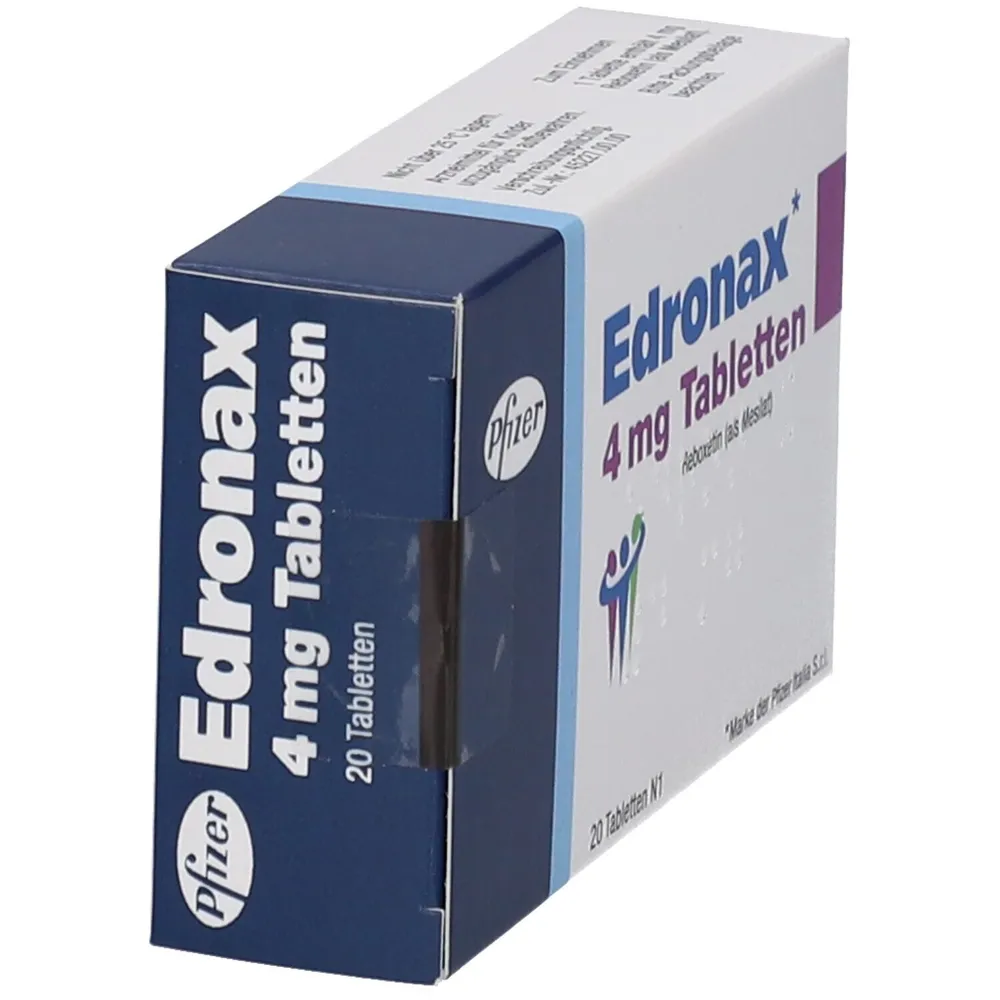
Table of Contents
Package leaflet: Information for the user
EDRONAX, 4 mg, tablets
Reboxetine
Please read the entire leaflet carefully before using the medicine, as it contains
important information for the patient.
- Keep this leaflet, as you may need to read it again.
- If you have any questions, please consult your doctor or pharmacist.
- This medicine has been prescribed for a specific individual. Do not pass it on to others. The medicine may harm someone else, even if their symptoms are the same.
- If you experience any adverse reactions, including any not listed in this leaflet, inform your doctor or pharmacist. See section 4.
Leaflet contents
- What Edronax is and what it is used for
- Important information before taking Edronax
- How to take Edronax
- Possible side effects
- How to store Edronax
- Contents of the pack and other information
1. What Edronax is and what it is used for
Edronax is indicated for the acute treatment of depression (including its severe forms) and for
maintenance treatment in patients who have responded well to initial therapy.
Many chemical substances in the brain affect mood. Noradrenaline is one of these substances.
In people with depression, noradrenaline levels are low. Edronax contains reboxetine, which belongs
to a group of medicines called selective noradrenaline reuptake inhibitors. Edronax enhances the action
of noradrenaline in the central nervous system, thereby reducing symptoms caused by its deficiency.
It alleviates depressive symptoms, improves mood, and reduces fatigue and anxiety.
Despite improvement, which usually occurs after several weeks, do not discontinue Edronax therapy
without consulting your doctor. This will reduce the risk of symptom relapse.
2. Important information before using Edronax
When not to use Edronax
- if the patient is allergic to the active substance or to any of the other ingredients of this medicine (listed in section 6).
Warnings and precautions
Inform your doctor if any of the following situations apply, as a dose adjustment or alternative treatment may be necessary:
- kidney or liver disease;
- seizures (epilepsy);
- glaucoma or increased intraocular pressure;
- difficulty in passing urine, with or without enlargement of the prostate gland;
- low blood pressure;
- cardiovascular disorders, e.g. hypertension, previous myocardial infarction;
- use of antidepressants known as "monoamine oxidase inhibitors" (MAOIs), or use of MAOIs within the last 2 weeks. Your doctor may advise discontinuation of MAOIs at least 2 weeks before starting treatment with Edronax.
Serotonin syndrome
Serotonin syndrome is a potentially life-threatening condition that may occur during treatment with Edronax, either as monotherapy or in combination with other medicines (see section 2 "Edronax with other medicines"). Symptoms of serotonin syndrome may include: confusion, agitation, hallucinations, coma, rapid heartbeat, elevated body temperature, rapid changes in blood pressure, sweating, hot flushes, tremor, hyperreflexia, nausea, vomiting, and diarrhoea.
If the patient experiences symptoms of serotonin syndrome, seek immediate medical attention or go to the emergency department of the nearest hospital.
Suicidal thoughts and worsening of depression or anxiety symptoms
Patients with depression and (or) anxiety disorders may sometimes experience thoughts of self-harm or suicide. These thoughts may worsen at the beginning of antidepressant treatment, as the therapeutic effect usually becomes apparent only after approximately two weeks, or sometimes later.
Such thoughts are more likely to occur:
- in patients who have previously experienced thoughts of self-harm or suicide;
- in younger patients. Clinical studies have shown that the risk of suicidal behaviour is higher in psychiatric patients under 25 years of age who are treated with antidepressants. If the patient experiences thoughts of self-harm or suicide, they should contact their doctor immediately or go to the hospital. It is advisable to discuss depression or anxiety with close family members and ask them to read this leaflet. They may also be asked to monitor whether symptoms of depression or anxiety worsen and to assess whether behavioural changes are concerning.
Edronax with other medicines
Inform your doctor or pharmacist about all medicines currently used, recently taken, or planned for use.
Edronax may interact with medicines such as:
- antihypertensive drugs;
- medicines which, when used concomitantly with Edronax, may increase the risk of serotonin syndrome (see section 2 "Warnings and precautions"):
- antidepressants such as MAO inhibitors, tricyclic antidepressants, tetracyclic antidepressants, nefazodone, selective serotonin reuptake inhibitors (SSRIs) (e.g. fluvoxamine), other serotonin-norepinephrine reuptake inhibitors (SNRIs), or lithium-containing compounds;
- migraine medications known as triptans;
- other MAO inhibitors such as linezolid (an antibiotic) and methylene blue (used in the treatment of high methemoglobin levels in blood);
- opioid-containing medicines (such as buprenorphine) used to treat severe pain and/or opioid dependence;
- anxiolytics such as buspirone;
- products containing tryptophan (used for sleep or depression problems);
- certain antibiotics (e.g. erythromycin, rifampicin);
- azole antifungal agents (e.g. fluconazole, ketoconazole);
- medicines containing ergotamine derivatives (which may be present in migraine or Parkinson's disease treatments, or in medicines used to prevent or treat bleeding after termination of pregnancy or childbirth);
- diuretics causing potassium loss;
- medicines used in the treatment of epilepsy and other conditions (e.g. phenytoin, carbamazepine, phenobarbital);
- medicines used in the treatment of depression and anxiety disorders – products containing St John's wort ( Hypericum perforatum ).
Taking Edronax with food, drink and alcohol
Edronax does not enhance the effects of alcohol on cognitive function; however, alcohol should not be consumed during treatment with Edronax.
Pregnancy, breastfeeding and fertility
If the patient is pregnant, breastfeeding, suspects she may be pregnant, or is planning to have a child, she should consult her doctor before using this medicine.
There are no clinical data on the use of Edronax in pregnant women. Limited post-marketing data do not indicate harmful effects of the medicine on pregnancy or on the health of the foetus and (or) newborn.
Edronax should be used during pregnancy only if the expected benefit to the mother outweighs the potential risk to the developing foetus. Consult your doctor before use.
Edronax passes into human milk. The expected concentration of the active substance in breast milk is very low; however, available data are insufficient to exclude risk to the breastfed infant. Use of Edronax during breastfeeding may be considered only if the potential benefit justifies the potential risk to the infant.
There are no clinical data on the effect of Edronax on fertility. However, animal studies have not shown any effect on fertility parameters.
Driving and using machines
Do not drive or operate machinery until the patient is reasonably certain that Edronax does not impair their ability to perform such activities.
3. How to use Edronax
This medicine should always be taken as directed by the physician. If in doubt, consult your doctor or pharmacist.
The recommended therapeutic dose for the treatment of depression in adults is usually 4 mg taken orally twice daily, giving a total daily dose of 8 mg. If there is an insufficient clinical response after 3-4 weeks, this dose may be increased to 10 mg per day. The maximum daily dose should not exceed 12 mg.
Edronax should not be used in elderly patients (over 65 years of age).
The initial dose in patients with renal or hepatic impairment should be 2 mg twice daily. This dose may then be increased depending on the patient's response to the medicine.
As with other medicines, the effect of Edronax will not be immediate. Improvement may occur only after several weeks of treatment.
If you feel that the effect of Edronax is too strong or too weak, consult your doctor.
Use in children and adolescents
Edronax should not be used in children and adolescents under 18 years of age. It should also be emphasized that patients under 18 years of age taking medicines of this class are at increased risk of experiencing adverse effects such as suicidal attempts, suicidal thoughts, and hostility (particularly aggression, defiant behavior, and manifestations of anger). Nevertheless, a doctor may prescribe this medicine to patients under 18 years of age if he or she considers it beneficial for them. If such a patient has any concerns, they should consult their doctor again to discuss them.
Inform the doctor if any of the above symptoms occur or worsen in patients under 18 years of age taking Edronax. Long-term safety regarding the impact on growth, maturation, and cognitive and behavioral development in this age group has not yet been established.
Taking more Edronax than recommended
If you take more Edronax than recommended, contact your doctor. Depending on the symptoms present, the doctor will initiate appropriate treatment.
Missing a dose of Edronax
Do not take a double dose to make up for a missed dose.
Stopping Edronax
Continue taking the medicine as prescribed by your doctor, even if you feel subjectively better. The treatment duration may last several months. Stopping the medicine too early may lead to a relapse of symptoms.
If you have any further doubts about using this medicine, consult your doctor or pharmacist.
4. Possible adverse reactions
Like any medicine, this medicine can cause adverse reactions, although not everybody gets them.
With Edronax, adverse reactions are usually mild in intensity and resolve after a few weeks of treatment.
If any of the adverse reactions listed below worsen or if you experience any adverse reactions not listed in this leaflet, inform your doctor or pharmacist.
Very common (may occur in more than 1 in 10 people)
- insomnia
- dizziness
- dry mouth
- constipation
- excessive sweating
Common (may occur in up to 1 in 10 people)
- akathisia (motor restlessness)
- taste disturbances
- accommodation disturbances
- increased heart rate
- palpitations
- vasodilation
- orthostatic hypotension
- hypotension
- loss of appetite, decreased appetite, or lack of appetite
- disturbances in the sensation of needing to urinate
- feeling of incomplete bladder emptying
- urinary tract infections
- painful urination
- urinary retention
- chills
- ejaculation and erection disorders, painful ejaculation, delayed ejaculation, testicular disorders – primarily testicular pain
Uncommon (may occur in up to 1 in 100 people)
- vestibular dizziness
Additionally, the following adverse reactions have been reported in spontaneous reports:
Very common (may occur in more than 1 in 10 people)
- nausea
Common (may occur in up to 1 in 10 people)
- agitation
- anxiety
- paraesthesia (sensory disturbances such as tingling and numbness, which may occur throughout the body)
- hypertension
- vomiting
Uncommon (may occur in up to 1 in 100 people)
- pupil dilation
Frequency not known (cannot be estimated from the available data)
- serotonin syndrome (see section 2 “Warnings and precautions”)
- hyponatraemia (low blood sodium levels)
- hallucinations
- aggressive behaviour
- peripheral coldness
- Raynaud's phenomenon (poor blood circulation in the extremities, usually affecting fingers and toes, but may also affect the nose and ears; the skin becomes pale, cold and numb)
- testicular pain
- allergic dermatitis
- rash
- irritability
Cases of suicidal thoughts and suicidal behaviour have been observed during treatment with Edronax or shortly after discontinuation of treatment (see section: Warnings and precautions).
Reporting of adverse reactions
If any adverse reactions occur, including any not listed in this leaflet, inform your doctor, pharmacist, or nurse. Adverse reactions can be reported directly to the Department of Monitoring Adverse Drug Reactions, Office for Registration of Medicinal Products, Medical Devices and Biocidal Products
Al. Jerozolimskie 181C
02-222 Warsaw
Tel.: + 48 22 49 21 301
Fax: + 48 22 49 21 309
Website: https://smz.ezdrowie.gov.pl
Adverse reactions can also be reported to the marketing authorisation holder or its representative.
Reporting adverse reactions helps provide more information on the safety of the medicine.
5. How to store Edronax
Store below 25°C.
Bottle: Keep the container tightly closed to protect from moisture.
Keep the medicine out of the sight and reach of children.
Do not use this medicine after the expiry date stated on the packaging after: EXP.
The expiry date refers to the last day of the stated month.
Medicines must not be disposed of via wastewater or household waste. Ask your pharmacist how to dispose of medicines no longer required. This will help protect the environment.
6. Contents of the pack and other information
What Edronax contains
- The active substance is reboxetine. One tablet contains 4 mg of reboxetine (as reboxetine methanesulphonate).
- The other ingredients are: microcrystalline cellulose, calcium hydrogen phosphate dihydrate, crospovidone, colloidal anhydrous silica, magnesium stearate.
What Edronax looks like and contents of the pack
White, round, convex tablets with a diameter of 8 mm, with a central dividing score line on one side. To the left
of the score line is the letter "P", to the right the letter "U". On the reverse side of the tablet is the number "7671".
The Edronax pack contains 20 or 60 tablets in blisters or in a high-density polyethylene (HDPE) bottle with a
cylinder containing a desiccant in the form of silica gel, closed with a child-resistant polypropylene cap that is
secured by pressing and turning. Each bottle contains a desiccant in the form of silica gel, which should be kept
inside the bottle to protect the tablets. The desiccant in the form of silica gel is located in a separate cylinder and
must not be swallowed.
Not all pack sizes may be marketed.
Marketing Authorisation Holder
Pfizer Europe MA EEIG
Boulevard de la Plaine 17
1050 Bruxelles
Belgium
Manufacturer
Pfizer Italia S.r.l
63100 Localita Marino del Tronto
Ascoli Piceno
Italy
For further information regarding this medicinal product, please contact the local representative of the Marketing Authorisation Holder:
Pfizer Polska Sp. z o.o.
tel. 22 335 61 00
Detailed and up-to-date information about this product can be obtained by scanning the QR code located on the outer packaging using a mobile device. The same information is also available at the following URL: https://www.pfizer.pl/ulotka-edronax and on the website of the Office for Registration of Medicinal Products, Medical Devices and Biocidal Products http://www.urpl.gov.pl .
What is depression?
Patients with depression experience low mood and reduced energy levels. Depression is a common illness affecting people of all ages. There is no single obvious cause of depression; it may be triggered by physical illness, loss of a loved one, stress, overwork, relationship problems, financial difficulties, or even childbirth.