Duspatalin
Poland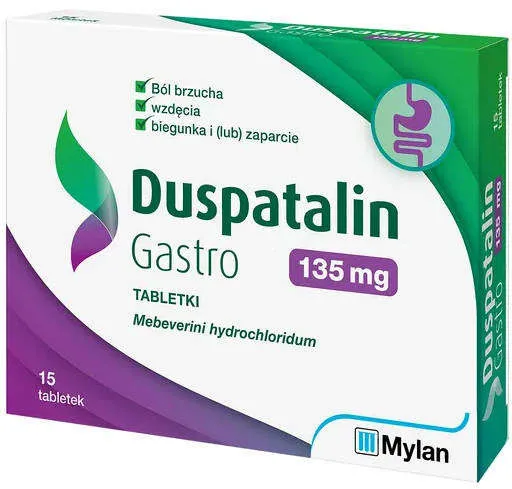
Table of Contents
PACKAGE LEAFLET: INFORMATION FOR THE PATIENT
Warning! Keep this leaflet, information on the immediate packaging is in a foreign language!
Duspatalin
135 mg , film-coated tablets
Mebeverini hydrochloridum
Please read this leaflet carefully before taking this medicine, as it contains
important information for the patient.
This medicine should always be taken exactly as described in this patient leaflet or as advised by a doctor or pharmacist.
- Keep this leaflet for future reference.
- If you need advice or further information, please contact your pharmacist.
- If you experience any side effects, including any possible side effects not listed in this leaflet, inform your doctor or pharmacist. See section 4.
- If there is no improvement after 5 days, or if you feel worse, consult your doctor.
Contents of the leaflet
- What Duspatalin is and what it is used for
- Important information before taking Duspatalin
- How to take Duspatalin
- Possible side effects
- How to store Duspatalin
- Contents of the pack and other information
1. What Duspatalin is and what it is used for
What Duspatalin is
Duspatalin comes in the form of tablets. Duspatalin contains a medicinal substance called mebeverine hydrochloride.
It belongs to a group of medicines known as spasmolytics, which act in the intestine.
The intestine is part of the gastrointestinal tract. Its walls are made of muscle. Food passes through the intestine during digestion. When the intestinal muscles contract strongly, this causes pain. Duspatalin acts by relaxing these muscles and relieving pain.
What Duspatalin is used for
Duspatalin is used in adults and children over 10 years of age for the treatment of abdominal pain or discomfort (e.g. bloating, feeling of distension) associated with gastrointestinal motility disorders and changes in bowel habits and stool consistency, including diarrhoea and/or constipation. Duspatalin should not be used for longer than 5 days without medical advice. If there is no improvement after 5 days, or if you feel worse, you should consult your doctor.
2. Important information before taking Duspatalin
When not to take Duspatalin
- in children under 10 years of age
- in pregnant or breastfeeding women
- if you are allergic to the active substance or to any of the other ingredients of this medicine (listed in section 6).
Do not take Duspatalin if any of the above apply to you. If in doubt, consult your doctor or pharmacist before taking this medicine.
Warnings and precautions
Talk to your doctor before taking this medicine if:
- you are over 40 years of age
- if someone in your family has been diagnosed with colorectal cancer, coeliac disease, or inflammatory bowel disease
- abdominal pain occurs at night
- there is blood in the stool
- you experience nausea or vomiting
- you have lost your appetite or have lost weight rapidly and unexpectedly
- you are pale and feel tired (anaemia)
- you have severe constipation
- you have a fever, which may be a sign of inflammation
- you have recently travelled abroad
- you have recently taken antibiotics
- you have difficulty or pain when urinating
- you are a woman experiencing abnormal vaginal bleeding or discharge
- you are pregnant or suspect you may be pregnant
If any of the above apply to you (or if you are in any doubt), consult your doctor before taking Duspatalin.
Duspatalin and other medicines
No interaction is expected between Duspatalin and other medicines. However, you should inform your doctor or pharmacist about all medicines you are currently taking or have recently taken, as well as any medicines you plan to take.
Pregnancy, breastfeeding and fertility
During pregnancy, while breastfeeding, if you suspect you may be pregnant, or if you are planning a pregnancy, consult your doctor or pharmacist before using this medicine.
- Inform your doctor if you are pregnant or suspect pregnancy. Duspatalin is not recommended during pregnancy. Your doctor may advise you to stop taking Duspatalin or to use an alternative medicine.
- Inform your doctor if you are breastfeeding or intend to breastfeed. Duspatalin is not recommended for breastfeeding mothers. Your doctor may advise you to stop breastfeeding or to use an alternative medicine.
Driving and operating machinery
It is unlikely that Duspatalin will affect your ability to drive or operate machinery.
Duspatalin contains monohydrate lactose and sucrose (types of sugars). If you have previously been diagnosed with intolerance to certain sugars, consult your doctor before taking this medicine.
3. How to use Duspatalin
This medicine should always be taken exactly as described in this patient information leaflet or as directed by your doctor or pharmacist. If in doubt, consult your doctor or pharmacist.
How to take the medicine
- Duspatalin may be taken by adults and children over 10 years of age.
- Tablets should be swallowed whole with an adequate amount of water (at least 100 ml). Do not crush or chew the tablets.
- Try to take the tablets at the same time each day. This will help you remember to take them.
Dosage
Adults and children over 10 years of age
- The usual dose is 1 tablet of 135 mg three times daily.
- The medicine should be taken 20 minutes before meals at regular intervals throughout the day.
Duspatalin should not be used in children under 10 years of age.
If you take more Duspatalin than you should
If you take more than the recommended dose, contact your doctor or go to the nearest hospital immediately. Take the medicine package and the enclosed leaflet with you.
If you forget to take a dose of Duspatalin
- If you miss a dose, take the next dose at the scheduled time. Miss the forgotten dose.
- Do not take a double dose to make up for a missed dose.
If you have any further questions about the use of this medicine, consult your doctor or pharmacist.
4. Possible adverse reactions
Like all medicines, this medicine can cause adverse reactions, although not everyone experiences them.
The following undesirable effects may occur after taking this medicine:
You must stop taking Duspatalin and contact your doctor immediately if any of the following serious adverse reactions occur.
Urgent medical attention may be required:
- Difficulty breathing, swelling of the face, neck, lips, tongue, or throat. This may be a severe allergic reaction (hypersensitivity) to the medicine. If any of the above symptoms occur, you must stop taking the medicine and contact your doctor immediately.
Other adverse reactions
- Milder allergic reactions (hypersensitivity) to the medicine may occur, such as rash, red, itchy skin eruptions. If any adverse reactions occur, including any possible adverse reactions not listed in this leaflet, you should consult your doctor or pharmacist. Reporting of adverse reactions If you experience any adverse reactions, including those not listed in this leaflet, inform your doctor or pharmacist. Adverse reactions can be reported directly to the Department of Monitoring Adverse Drug Reactions of the Office for Registration of Medicinal Products, Medical Devices and Biocidal Products, Al. Jerozolimskie 181C, 02-222 Warsaw, phone: +48 22 49-21-301, fax: +48 22 49-21-309, Website: https://smz.ezdrowie.gov.pl
By reporting adverse reactions, more information on the safety of this medicine can be collected.
5. How to store Duspatalin
- Keep this medicine out of sight and reach of children.
- Store below 25°C.
- Do not use this medicine after the expiry date stated on the packaging. The expiry date refers to the last day of the stated month.
- Medicines must not be disposed of via wastewater or household waste. Ask your pharmacist how to dispose of medicines no longer required. Proper disposal helps protect the environment.
6. Contents of the packaging and other information
What Duspatalin contains
- The active substance is mebeverine hydrochloride. Each tablet contains 135 mg of the active substance.
- The other ingredients are: monohydrate lactose, sodium carboxymethyl starch (type A), povidone, talc, magnesium stearate. Coating: talc, sucrose, arabic gum, gelatin, and Carnauba wax.
What Duspatalin looks like and contents of the pack
The tablets are round and white.
The tablets are packed in PVC/Al blisters in cardboard boxes.
The pack contains 15 tablets.
For further information, please contact the marketing authorisation holder or the parallel importer.
Marketing authorisation holder in Spain, country of export:
Mylan IRE Healthcare Limited
Unit 35/36 Grange Parade,
Baldoyle Industrial Estate, Dublin 13
Ireland
Manufacturer
Recipharm Parets S.L.U.
C/Ramón y Cajal, 2
Parets del Vallès
Barcelona, Spain
Parallel importer:
Medezin Sp. z o.o.
Zbąszyńska 3
91-342 Łódź
Repackaged in:
Medezin Sp. z o.o.
Zbąszyńska 3
91-342 Łódź
Marketing authorisation number in Spain, country of export: 779678.7
Parallel import authorisation number: 206/19