Duphaston
Poland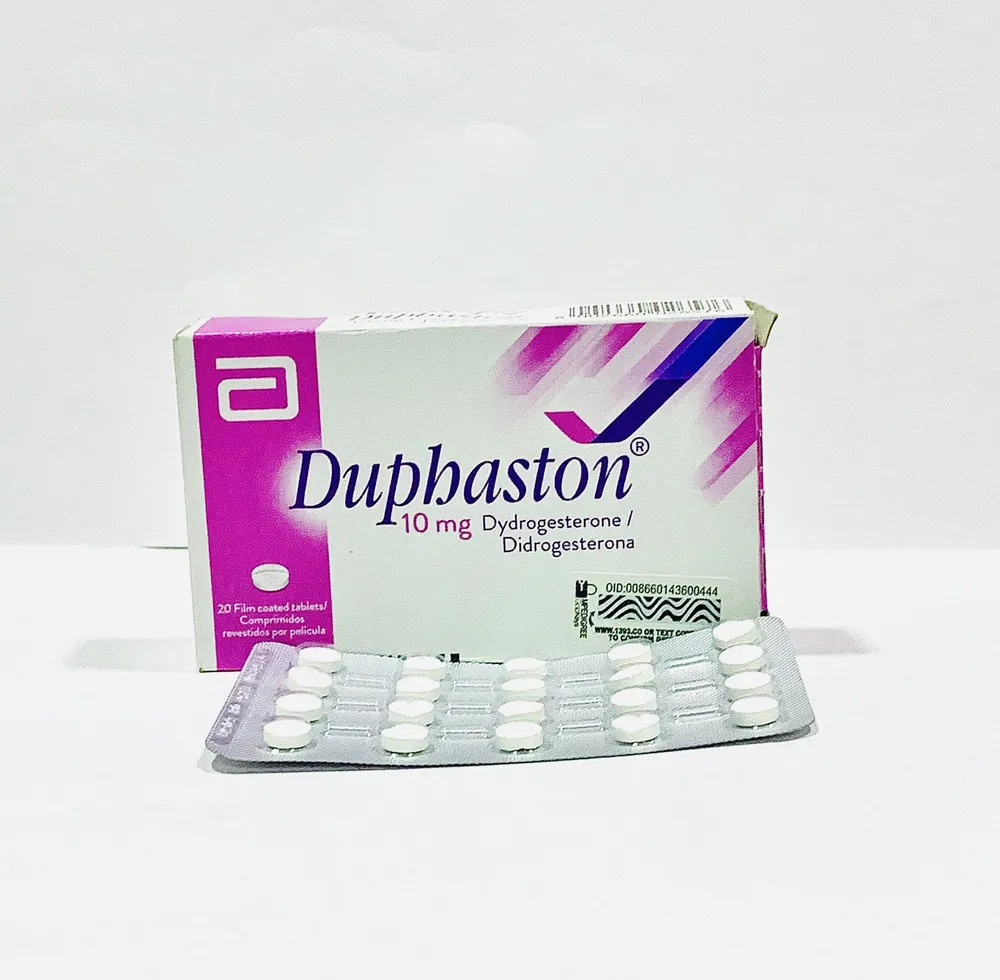
Table of Contents
Patient Information Leaflet
Warning! Keep this leaflet! Information on the immediate packaging in a foreign language.
Duphaston
10 mg, coated tablets
Dydrogesteronum
Please read this leaflet carefully before taking this medicine, as it contains
important information for you.
- Keep this leaflet, as you may need to read it again.
- If you have any further questions, please ask your doctor or pharmacist.
- This medicine has been prescribed for a specific individual. Do not pass it on to others. It may harm them even if their symptoms are the same.
- If you experience any side effects, including any not listed in this leaflet, please inform your doctor or pharmacist. See section 4.
Table of contents
- What Duphaston is and what it is used for
- Important information before taking Duphaston
- How to take Duphaston
- Possible side effects
- How to store Duphaston
- Contents of the pack and other information
1. What Duphaston is and what it is used for
What Duphaston is
Duphaston contains an active substance called “dydrogesterone”.
- Dydrogesterone is a synthetic hormone.
- It is very similar in structure and action to the hormone “progesterone”, naturally produced in the body.
- Medicines such as Duphaston are known as progestagens.
What Duphaston is used for
Duphaston may be used alone or in combination with oestrogen. The need to take oestrogen simultaneously depends on the medical indication.
Duphaston is used in the treatment of:
- Disorders caused by insufficient production of progesterone in the body, such as:
- painful menstruation;
- endometriosis – a condition in which endometrial tissue occurs outside the uterine cavity;
- absence of menstruation before menopause;
- irregular menstruation;
- menstrual bleeding that is excessively heavy or occurs at irregular times (between periods);
- premenstrual syndrome;
- infertility due to low progesterone levels; and
- to reduce the risk of miscarriage.
- Symptoms of menopause – this treatment is known as Hormone Replacement Therapy (HRT).
- These symptoms vary among women.
- They may include hot flushes, night sweats, sleep disturbances, vaginal dryness, and urinary tract disorders.
How Duphaston works
Normally, the body produces appropriate amounts of natural progesterone and natural oestrogen (another important female hormone) in balanced proportions. If the body does not produce enough progesterone, Duphaston supplements this deficiency and restores hormonal balance.
Your doctor may prescribe concomitant oestrogen therapy with Duphaston, depending on the indication.
In some women receiving HRT, taking oestrogen alone may lead to endometrial hyperplasia (overgrowth of the uterine lining). This may also occur in women who have had a hysterectomy or in whom endometriosis has been diagnosed in the past. Taking dydrogesterone for part of the cycle helps prevent endometrial hyperplasia in these patients.
2. Important information before taking Duphaston
When not to take Duphaston:
- if the patient is allergic to dydrogesterone or any of the other ingredients of Duphaston (listed in section 6);
- if there is or there is a justified suspicion of a tumour (growth) whose development is dependent on progesterone;
- if the patient has meningioma or has ever been diagnosed with meningioma (usually a benign tumour of the membrane layer between the brain and skull);
- if there is vaginal bleeding of unknown cause.
Do not take Duphaston if any of the above apply to the patient. If in doubt, consult a doctor or pharmacist before taking Duphaston.
When taking Duphaston together with oestrogen, e.g. as HRT,
please also refer to section 2 of the patient leaflet included with the oestrogen-containing medicine.
Warnings and precautions
If Duphaston is taken due to abnormal bleeding, the doctor will determine the cause of bleeding before starting treatment.
Usually, unexpected vaginal bleeding or spotting is not a cause for concern. This may occur especially during the first few months of taking Duphaston.
However, contact your doctor immediately if bleeding or spotting:
- persists for longer than a few months;
- appears after some time from starting treatment;
- occurs even after stopping treatment.
These may be symptoms of endometrial hyperplasia. The doctor will investigate the cause of bleeding or spotting and may recommend testing for endometrial cancer.
Consult your doctor or pharmacist before starting
Duphaston if any of the following conditions apply:
- depression;
- liver disease;
- a rare, inherited blood disorder called "porphyria".
If any of the above warnings apply to the patient (or if in doubt),
contact your doctor or pharmacist before starting Duphaston.
It is especially important to inform the doctor if any of the above conditions worsened during pregnancy or previous hormonal therapy. If symptoms worsen or recur during treatment with Duphaston, the doctor may recommend stopping treatment.
Duphaston and HRT
HRT carries certain risks in addition to its benefits, which the patient and doctor must consider before starting treatment. When taking Duphaston together with oestrogen as HRT, the following information is important. Also refer to the patient leaflet included with the oestrogen-containing medicine.
Early menopause
Limited data are available on the risks of using HRT at the onset of perimenopausal symptoms. The risk is lower in younger women. This means that for younger women using HRT, the benefit-risk ratio is more favourable than for older women.
Medical examinations
Before starting or restarting HRT, the doctor will take a medical and family history. The doctor may also recommend breast and pelvic examinations.
Before and during treatment, the doctor may recommend screening tests such as mammography (an X-ray examination of the breasts). The doctor will advise how often these tests should be performed. After starting treatment with Duphaston, schedule regular check-ups with your doctor (at least once a year).
Endometrial cancer and endometrial hyperplasia
Women with an intact uterus who take oestrogens alone for a prolonged period as part of HRT have an increased risk of:
- endometrial cancer;
- endometrial hyperplasia.
Taking Duphaston together with oestrogen (for at least 12 days per month in a 28-day cycle) or as continuous combined therapy can prevent this additional risk.
Breast cancer
Evidence confirms that using hormone replacement therapy (HRT) in the form of oestrogen-progestagen combination or oestrogen alone increases the risk of developing breast cancer. The additional risk depends on how long the patient uses HRT. This additional risk becomes apparent after about 3 years (1–4) of HRT use. After stopping HRT, the additional risk gradually decreases, but may persist for 10 years or longer if HRT was used for more than 5 years.
You should:
- have regular check-ups – your doctor will advise how often these should be performed;
- regularly examine your breasts yourself for the following changes:
- skin dimpling,
- changes in the nipple,
- visible or palpable lumps.
If you notice any changes, contact your doctor immediately.
Ovarian cancer
Ovarian cancer is rare – significantly rarer than breast cancer. Using HRT containing oestrogen alone or a combination of oestrogen and progestagen is associated with a slightly increased risk of ovarian cancer.
The risk of ovarian cancer depends on age. For example, in women aged 50 to 54 who do not use HRT, ovarian cancer will be diagnosed in about 2 out of 2,000 women over a 5-year period. In women who have used HRT for 5 years, it will occur in about 3 out of 2,000 users (i.e. about 1 additional case).
Meningioma
Using Duphaston is associated with the development of a usually benign tumour of the membrane layer between the brain and skull (meningioma). If a patient is diagnosed with meningioma, the doctor will discontinue treatment with Duphaston (see section "When not to take..."). If the patient experiences any symptoms such as visual disturbances (e.g. double or blurred vision), hearing loss or tinnitus, loss of smell, worsening headaches, memory loss, seizures, or weakness in the arms or legs, she should inform her doctor immediately.
Blood clots
HRT increases the risk of venous blood clots. This risk is 3 times higher than in women not using HRT. The risk is highest during the first year of HRT use.
The occurrence of blood clots is more likely in cases of:
- advanced age;
- presence of cancer;
- overweight;
- taking oestrogens;
- pregnancy or immediately after childbirth;
- personal or family history of blood clots in the legs or lungs;
- immobility due to surgery, injury, or illness (see information in section "Surgery", below);
- presence of a disease called "systemic lupus erythematosus" – a condition causing joint pain, rash, and fever.
If any of the above risk factors apply to the patient (or if in doubt), contact your doctor to confirm whether the patient can start HRT.
If painful leg swelling, sudden chest pain, or difficulty breathing occur:
- contact your doctor immediately;
- stop using HRT until the doctor decides whether to resume treatment.
These may be symptoms of blood clots.
Also inform your doctor or pharmacist if you are taking anticoagulant medicines (blood thinners) such as warfarin. The doctor will pay special attention to the benefits and risks of using HRT.
Surgery
If surgery is planned, inform your doctor about using HRT. It may be necessary to stop HRT several weeks before surgery. In some cases, alternative treatment may be required before and after surgery. The doctor will advise when HRT can be restarted.
Heart disease
HRT does not prevent heart disease. Women taking oestrogen and progestogen as HRT have a slightly higher probability of developing heart disease than women not using HRT. The risk of heart disease increases with age. The number of additional cases of heart disease due to using oestrogen-progestagen HRT is very small in healthy women with early menopausal symptoms but before menopause. The number of additional cases increases with age.
If chest pain radiating to the arm or neck occurs:
- contact your doctor immediately;
- stop using HRT until the doctor resumes treatment.
This pain may be a sign of myocardial infarction.
Stroke
Using HRT as oestrogen-progestagen therapy or oestrogen-only therapy increases the risk of stroke. This risk is up to 1.5 times higher than in women not using HRT. The increase in risk for HRT users compared to non-users does not change with age or time since menopause. However, since the risk of stroke is strongly age-dependent, the overall risk of stroke in women using HRT increases with age.
If severe, unexplained headache or migraine (with or without visual disturbances) occurs:
- contact your doctor immediately;
- stop using HRT until the doctor resumes treatment.
This may be an early sign of stroke.
Children and adolescents
There is no indication for using Duphaston in children before their first menstruation. It is not known whether Duphaston is safe and effective in adolescents aged 12–18 years.
Duphaston with other medicines
Tell your doctor or pharmacist about all medicines you are currently taking or have recently taken, including those obtained without a prescription, as well as herbal medicines.
In particular, inform your doctor or pharmacist if you are taking the following medicines:
- herbal remedies containing St John's wort (Hypericum perforatum), sage, or melissa;
- anticonvulsants (used to treat epilepsy) – such as phenobarbital, carbamazepine, phenytoin;
- antibacterial medicines (used to treat infections) – such as rifampicin, rifabutin, nevirapine, efavirenz;
- antiviral medicines (used to treat HIV infection – AIDS) – such as ritonavir, nelfinavir.
The above medicines may reduce the effectiveness of Duphaston and lead to bleeding and spotting. If you are taking any of the above medicines (or if in doubt), contact your doctor or pharmacist before starting HRT.
Duphaston with food and drink
Duphaston can be taken with or without food.
Pregnancy, breastfeeding and fertility
During pregnancy, while breastfeeding, or if pregnancy is suspected or planned, consult your doctor before using this medicine.
Pregnancy
There may be an increased risk of hypospadias (a congenital malformation of the penis involving an abnormally located urethral opening) in children whose mothers took certain progestagens. However, this increased risk has not been conclusively confirmed. To date, there is no evidence that using dydrogesterone during pregnancy is harmful. More than 10 million pregnant women have taken Duphaston.
- If you are pregnant before taking Duphaston, consult your doctor.
- If you become pregnant or suspect you are pregnant, contact your doctor. The doctor will discuss the benefits and risks of taking Duphaston during pregnancy.
Breastfeeding
Do not take Duphaston while breastfeeding. It is not known whether Duphaston passes into breast milk or affects the infant. Studies with other progestagens have shown that small amounts of the drug pass into breast milk.
Fertility
There is no evidence that dydrogesterone reduces fertility when taken as recommended by a doctor.
Driving and using machines
After taking Duphaston, mild drowsiness or dizziness may occur. This is more likely during the first few hours after taking the medicine. If these symptoms occur, do not drive or operate tools or machinery. The patient should wait and observe how the medicine affects her before deciding to drive or operate tools or machinery.
Duphaston contains lactose monohydrate (milk sugar)
If the patient has been informed by a doctor of intolerance or inability to digest certain sugars, consult the doctor before taking the medicine. This applies to rare inherited disorders affecting the body's use of lactose, such as "lactase deficiency" or "glucose-galactose malabsorption syndrome".
3. How to take Duphaston
Duphaston should always be taken exactly as directed by your doctor. If you are unsure, you should contact your doctor or pharmacist. Your doctor will adjust the dose according to your needs.
Taking the medicine
- Swallow the tablet with water.
- The tablet may be taken with or without food.
- If more than one tablet per day is prescribed, doses should be evenly spaced throughout the day; for example, one tablet in the morning and one in the evening.
- Try to take the tablets at the same time each day. This helps ensure a constant level of medicine in your body and also helps you remember to take it.
- The break line on the tablet is intended only to facilitate swallowing and should not be used to divide the dose in half.
How much medicine to take
The number of tablets and the days on which they are taken depend on the indication. If the patient still menstruates, day 1 of the cycle is the first day of bleeding. If the patient no longer has natural periods, the doctor will determine the first day of the cycle and decide when to start taking the tablets.
Use in the treatment of painful menstruation
- Take 1 or 2 tablets per day.
- Use only from day 5 to day 25 of the cycle.
Use in the treatment of endometriosis
- Take 1 to 3 tablets per day.
- Your doctor will instruct you to take the tablets:
- Every day of the cycle, or
- Only from day 5 to day 25 of the cycle.
Use in the treatment of absent menstruation before menopause
- Take 1 or 2 tablets per day.
- Use for 14 days during the second half of the expected cycle.
Use in the treatment of irregular menstruation
- Take 1 or 2 tablets per day.
- Use from the second half of the cycle until the first day of the next cycle.
- The day treatment starts and the number of days the medicine is taken depend on the length of the cycle.
Use in the treatment of abnormal uterine bleeding
- For treatment aimed at stopping bleeding:
- Take 2 or 3 tablets per day.
- Use for up to 10 days.
- For continuous treatment:
- Take 1 or 2 tablets per day.
- Use during the second half of the cycle.
- The day treatment starts and the number of days the medicine is taken depend on the length of the cycle.
Use in the treatment of premenstrual syndrome (PMS)
- Take 2 tablets per day.
- Use from the second half of the cycle until the first day of the next cycle.
- The day treatment starts and the number of days the medicine is taken depend on the length of the cycle.
Use to reduce the risk of miscarriage
- If the patient has not had previous miscarriages:
- Take a single dose of up to 4 tablets.
- Then take 2 or 3 tablets per day until symptoms subside.
- If the patient has had previous miscarriages:
- Take 2 tablets per day.
- Continue until week 12 of pregnancy.
Use in infertility caused by low progesterone levels
- Take 1 or 2 tablets per day.
- Use from the second half of the cycle until the first day of the next cycle.
- The day treatment starts and the number of days the medicine is taken depend on the length of the cycle.
- Treatment should continue for at least 3 consecutive cycles.
Use in the treatment of menopausal symptoms – HRT
- If the patient is using sequential HRT (taking an estrogen tablet or using an estrogen patch throughout a 28-day cycle):
- Take 1 tablet of Duphaston once daily.
- Use during the last 14 days of each 28-day cycle.
- If the patient is using cyclic HRT (taking an estrogen tablet or using an estrogen patch usually for 21 days followed by a 7-day break without estrogen):
- Take 1 tablet of Duphaston per day.
- Use during the last 12 to 14 days of estrogen therapy.
- If necessary, your doctor may increase the dose to 2 tablets per day.
Taking more Duphaston than recommended
It is unlikely that taking too many Duphaston tablets by a patient (or another person) would be harmful. Specific treatment is not required. If you have any doubts or experience any worrying symptoms, contact your doctor.
Missing a dose of Duphaston
- If you miss a dose, take it as soon as possible. However, if more than 12 hours have passed since the scheduled dose time, do not take the missed tablet and take the next tablet at the usual time.
- Do not take a double dose to make up for a missed dose.
- If a dose is missed, breakthrough bleeding or spotting may occur.
Stopping Duphaston
Do not stop taking Duphaston without consulting your doctor.
4. Possible adverse effects
Like all medicines, Duphaston may cause adverse effects, although not everyone experiences them. The following adverse effects may occur during treatment with Duphaston:
Adverse effects during treatment with Duphaston alone
If any of the following adverse effects occur,
stop taking Duphaston immediately and contact your doctor:
- Liver disorders – symptoms may include yellowing of the skin or whites of the eyes (jaundice), weakness, general malaise, or stomach pain (affects less than 1 in 100 patients);
- Allergic reactions – symptoms may include difficulty breathing or systemic symptoms such as nausea, vomiting, diarrhoea, or low blood pressure (affects less than 1 in 1,000 patients);
- Swelling of the skin around the face and throat, which may cause difficulty breathing (affects less than 1 in 1,000 patients). If any of the above adverse effects occur, stop taking Duphaston immediately and contact your doctor.
Other adverse effects during treatment with Duphaston alone
Common (affects less than 1 in 10 patients)
- Migraine, headache;
- Nausea;
- Tenderness or pain in the breasts;
- Irregular, heavy, or painful menstrual bleeding;
- Absence of menstruation or menstrual bleeding occurring less frequently than normal.
Uncommon (affects less than 1 in 100 patients)
- Weight gain;
- Dizziness;
- Depression;
- Vomiting;
- Skin allergic reactions – such as rash, severe itching, or urticaria.
Rare (affects less than 1 in 1,000 patients)
- Somnolence;
- Breast swelling;
- A type of anaemia occurring due to breakdown of red blood cells;
- Fluid retention causing oedema, commonly affecting the lower legs or ankles;
- Increase in size of tumours under the influence of progestagens (such as meningioma).
Younger patients can be expected to experience similar adverse effects as those observed in adults.
Adverse effects during treatment with Duphaston combined with oestrogen (HRT – oestrogen with progestagen)
When taking Duphaston together with oestrogen, please also read the patient leaflet provided with the oestrogen-containing medicine. For further information regarding the adverse effects listed below, see section "Important information before taking Duphaston".
If any of the following adverse effects occur,
stop taking Duphaston immediately and contact your doctor:
- Painful swelling of the legs, sudden chest pain, or difficulty breathing – these may be symptoms of blood clots;
- Chest pain radiating to the arm or neck – these may be symptoms of myocardial infarction (heart attack);
- Severe, unexplained headaches or migraine (with or without visual disturbances) – these may be symptoms of stroke. If any of the above adverse effects occur, stop taking Duphaston immediately and contact your doctor.
Seek immediate medical advice if the patient notices:
- Dimpling of the skin on the breast, changes in the nipple, or visible or palpable lumps – these may be symptoms of breast cancer.
Other adverse effects occurring during treatment with Duphaston combined with oestrogen include:
- Excessive growth of the endometrium (endometrial hyperplasia);
- Endometrial cancer;
- Ovarian cancer.
Reporting of adverse effects
If any adverse effects occur, including any not listed in this leaflet, inform your doctor or pharmacist. Adverse effects can be reported directly to the Department of Monitoring Adverse Drug Reactions, Office for Registration of Medicinal Products, Medical Devices and Biocidal Products, Al. Jerozolimskie 181C, 02-222 Warsaw, tel.: +48 22 49 21 301, fax: +48 22 49 21 309, website: https://smz.ezdrowie.gov.pl.
Reporting adverse effects helps to provide more information on the safety of the medicine.
5. How to store Duphaston
Keep this medicine out of sight and reach of children.
No special requirements for storage.
Do not use this medicine after the expiry date stated on the packaging.
The expiry date refers to the last day of the stated month.
Medicines should not be disposed of via wastewater or household waste. Ask your pharmacist how to dispose of medicines no longer required. Such measures help protect the environment.
6. Contents of the packaging and other information
What Duphaston contains
- The active substance is dydrogesterone.
- Each coated tablet contains 10 mg of dydrogesterone.
- Other ingredients are: monohydrate lactose, hypromellose, corn starch, colloidal anhydrous silica, magnesium stearate. Coating: Opadry Y-1-7000 (hypromellose, polyethylene glycol 400, titanium dioxide (E 171)).
What Duphaston looks like and contents of the pack
White, round, biconvex, scored coated tablets with the imprint “155” on both sides of the score line on one side of the tablet.
20 tablets in a PVC/Al blister pack, packed in a cardboard box.
For more detailed information, please contact the marketing authorisation holder or the parallel importer.
Marketing authorisation holder in Slovakia, country of export:
Theramex Ireland Limited
3rd Floor, Kilmore House
Park Lane, Spencer Dock
D01YE64 Dublin 1, Ireland
Manufacturer:
Abbott Biologicals B.V.
Veerweg 12, 8121 AA Olst
Netherlands
Parallel importer:
InPharm Sp. z o.o.
ul. Strumykowa 28/11
03-138 Warsaw, Poland
Repackaged in:
InPharm Sp. z o.o. Services sp. k.
ul. Chełmżyńska 249
04-458 Warsaw, Poland
Marketing authorisation number in Slovakia, country of export: 56/0379/00-S
Parallel import authorisation number: 74/26