Duphalac fruit
Poland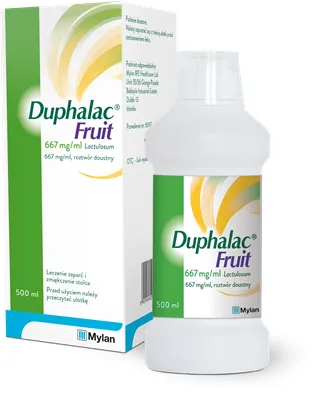
Instructions for Use
Patient Information Leaflet
Duphalac Fruit
667 mg/ml, oral solution
Lactulosum
Please read carefully the entire leaflet before taking the medicine, as it contains
important information for the patient.
This medicine should always be taken exactly as described in this patient leaflet or as advised by
your doctor or pharmacist.
- Keep this leaflet for future reference.
- If you need advice or further information, please consult your pharmacist.
- If you experience any adverse reactions, including any possible side effects not listed in this leaflet, inform your doctor or pharmacist. See section 4.
- If there is no improvement after a few days, or if you feel worse, you should contact your doctor.
Table of Contents
- What Duphalac Fruit is and what it is used for
- Important information before taking Duphalac Fruit
- How to take Duphalac Fruit
- Possible side effects
- How to store Duphalac Fruit
- Contents of the pack and other information
1. What Duphalac Fruit is and what it is used for
What Duphalac Fruit is
Duphalac Fruit contains a laxative agent called lactulose. It softens the stool and facilitates its passage through the intestine by retaining water in the bowel. It is not absorbed from the gastrointestinal tract.
What Duphalac Fruit is used for
- Duphalac Fruit is used for the symptomatic treatment of constipation (infrequent bowel movements, hard and dry stools) and for stool softening, for example:
- in case of haemorrhoids (piles)
- after surgery on the anus or large intestine. If there is no improvement or if symptoms worsen after a few days, medical advice should be sought.
2. Important information before taking Duphalac Fruit
When not to take Duphalac Fruit
- if the patient has a known allergy (hypersensitivity) to lactulose or any of the other ingredients of Duphalac Fruit (see sections 2 and 6)
- if the patient has:
- galactosaemia (a serious genetic disorder that prevents proper digestion of galactose)
- gastrointestinal obstruction (other than constipation)
- gastrointestinal perforation or risk of its occurrence (e.g. in inflammatory bowel disease such as Crohn's disease or ulcerative colitis)
If in doubt, consult a doctor or pharmacist before taking Duphalac Fruit.
Warnings and precautions
Consult a doctor or pharmacist before using Duphalac Fruit if the patient has any medical conditions, especially:
- abdominal pain of unknown cause
- Roemheld syndrome (a condition in which gas accumulation in the gastrointestinal tract or disturbances in normal gastric passage cause cardiac symptoms)
- lactose intolerance (inability to digest milk sugar, lactose)
- diabetes
Do not take Duphalac Fruit if any of the following conditions are present:
- galactose or fructose intolerance
- Lapp-type lactase deficiency
- glucose-galactose malabsorption
Patients with Roemheld syndrome: if bloating or excessive flatulence occurs after taking the medicine, discontinue treatment and consult a doctor.
In such cases, treatment should be supervised by a physician.
Duphalac Fruit may disrupt the normal bowel movement pattern.
Prolonged use of an inappropriate dose (more than 2–3 bowel movements per day) or incorrect use may lead to diarrhoea and electrolyte imbalances.
Do not use Duphalac Fruit for longer than two weeks without consulting a doctor.
When using laxatives, it is recommended to drink an adequate amount of fluids (about 2 L/day, i.e. 6–8 glasses).
If there is no improvement or symptoms worsen after several days of using Duphalac Fruit, consult a doctor.
Duphalac Fruit and other medicines
Inform the doctor or pharmacist about all medicines currently or recently taken, as well as any medicines the patient plans to take.
Lactulose may increase potassium loss caused by other drugs (e.g. thiazides, corticosteroids, and amphotericin B).
Concomitant use of cardiac glycosides (e.g. digoxin) with lactulose may enhance their potassium-lowering effect in blood.
If any of the above apply (or if in doubt), consult a doctor or pharmacist before using Duphalac Fruit.
Duphalac Fruit with food and drink
Duphalac Fruit may be taken with or without food. There are no restrictions regarding food or drink intake.
Pregnancy, breastfeeding and fertility
Duphalac Fruit may be used during pregnancy and breastfeeding.
No effect on fertility is expected.
Before taking any medicine, consult a doctor or pharmacist.
Children
In exceptional cases, a doctor may prescribe Duphalac Fruit for use in children, infants, and newborns. In such cases, treatment must be supervised by a physician.
This medicine contains 14.37 mg of propylene glycol (E 1520) in each 15 mL dose, or 0.96 mg/mL.
Before administering the medicine to a child under 4 weeks of age, consult a doctor or pharmacist, especially if the child is taking other medicines containing propylene glycol or alcohol.
Driving and operating machinery
Duphalac Fruit has no effect or negligible effect on the ability to drive and operate machinery.
Duphalac Fruit contains sugars, such as lactose, galactose, or fructose.
If a sugar intolerance has been diagnosed by a doctor, consult a doctor before taking this medicine.
3. How to take Duphalac Fruit
Duphalac Fruit should always be taken exactly as described in this leaflet or as directed
by the physician or pharmacist. In case of doubt, consult your doctor
or pharmacist.
Doses should be taken daily at the same time.
The medicine should be swallowed quickly. Do not retain in the oral cavity.
Duphalac Fruit may be taken diluted in a small amount of liquid or undiluted.
For Duphalac Fruit in bottles, the provided measuring cup may be used.
For Duphalac Fruit in single-dose sachets containing 15 ml, tear off the corner of the sachet and immediately take the contents.
Dosage
The dose may be administered once daily, e.g. at breakfast time, or divided into two doses.
After a few days, the initial dose may be adjusted to a maintenance dose based on the treatment response.
The therapeutic effect may occur after a few days (2–3 days) of treatment.
Duphalac in bottles or 15 ml sachets:
| Initial daily dose | Maintenance daily dose | |
| Adults and adolescents | 15-45 ml (10-30 g lactulose) corresponds to 1-3 sachets | 15-30 ml (10-20 g lactulose) corresponds to 1-2 sachets |
| Children (7-14 years) | 15 ml (10 g lactulose) corresponds to 1 sachet | 10-15 ml (7-10 g lactulose) corresponds to 1 sachet* |
| Children (1-6 years) | 5-10 ml (3-7 g lactulose) | 5-10 ml (3-7 g lactulose) |
| Infants under 1 year | up to 5 ml (up to 3 g lactulose) | up to 5 ml (up to 3 g lactulose) |
* if the maintenance dose is below 15 ml, Duphalac in a bottle should be used.
Use in children
For accurate dosing in infants and children up to 7 years of age, Duphalac Fruit in a bottle should be used.
Laxatives may be used in children, infants, and newborns only in exceptional cases and under medical supervision.
Duphalac Fruit should not be given to children under 14 years of age without consulting a physician who will prescribe the medication and monitor the treatment.
Elderly population and patients with renal or hepatic impairment
No special dosage recommendations.
Taking more than the recommended dose of Duphalac Fruit
In case of overdose, diarrhea, electrolyte loss, and abdominal pain may occur. If more Duphalac Fruit has been taken than recommended, contact a doctor or pharmacist.
Missed dose of Duphalac Fruit
If a dose of Duphalac Fruit is missed, take the next dose at the scheduled time. Do not take a double dose to make up for the missed dose.
Stopping treatment with Duphalac Fruit
Do not stop or change treatment without consulting a doctor.
If you have any further questions regarding the use of this medicine, consult your doctor, pharmacist, or nurse.
4. Possible adverse effects
Like all medicines, this medicine can cause adverse effects, although not everybody will experience them.
Very common (may affect more than 1 in 10 people)
- diarrhoea
Common (may affect up to 1 in 10 people)
- abdominal distension (swollen stomach)
- nausea
- vomiting
- abdominal pain
Uncommon (may affect up to 1 in 100 people)
- electrolyte imbalance due to diarrhoea
Frequency not known (frequency cannot be estimated from the available data)
- allergic reactions, rash, itching, urticaria
Abdominal distension may occur during the first few days of treatment. It usually resolves after several days.
If doses higher than recommended are used, abdominal pain and diarrhoea may occur.
In such a case, the dose should be reduced.
If any adverse effects occur, including any possible adverse effects not listed in this leaflet, consult a doctor or pharmacist.
Reporting of adverse effects
If any adverse effects occur, including any adverse effects not listed in this leaflet, inform a doctor or pharmacist. Adverse effects can be reported directly to: Department of Monitoring of Adverse Drug Reactions, Office for Registration of Medicinal Products, Medical Devices and Biocidal Products, Al. Jerozolimskie 181C, 02-222 Warsaw, tel.: +48 22 49 21 301; fax: +48 22 49 21 309; website: https://smz.ezdrowie.gov.pl
Adverse effects can also be reported to the marketing authorisation holder.
Reporting adverse effects helps to provide more information on the safety of this medicine.
5. How to store Duphalac Fruit
Keep the medicine out of the sight and reach of children.
Do not use this medicine after the expiry date stated on the cardboard box or bottle: Expiry date (EXP). The expiry date refers to the last day of the specified month.
Partially used sachets should be discarded.
Medicines must not be disposed of via wastewater or household waste. Ask your pharmacist how to dispose of medicines no longer in use. This helps protect the environment.
No special storage conditions are required for this medicine.
After 21 weeks from first opening the bottle, the medicine should be discarded.
6. Contents of the package and other information
What Duphalac Fruit contains
The active substance is lactulose.
One sachet of Duphalac Fruit contains 15 ml of oral solution, corresponding to 10 g of lactulose.
One ml of Duphalac Fruit contains 667 mg of lactulose.
Duphalac Fruit contains plum flavour. The flavour contains propylene glycol (E 1520).
Duphalac Fruit contains residues from the manufacturing process, see section 2.
What Duphalac Fruit looks like and contents of the pack
Duphalac Fruit oral solution is a clear, viscous liquid, colourless to brownish-yellow.
Duphalac Fruit is packed in 15 ml sachets made of PET/Aluminium/PET/PE, contained in a cardboard box.
1 pack contains 20 sachets in a cardboard box.
Duphalac Fruit is also available in HDPE bottles of 200 ml, 300 ml, 500 ml (in a cardboard box), 800 ml or 1000 ml, with a PP screw cap and a PP measuring cup graduated at: 2.5 ml; 5 ml; 10 ml; 15 ml; 20 ml; 25 ml and 30 ml.
Not all pack sizes may be marketed.
Marketing Authorisation Holder
Cooper Consumer Health B.V.
Verrijn Stuartweg 60
1112AX Diemen
The Netherlands
Manufacturer
Abbott Biologicals B.V.
Veerweg 12, 8121 AA Olst
The Netherlands
Similar Medications
-
Duphalac
Form: solution, oral
Active substance Dosage Lactulose 667 mg/ml Manufacturer: Abbott Biologicals B.V.
This page has been machine-translated and may contain inaccuracies. The original data is available in the manufacturing country's language.
Last data check: June 04, 2026 · Data source: Rejestr Produktów Leczniczych (URPL)