Duphagol
Poland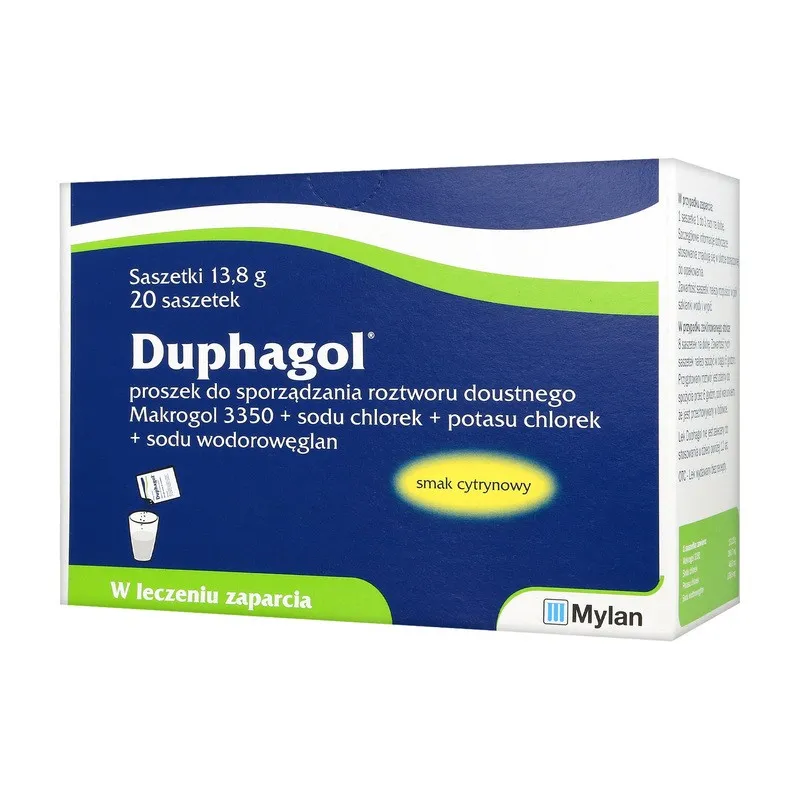
Table of Contents
Patient Information Leaflet
Duphagol
13.125 g + 350.7 mg + 46.6 mg + 178.5 mg, powder for oral solution
Macrogol 3350 + sodium chloride + potassium chloride + sodium bicarbonate
Please read this leaflet carefully before taking this medicine, as it contains
important information for you.
This medicine should always be used exactly as described in this patient leaflet or as advised
by your doctor or pharmacist.
- Keep this leaflet so that you can read it again if necessary.
- If you need advice or further information, please consult your pharmacist.
- If you experience any adverse reactions, including any possible side effects not listed in this leaflet, inform your doctor or pharmacist. See section 4.
- If there is no improvement within 2 weeks after the onset of constipation, or if your condition worsens, you should contact your doctor. If this medicine is being used to treat severe constipation (so-called spastic constipation or faecal impaction), follow your doctor's instructions.
Table of contents
- What Duphagol is and what it is used for
- Important information before taking Duphagol
- How to take Duphagol
- Possible side effects
- How to store Duphagol
- Contents of the pack and other information
1. What Duphagol is and what it is used for
Duphagol helps maintain normal intestinal peristalsis (bowel function), even in cases of prolonged constipation. After consulting a doctor, Duphagol may also be used in the treatment of severe constipation (so-called spastic constipation or faecal impaction).
Macrogol 3350 increases stool volume by retaining water in the intestine, which helps normalize colonic peristalsis. As a result, softened stool is moved more effectively through the bowel, facilitating defecation. The electrolytes contained in the medicine help maintain normal levels of salts and water in the body.
If there is no improvement within 2 weeks after the onset of constipation, or if your condition worsens, you should contact your doctor. If this medicine is being used to treat severe constipation (so-called spastic constipation or faecal impaction), follow your doctor's instructions.
2. Important information before taking Duphagol
When not to use Duphagol:
- if the patient is allergic to macrogol 3350, sodium chloride, potassium chloride, sodium bicarbonate, or any of the other ingredients of this medicine (listed in section 6),
- if the patient has intestinal obstruction, perforation, or severe inflammatory bowel conditions such as ulcerative colitis, Crohn's disease, toxic megacolon, or intestinal obstruction.
Warnings and precautions
Before starting treatment with Duphagol, discuss this with your doctor.
While taking Duphagol, it is important to continue drinking plenty of fluids. The fluid taken with Duphagol must not replace regular fluid intake.
If adverse effects occur, such as swelling, shortness of breath, fatigue, dehydration (symptoms include increased thirst, dry mouth, and weakness), or heart disturbances, stop taking Duphagol immediately and contact your doctor without delay.
Do not use Duphagol for prolonged periods unless advised by a doctor, for example, if the patient is taking medications that may cause constipation or has a condition causing constipation, such as Parkinson's disease or multiple sclerosis.
Children
This medicine should not be given to children under 12 years of age.
Duphagol and other medicines
Tell your doctor or pharmacist about all medicines the patient is currently taking or has recently taken, as well as any medicines the patient plans to take.
Some medicines, such as antiepileptic drugs, may not be fully effective when taken concurrently with Duphagol. Therefore, do not take other oral medicines within one hour before, during, or one hour after taking Duphagol.
Duphagol may interact with starch-based food thickeners, causing thickened products—intended for individuals with swallowing difficulties—to become diluted. Duphagol should be used cautiously in combination with starch-based thickeners.
Pregnancy, breastfeeding, and fertility
If a woman is pregnant, breastfeeding, suspects she may be pregnant, or is planning to have a child, she should consult her doctor before using this medicine.
Duphagol may be used during pregnancy and breastfeeding.
Driving and operating machinery
Duphagol has no influence on the ability to drive or operate machinery.
Duphagol contains sodium. This medicine contains 187 mg of sodium (the main component of table salt) per sachet, equivalent to 9.5% of the maximum recommended daily dietary sodium intake for adults.
3. How to take Duphagol
This medicine should always be taken as directed by a doctor or pharmacist. If in doubt,
consult a doctor or pharmacist.
Recommended dose for constipation:
1 sachet 1 to 3 times daily. The usual dose for most patients is 1–2 sachets
per day. Depending on individual response, up to 3 sachets
per day may be necessary. The dose depends on the severity of constipation. It may be reduced after a few days of treatment to the lowest effective dose. The normal duration of treatment is 2 weeks. You should
contact your doctor if symptoms do not improve after 2 weeks.
The contents of a sachet should be poured into half a glass of water (approximately 125 ml). Mix until the powder dissolves and drink immediately. Fruit juice or fruit syrup may be added to taste just before taking the medicine.
Children (under 12 years of age): Duphagol is not recommended.
Recommended dose for faecal impaction:
Adults: usually 8 sachets per day. The contents of these sachets should be taken
within 6 hours each day for up to 3 days, if necessary. Treatment for faecal impaction should not last longer than 3 days.
When using Duphagol for faecal impaction, the contents of 8 sachets
can be dissolved in 1 litre of water. After dissolving, the solution should be stored in a refrigerator.
Patients with cardiovascular disorders:
When treating faecal impaction, the dose should be divided so that no more than 2 sachets are taken within one hour.
Patients with renal impairment:
There is no need to adjust the dose of Duphagol, either during treatment for constipation or for faecal impaction.
Taking more Duphagol than recommended
If an excessive dose of Duphagol has been taken and severe diarrhoea or
vomiting occurs, treatment should be stopped. After symptoms subside, treatment may be continued using a reduced dose. If the patient is concerned, they should contact a doctor
or pharmacist.
If a dose of Duphagol is missed
Do not take a double dose to make up for a missed dose.
This medicine should always be taken exactly as described in this patient information leaflet or as directed by a doctor or pharmacist. If in doubt, consult a doctor or pharmacist.
If you have any further questions about the use of this medicine, consult your doctor or pharmacist.
4. Possible adverse reactions
Like all medicines, this medicine can cause adverse reactions, although not everyone experiences them.
Very common (may occur in more than 1 out of 10 people): stomach pains and cramps,
diarrhoea, vomiting, nausea, abdominal rumbling and flatulence-related discomfort.
Common (may occur in up to 1 out of 10 people): itching, headache, swelling of the hands, feet
or ankles.
Uncommon (may occur in up to 1 out of 100 people): rash, indigestion, and abdominal bloating.
Very rare (may occur in up to 1 out of 10,000 people): severe allergic reactions causing breathing
difficulties or swelling of the face, lips, tongue or throat. If any of these symptoms occur, contact a doctor immediately and discontinue taking Duphagol. Allergic reactions (e.g. skin reactions
and catarrh), abnormally increased or decreased blood potassium levels, and discomfort around the anus.
Frequency not known (frequency cannot be estimated from the available data): changes in body fluids or electrolyte levels (low sodium levels).
Reporting of adverse reactions
If any adverse reactions occur, including any adverse reactions not listed in this leaflet, inform a doctor or pharmacist. Adverse reactions can be reported directly to the Department of Monitoring Adverse Drug Reactions at the Office for Registration of Medicinal Products, Medical Devices and Biocidal Products, Al. Jerozolimskie 181C, 02-222 Warsaw, tel.: +48 22 49 21 301,
fax: +48 22 49 21 309, website: https://smz.ezdrowie.gov.pl
Adverse reactions can also be reported to the marketing authorisation holder.
Reporting adverse reactions helps provide more information on the safety of this medicine.
5. How to store Duphagol
Keep this medicine out of sight and reach of children.
Do not use this medicine after the expiry date stated on the sachet and cardboard packaging. The expiry date refers to the last day of the stated month.
No special temperature storage precautions are required for this product.
Store in the original packaging to protect from moisture. After dissolving the contents of the sachet, the solution should be stored in a refrigerator (2°C – 8°C). Any unused solution must be discarded after 6 hours.
Medicines must not be disposed of via wastewater or household waste. Ask your pharmacist how to dispose of medicines no longer required. This will help protect the environment.
6. Contents of the package and other information
What Duphagol contains
- The active substances are macrogol 3350 (also known as polyethylene glycol 3350) 13.125 g, sodium chloride 350.7 mg, potassium chloride 46.6 mg, sodium bicarbonate 178.5 mg.
- The other ingredients (excipients) are potassium acesulfame (E 950) (sweetener) and lemon flavour (flavouring).
What Duphagol looks like and contents of the pack
White powder for oral solution.
Sachets contain 13.8 g of powder. The pack contains 10, 20, 30, 40, 50, 60 and 100 or 2x50 sachets.
Not all pack sizes may be marketed.
Marketing Authorisation Holder
Viatris Healthcare Limited
Damastown Industrial Park
Mulhuddart
Dublin 15
DUBLIN
Ireland
Manufacturer
Klocke Pharma-Service GmbH
Strassburger Strasse 77
D-777 67 Appenweier
Germany
Lamp San Prospero S.p.A.
Via Della Pace 25/a
San Prospero, 41030
Italy
For further information, please contact:
Viatris Healthcare Sp. z o.o.
tel.: 22 546 64 00
This medicinal product is authorised in the Member States of the European Economic Area under the following names:
| Denmark, Norway, Finland, Hungary, Iceland, Sweden | Moxalole |
| Austria, Belgium, Cyprus, Italy, Ireland, Luxembourg, Netherlands, Portugal, United Kingdom | Molaxole |
| Poland | Duphagol |