Dtp-diphtheria-tetanus-pertussis vaccine adsorbed
Poland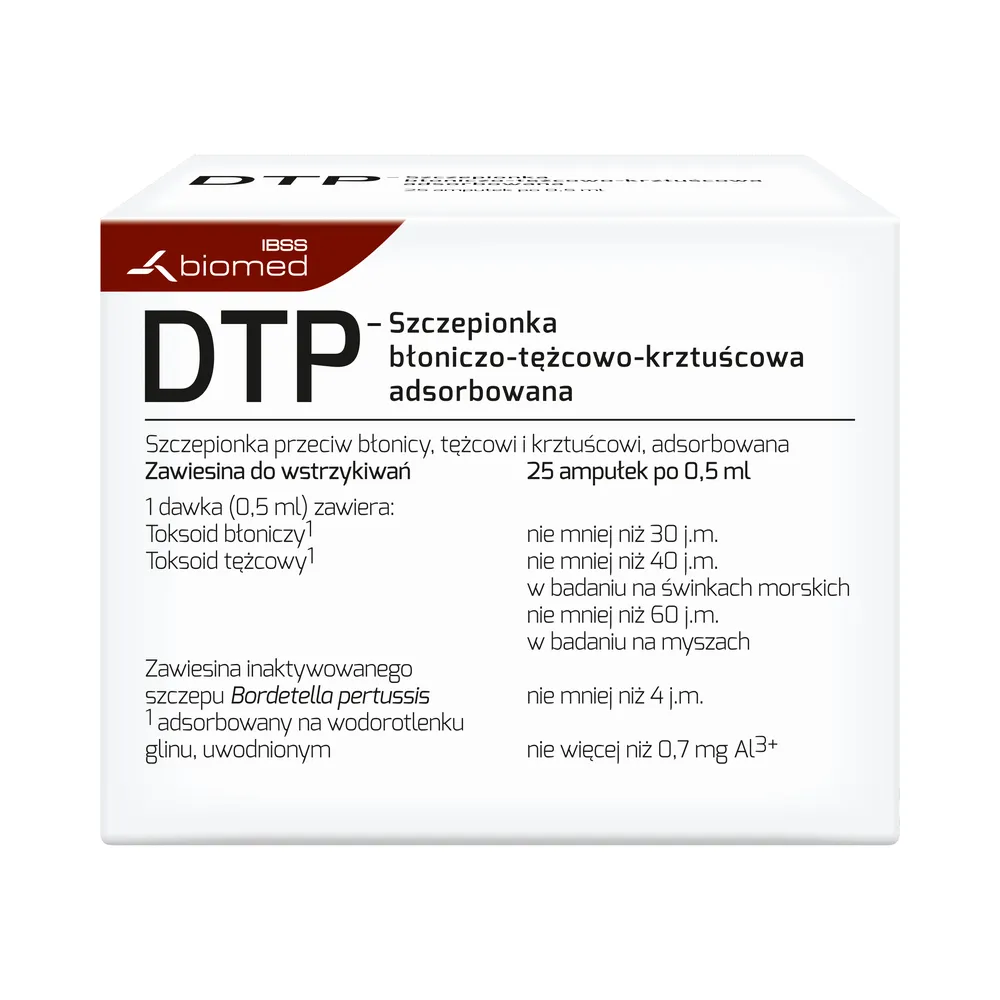
Table of Contents
- Package leaflet: Information for the user
- 1. What DTP – Adsorbed Diphtheria-Tetanus-Pertussis Vaccine (referred to below as DTP vaccine) is and what it is used for
- 2. Important information before administering the DTP vaccine
- 3. How to use the DTP vaccine
- 4. Possible adverse reactions
- 5. How to store DTP-Szczepionka błoniczo-tężcowo-krztuścowa adsorbowana
- 6. Contents of the packaging and other information
- Information intended exclusively for healthcare professionals
Package leaflet: Information for the user
DTP – Adsorbed Diphtheria-Tetanus-Pertussis Vaccine
suspension for injection
Vaccine against diphtheria, tetanus and pertussis, adsorbed
Not less than 30 I.U. of diphtheria toxoid, not less than 40 I.U. of tetanus toxoid and not less than 4 I.U. of inactivated Bordetella pertussis suspension / 0.5 ml
1 dose (0.5 ml)
Please read all of this leaflet carefully before the vaccine is administered, as it contains important information for the patient.
- Keep this leaflet, so that you can read it again if necessary.
- If you have any further questions, please consult your doctor, pharmacist or nurse.
- This vaccine has been prescribed for a specific individual. Do not pass it on to others.
- If any adverse reactions occur in the patient, including any adverse reactions not listed in this leaflet, inform your doctor, pharmacist or nurse. See section 4.
Contents of the leaflet
- What DTP – Adsorbed Diphtheria-Tetanus-Pertussis Vaccine (referred to below as DTP vaccine) is and what it is used for
- Important information before using the DTP vaccine
- How to use the DTP vaccine
- Possible side effects
- How to store the DTP vaccine
- Contents of the package and other information
1. What DTP – Adsorbed Diphtheria-Tetanus-Pertussis Vaccine (referred to below as DTP vaccine) is and what it is used for
The DTP vaccine protects against three diseases: diphtheria, tetanus and pertussis, caused by Corynebacterium diphtheriae, Clostridium tetani and Bordetella pertussis, respectively. The active substances of the vaccine are tetanus and diphtheria toxoids (non-infectious components derived from bacteria) and a suspension of inactivated Bordetella pertussis strain (whole-cell pertussis component of the vaccine). After administration, the child's body produces antibodies that protect against these diseases.
The immunogenic properties of the vaccine are enhanced by aluminium hydroxide (adjuvant).
The vaccine is intended for active immunization of children from the age of 6 weeks up to 2 years of age, in accordance with the National Immunization Programme, which provides information on these vaccinations.
Children who have not been vaccinated according to the recommended schedule may still be vaccinated up to the age of 3 years, provided there are no contraindications to whole-cell pertussis vaccination.
Adequate level of immunity is achieved after administration of all doses according to the National Immunization Programme.
2. Important information before administering the DTP vaccine
When not to use the DTP vaccine:
- if the child has:
- hypersensitivity to the active substances or any of the other components of this vaccine (listed in section 6). Symptoms of hypersensitivity include:
- rash or blistering rash, which may be itchy,
- swelling of the eyes and face,
- difficulty breathing and swallowing,
- sudden drop in blood pressure and loss of consciousness,
- acute illness with fever.
- chronic diseases during an exacerbation period. In such cases, vaccination should be postponed until the exacerbation has resolved,
- progressive neurological disorders,
- if within 2 days after previous administration of the vaccine, the child:
- experienced persistent, inconsolable crying or high-pitched screaming (encephalopathic cry) lasting for 3 hours or more,
- developed a body temperature of 40.5°C or higher, not caused by other factors,
- experienced loss of consciousness or a hypotonic-hyporeactive episode (limpness or decreased muscle tone, reduced and weakened response to external stimuli, skin discoloration (pallor or cyanosis)), possibly accompanied by breathing disturbances.
- if within 3 days after previous administration of the vaccine, the child:
- developed cerebral symptoms manifested by disturbances in consciousness and focal neurological signs,
- experienced seizures with or without fever,
- if within 7 days after previous administration of the pertussis (whooping cough) vaccine, the child developed nervous system disorders (encephalopathy).
If there are any contraindications to DTP vaccination with DTP-Szczepionka błoniczo-tężcowo-krztuścowa adsorbowana, the risk of administering the vaccine should be weighed against the risk of infection.
Warnings and precautions
Before administering the DTP vaccine, consult with a physician. Vaccination should be preceded by a medical examination and a review of the child's general health status and previously administered and documented vaccinations. This procedure helps predict the risk of adverse reactions following DTP vaccination.
Exercise special caution and inform the doctor if undesirable effects described in section 4 or any other concerning reactions occurred after a previous dose of the vaccine.
For safety reasons, the child should remain under medical observation for 30 minutes after vaccination.
The vaccine contains trace amounts of thiomersal; therefore, allergic reactions may occur in your child. Inform the doctor if your child has had or currently has known allergic reactions. You should also inform the doctor if any health disturbances occurred after previous vaccination.
DTP vaccine and other medicines
The DTP vaccine may be administered simultaneously with other vaccines according to the National Immunization Program, and with immunoglobulins if necessary (administration method of DTP together with other vaccines and immunoglobulins is described in section 3 of the leaflet).
In children undergoing immunosuppressive treatment (which suppresses immune system activity) or who have immune deficiencies, the immune response to the vaccine may be reduced.
In such cases, the doctor may decide to postpone vaccination until completion of therapy and order testing of post-vaccination antibody levels against tetanus, diphtheria, and pertussis.
When administering DTP-Szczepionka błoniczo-tężcowo-krztuścowa adsorbowana simultaneously with a conjugated pneumococcal vaccine, the doctor may recommend giving the child a medicine to reduce fever.
You should tell the doctor about all medicines and vaccines the child is currently taking or has recently taken, as well as any medicines or vaccines the child will receive in the future.
Pregnancy and breastfeeding
Not applicable. The vaccine is administered only to children.
Driving and operating machinery
Not applicable. The vaccine is administered only to children.
3. How to use the DTP vaccine
This vaccine should always be used as directed by a physician. If in doubt, consult your doctor.
The DTP vaccine will be administered by a doctor or nurse as an intramuscular injection.
The vaccine must never be administered intravenously.
For infants under 12 months of age, a dose of 0.5 ml should be given intramuscularly into the anterolateral aspect of the thigh. It is recommended to alternate injection sites for subsequent doses (opposite lower limb). In children over 12 months of age, the 0.5 ml dose may optionally be administered into the deltoid muscle, provided the child's muscle mass is sufficient.
Different vaccines and immunoglobulins administered simultaneously should be injected at different body sites, using separate syringes and needles.
Dosage
According to the current National Immunization Program, the vaccination schedule includes three primary doses administered during the first six months of life, given at intervals of 6–8 weeks, and a fourth dose as a booster vaccination in the second year of life, with the possibility of completing the vaccination series before the end of the third year of life.
Use of a higher than recommended dose of the DTP vaccine
Overdose is unlikely, as the packaging is single-dose.
In case of doubt, consult your doctor.
Interrupting use of the DTP vaccine
If you have any further questions regarding the use of this vaccine, consult your doctor, pharmacist, or nurse.
4. Possible adverse reactions
Like any vaccine, this vaccine may cause adverse reactions, although they do not occur
in everyone.
Unknown frequency (frequency cannot be determined from available data):
- enlargement and/or tenderness of lymph nodes,
- allergic reaction manifesting as:
- urticaria,
- rash (macular, papular, or maculopapular),
- swelling (including facial swelling with breathing difficulty – dyspnoea),
- anaphylactic shock,
- decreased or loss of appetite,
- persistent, inconsolable crying or high-pitched screaming (encephalitic cry) lasting 3 hours or longer,
- increased irritability, which usually resolves within 24–48 hours, restlessness,
- decreased responsiveness to stimuli,
- seizures with or without fever, accompanied by jaw clenching, increased muscle tone followed by decreased muscle tone (flaccidity),
- hypotonic-hyporesponsive episode, characterized by limpness or decreased muscle tone, reduced and weakened response to external stimuli, change in skin colour (pallor or cyanosis),
- neurological disorders,
- flaccid paralysis of the upper limb, which may be a symptom of brachial plexus neuritis,
- limited mobility and/or pain in the upper limb,
- muscle flaccidity,
- serum sickness,
- somnolence,
- tremors,
- swelling or change in skin colour of the lower limbs (redness, cyanosis), sometimes accompanied by mottling or petechiae, observed in cases of concomitant administration of DTP vaccine and Haemophilus influenzae type b vaccine, resolving spontaneously without long-term consequences,
- pallor, cyanosis, mottling, petechiae,
- apnoea in very premature infants (born before or at 28 weeks of gestation),
- breathing disorders,
- upper respiratory tract inflammation,
- cough,
- bronchitis,
- vomiting,
- diarrhoea,
- chills,
- fever of 39–40°C or higher,
- local reactions: redness, pain, swelling. Fever and local reactions usually resolve within 24–48 hours,
- decreased or loss of thirst,
- presence of adjuvant (aluminium hydroxide) in the vaccine may lead to formation of subcutaneous nodules (very rare, frequency 1/100,000), which may occasionally develop into sterile abscesses. Subcutaneous nodules that do not disappear within 6 weeks may result from sensitization to aluminium.
Reporting of adverse reactions
If any adverse reactions occur, including any adverse reactions not listed in this leaflet, inform a doctor, pharmacist, or nurse. Adverse reactions can be reported directly to the Department of Monitoring Adverse Drug Reactions, Office for Registration of Medicinal Products, Medical Devices and Biocidal Products, Al. Jerozolimskie 181C, 02-222 Warsaw, tel.: 22 49-21-301, fax: 22 49-21-309, website: https://smz.ezdrowie.gov.pl.
Adverse reactions can also be reported to the responsible entity.
Reporting adverse reactions helps to provide more information on the safety of the medicinal product.
5. How to store DTP-Szczepionka błoniczo-tężcowo-krztuścowa adsorbowana
Store upright in a refrigerator (2 °C - 8 °C).
Do not freeze. If frozen, destroy the vaccine.
Keep the vaccine out of the sight and reach of children.
Do not use this vaccine after the expiry date stated on the carton.
The expiry date refers to the last day of the stated month.
Medicines must not be disposed of via wastewater or household waste.
Ask your pharmacist how to dispose of medicines no longer required. This will help protect the environment.
6. Contents of the packaging and other information
What the DTP vaccine contains
The active substances of the vaccine are:
Diphtheria toxoid not less than 30 I.U.
Tetanus toxoid not less than 40 I.U.
Suspension of inactivated Bordetella pertussis strain not less than 4 I.U.
adsorbed on aluminium hydroxide, hydrated, containing not more than 0.7 milligrams of Al
The other ingredients are: sodium chloride and water for injections.
What the DTP vaccine looks like and contents of the pack
The vaccine is a white or almost white suspension in glass vials.
During storage, a white sediment forms at the bottom of the vial, with a clear supernatant (liquid) above it.
The vaccine is available in packs of 25 vials containing 0.5 ml each, in a cardboard box.
Marketing Authorisation Holder and Manufacturer
Institute of Serum and Vaccine Biotechnology BIOMED Joint Stock Company
Sosnowa Ave. 8
30-224 Kraków
Tel.: +48 12 37 69 200
Fax: +48 12 37 69 205
e-mail: [email protected]
Information intended exclusively for healthcare professionals
Administration of DTP vaccine
Shake well before use to obtain a uniform suspension.
Visually inspect the vaccine for the presence of any foreign particles and (or) any changes in its appearance. Do not use the vaccine if any changes are observed.
Administer a 0.5 mL dose intramuscularly.
Recommended injection sites are the deltoid muscle or the anterolateral thigh.
Do not administer intravenously! Ensure that the needle has not entered a blood vessel.
There are no data on immunogenicity and reactogenicity when the vaccine is administered subcutaneously in patients with coagulation disorders.
Warning: due to the risk of anaphylactic shock associated with vaccine administration, the vaccination room should be equipped with a standard anaphylaxis kit.