Driptane
Poland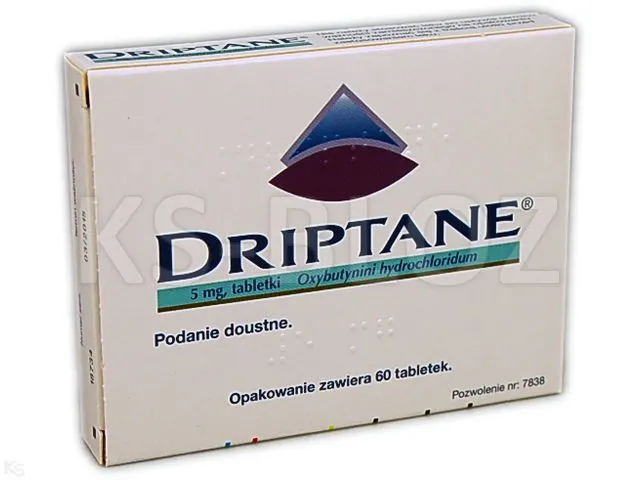
Table of Contents
Patient Information Leaflet
Caution! Please keep this leaflet. The information on the immediate packaging is in a foreign language.
Driptane
5 mg, tablets
Oxybutynini hydrochloridum
Please read the following information carefully before taking this medicine, as it contains
important information for the patient.
- Keep this leaflet for future reference.
- If you have any doubts, please consult your doctor or pharmacist.
- This medicine has been prescribed for a specific individual. Do not share it with others. This medicine may harm someone else, even if their symptoms are similar.
- If you experience any adverse reactions, including those not listed in this leaflet, inform your doctor, pharmacist, or nurse.
Table of Contents
- What Driptane is and what it is used for
- Important information before taking Driptane
- How to take Driptane
- Possible side effects
- How to store Driptane
- Contents of the package and other information
1. What Driptane is and what it is used for
Driptane contains the active substance oxybutynini hydrochloridum (oxybutynin hydrochloride) and belongs to a group of medicines called spasmolytics. It relaxes the detrusor muscle of the urinary bladder, increases bladder capacity, and delays the urge to urinate.
Indications:
Driptane is used to relieve symptoms of unstable bladder and urinary disorders in patients with neurogenic bladder—detrusor hyperreflexia (urgent need to urinate, urinary incontinence, difficulty passing urine).
Driptane is used in children aged 5 years and older in the following cases:
- Loss of control over urination (urinary incontinence)
- Frequent urination or sudden urge to urinate
- Nocturnal enuresis (bedwetting), when other treatments have not been effective.
2. Important information before taking Driptane
When not to take Driptane
- if the patient is allergic to the active substance or any of the other ingredients of this medicine (listed in section 6)
- if there is urinary outflow obstruction, when urine retention may occur
- if gastrointestinal disorders are present, such as gastrointestinal obstruction, intestinal atony, paralytic ileus, toxic megacolon, or severe form of ulcerative colitis
- if the patient has a muscle disease called myasthenia gravis
- if the patient has a condition of the eye called narrow-angle glaucoma or shallow anterior chamber.
Warnings and precautions
Driptane should be used with caution in elderly individuals with frail body build and in children, who may be more sensitive to this medicine, as well as in patients with autonomic nervous system dysfunction (such as patients with Parkinson's disease), impaired liver or kidney function, severe gastrointestinal motility disorders, and cerebral circulation disorders.
Driptane should be used with caution in elderly patients due to the risk of cognitive function disturbances.
Driptane may worsen symptoms of hyperthyroidism, coronary heart disease, congestive heart failure, benign prostatic hyperplasia, arterial hypertension, cognitive impairments, as well as cardiac arrhythmias and increased heart rate.
Monitoring of the patient is recommended, especially during the first few months after initiation of treatment or dose increase. The physician may consider discontinuing treatment or reducing the dose if central nervous system effects occur (e.g. hallucinations, agitation, confusion, drowsiness).
Since Driptane may cause narrow-angle glaucoma (an eye condition), immediate medical attention should be sought in case of sudden loss of visual acuity or eye pain.
Chronic use of Driptane may lead to dental caries, periodontitis, or oral candidiasis due to reduced or inhibited salivary secretion. Regular dental check-ups are recommended during prolonged treatment.
Driptane should be used with caution in patients with hiatal hernia, gastroesophageal reflux, and/or those currently taking medications (such as bisphosphonates used in osteoporosis and bone diseases) that may cause or exacerbate esophagitis.
Taking Driptane in high environmental temperatures may lead to heat stroke due to reduced sweating.
Driptane is considered unsafe in patients with porphyria (a rare genetic disorder involving disturbances in heme synthesis).
Children and adolescents
The use of oxybutynin is not recommended in children under 5 years of age. The safety of oxybutynin has not been established in this age group.
Caution should be exercised when using Driptane in children aged 5 years and older due to possible increased sensitivity to the drug's effects, particularly regarding adverse effects on the central nervous system and psychiatric symptoms.
Driptane with other medicines
Inform your doctor or pharmacist about all medicines currently taken or recently used, as well as any medicines planned for use.
Inform your doctor if you are taking:
- other anticholinergic drugs (such as amantadine, other anticholinergics used in Parkinson's disease (e.g. biperiden, levodopa), antihistamines, antipsychotics (e.g. phenothiazine derivatives, butyrophenones, clozapine), quinidine, digitalis preparations, tricyclic antidepressants, atropine and related substances such as atropine-based antispasmodics and dipyridamole), as their effects may be intensified.
By reducing gastrointestinal motility, oxybutynin may affect the absorption of other drugs.
Oxybutynin is metabolized by cytochrome P450 isoenzyme CYP3A4. Concomitant use of CYP3A4 inhibitors (e.g. itraconazole – an antifungal medicine) may inhibit oxybutynin metabolism and increase its effects. Oxybutynin may reduce the effectiveness of prokinetic drugs.
Concomitant use with cholinesterase inhibitors may reduce the efficacy of cholinesterase inhibitors.
Driptane with food, drink, and alcohol
Alcohol may intensify drowsiness caused by Driptane.
Pregnancy, breastfeeding, and fertility
If the patient is pregnant, breastfeeding, suspects she may be pregnant, or is planning pregnancy, she should consult a doctor or pharmacist before using this medicine.
Pregnancy
There are insufficient data on the safety of Driptane during pregnancy. Animal studies have shown adverse effects on reproduction at doses toxic to the mother. The potential risk in humans is unknown. Driptane should be avoided during pregnancy unless absolutely necessary.
Breastfeeding
Oxybutynin passes into breast milk in small amounts when taken during breastfeeding.
Therefore, Driptane should not be taken during breastfeeding.
Effect on fertility
There are no adequate data in humans. Animal studies did not show harmful effects on fertility in males or females.
Driving and operating machinery
The medicine may cause blurred vision or drowsiness. Caution should be exercised when performing tasks requiring concentration, such as driving vehicles, operating machinery, or performing hazardous work while taking this medicine.
Driptane contains lactose (a type of sugar). If the patient has previously been diagnosed with intolerance to certain sugars, the patient should consult a doctor before taking this medicine.
3. How to take Driptane
This medicine should always be taken as directed by a doctor or pharmacist. If in doubt,
consult a doctor or pharmacist.
Adults
The usual dose for adults is 5 mg (1 tablet) two or three times daily.
Maximum dose for adults – 4 tablets per day.
Elderly patients
In elderly patients, the drug's half-life is prolonged; therefore, a dose of 2.5 mg (0.5
tablet) twice daily is sufficient. The dose may be increased to 5 mg (1 tablet) twice daily if
the patient tolerates the medicine well.
Children from 5 years of age
Neurogenic bladder: the usual dose for children from 5 years of age is 2.5 mg (0.5 tablet) twice daily.
The dose may be increased to 5 mg (1 tablet) two or three times daily provided the child tolerates the medicine well.
Nocturnal enuresis: the usual dose for children from 5 years of age is 2.5 mg (0.5 tablet) twice daily.
The dose may be increased to 5 mg (1 tablet) two or three times daily provided the child tolerates the medicine well.
The last dose of the day should be taken before bedtime.
The tablet has a score line, allowing for easy splitting into halves of 2.5 mg to reduce the dose.
Method of administration
The tablet should be swallowed whole with water.
Taking more Driptane than recommended
Symptoms of Driptane overdose are related to an intensification of the adverse effects usually observed on the central nervous system (ranging from anxiety and agitation to psychotic behavior). Circulatory disturbances (facial flushing, hypotension, circulatory failure, etc.), respiratory failure, paralysis, and coma may occur.
In case of overdose, seek immediate medical advice.
Missed dose of Driptane
Do not take a double dose to make up for a missed dose.
If a dose is missed, take the next dose at the scheduled time as usual.
4. Possible adverse reactions
Like all medicines, this medicine can cause adverse reactions, although they do not occur in everyone.
Very common adverse reactions (may affect more than 1 in 10 people)
- constipation, nausea, dryness of the oral mucosa
- dizziness, headache, drowsiness
- dry skin
- blurred vision
Common adverse reactions (may affect up to 1 in 10 people)
- diarrhoea, vomiting
- states of disorientation
- dryness of the ocular mucosa
- urinary retention
- facial skin flushing
- strong heartbeat, which may be rapid or irregular
Uncommon adverse reactions (may affect up to 1 in 100 people)
- discomfort in the abdominal area, anorexia (loss of appetite), decreased appetite, swallowing disorders
Frequency not known (cannot be estimated from available data)
- urinary tract infections
- gastro-oesophageal reflux, pseudo-obstruction in patients at risk (elderly patients or patients with constipation and treated with other medicines reducing intestinal motility)
- restlessness, anxiety, hallucinations, nightmares, delusions, cognitive disorders in elderly patients, symptoms of depression, dependence (in patients with history of drug or substance abuse), disorientation, delirium
- cognitive disorders, convulsions
- tachycardia, cardiac arrhythmias
- heat stroke
- angle-closure glaucoma, mydriasis, increased intraocular pressure
- disturbances in urination
- angioedema, rash, urticaria, decreased sweating, photophobia
- hypersensitivity reactions
- nosebleeds
- muscular disorders (muscle weakness, pain, cramps)
Reporting of adverse reactions
If any adverse reactions occur, including any adverse reactions not listed
in this leaflet, please inform your doctor, pharmacist or nurse. Adverse reactions
can be reported directly to the Department of Monitoring Adverse Drug Reactions of the Office for Registration of Medicinal Products, Medical Devices and Biocidal Products:
Al. Jerozolimskie 181C, 02-222 Warsaw, tel.: + 48 22 49-21-301, fax: + 48 22 49-21-309, website: https://smz.ezdrowie.gov.pl
By reporting adverse reactions, additional information on the safety of the medicine can be collected.
5. How to store Driptane
Keep this medicine out of sight and reach of children.
Do not use this medicine after the expiry date stated on the packaging. The expiry date refers to the last day of the specified month.
Store below 30°C.
Medicines must not be disposed of via wastewater or household waste. Ask your pharmacist how to dispose of medicines no longer in use. Proper disposal helps protect the environment.
6. Contents of the pack and other information
What Driptane contains
- The active substance is oxybutynin chloride. Each tablet contains 5 mg of oxybutynin chloride.
- The other components are: microcrystalline cellulose, calcium stearate, lactose.
What Driptane looks like and contents of the pack
Packs containing 30 or 60 tablets.
For further information, please contact the responsible party or the parallel importer.
Responsible entity in Romania, country of export:
Viatris Healthcare Limited
Damastown Industrial Park, Mulhuddart, Dublin 15, Dublin, Ireland
Manufacturer:
Astrea Fontaine
Rue des Près Potets
21121 Fontaine lès Dijon
France
Parallel importer:
Delfarma Sp. z o.o.
ul. Św. Teresy od Dzieciątka Jezus 111, 91-222 Łódź
Repackaged in:
Delfarma Sp. z o.o.
ul. Św. Teresy od Dzieciątka Jezus 111, 91-222 Łódź
Permit number in Romania, country of export: 9945/2017/01
Parallel import permit number: 378/25