Dorzolamide + timolol misom
Poland
Table of Contents
- Package leaflet: Information for the user
- 1. What Dorzolamid+Timolol Misom is and what it is used for
- 2. Important information before using Dorzolamid+Timolol Misom
- 3. How to use Dorzolamid+Timolol Misom
- 4. Possible adverse reactions
- 5. How to store Dorzolamid+Timolol Misom
- 6. Contents of the packaging and other information
Package leaflet: Information for the user
Dorzolamid+Timolol Misom, 20 mg/mL + 5 mg/mL, eye drops, solution in single-dose container
Dorzolamidum + Timololum
Please read this leaflet carefully before using this medicine because it contains important information for you.
- Keep this leaflet. You may need to read it again.
- If you have any questions, ask your doctor or pharmacist.
- This medicine has been prescribed for a specific individual. Do not pass it on to others. It may harm them even if their symptoms are the same.
- If you experience any adverse reactions, including any not listed in this leaflet, inform your doctor or pharmacist. See section 4.
Contents of the leaflet
- What Dorzolamid+Timolol Misom is and what it is used for
- Important information before using Dorzolamid+Timolol Misom
- How to use Dorzolamid+Timolol Misom
- Possible side effects
- How to store Dorzolamid+Timolol Misom
- Contents of the pack and other information
1. What Dorzolamid+Timolol Misom is and what it is used for
Dorzolamid+Timolol Misom contains two active substances: dorzolamide and timolol.
- Dorzolamide belongs to a group of medicines called "carbonic anhydrase inhibitors".
- Timolol belongs to a group of medicines called "beta-blockers".
These medicines reduce intraocular pressure through two different mechanisms.
Dorzolamid+Timolol Misom is indicated for the treatment of glaucoma to reduce elevated intraocular pressure when treatment with eye drops containing only a beta-adrenergic receptor blocker is insufficient.
2. Important information before using Dorzolamid+Timolol Misom
When not to use Dorzolamid+Timolol Misom
- if the patient is allergic to dorzolamide hydrochloride, timolol maleate, or any of the other ingredients of this medicine (listed in section 6),
- if the patient currently has or has previously had respiratory disorders such as asthma or severe chronic obstructive pulmonary disease (a serious lung condition that may cause wheezing, breathing difficulties, and/or long-lasting cough),
- if the patient has bradycardia (slow heart rate), heart failure, or cardiac arrhythmias (irregular heartbeat),
- if the patient has severe kidney disease, severe renal dysfunction, or a history of kidney stones,
- if the patient has hyperchloremic acidosis (excessive blood acidity due to accumulation of chloride ions in the body). If in doubt about whether this medicine can be used, consult a doctor or pharmacist.
Warnings and precautions
Before starting treatment with Dorzolamid+Timolol Misom, discuss this with your doctor or
pharmacist.
Inform your doctor about any current or past eye disorders and medical conditions, including:
- ischemic heart disease (symptoms include chest pain or pressure, shortness of breath, or a choking sensation), heart failure, or low blood pressure;
- disturbances in heart rate, such as bradycardia;
- breathing problems, asthma, or chronic obstructive pulmonary disease;
- disorders associated with poor blood circulation (such as Raynaud's disease or Raynaud's syndrome);
- diabetes, because timolol may mask the signs and symptoms of hypoglycemia (low blood sugar);
- hyperthyroidism, because timolol may mask its signs and symptoms.
Before undergoing surgery, inform the attending physician that you are using Dorzolamid+Timolol Misom, as timolol may alter the effects of certain anesthetic drugs.
Also inform your doctor about any allergies and allergic reactions, including such as urticaria, facial swelling, swelling of the lips, tongue, and/or throat, which may cause difficulty in breathing and swallowing.
Inform your doctor if the patient has experienced muscle weakness or has been diagnosed with myasthenia gravis (Myasthenia gravis).
If eye irritation or any new eye problem occurs, such as eye redness or eyelid swelling, consult a doctor immediately.
If the patient suspects that Dorzolamid+Timolol Misom is causing an allergic reaction or hypersensitivity (e.g. skin rash, severe skin reaction, eye redness or itching), discontinue use of this medicine and contact a doctor immediately.
Inform your doctor if an eye infection occurs, if the eye has been injured, after eye surgery, or if a reaction occurs accompanied by new or worsening symptoms.
After ocular administration, Dorzolamid+Timolol Misom may have systemic effects throughout the body.
Children
Experience with the use of medicines containing dorzolamide and timolol in infants and children is limited.
Elderly patients
In clinical studies with the combination of dorzolamide and timolol, similar effects were observed in elderly and younger patients.
Patients with liver function disorders
Inform your doctor about any current or past liver diseases.
Dorzolamid+Timolol Misom and other medicines
Dorzolamid+Timolol Misom may interact with other medicines the patient is taking, including other eye drops used in the treatment of glaucoma. This also applies to other ophthalmic anti-glaucoma medications.
Inform your doctor if you are taking or plan to take medicines that lower blood pressure, heart medications, or antidiabetic drugs. Tell your doctor or pharmacist about all medicines currently being taken or recently used (including those available without a prescription), as well as any medicines the patient plans to use. This is particularly important when:
- taking medicines that lower blood pressure or are used for heart conditions (such as calcium channel blockers, beta-adrenergic receptor antagonists, or digoxin);
- taking medicines used for cardiac arrhythmias or to restore regular heart rhythm (such as calcium channel blockers, beta-adrenergic receptor antagonists, or digoxin);
- using other eye drops containing beta-adrenergic receptor antagonists;
- taking other carbonic anhydrase inhibitors, such as acetazolamide;
- taking monoamine oxidase inhibitors (MAOIs), used in the treatment of depression;
- taking parasympathomimetic drugs, which may be used for urinary disorders. Parasympathomimetic drugs are also sometimes used to restore normal intestinal motility;
- taking opioids such as morphine, used to treat moderate to severe pain;
- taking antidiabetic medicines;
- taking antidepressants such as fluoxetine and paroxetine;
- taking sulfonamide drugs;
- taking quinidine (a medicine used to treat heart conditions and certain forms of malaria).
Pregnancy and breastfeeding
If the patient is pregnant or breastfeeding, suspects she may be pregnant, or is planning to have a child, she should consult her doctor or pharmacist before using this medicine.
Use during pregnancy
Do not use Dorzolamid+Timolol Misom during pregnancy unless considered necessary by a doctor.
Use during breastfeeding
Dorzolamid+Timolol Misom should not be used during breastfeeding. Timolol may pass into human milk. Consult a doctor before taking any medicine while breastfeeding.
Driving and operating machinery
No studies on the effects on the ability to drive or operate machinery have been conducted. Some adverse effects associated with the use of Dorzolamid+Timolol Misom, such as blurred vision, may affect the ability to drive and/or operate machinery. Patients should refrain from driving or operating machinery until these symptoms have completely resolved.
3. How to use Dorzolamid+Timolol Misom
This medicine should always be used exactly as prescribed by your doctor. If in doubt, consult your
doctor or pharmacist. Your doctor will determine the appropriate dose and duration of treatment.
The recommended dose is one drop into the affected eye(s) in the morning and evening.
If this medicine is used together with other eye drops, the drops should be administered at least
10 minutes apart.
Do not change the dose of this medicine without consulting your doctor.
If you have difficulty administering the drops, ask for help from a family member or caregiver.
Do not allow any part of the container to touch the eye or surrounding area. This may cause eye
injury. It may also lead to bacterial contamination, which could result in an eye infection causing
serious damage to the eye, and even loss of vision. To avoid possible contamination of the single-dose container, wash your hands before using this medicine and avoid contact between the dropper tip and any surface.
A new single-dose container should be opened immediately before each use; each container contains sufficient solution for both eyes if your doctor has instructed you to use the drops in both eyes. Any opened container with remaining solution must be discarded immediately after use.
Instructions for use
Open the foil pouch containing individual single-dose containers. Write the date of first opening on the pouch.
Each time using Dorzolamid+Timolol Misom
- Wash your hands
- Remove the strip of containers from the pouch
- Detach one single-dose container from the strip
- Return the strip with remaining containers back into the pouch and fold the edge to close the pouch
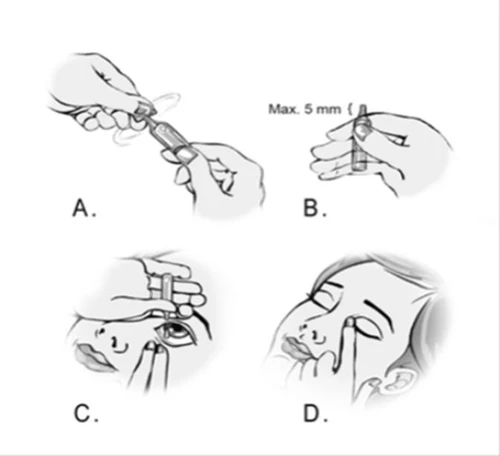
- To open the container, unscrew the cap. (Figure A)
- Hold the container between your thumb and index finger. Remember that the tip of the container should not extend more than 5 mm beyond the edge of your index finger. (Figure B)
- Tilt your head backward or lie down. Place your hand on your forehead. Your index finger should be aligned with your eyebrow or resting on the bridge of your nose. Look upward. Pull the lower eyelid downward with the other hand. Do not allow any part of the container to touch the eye or surrounding area. Gently squeeze the container so that one drop enters the space between the eyelid and the eye (Figure C). Do not blink while administering the drop. Each single-dose container contains sufficient solution for both eyes.
- Close the eye and press with your finger on the inner corner of the eye for about two minutes. This helps prevent the medicine from being absorbed into the rest of the body (Figure D).
- Wipe away any excess solution from the skin around the eye.
If your doctor has instructed you to use the drops in both eyes, repeat steps 7 to 9 for the second eye.
After instilling the drops into the eye(s), discard the used single-dose container, even if some
solution remains, to avoid contamination of the preservative-free solution.
Store the remaining containers in the foil pouch; the remaining containers may be used within 15 days of opening the pouch. If any containers remain after 15 days from opening the pouch, they should be safely discarded and a new pouch opened. It is important to continue using the eye drops as directed by your doctor.
If you have any doubts about how to use this medicine, ask your doctor, pharmacist, or nurse.
Use of a higher than recommended dose of Dorzolamid+Timolol Misom
If too many drops are administered into the eye or if the contents of the container are swallowed, symptoms such as dizziness, difficulty breathing, or a sensation of slowed heart rate may occur among others. Contact your doctor immediately.
Missed dose of Dorzolamid+Timolol Misom
This medicine should be used exactly as directed by your doctor.
If you miss a dose, use it as soon as possible. However, if it is almost time for the next dose, do not administer the missed dose and return to your regular dosing schedule.
Do not use a double dose to make up for a missed dose.
Stopping Dorzolamid+Timolol Misom
Before stopping this medicine, consult your doctor.
If you have any further questions about using this medicine, consult your doctor or pharmacist.
4. Possible adverse reactions
Like all medicines, Dorzolamid+Timolol Misom may cause adverse reactions, although not
everyone will experience them.
Serious adverse reactions:
If any of the following adverse reactions occur, discontinue use of this
medication immediately and seek medical help at once, as these may be symptoms of an allergic reaction.
Generalized allergic reactions, including subcutaneous swelling, may occur in the facial area and
limbs and may cause airway obstruction and difficulty swallowing, shortness of breath,
urticaria or itchy rash, localized and generalized rash, pruritus, as well as severe, sudden, and
life-threatening allergic reactions.
During clinical trials or after market introduction of eye drop solutions containing
dorzolamide and timolol, the following adverse reactions related to this product or to one of
its active ingredients have been reported:
Very common (may affect more than 1 in 10 people):
- Burning and stinging sensation in the eye, altered taste sensation.
Common (may affect up to 1 in 10 people):
- Redness of the eyes and surrounding skin (around the eyes)
- Tearing or itchy eyes
- Corneal abrasions (damage to the front layer of the eyeball)
- Swelling and/or irritation of the eyes and skin around the eyes
- Foreign body sensation in the eye
- Decreased corneal sensitivity (inability to feel a foreign body in the eye or inability to feel pain)
- Eye pain
- Dry eyes
- Blurred vision
- Headache, sinusitis (feeling of pressure or fullness in the nose)
- Malaise, nausea, weakness, and fatigue
Uncommon (may affect up to 1 in 100 people):
- Dizziness
- Depression
- Iritis (inflammation of the iris)
- Visual disturbances, including refractive changes (in some cases caused by discontinuation of medications used to treat excessive pupil constriction)
- Slowed heart rate
- Fainting
- Breathing difficulties (dyspnea)
- Indigestion
- Kidney stones
Rare (may affect up to 1 in 1,000 people):
- Systemic lupus erythematosus (an autoimmune disease that may cause inflammation of internal organs)
- Tingling or numbness of hands or feet
- Insomnia
- Nightmares
- Memory loss
- Worsening of objective and subjective symptoms of myasthenia (a muscle disorder)
- Decreased libido
- Stroke
- Transient myopia that may resolve after discontinuation of the medication
- Choroidal detachment following filtration surgery, a layer beneath the retina containing blood vessels, which may lead to visual disturbances
- Ptosis (drooping eyelid, with eyelids half-closed)
- Double vision
- Crusting of the eyelids
- Corneal edema (with subjective visual disturbances)
- Low intraocular pressure
- Tinnitus (ringing in the ears)
- Low blood pressure
- Changes in heart rhythm or heart rate
- Congestive heart failure (a heart condition characterized by shortness of breath and swelling of feet and legs due to fluid accumulation)
- Edema (fluid accumulation)
- Cerebral ischemia (reduced blood flow to the brain)
- Chest pain
- Palpitations (rapid and/or irregular heartbeat)
- Heart attack
- Raynaud's phenomenon, swelling of hands and feet or cold hands and feet, and poor circulation in upper and lower limbs
- Leg muscle cramps and/or leg pain while walking (claudication)
- Dyspnea (shortness of breath)
- Respiratory failure
- Catarrh or nasal congestion
- Nosebleeds
- Bronchoconstriction in the lungs causing breathing difficulties
- Cough
- Sore throat
- Dry mouth
- Diarrhea
- Contact dermatitis
- Hair loss
- Silvery-white rash (psoriasis-like rash)
- Peyronie's disease (which may lead to penile curvature), allergic reactions such as rash, urticaria, pruritus; in rare cases, swelling of the lips, eyelids, and oral cavity may also occur
- Wheezing or severe skin reactions (Stevens-Johnson syndrome, toxic epidermal necrolysis)
Like other medicines administered locally into the eyes, timolol may be absorbed into the bloodstream, which
may result in adverse reactions similar to those observed after oral administration of
beta-adrenergic receptor blocking agents. Adverse reactions occur less frequently with topical
eye drops than with systemic administration, such as oral or injectable forms.
Among the additional adverse reactions listed above are those typical of the therapeutic class of beta-adrenergic blocking agents used in eye diseases.
Unknown (frequency cannot be estimated from available data):
Low blood sugar levels, heart failure, cardiac arrhythmias, abdominal pain, vomiting, muscle pain unrelated to physical exertion, sexual dysfunction, hallucinations, foreign body sensation in the eye (feeling that something is in the eye).
Reporting of adverse reactions
If any adverse symptoms occur, including any not listed in this leaflet, inform your doctor or pharmacist. Adverse reactions can be reported directly to the Department for Monitoring Adverse Drug Reactions of the Office for Registration of Medicinal Products, Medical Devices and Biocidal Products
Al. Jerozolimskie 181C
PL-02 222 Warsaw
Tel.: + 48 22 49 21 301
Fax: + 48 22 49 21 309
Website: https://smz.ezdrowie.gov.pl
By reporting adverse reactions, additional information on the safety of this medicine can be collected.
Adverse reactions can also be reported to the responsible entity.
5. How to store Dorzolamid+Timolol Misom
Keep this medicine out of sight and reach of children.
Do not use this medicine after the expiry date, which is stated on the carton, sachet, and single-dose container, marked as EXP. The first two digits indicate the month, and the remaining four digits indicate the year. The expiry date refers to the last day of the specified month.
Store below 25°C.
Keep the single-dose containers in the original aluminium sachet to protect from light.
The shelf life of unopened single-dose containers of Dorzolamid + Timolol Misom is 15 days after first opening the sachet.
After this period, all unused single-dose containers must be discarded.
After opening a single-dose container, use immediately and dispose of the container with any remaining solution immediately after first use.
Medicines must not be disposed of via wastewater or household waste. Ask your pharmacist how to dispose of medicines no longer required. This will help protect the environment.
6. Contents of the packaging and other information
What the medicinal product contains Dorzolamid+Timolol Misom
- The active substances are dorzolamide and timolol.
- Each millilitre of solution contains 20 mg of dorzolamide (as 22.26 mg dorzolamide hydrochloride) and 5 mg of timolol (as 6.83 mg timolol maleate).
- The other components are hydroxyethylcellulose, mannitol, sodium citrate, sodium hydroxide (for pH adjustment) and water for injections.
What Dorzolamid+Timolol Misom looks like and contents of the pack
Dorzolamid+Timolol Misom is a clear, colourless, slightly viscous solution.
Each foil sachet contains 15 or 10 single-dose containers made of low-density polyethylene, each containing 0.2 ml of solution.
Pack sizes:
10 x 0.2 ml (1 sachet containing 10 single-dose containers)
15 x 0.2 ml (1 sachet containing 15 single-dose containers)
30 x 0.2 ml (2 sachets containing 15 single-dose containers each or 3 foil sachets containing 10 single-dose containers each)
50 x 0.2 ml (5 sachets, each containing 10 single-dose containers)
60 x 0.2 ml (4 sachets containing 15 single-dose containers each or 6 sachets containing 10 single-dose containers each)
90 x 0.2 ml (6 sachets containing 15 single-dose containers each or 9 sachets containing 10 single-dose containers each)
100 x 0.2 ml (10 sachets, each containing 10 single-dose containers)
120 x 0.2 ml (8 sachets containing 15 single-dose containers each or 12 sachets containing 10 single-dose containers each).
Not all pack sizes may be marketed.
Marketing Authorisation Holder
Brown & Burk IR Limited
22 Northumberland Road,
Ballsbridge, Dublin 4, Ireland.
Importer
Eurofins Analytical Services Hungary Kft.
Anonymus Utca 6,
1045 Budapest
Hungary