Doxium 500
Poland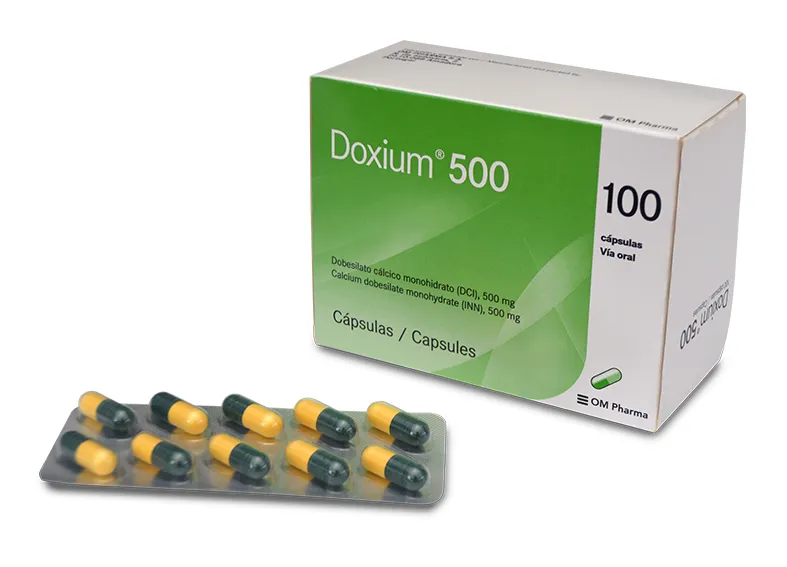
Table of Contents
PACKAGE LEAFLET: INFORMATION FOR THE USER
DOXIUM 500, 500 mg, hard capsules
Calcii dobesilas
Please read the entire leaflet carefully before taking this medicine, as it contains
important information for the patient.
- Keep this leaflet, so that you can read it again if necessary.
- If you have any doubts, please consult your doctor or pharmacist.
- This medicine has been prescribed for a specific individual. Do not give it to others. The medicine may harm another person, even if their symptoms are the same.
- If you experience any adverse reactions, including any not listed in this leaflet, inform your doctor or pharmacist. See section 4.
Contents of the leaflet
- What DOXIUM 500 is and what it is used for
- Important information before taking DOXIUM 500
- How to take DOXIUM 500
- Possible side effects
- How to store DOXIUM 500
- Contents of the package and other information
1. WHAT DOXIUM 500 IS AND WHAT IT IS USED FOR
Indications:
Clinical symptoms of chronic venous insufficiency of the lower limbs (pain, cramps, paresthesia, edema, skin changes due to blood stasis), mild to moderate non-proliferative diabetic retinopathy, to delay disease progression.
2. IMPORTANT INFORMATION BEFORE TAKING DOXIUM 500
When not to take DOXIUM 500
- if the patient is allergic to calcium dobesilate or any of the other ingredients of this medicine (listed in section 6).
Warnings and precautions
Before starting treatment with DOXIUM 500, discuss this with your doctor or pharmacist.
In very rare cases, administration of DOXIUM 500 may cause agranulocytosis –
a condition in which a significant decrease in white blood cells increases the risk of
infections. In such cases, symptoms such as high fever, oral infections (tonsillitis),
sore throat, inflammatory changes in the genital and anal areas, and other symptoms
that usually indicate the presence of infection may occur. If such symptoms occur, treatment must be stopped immediately and the doctor should be informed.
DOXIUM 500 may cause severe allergic reactions (anaphylactic reaction or anaphylactic shock) with symptoms such as skin reactions, fever, difficulty breathing, or dizziness. In such cases, treatment must be stopped immediately and the doctor should be informed.
Clean 1.3.1.EN-EN-EN Pg. 1
You should also tell your doctor:
- if the patient has kidney disease, especially if dialysis is required, as dose reduction may be necessary.
- If the patient is to undergo laboratory tests during treatment with DOXIUM 500, blood samples and other laboratory specimens should be collected before taking the first dose of the medicine to minimize potential interference of DOXIUM 500 with test results.
Children and adolescents
The safety and efficacy of DOXIUM 500 have not been evaluated in children and adolescents.
DOXIUM 500 and other medicines
You must inform your doctor or pharmacist about all medicines currently taken or recently taken, as well as any medicines you plan to take.
To date, no confirmed cases of interactions between DOXIUM 500 and other medicines are known.
DOXIUM 500 may affect laboratory test results for serum creatinine levels.
Therefore, you should inform your doctor about all laboratory tests, especially those assessing kidney function.
Pregnancy, breastfeeding and fertility
If the patient is pregnant or breastfeeding, suspects she may be pregnant, or is planning to have a child, she should consult a doctor or pharmacist before using this medicine.
Pregnancy
There are no data indicating that DOXIUM 500 has adverse effects on the embryo or fetus; however, this medicine should not be used during pregnancy.
Breastfeeding
After oral administration, the active substance of DOXIUM 500, calcium dobesilate, passes into breast milk in very small amounts. For safety reasons, either treatment or breastfeeding should be discontinued. In such a case, consult your doctor.
Driving and operating machinery
DOXIUM 500 has no influence on the ability to drive or operate machinery.
3. HOW TO TAKE DOXIUM 500
This medicine should always be taken as directed by a doctor or pharmacist. If in doubt, consult a doctor or pharmacist.
Dosage
For adults only
Recommended dose:
Diabetic retinopathy: 1000 to 1500 mg/day (500 mg two to three times daily)
Chronic venous insufficiency: 500 to 1000 mg/day (500 or 1000 mg once daily).
The dose should be individually adjusted according to the severity of symptoms. The duration of treatment depends on the type and course of the disease and usually lasts from several weeks to several months.
Patients with renal impairment
The safety and efficacy of DOXIUM 500 in patients with impaired renal function have not been evaluated. Since the drug is excreted via the kidneys, caution should be exercised, and in patients with renal impairment (especially those requiring dialysis), the dose of DOXIUM 500 may need to be reduced.
Clean 1.3.1.PL-PL-PL Pg. 2
Patients with hepatic impairment
The safety and efficacy of DOXIUM 500 in patients with impaired liver function have not been evaluated; therefore, caution is advised.
If you feel that the effect of DOXIUM 500 is too strong or too weak, consult your doctor or pharmacist.
Method of administration
DOXIUM 500 is taken orally. The capsules should be swallowed whole, without opening them.
To minimize any potential stomach discomfort, DOXIUM 500 capsules should be taken during or immediately after a meal.
Taking more DOXIUM 500 than recommended
There have been no reported cases of overdose so far.
Missing a dose of DOXIUM 500
Do not take a double dose to make up for a missed capsule.
Stopping DOXIUM 500 treatment prematurely
Stopping treatment with DOXIUM 500 before completing the prescribed course may negatively affect treatment outcome. Do not discontinue therapy without consulting your doctor.
If you have any further questions about the use of this medicine, consult your doctor or pharmacist.
4. POSSIBLE ADVERSE REACTIONS
Like all medicines, this medicine can cause adverse reactions, although not everyone experiences them.
Common adverse reactions (may occur in up to 1 in 10 patients):
Abdominal pain, nausea, diarrhoea, vomiting, headache, joint pain, muscle pain, increased alanine aminotransferase activity (a change in liver function which can be detected in blood tests).
Uncommon adverse reactions (may occur in up to 1 in 100 patients):
Fever, chills, feeling unwell, fatigue, hypersensitivity (rash, allergic dermatitis, itching, urticaria, facial swelling; see section "Warnings and precautions").
Very rare adverse reactions (may occur in up to 1 in 10,000 patients):
Marked decrease in the number of certain white blood cells leading to increased risk of infection (agranulocytosis; see section "Warnings and precautions"), severe allergic reaction leading to breathing difficulties or dizziness (anaphylactic reaction; see section "Warnings and precautions").
Frequency not known (frequency cannot be estimated from the available data):
Reduced number of white blood cells called neutrophils (neutropenia), reduced number of white blood cells (leukopenia).
These reactions usually resolve spontaneously after discontinuation of treatment.
Reporting of adverse reactions
If any adverse reactions occur, including any adverse reactions not listed in the leaflet, inform your doctor or pharmacist. Adverse reactions can be reported directly to the Department of Monitoring of Adverse Drug Reactions of the Office for Registration of Medicinal Products, Medical Devices and Biocidal Products.
Al. Jerozolimskie 181C
02-222 Warsaw
Website: https://smz.ezdrowie.gov.pl
Reporting adverse reactions enables the collection of further information on the safety of the medicine.
5. HOW TO STORE DOXIUM 500
Keep the medicine out of sight and reach of children.
Do not use the medicine after the expiry date stated on the packaging. The expiry date refers to the last day of the stated month.
Store below 25°C.
Medicines should not be disposed of via wastewater or household waste. Ask your pharmacist how to dispose of medicines no longer required. This will help protect the environment.
6. PACK CONTENTS AND OTHER INFORMATION
What DOXIUM 500 contains
The active substance in DOXIUM 500 is calcium dobesilate (Calcii dobesilas).
Each hard capsule contains 500 mg of calcium dobesilate.
Other ingredients are: corn starch, magnesium stearate.
Capsule shell composition: yellow iron oxide (E 172), titanium dioxide (E 171), gelatin, indigo carmine (E 132).
What DOXIUM 500 looks like and contents of the pack
DOXIUM 500 capsules are opaque, with a yellow body and dark green cap.
Packaging contains 30 or 60 hard capsules in aluminum blisters or PVC/PVDC blisters (10 capsules per blister).
Not all pack sizes may be marketed.
Marketing Authorisation Holder and Manufacturer
Marketing Authorisation Holder
OMEDICAMED Unipessoal Lda
Avenida António Augusto de Aguiar nº 19 – 4º
1050-012 Lisboa
Portugal
Manufacturer
FLAVINE PHARMA FRANCE
3 voie d’Allemagne,
13127 Vitrolles, France
Clean 1.3.1.PL-PL-PL Pg. 4
For further information, please contact the local representative of the Marketing Authorisation Holder:
GEDEON RICHTER POLSKA Sp. z o.o.
Medical Department
ul. ks. J. Poniatowskiego 5
05-825 Grodzisk Mazowiecki
telephone: +48 (22) 755 96 48
[email protected]
Clean 1.3.1.PL-PL-PL Pg. 5