Doritri mint
Poland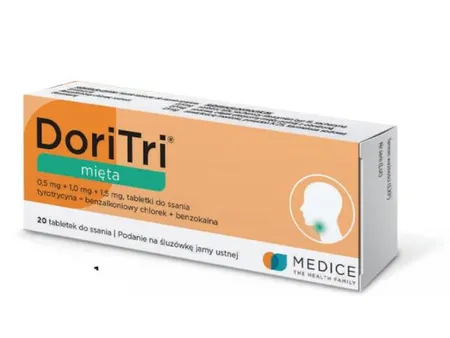
Table of Contents
Package leaflet: Information for the patient
DoriTri mint, 0.5 mg + 1.0 mg + 1.5 mg, lozenges for sucking
tyrothricin + benzalkonium chloride + benzocaine
Please read all of this leaflet carefully before taking this medicine, because it contains
important information for you.
This medicine should always be used exactly as described in this patient leaflet or as directed by
your doctor or pharmacist.
- Keep this leaflet, as you may need to read it again.
- If you need advice or further information, please contact your pharmacist.
- If you experience any side effects, including any not listed in this leaflet, tell your doctor or pharmacist. See section 4.
- If there is no improvement after 2 days or if you feel worse, contact your doctor.
Leaflet contents
- What DoriTri mint lozenges are and what they are used for
- Important information before taking DoriTri mint lozenges
- How to take DoriTri mint lozenges
- Possible side effects
- How to store DoriTri mint lozenges
- Contents of the pack and other information
1. What DoriTri mint lozenges are and what they are used for
DoriTri mint contains benzocaine, a local anaesthetic, and tyrothricin and benzalkonium chloride as antibacterial agents. It is used in the treatment of diseases of the mouth and throat.
DoriTri mint is intended for local, short-term supportive treatment of mild to moderate inflammatory conditions of the throat and oral cavity, such as:
- sore throat with pain and difficulty swallowing
- inflammatory conditions of the oral mucosa and gums.
In case of severe throat infection or sore throat accompanied by fever, headache, nausea or vomiting, consult a doctor before use.
DoriTri mint is indicated for use in adults and adolescents aged 12 years and older.
2. Important information before taking DoriTri mint lozenges
When not to take DoriTri mint lozenges
- if you are allergic to tyrothricin, benzalkonium chloride, benzocaine or any of the other ingredients of this medicine (listed in section 6), especially if you are allergic to para-related compounds or to quaternary ammonium salts.
- on large open wounds in the mouth or throat.
- in children under 2 years of age.
Warnings and precautions
Before starting to take DoriTri mint, discuss it with your doctor or pharmacist.
In case of purulent tonsillitis with fever, your doctor will decide whether DoriTri mint should be used in addition to basic treatment, e.g. antibiotics.
Do not take DoriTri mint if you have open wounds in the mouth or throat.
If you have a severe throat infection or sore throat with high fever, headache, nausea or vomiting, consult your doctor before taking DoriTri mint. If these symptoms occur during treatment with DoriTri mint, stop treatment and contact your doctor.
Patients prone to skin hypersensitivity reactions (allergic contact dermatitis) should avoid using DoriTri mint due to the risk of hypersensitivity reactions.
Children
The safety and efficacy of DoriTri mint have not been established in children under 12 years of age. Therefore, there are no dosage recommendations for children aged 6 to 11 years. DoriTri mint should not be used in children under 6 years of age, as controlled sucking cannot be guaranteed. DoriTri mint is contraindicated in children under 2 years of age.
DoriTri mint lozenges and other medicines
Tell your doctor or pharmacist about all medicines you are currently taking or have recently taken, as well as any medicines you plan to take.
No interactions with other medicines have been reported with proper use.
The effect of benzalkonium chloride may be reduced when used simultaneously with anionic surfactants, such as toothpaste.
Agents causing methaemoglobinaemia (e.g. local anaesthetics, dapsone) may increase the risk of methaemoglobinaemia.
Pregnancy and breastfeeding
If you are pregnant or breastfeeding, think you may be pregnant, or are planning to have a baby, consult your doctor or pharmacist before using this medicine.
Although there is currently no evidence that DoriTri mint has harmful effects on the foetus, as a precaution, it should not be used during pregnancy or breastfeeding.
Driving and operating machinery
DoriTri mint has no effect or has a negligible effect on the ability to drive and operate machinery.
DoriTri mint lozenges contain 870.7 mg of sorbitol
Sorbitol is a source of fructose. If fructose intolerance has previously been diagnosed in you (or your child) or if you have a hereditary fructose intolerance, a rare genetic disorder in which the body cannot break down fructose, you should consult your doctor before taking this medicine or giving it to your child. Sorbitol may cause gastrointestinal discomfort and may have a mild laxative effect.
DoriTri mint lozenges contain 11.2 mg of sucrose from the excipient - sucrose stearate
If you have previously been diagnosed with intolerance to certain sugars, you should consult your doctor before taking this medicine.
DoriTri mint lozenges contain 1 mg of sodium from the excipients: sodium saccharin and sodium carmellose.
The medicine contains less than 1 mmol (23 mg) of sodium per lozenge, meaning the medicine is considered "sodium-free".
DoriTri mint lozenges contain field mint essential oil containing limonene.
Limonene may cause allergic reactions.
3. How to take DoriTri mint lozenges
This medicine should always be taken exactly as described in this patient leaflet or as directed by your doctor or pharmacist. If in doubt, consult your doctor or pharmacist.
Dosage
The recommended dose for adults and adolescents aged 12 years and older is: 1–2 lozenges to be sucked slowly in the mouth several times a day, every 2–3 hours.
Do not exceed the daily dose of 8 lozenges.
Continue treatment for one more day after symptoms have subsided.
Due to insufficient experience with use in children under 12 years of age, no recommendations can be given for use in children aged 6 to 11 years.
Method of administration
Place the lozenge(s) in the mouth and allow them to dissolve slowly. Do not chew or swallow the lozenge whole.
Do not use DoriTri mint before or after tooth brushing, as toothpaste may reduce the effectiveness of the lozenges.
Taking more DoriTri mint lozenges than recommended
With proper use, poisoning with DoriTri mint can be excluded, and no such cases have been reported so far.
After taking a large number of lozenges, gastrointestinal symptoms and increased methaemoglobin formation may occur (especially in children). Possible symptoms include shortness of breath and bluish discoloration of lips and fingers. Contact a doctor if significant overdose is suspected, especially in children.
Recommended measures include administration of large amounts of water and activated charcoal tablets, as well as appropriate measures taken by a doctor to treat methaemoglobinaemia.
If you miss a dose of DoriTri mint lozenges
Do not take a double dose to make up for a missed dose.
Take one lozenge as soon as possible and continue with the usual dosing schedule.
If you have any further questions about the use of this medicine, consult your doctor or pharmacist.
4. Possible adverse reactions
Like all medicines, this medicine can cause adverse reactions, although not everybody will experience them.
Possible adverse reactions:
Rare (may occur in less than 1 in 1,000 people):
- Skin hypersensitivity reactions, particularly to esters of para-aminobenzoic acid (benzocaine). In sensitive patients, sensitization to para-group compounds (e.g. penicillins, sulfonamides, sunscreen cosmetics, p-aminosalicylic acid) may be induced.
- Hypersensitivity reactions (including respiratory disturbances syndrome) to peppermint oil may occur in sensitized patients.
- Altered taste perception or tongue numbness.
- Application of tyrothricin on open wounds or abrasions may cause bleeding.
Very rare (may occur in less than 1 in 10,000 people):
- Local application of benzocaine, especially in children and over large wound surfaces, has led to increased methemoglobin levels in the blood. Possible symptoms include breathlessness and bluish discoloration of lips and fingers.
- Laxative effect due to sorbitol content, particularly at high doses.
Reporting of adverse reactions
If any adverse reactions occur, including any adverse reactions not listed in this leaflet, inform your doctor, pharmacist, or nurse. Adverse reactions can be reported directly to the Department of Monitoring Adverse Drug Reactions of the Office for Registration of Medicinal Products, Medical Devices and Biocidal Products
Al. Jerozolimskie 181C
02-222 Warsaw
Tel.: + 48 22 49 21 301
Fax: + 48 22 49 21 309
Website: https://smz.ezdrowie.gov.pl
Adverse reactions can also be reported to the marketing authorization holder.
Reporting adverse reactions helps to provide more information on the safety of the medicine.
5. How to store DoriTri mięta, lozenges
Keep this medicine out of the sight and reach of children.
Do not use this medicine after the expiry date stated on the carton and blister after:
"EXP". The expiry date refers to the last day of the stated month.
Storage conditions:
Do not store above 25°C.
6. Contents of the pack and other information
What DoriTri Mint, lozenges contains:
- Active substances: Each lozenge contains: Tyrothricin 0.5 mg Benzalkonium chloride solution 1.0 mg Benzocaine 1.5 mg
- Other ingredients: Sorbitol (E 420), talc, stearic acid saccharate type III, sodium saccharin, peppermint essential oil with reduced menthol content (containing limonene), povidone K 25, sodium carmellose
What DoriTri Mint, lozenges looks like and contents of the pack
White, round, flat-faced lozenges with smooth surface, bevelled edges, and a diameter of approximately 16 mm.
The pack contains 20 or 40 lozenges.
Not all pack sizes may be marketed.
Marketing Authorisation Holder and Manufacturer
Marketing Authorisation Holder
Medice Pharma GmbH & Co. KG
Kuhloweg 37
58638 Iserlohn
Germany
Telephone: +49 2371 937-111
Fax: +49 2371 937-329
E-mail: [email protected]
Manufacturer
Medice Arzneimittel Pütter GmbH & Co. KG
Kuhloweg 37
58638 Iserlohn
Germany
This medicinal product is authorised in the European Economic Area under the following names:
Bulgaria Доритрицин Мента
Croatia Doritri s eteričnim uljem metvice 1,0 mg/1,5 mg/0,5 mg pastile
Czech Republic Doritri Máta
Estonia Doritri Mint
Latvia Doritri Mint 1 mg/1,5 mg/0,5 mg presētas sūkājamās tabletes
Lithuania Doritri Mint
Poland DoriTri mięta
Portugal Doritri Menta pastilhas
Romania Dorithricin Menta 0,5 mg/1,0 mg/1,5 mg comprimate de supt
Slovenia Doritri z okusom mete 1,0 mg/1,5 mg/0,5 mg stisnjene pastile