Doreta
Poland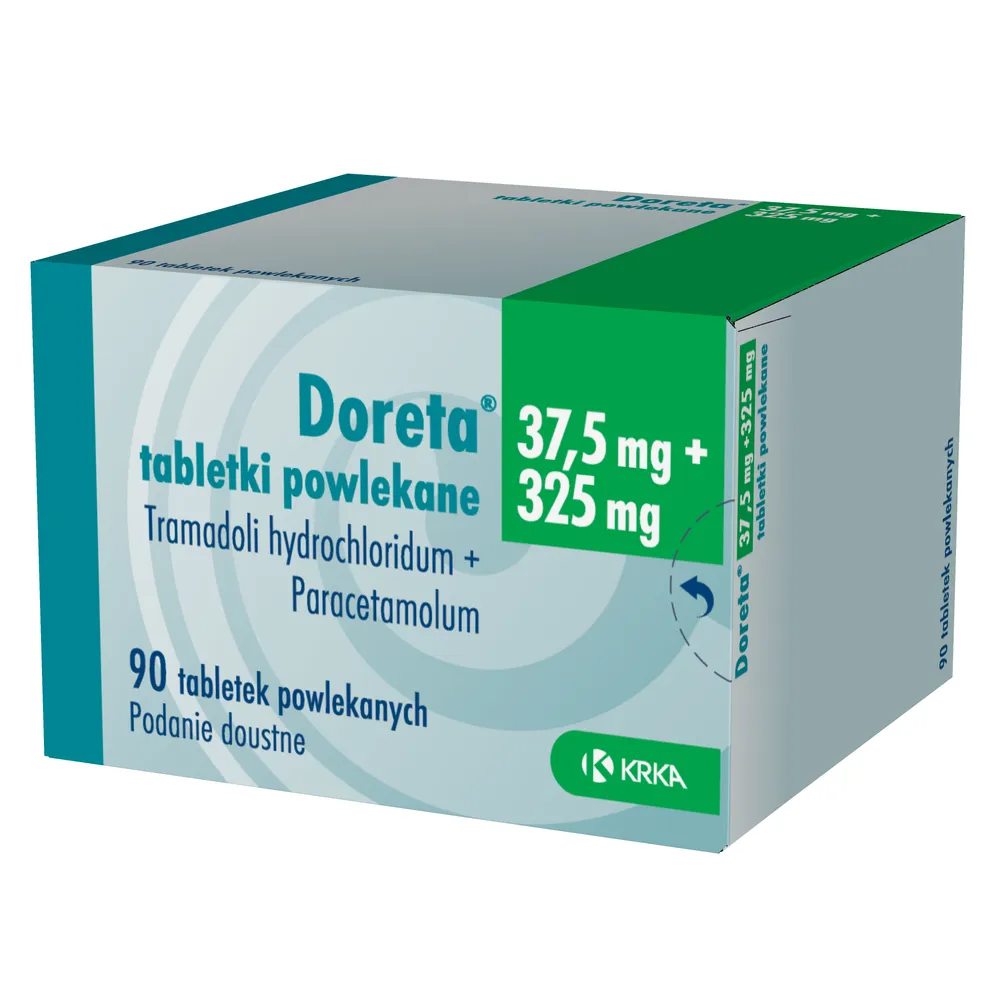
Table of Contents
PACKAGE LEAFLET: INFORMATION FOR THE PATIENT
Warning! Keep the leaflet. Information on the immediate packaging is in a foreign language!
Doreta
37.5 mg + 325 mg, coated tablets
Tramadoli hydrochloridum + Paracetamolum
Please read this leaflet carefully before using the medicine, as it contains
important information for the patient.
- Keep this leaflet, so that you can read it again if necessary.
- If you have any questions, please consult your doctor or pharmacist.
- This medicine has been prescribed for a specific individual. Do not pass it on to others. The medicine may harm another person, even if their symptoms are the same.
- If you experience any adverse reactions, including any not listed in this leaflet, inform your doctor or pharmacist. See section 4.
Table of contents of the leaflet
- What Doreta is and what it is used for
- Important information before taking Doreta
- How to take Doreta
- Possible side effects
- How to store Doreta
- Contents of the pack and other information
1. What Doreta is and what it is used for
Doreta is a combination medicine containing two analgesics: tramadol and paracetamol,
which together act to relieve pain.
Doreta is indicated for the treatment of moderate to severe pain, when your doctor
determines that tramadol in combination with paracetamol is required.
Doreta is intended for use in adults and adolescents aged 12 years and older.
2. Important information before using Doreta
When not to use Doreta:
- if the patient is allergic to paracetamol, tramadol, or any of the other ingredients of this medicine (listed in section 6),
- in case of acute alcohol intoxication, sedatives, analgesics or other psychotropic medicines (used in the treatment of mental disorders),
- when using MAO inhibitors (certain medicines used to treat depression or Parkinson's disease) or within 14 days after their discontinuation,
- in patients with severe liver disease,
- in patients with epilepsy that is not adequately controlled with medication.
Warnings and precautions
Before starting to take Doreta, discuss this with your doctor or pharmacist.
Special caution is required when using Doreta:
- in patients with kidney disease,
- in patients with liver disease or alcoholic liver damage, or in whom yellowing of the eyes and skin occurs, which may indicate jaundice or biliary tract disease,
- in patients with breathing difficulties, e.g. asthma or lung problems,
- in patients dependent on other medicines used to relieve moderate to severe pain, such as morphine,
- in patients with epilepsy or who have experienced seizures or epileptic fits,
- in patients with head injury, in shock, or with severe headache, associated or not associated with vomiting,
- if the patient is taking other medicines containing paracetamol or tramadol,
- if the patient is taking other analgesics containing buprenorphine, nalbuphine or pentazocine,
- if the patient is to undergo anaesthesia. Inform the doctor or dentist about the use of Doreta.
- if the patient has depression and is taking antidepressants, as some of them may interact with tramadol (see "Doreta with other medicines").
Excessive fatigue, loss of appetite, severe abdominal pain, nausea, vomiting or low blood pressure.
These may indicate adrenal insufficiency (low cortisol levels). If such symptoms occur, contact a doctor, who will decide whether hormone replacement is necessary.
Serotonin syndrome
There is a small risk of so-called serotonin syndrome when tramadol is taken in combination with certain antidepressants or tramadol alone. If the patient experiences any symptoms of this severe syndrome, immediate medical advice should be sought (see section 4 "Possible side effects").
Sleep-related breathing disorders
Doreta may cause sleep-related breathing disorders such as sleep apnoea (pauses in breathing during sleep) and sleep-related hypoxemia (low blood oxygen levels). Symptoms may include breathing pauses during sleep, nocturnal awakenings due to breathlessness, difficulty maintaining sleep or excessive daytime sleepiness. If the patient or another person observes these symptoms, contact a doctor. The doctor may recommend reducing the dose.
Tramadol is metabolized in the liver by an enzyme. Some individuals have a variant of this enzyme, which may have various effects. In some individuals, pain relief may be insufficient, while in others, severe adverse effects may be more likely.
Discontinue use and contact a doctor immediately if the patient experiences any of the following adverse effects: slowed or shallow breathing, confusion, drowsiness, pinpoint pupils, nausea or vomiting, constipation, or loss of appetite.
Children and adolescents
Use in children with breathing disorders.
Tramadol is not recommended in children with breathing disorders, as tramadol toxicity symptoms may be intensified in them.
Doreta with other medicines
Inform your doctor or pharmacist about all medicines currently or recently taken, as well as any medicines the patient plans to take.
Warning: This medicine contains paracetamol and tramadol. Inform your doctor about taking other medicines containing paracetamol or tramadol to avoid exceeding the maximum daily dose.
Concomitant use of Doreta with monoamine oxidase inhibitors (MAOIs) is contraindicated (see section "When not to use Doreta:").
It is not recommended to use Doreta simultaneously with the following medicines, as this may affect their proper function:
- carbamazepine (a medicine used to treat epilepsy or certain types of pain),
- buprenorphine, nalbuphine or pentazocine (opioid analgesics). The analgesic effect may be reduced.
Using Doreta together with the following medicines may increase the risk of adverse effects:
- triptans (medicines used to treat migraine) or selective serotonin reuptake inhibitors (SSRIs, medicines used to treat depression). Contact a doctor if disorientation, agitation (especially motor agitation), fever, excessive sweating, uncontrolled limb or eye movements, uncontrolled muscle contractions or diarrhoea occur.
- sedatives, sleeping pills, other analgesics such as morphine and codeine (also used to treat cough), baclofen (a muscle relaxant), antihypertensive medicines, antidepressants or antihistamines. Contact a doctor if drowsiness or fainting occurs.
- medicines that may cause seizures (fits), such as certain antidepressants, antipsychotics, anaesthetics, mood-affecting medicines or bupropion (a medicine used for smoking cessation). The risk of seizures may increase if the patient takes Doreta together with these medicines. The doctor will inform the patient whether Doreta is suitable for them.
- certain antidepressants. Doreta may interact with these medicines and cause serotonin syndrome (see section 4 "Possible side effects").
- warfarin or phenprocoumon (medicines used to thin the blood). The effect of these medicines may change and bleeding may occur (see section 4). Any prolonged or unexpected bleeding should be reported to a doctor immediately.
- flucloxacillin (an antibiotic), due to the serious risk of a disorder affecting blood and body fluids (metabolic acidosis with a high anion gap), which requires urgent treatment and may occur particularly in patients with severe kidney function disorders, sepsis (a condition where bacteria and their toxins circulate in the blood, leading to organ damage), malnutrition, chronic alcoholism, and in patients taking maximum daily doses of paracetamol.
The effect of Doreta may be altered if taken together with the following medicines:
- metoclopramide, domperidone or ondansetron (medicines used to treat nausea and vomiting),
- cholestyramine (a medicine used to lower blood cholesterol levels).
Concomitant use of Doreta and sedatives, such as benzodiazepines or similar medicines, increases the risk of drowsiness, breathing difficulties (respiratory depression), coma, and may be life-threatening. Therefore, concomitant use should only be considered when other treatment options are not possible.
If, however, a doctor has prescribed Doreta together with sedative medicines, the doctor should limit the dose and duration of concomitant treatment.
Inform the doctor about all sedative medicines being taken and strictly follow the doctor's dosing instructions. It may be helpful to inform friends or family members about the above-mentioned symptoms. If such symptoms occur, contact a doctor.
Doreta with food, drink and alcohol
Doreta can be taken with or without food.
- Taking Doreta may cause drowsiness. Drinking alcohol may intensify drowsiness. Alcohol: enhances the sedative effect of opioid analgesics, which, by affecting concentration ability, may make driving and operating machinery dangerous; avoid drinking alcoholic beverages and
taking medicines containing alcohol.
Pregnancy, breastfeeding and effects on fertility
If the patient is pregnant, breastfeeding, suspects she may be pregnant, or is planning to have a child, she should consult a doctor or pharmacist before using this medicine.
Pregnancy
Since Doreta contains two active substances, including tramadol, it should not be taken during pregnancy.
Breastfeeding
Tramadol is excreted in the milk of breastfeeding women. Therefore, Doreta should not be used more than once during breastfeeding, or if Doreta is taken more than once, breastfeeding should be discontinued.
Fertility
Based on the use of tramadol in humans, it is suggested that tramadol does not affect fertility in women and men. There are no available data on the effect on fertility of combined treatment with tramadol and paracetamol.
Driving and operating machinery
Do not drive, operate machinery or perform other tasks requiring concentration until you know how Doreta affects you. Doreta may cause drowsiness.
Doreta contains sodium
This medicinal product contains less than 1 mmol (23 mg) of sodium per dose, i.e. the medicine is considered "sodium-free".
3. How to take Doreta
This medicine should always be taken as directed by the physician. If in doubt, consult your doctor or pharmacist.
The initial dose is usually two tablets. If necessary, subsequent doses may be taken every six hours, as directed by the physician.
Do not take more than 8 tablets per day (corresponding to 300 mg of tramadol hydrochloride and 2600 mg of paracetamol).
The dose should be adjusted according to the intensity of pain and the individual patient's sensitivity to pain. In general, the lowest effective dose providing adequate pain relief should be used.
Severe liver disease (liver failure)
Patients with severe liver impairment should not take Doreta.
In patients with mild or moderate liver impairment, the physician may increase the dosing intervals.
Use in children
Doreta is not recommended for use in children under 12 years of age.
Elderly patients
In elderly patients (over 75 years of age), elimination of tramadol may be delayed. The physician may increase the dosing intervals.
Method of administration
Tablets should be swallowed whole with liquid. Do not crush or chew the tablets.
This medicine should be used for the shortest possible duration.
If you feel that the effect of Doreta is too strong (e.g. drowsiness or breathing difficulties occur) or too weak (e.g. inadequate pain relief), consult your doctor or pharmacist. If there is no improvement, contact your doctor.
Taking more Doreta than recommended
In case of overdose, seek medical advice immediately, even if the patient feels well, because of the risk of delayed, severe liver damage.
If more than the recommended dose of Doreta is taken, serious circulatory disturbances, disturbances of consciousness up to coma, seizures or breathing problems, malaise, vomiting, weight loss or abdominal pain may occur.
Missed dose of Doreta
Do not take a double dose to make up for a missed dose.
If a dose is missed, take the next tablet at the usual time.
Stopping Doreta
If the patient has been taking Doreta for some time, they should consult their doctor before stopping treatment, as the body may have become accustomed to the medicine. Do not stop taking this medicine suddenly without medical advice. If the patient wishes to discontinue Doreta, this should be discussed with the doctor, especially if the medicine has been taken long-term. The doctor will advise when and how to stop taking the medicine; this may involve gradually reducing the dose to minimize the likelihood of adverse effects (withdrawal symptoms). If Doreta is stopped abruptly, malaise may occur. The patient may experience anxiety, agitation, nervousness, insomnia, hyperactivity, tremor and/or gastrointestinal disturbances.
If you have any further questions about the use of this medicine, consult your doctor or pharmacist.
4. Possible adverse effects
Like all medicines, this medicine may cause adverse effects, although not everybody will experience them.
Very common adverse effects (may occur in more than 1 in 10 patients):
- nausea,
- dizziness,
- drowsiness. These symptoms are usually mild and not very troublesome.
Common adverse effects (may occur in up to 1 in 10 patients):
- vomiting,
- gastrointestinal disturbances (constipation, bloating, diarrhoea),
- abdominal pain,
- dry mouth,
- headache,
- tremor,
- disorientation,
- sleep disturbances,
- mood changes (anxiety, nervousness, euphoria – continuous feeling of elevated mood),
- increased sweating,
- itching.
Uncommon adverse effects (may occur in up to 1 in 100 patients):
- high blood pressure, disturbances in heart rhythm and rate,
- difficulty or pain when urinating, presence of protein in urine,
- skin reactions (urticaria, rashes),
- ringing in the ears,
- depression,
- nightmares,
- hallucinations (hearing, seeing or feeling things that do not exist in reality),
- memory loss,
- difficulty swallowing,
- blood in stool,
- chills,
- hot flushes,
- chest pain,
- involuntary muscle twitching,
- tingling and numbness sensations,
- shortness of breath,
- increased liver enzyme activity.
Rare adverse effects (may occur in up to 1 in 1000 patients):
- drug dependence,
- seizures, coordination problems,
- blurred vision,
- delirium,
- transient loss of consciousness,
- pinpoint pupils,
- speech disturbances,
- excessive dilation of pupils.
Very rare adverse effects (may occur in up to 1 in 10,000 patients):
- drug abuse.
Adverse effects with unknown frequency (frequency cannot be estimated from the available data):
- decreased blood sugar levels,
- hiccups,
- serotonin syndrome, which may present with changes in mental status (e.g. agitation, hallucinations, coma), as well as other symptoms such as fever, rapid heartbeat, unstable blood pressure, involuntary muscle contractions, muscle rigidity, lack of coordination, and/or gastrointestinal symptoms (e.g. nausea, vomiting, diarrhoea) (see section 2 “Important information before taking Doreta”).
The following adverse effects have been reported by patients taking medicines containing only
tramadol hydrochloride or paracetamol. However, if any of these adverse effects occur during
treatment with Doreta, you should inform your doctor:
- feeling faint when standing up from a sitting or lying position, slow heartbeat, fainting, changes in appetite, muscle weakness, slower or shallower breathing, mood changes, changes in activity, changes in perception, worsening of asthma.
- in some rare cases, skin rash indicating an allergic reaction may progress to sudden swelling of the face and neck, breathing difficulties, or drop in blood pressure and fainting; if such symptoms occur, stop taking this medicine immediately and seek medical help without delay. Do not take this medicine again.
Rarely, patients who have been taking tramadol for some time may experience unpleasant symptoms if the medicine is stopped suddenly. Patients may feel agitation, anxiety, nervousness, or tremor, hyperactivity, insomnia, or gastrointestinal disturbances. In a very small number of patients, panic attacks, hallucinations, or unusual sensations such as itching, tingling, numbness of the skin, and ringing in the ears may occur. If any of these symptoms, or any other unusual symptoms, occur, consult your doctor or pharmacist as quickly as possible.
In exceptional cases, blood tests may reveal certain abnormalities, such as a low platelet count, which may cause nosebleeds or bleeding gums.
Very rarely, severe skin reactions have been reported after taking medicines containing paracetamol.
Taking Doreta together with anticoagulant medicines (e.g. phenylprocoumon, warfarin) may increase the risk of bleeding. Any prolonged or unexpected bleeding should be reported to your doctor immediately.
Reporting of adverse effects
If any adverse effects occur, including any not listed in this leaflet, inform your doctor or pharmacist. Adverse effects can be reported directly to the Department of Monitoring Adverse Drug Reactions of the Office for Registration of Medicinal Products, Medical Devices and Biocidal Products:
Al. Jerozolimskie 181C
02-222 Warsaw
tel.: + 48 22 49 21 301
fax: + 48 22 49 21 309
website: https://smz.ezdrowie.gov.pl
Reporting adverse effects helps to provide more information on the safety of this medicine.
5. How to store Doreta
Keep this medicine out of the sight and reach of children.
Do not use this medicine after the expiry date stated on the packaging. The expiry date refers to the last day of the stated month.
No special storage conditions apply.
Medicines must not be disposed of via wastewater or household waste. Ask your pharmacist how to dispose of medicines no longer required. This will help protect the environment.
6. Contents of the packaging and other information
What Doreta contains
- The active substances in Doreta are tramadol hydrochloride and paracetamol. Each coated tablet contains 37.5 mg of tramadol hydrochloride, equivalent to 32.94 mg of tramadol and 325 mg of paracetamol.
- Other ingredients are:
- tablet core: pregelatinized starch, corn starch, sodium carboxymethyl starch (type A), microcrystalline cellulose (Avicel PH 102), magnesium stearate;
- tablet coating: hypromellose, titanium dioxide (E 171), polyethylene glycol 400, yellow iron oxide (E 172), polysorbate 80. See section 2 "Doreta contains sodium".
What Doreta looks like and contents of the pack
The coated tablets are yellow-brown, oval-shaped and slightly convex on both sides.
Packaging: 30, 60 or 90 coated tablets in blisters, packed in a cardboard box.
For more detailed information, please contact the Marketing Authorisation Holder or the Parallel Importer.
Marketing Authorisation Holder in Romania, country of export:
KRKA, d.d., Novo mesto
Šmarješka cesta 6
8501 Novo mesto
Slovenia
Manufacturer:
KRKA, d.d., Novo mesto
Šmarješka cesta 6
8501 Novo mesto
Slovenia
TAD Pharma GmbH
Heinz-Lohmann-Straße 5
27472 Cuxhaven
Germany
Parallel Importer:
Medezin Sp. z o.o.
ul. Zbąszyńska 3
91-342 Łódź
Repackaged in:
Medezin Sp. z o.o.
ul. Zbąszyńska 3
91-342 Łódź
CEFEA Sp. z o.o. Sp. komandytowa
ul. Działkowa 56
02-234 Warszawa
SHIRAZ PRODUCTIONS Sp. z o.o.
ul. Tymiankowa 24/28
95-054 Ksawerów
Marketing Authorisation numbers in Romania, country of export: 6991/2014/04
6991/2014/02
6991/2014/03
6991/2014/05
6991/2014/06
6991/2014/07
6991/2014/08
6991/2014/09
6991/2014/10
6991/2014/11
Parallel Import Licence number: 326/18
This medicinal product is authorised for marketing in the European Economic Area and in the United Kingdom (Northern Ireland) under the following names:
| Bulgaria, Czech Republic, Estonia, Lithuania, Latvia, Slovakia, Slovenia, Romania, Hungary, | Doreta |
| France | Tramadol/paracetamol Krka |
| Spain | Tramadol/Paracetamol Krka |
| Portugal | Rapat |
| United Kingdom (Northern Ireland) | Tramadol Hydrochloride/Paracetamol |