Dolomite vis
Poland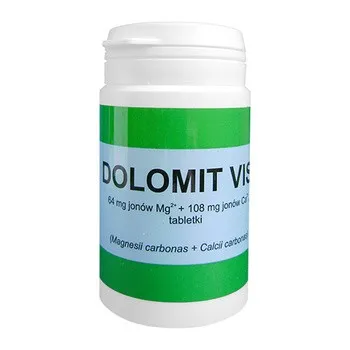
Table of Contents
Patient Information Leaflet
DOLOMIT VIS
32 mg Mg²⁺ ions + 54 mg Ca²⁺ ions tablets
(Magnesii carbonas + Calcii carbonas)
Please read this leaflet carefully before using the medicine, as it contains
important information for the patient.
The medicine should always be used exactly as described in this patient leaflet or according to
the instructions provided by the doctor, pharmacist, or nurse.
- Keep this leaflet, so that you can read it again if necessary.
- If you need advice or further information, please consult your pharmacist.
- If you experience any adverse reactions, including any possible adverse reactions not listed in this leaflet, inform your doctor, pharmacist, or nurse. See section 4.
Table of contents:
- What Dolomit VIS is and what it is used for
- Important information before taking Dolomit VIS
- How to take Dolomit VIS
- Possible side effects
- How to store Dolomit VIS
- Contents of the pack and other information
1. What Dolomit VIS is and what it is used for
Dolomite is a natural mineral consisting mainly of calcium carbonate and magnesium carbonate, along with small amounts of iron, aluminium, silicon, manganese, zinc, and copper ions. It is used therapeutically to correct calcium-magnesium imbalance in the body in conditions of hypocalcemia and hypomagnesemia, and prophylactically to prevent calcium and magnesium deficiencies.
The daily human requirement for calcium is 700–800 mg and for magnesium 270–350 mg. Both elements are supplied to the body through diet.
Magnesium- and calcium-containing preparations are used prophylactically in cases of physical and mental fatigue, increased irritability, stressful situations, sleep disturbances, muscle pains, prolonged physical exertion, periods of rapid growth in children and adolescents, pregnancy, and lactation. Additionally, they are indicated during convalescence after illness or bone fractures. In women during menopause, they help prevent bone demineralization and are used as supportive treatment in comprehensive osteoporosis management.
2. Important information before using D VIS medicine
When not to use D VIS
Do not take D VIS if you are hypersensitive to the active substance or to any of the excipients, in cases of hypercalcaemia (elevated calcium levels in blood), hypermagnesaemia (excess magnesium), atrioventricular block, myasthenia (autoimmune neuromuscular disease), anuria, kidney diseases with impaired filtration, or significant reduction in systolic and diastolic blood pressure. Do not use in combination with oral anticoagulants or cardiac glycosides.
If the patient has previously been diagnosed with intolerance to certain sugars, they should consult a physician before taking this medicine.
Malignant tumours in development are a contraindication for administering this medicinal product, as magnesium may stimulate their growth.
When to exercise special caution when using D VIS
- If the patient has renal insufficiency, mild hypercalciuria (disturbance in calcium metabolism), or kidney stones, because calcium excretion in urine must then be monitored. Patients with kidney stones should drink plenty of fluids during treatment. During therapy, serum calcium levels should be monitored.
Other medicines and D VIS
Inform your doctor or pharmacist about all medicines currently used or recently taken, as well as any medicines you plan to use.
Due to reduced absorption of both calcium and magnesium, as well as the following drugs, D VIS should not be administered simultaneously with phosphates, iron compounds, fluoroquinolones, tetracyclines, or oral anticoagulants derived from warfarin (a 3-hour interval between administration of both drugs is recommended).
Diuretic drugs (furosemide, ethacrynic acid) increase magnesium excretion in urine.
Calcium salts administered intravenously reduce the effect of magnesium.
Thiazide diuretics (e.g. hydrochlorothiazide) enhance calcium reabsorption and pose a risk of hypercalcaemia. High doses of calcium in combination with vitamin D may reduce the effect of verapamil and other calcium antagonists.
Large doses of calcium administered simultaneously with cardiac glycosides intensify their effect and may lead to cardiac arrhythmias.
Use of D VIS with food and drink
Alcohol and high amounts of glucose increase magnesium excretion in urine.
Pregnancy and breastfeeding
Consult a doctor before taking this medicine.
Driving vehicles and operating machinery
D VIS does not affect the ability to drive vehicles or operate machinery.
Important information about certain ingredients
The medicine contains lactose and sucrose. See section 2.
3. How to use D VIS medicine
Adults and children over 12 years of age:
- Prophylactically: 1 to 2 tablets per day;
- Therapeutically, in cases of calcium and magnesium deficiency: 2 to 6 tablets per day, depending on the severity of the deficiency. The medicine should be taken after a meal, with water. If the effect of the medicine seems too strong or too weak, consult a doctor. In case of overdose of D VIS medicine If diarrhea occurs, reduce the daily dose or temporarily discontinue the medicine. Symptoms of drowsiness may indicate that a high magnesium concentration in serum has been reached. In case of ingestion of a higher than recommended dose, seek immediate medical or pharmaceutical advice.
Missed dose of D VIS medicine Do not take a double dose to make up for a missed dose.
4. Possible adverse reactions
Like all medicines, this medicine can cause adverse reactions, although not everyone experiences them.
The adverse reactions are listed below, classified by MedDRA system organ classes, and within each group,
ordered by frequency, from most common to least common:
- very common: occurs in more than 1 in 10 patients;
- common: occurs in 1 to 10 in 100 patients;
- uncommon: occurs in 1 to 10 in 1,000 patients;
- rare: occurs in 1 to 10 in 10,000 patients;
- very rare: occurs in less than 1 in 10,000 patients;
- frequency not known: cannot be estimated based on available data.
Gastrointestinal disorders
Nausea, vomiting, diarrhoea – frequency not known (cannot be estimated based on available data).
General disorders and administration site conditions
With prolonged use, drowsiness may occur – frequency not known (cannot be estimated based on available data).
Reporting of suspected adverse reactions
If any adverse reactions occur, including any adverse reactions not listed in this leaflet, inform your doctor, pharmacist, or nurse. Adverse reactions can be reported directly to the Department of Monitoring Adverse Drug Reactions at the Office for Registration of Medicinal Products, Medical Devices and Biocidal Products:
Al. Jerozolimskie 181C, 02-222 Warsaw,
Tel.: +48 22 49-21-301, Fax: +48 22 49-21-309,
Website: https://smz.ezdrowie.gov.pl
Adverse reactions can also be reported to the marketing authorization holder.
Reporting of adverse reactions helps to provide more information on the safety of the medicine.
5. How to store Dolomit VIS
- Keep the medicine out of the reach and sight of children.
- Store below 25ºC. Do not use Dolomit VIS after the expiry date stated on the packaging after "Expiry date". The expiry date refers to the last day of the stated month. Medicines must not be disposed of via wastewater or household waste. Ask your pharmacist how to dispose of medicines no longer in use. This will help protect the environment.
6. Contents of the packaging and other information
What the medicine D VIS contains
1 tablet (250 mg of dolomite) contains: magnesium carbonate and calcium carbonate (corresponding to 32 mg of magnesium ions and 54 mg of calcium ions) and excipients: sucrose, lactose monohydrate, potato starch, magnesium stearate, peppermint oil.
What D VIS looks like and contents of the packaging
Packaging: container made of PE or PP with a PE cap with tamper-evident seal, or brown glass jar with a PE screw cap, in a cardboard box.
30 tablets – 1 container of 30 tablets
60 tablets – 1 container of 60 tablets
72 tablets – 1 container of 72 tablets
Not all pack sizes may be marketed.
Marketing Authorisation Holder and Manufacturer:
Chemical-Pharmaceutical Plants „VIS” Sp. z o.o.
ul. Św. Elżbiety 6a
41-905 Bytom
For more detailed information, please contact the local representative of the Marketing Authorisation Holder.