Dip relief
Poland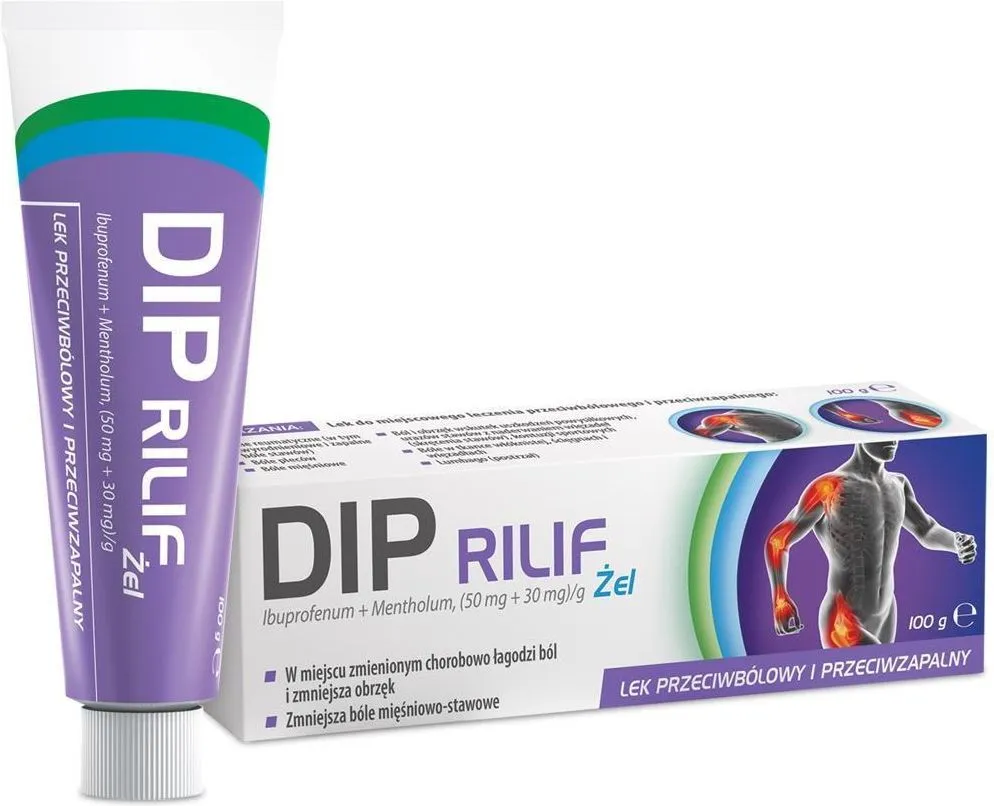
Table of Contents
Package leaflet: Information for the patient
DIP RILIF, (50 mg + 30 mg)/g, gel
Ibuprofenum + Mentholum
Please read carefully the entire leaflet before using the medicine, as it contains
important information for the patient.
This medicine should always be used exactly as described in this patient leaflet or as directed by
the doctor or pharmacist.
- Keep this leaflet, so you can read it again if needed.
- If you need advice or further information, please consult your pharmacist.
- If you experience any adverse effects, including any not listed in this leaflet, inform your doctor or pharmacist. See section 4.
- If there is no improvement or if your condition worsens after 14 days, consult your doctor.
Table of contents
- What DIP RILIF is and what it is used for
- Important information before use
- How to use
- Possible side effects
- How to store
- Contents of the pack and other information
1. What DIP RILIF is and what it is used for
DIP RILIF is a medicine with combined action of two active substances: ibuprofen and menthol.
It rapidly relieves pain shortly after application to the skin.
The medicine has analgesic and anti-inflammatory effects. It reduces inflammation at the affected site, relieves pain and decreases swelling.
DIP RILIF is indicated for local analgesic and anti-inflammatory treatment in:
- rheumatic pain (including joint pain due to degenerative and inflammatory changes)
- back pain
- muscle pain
- pain and swelling resulting from sports injuries, joint injuries with ligament sprains (joint sprains), contusions
- pain in fibrous tissue, tendons and ligaments
- lumbago (lumbago).
2. Important information before use
When not to use DIP RILIF:
Do not use this medicine:
- if you are allergic to ibuprofen, menthol or any of the other ingredients of this medicine (listed in section 6), acetylsalicylic acid or other non-steroidal anti-inflammatory drugs (NSAIDs)
- during the last 3 months of pregnancy
- in patients with asthma who previously experienced attacks of breathlessness, rash, rhinitis or other allergic symptoms after taking acetylsalicylic acid or other NSAIDs
- on mucous membranes, lips, nostrils or genital areas
- in the eyes or on skin around the eyes
- on damaged or inflamed skin
- in children under 12 years of age.
Warnings and precautions
Before using this medicine, consult your doctor or pharmacist:
- if you are allergic to medicines or cosmetics
- if you have kidney disease
- if you are taking acetylsalicylic acid or other medicines
- if you have active peptic ulcer disease. Discontinue use if urticaria or skin irritation occurs and consult your doctor.
Severe skin reactions, such as exfoliative dermatitis, erythema multiforme, Stevens-Johnson syndrome, toxic epidermal necrolysis, drug reaction with eosinophilia and systemic symptoms (DRESS), and acute generalized exanthematous pustulosis (AGEP), have been reported with the use of ibuprofen. If you experience any of the symptoms related to these serious skin reactions described in section 4, stop using DIP RILIF immediately and seek medical help.
DIP RILIF and other medicines
Using this medicine together with acetylsalicylic acid or other non-steroidal anti-inflammatory drugs may increase the frequency of adverse effects.
Inform your doctor or pharmacist about all medicines you are currently taking or have recently taken, including those obtained without a prescription, as well as any medicines you plan to take.
Pregnancy, breastfeeding and fertility
If you are pregnant or breastfeeding, think you may be pregnant or are planning to have a baby, consult your doctor or pharmacist before using this medicine.
Do not use this medicine during the last 3 months of pregnancy. Do not use this medicine during the first 6 months of pregnancy unless absolutely necessary and recommended by a doctor. If treatment is required during this period, use the lowest dose for the shortest possible duration.
Oral formulations (e.g. tablets) containing ibuprofen may cause adverse effects in the unborn child. It is unknown whether the same risk applies when ibuprofen is applied to the skin.
Due to insufficient data, the use of this medicine is not recommended during breastfeeding.
Driving and operating machinery
DIP RILIF does not affect the ability to drive or operate machinery.
This medicine contains propylene glycol and ethanol.
Propylene glycol
This medicine contains 100 mg of propylene glycol in each gram of gel.
Propylene glycol may cause skin irritation.
Ethanol
This medicine contains 300 mg of 96% ethanol in each gram of gel.
It may cause stinging on damaged skin.
This medicine is flammable. Do not use near open flames or lit cigarettes.
3. How to use
This medicine should always be used exactly as described in this patient information leaflet or as directed by a doctor or pharmacist. If in doubt, consult a doctor or pharmacist.
The product is intended for topical application on the skin only.
Use in adults and adolescents over 12 years of age
- Apply a thin layer of gel to the painful area and gently massage until the medicine is absorbed. Repeat no more than 3 times daily, leaving at least a 4-hour interval between applications. For tubes containing 30 g, 50 g, or 100 g of medicine, apply 1 to 4 cm of gel per dose; for tubes containing 15 g of medicine, apply 4 to 10 cm of gel per dose.
- After using the gel, always wash your hands unless the hands are the area being treated.
Do not cover the area where the gel has been applied with dressings such as bandages or plasters.
Use of a higher than recommended dose of the medicine
Overdose during topical use is unlikely.
Symptoms of ibuprofen overdose include headache, vomiting, drowsiness, and decreased blood pressure.
If more than the recommended dose has been used, seek immediate advice from a doctor or pharmacist. Correction of electrolyte imbalances may be necessary.
4. Possible adverse reactions
Like all medicines, this medicine can cause adverse reactions, although not everyone will experience them.
The most commonly observed adverse reactions are local reactions: redness, itching,
burning sensation, rash, urticaria, and burning at the site of application.
Less frequently, gastrointestinal disorders occur – abdominal pain and dyspepsia.
In predisposed individuals who have or previously had asthmatic attacks or allergic diseases,
attacks of breathlessness may occur.
Skin photosensitivity – frequency of occurrence is unknown.
If any of the following symptoms occur in a patient, ibuprofen use must be stopped immediately and medical help should be sought:
- Red, flat, target-like or circular spots on the trunk, often with blisters in the center, skin peeling, mucosal ulcers in the mouth, throat, nose, genital organs, and eyes. These severe skin rashes may be preceded by fever and influenza-like symptoms (exfoliative dermatitis, erythema multiforme, Stevens-Johnson syndrome, toxic epidermal necrolysis).
- Widespread rash, high body temperature, and enlarged lymph nodes (DRESS syndrome).
- Red, scaly rash with subcutaneous nodules and blisters, accompanied by fever. Symptoms usually appear at the beginning of treatment (acute generalized exanthematous pustulosis).
Reporting of adverse reactions
If any adverse reactions occur, including any adverse reactions not listed
in this leaflet, inform a doctor or pharmacist. Adverse reactions can
be reported directly to the Department of Monitoring Adverse Drug Reactions at the Office for Registration of Medicinal Products, Medical Devices and Biocidal Products
Al. Jerozolimskie 181C, 02-222 Warsaw
Tel.: + 48 22 49 21 301
Fax: + 48 22 49 21 309
Website: https://smz.ezdrowie.gov.pl
Adverse reactions can also be reported to the marketing authorization holder.
Reporting adverse reactions helps to provide more information on the safety of the medicine.
5. How to store the medicine
- Keep the medicine out of sight and reach of children.
- Do not use this medicine after the expiry date stated on the packaging. The expiry date refers to the last day of the stated month.
- Store below 25°C.
- Shelf life after first opening the tube: 3 months.
- Medicines must not be disposed of via wastewater or household waste. Ask your pharmacist how to dispose of medicines no longer required. Such measures help protect the environment.
6. Contents of the package and other information
The active substances in the medicine are ibuprofen and menthol.
1 g of gel contains 50 mg of ibuprofen and 030 mg of menthol.
Other ingredients: carbomer, propylene glycol, ethanol 96%, diisopropanolamine, purified water.
The package contains 15 g, 30 g, 50 g or 100 g of gel.
Marketing Authorisation Holder
The Mentholatum Company (Ireland) Limited
Ground Floor
71 Lower Baggot Street
DUBLIN
D02 P593
IRELAND
Importer:
The Mentholatum Company (Ireland) Limited
1st Floor, Building Two,
Dublin Airport Central,
Swords, Co.
Dublin, K67 E2H3,
Ireland
For further information, please contact:
EGIS Polska Sp. z o.o.
ul. Komitetu Obrony Robotników 45D
02-146 Warsaw
tel. 22 417 92 00