Dicortineff
Poland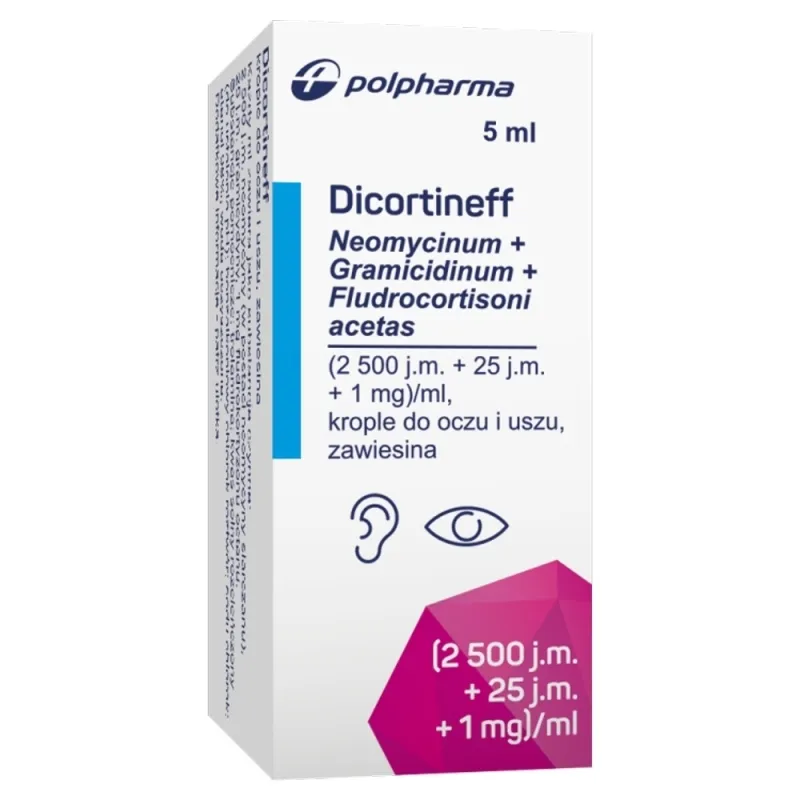
Table of Contents
Patient Information Leaflet: Instructions for Use
DICORTINEFF, (2,500 IU + 25 IU + 1 mg)/ml, eye and ear drops, suspension
Neomycinum + Gramicidinum + Fludrocortisoni acetas
Please read this leaflet carefully before using the medicine, as it contains important information for the patient.
- Keep this leaflet for future reference.
- If you have any questions, please consult your doctor or pharmacist.
- This medicine has been prescribed for a specific individual. Do not share it with others. This medicine may harm other people, even if their symptoms are the same.
- If you experience any adverse reactions, including any not listed in this leaflet, inform your doctor or pharmacist. See section 4.
Table of Contents
- What is Dicortineff and what is it used for
- Important information before using Dicortineff
- How to use Dicortineff
- Possible side effects
- How to store Dicortineff
- Contents of the pack and other information
1. What is Dicortineff and what is it used for
Dicortineff is a combination medicine intended for topical use, containing the antibiotics neomycin and gramicidin, and the glucocorticosteroid fludrocortisone. The medicine exerts antibacterial, anti-inflammatory, and antiallergic effects. It relieves itching, burning, and reduces swelling.
Dicortineff is used:
a) in ophthalmology:
- in inflammatory conditions of the eyeball, uvea, conjunctiva, and eyelid margins;
b) in otolaryngology:
- in inflammatory conditions of the external and middle ear;
- in inflammatory conditions of the ear following surgical procedures;
- in traumatic conditions of the external auditory canal.
2. Important information before using Dicortineff
When not to use Dicortineff:
- if the patient is allergic to neomycin sulfate, gramicidin, fludrocortisone acetate, or other aminoglycoside antibiotics, or any of the other ingredients of this medicine (listed in section 6);
- viral, tuberculous, or fungal infections of the eye or ear;
- diseases associated with corneal epithelial defects, when the medicine is to be used in the eye;
- glaucoma, when the medicine is to be used in the eye;
- perforation (rupture) of the eardrum, when the medicine is to be used in the ear.
Warnings and precautions
Before starting treatment with Dicortineff, discuss this with your doctor or pharmacist.
Use only in the eyes or ears.
Extreme caution should be exercised when using the medicine in patients suspected of having a perforation (rupture) of the eardrum, as penetration of the medicine into the middle ear may cause burning pain and even damage to the auditory nerve.
Prolonged use of Dicortineff may lead to bacterial and fungal superinfections, and in predisposed individuals, increased intraocular pressure may occur, and even steroid-induced cataract.
Hypersensitivity to locally applied aminoglycosides may occur in some patients, including cross-hypersensitivity to other aminoglycosides. If symptoms of hypersensitivity occur, use of the medicine should be discontinued.
Patients using eye drops containing neomycin sulfate should consult a doctor if eye pain, redness, swelling, or irritation worsens or persists.
Serious adverse effects, including neurotoxicity, ototoxicity, and nephrotoxicity, have occurred in patients receiving systemic neomycin or when applied topically to open wounds or damaged skin. Although these effects have not been reported following topical ocular use, caution should be exercised when concurrently using systemic aminoglycoside antibiotics.
Prolonged use of steroids in the eye may lead to ocular hypertension and/or glaucoma, with optic nerve damage, decreased visual acuity, visual field defects, and posterior subcapsular cataract. In patients treated long-term with corticosteroids administered to the eye, intraocular pressure should be monitored regularly and frequently.
If there is no clinical improvement, treatment with a combination medicine containing a corticosteroid and an antibiotic should not last longer than 7 days.
In diseases causing thinning of the cornea and sclera, perforations have occurred following local corticosteroid use.
Corticosteroids may reduce resistance to infections, promote the development of bacterial, viral, or fungal infections, and mask clinical signs of infection, mask the diagnosis of lack of antibiotic efficacy, or reduce hypersensitivity reactions to Dicortineff.
If the patient experiences blurred vision or other visual disturbances, contact a doctor.
Dicortineff and other medicines
Inform your doctor about all medicines currently used or recently used, as well as any medicines the patient plans to use, including those available without a prescription.
Interactions of individual components (neomycin, gramicidin, fludrocortisone) with various compounds have been described in the literature, but these relate to other dosage forms—administered orally or intravenously.
When using Dicortineff as an eye and ear suspension, small amounts of the active substances may occasionally penetrate into the systemic circulation. This may occur during prolonged instillation of the suspension (especially if the recommended dosage is significantly exceeded).
In such cases, there is a possibility of interactions with muscle relaxants and anticoagulant medicines. If absorbed into the systemic circulation, fludrocortisone may reduce the effectiveness of antidiabetic medicines.
Some medicines may enhance the effect of Dicortineff, and the doctor may wish to closely monitor the patient taking such medicines (including certain HIV medicines: ritonavir, cobicistat).
Pregnancy, breastfeeding, and fertility
If the patient is pregnant, breastfeeding, suspects she may be pregnant, or is planning to become pregnant, she should consult a doctor or pharmacist before using this medicine.
The medicine is not recommended for use in pregnant women.
The decision whether to discontinue breastfeeding or to stop treatment with Dicortineff, taking into account the benefits of breastfeeding for the child and the benefits of treatment for the nursing mother, should be made by the doctor.
There are no data on the effect of the medicine on fertility.
Driving and operating machinery
No effects of Dicortineff on the ability to drive or operate machinery have been reported.
As with other eye drops, transient blurred vision or other visual disturbances may occur after instillation, which may affect the ability to drive and operate machinery. Until these symptoms resolve, the patient should not drive or operate machinery.
Dicortineff contains benzalkonium chloride
The medicine contains 0.1 mg of benzalkonium chloride in each ml of suspension. Benzalkonium chloride may be absorbed by soft contact lenses and may change their color. Contact lenses should be removed before instillation, and at least 15 minutes should be waited before reinserting them. Benzalkonium chloride may also cause eye irritation, especially in individuals with dry eye syndrome or corneal disorders (the transparent front layer of the eye). If abnormal sensations, stinging, or pain in the eye occur after using the medicine, contact a doctor.
Wearing contact lenses is not recommended during treatment of eye infections.
3. How to use Dicortineff
This medicine should always be used as directed by the physician. If in doubt, consult your doctor.
Warning: shake well before use.
Duration of treatment: up to 2 days after symptoms have subsided, but not longer than 7 days.
Typical doses of Dicortineff:
Adults, adolescents, and children over 2 years of age
Ophthalmic administration
1-2 drops into the conjunctival sac 2 to 5 times daily.
Administration method
Do not touch the dropper tip, as this may contaminate the contents of the bottle.
- Wash hands thoroughly before instilling the drops.
- Unscrew the cap from the bottle.
- Tilt the head backward and gently pull down the lower eyelid to create a pouch between the eyelid and the eyeball.
- Invert the bottle and gently press with the thumb or index finger on the side wall until one drop of the medicine is dispensed into the eye. Do not touch the dropper tip to the eye or eyelids.
Failure to follow this instruction may result in contamination of the drops. Use of contaminated drops may lead to dangerous complications and even loss of vision.
- If the drop missed the eye, instill another one.
- After instillation of Dicortineff, gently press the inner corner of the eye for about 2 minutes. This helps reduce systemic absorption of the medicine.
- If the doctor has recommended instilling the medicine into the other eye as well, repeat steps 3, 4, and 5.
- The dropper is designed to accurately measure the drops; therefore, do not enlarge the dropper orifice.
- After instillation, close the bottle with the cap. Do not overtighten.
Otic administration
2-4 drops into the ear canal on a dressing 2-4 times daily.
Administration method
- Wash hands thoroughly before instilling the drops.
- Unscrew the cap from the bottle.
- Lie on your side with the affected ear facing upward.
- Gently pull the earlobe (lower part of the auricle) away from the neck.
- Invert the bottle and gently press with the thumb or index finger on the side wall until 2-4 drops of the medicine are dispensed into the affected ear.
- After instillation, remain lying down for approximately 15 minutes to allow the drops to flow into the ear canal.
- Wipe away excess drops with a clean tissue.
- After instillation, close the bottle with the cap. Do not overtighten.
Additional administration advice
- Assistance from another person when instilling ear drops or use of a mirror may facilitate administration.
- Take care to avoid getting water into the ear that has previously received the medicine.
- For hygienic reasons, the medicine container should be used by only one patient.
Overdose of Dicortineff
Overdose following instillation into the conjunctival sac, as well as after accidental oral ingestion, is unlikely due to the low content of active substance.
Accidental ingestion of the suspension does not cause severe adverse effects.
Administration of fluids is recommended to dilute the ingested medicine.
Missed dose of Dicortineff
Do not use a double dose to make up for a missed dose.
4. Possible adverse reactions
Like all medicines, this medicine can cause adverse reactions, although not everyone will experience them.
Dicortineff is generally well tolerated and usually does not cause significant adverse effects.
If severe hypersensitivity reactions occur after using the medicine, such as: rash,
redness and swelling of the skin, facial or throat swelling, chest tightness or
difficulty breathing, the use of Dicortineff must be discontinued immediately and medical advice must be sought
from a doctor or the nearest hospital must be visited immediately.
Rare (less than 1 in 1,000 patients):
- Non-specific conjunctivitis or allergic reactions. See below.
Frequency unknown (frequency cannot be estimated from available data):
- Itching or burning sensation in the conjunctiva, blurred vision,
- Hypersensitivity reactions, usually of delayed type, leading to irritation, burning, stinging, itching and skin inflammation. If any of these symptoms occur, consult a doctor.
Due to the presence of steroid in Dicortineff, in diseases causing thinning of the cornea or sclera, there is an increased risk of perforation, especially after prolonged treatment (see section Warnings and precautions).
Topically applied corticosteroids to the eye may cause increased intraocular pressure, leading to optic nerve damage and visual field defects.
Intensive or prolonged local administration of corticosteroids may lead to the development of posterior subcapsular cataract.
Reporting of adverse reactions
If any adverse symptoms occur, including any adverse effects not listed in this leaflet, inform a doctor or pharmacist. Adverse reactions can be reported directly to the Department of Monitoring Adverse Reactions of Medicinal Products at the Office for Registration of Medicinal Products, Medical Devices and Biocidal Products
Al. Jerozolimskie 181C
02-222 Warsaw
Tel.: +48 22 49 21 301
Fax: +48 22 49 21 309
Website: https://smz.ezdrowie.gov.pl
Adverse reactions can also be reported to the marketing authorization holder.
Reporting adverse reactions helps to provide more information on the safety of the medicine.
5. How to store Dicortineff
Store below 25°C.
Keep the medicine out of the sight and reach of children.
Shelf life after first opening the bottle: 4 weeks.
Shake well before use.
Do not use this medicine after the expiry date stated on the carton and bottle. The expiry date refers to the last day of the month indicated.
The label on the packaging shows the expiry date after the abbreviation EXP and the batch number after the abbreviation Lot.
Medicines must not be disposed of via wastewater or household waste. Ask your pharmacist how to dispose of medicines no longer required. This will help protect the environment.
6. Contents of the pack and other information
What Dicortineff contains
- The active substances are: neomycin, gramicidin, and fluocinolone acetonide. Each ml of the suspension contains 2,500 IU of neomycin (as neomycin sulfate), 25 IU of gramicidin, and 1 mg of fluocinolone acetonide.
- Other components: triethanolamine; diluted hydrochloric acid (for pH adjustment); benzalkonium chloride, solution; sodium chloride; ethanol 96%; purified water.
What Dicortineff looks like and contents of the pack
Dicortineff is a white or almost white suspension, in which sediment may appear at the bottom after prolonged standing; after gentle shaking, the mixture becomes homogeneous.
Polyethylene bottle with a capacity of 5 ml, with a dropper and a cap with a tamper-evident ring, packed in a cardboard box.
Marketing Authorisation Holder
Zakłady Farmaceutyczne POLPHARMA S.A.
Pelplińska 19, 83-200 Starogard Gdański
Poland
Tel. +48 22 364 61 01
Manufacturer
Rompharm Company SRL
1A Eroilor Street, 075100 Otopeni, Ilfov
Romania