Diclostim
Poland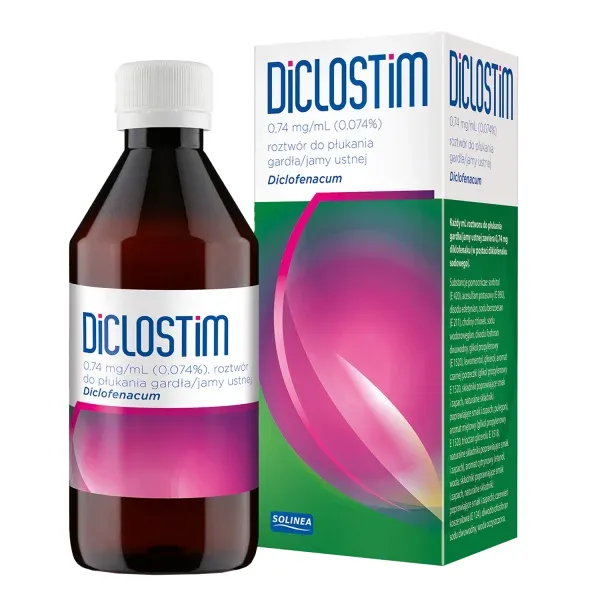
Instructions for Use
Package leaflet: Information for the user
Diclostim, 0,74 mg/mL (0,074%), solution for rinsing the throat/oral cavity
Diclofenacum
Please read all of this leaflet carefully before using this medicine, because it contains
important information for the patient.
This medicine should always be used exactly as described in this patient leaflet or as directed by
a doctor or pharmacist.
- Keep this leaflet so that you can read it again if necessary.
- If you need advice or further information, please consult your pharmacist.
- If you experience any adverse reactions, including any possible adverse reactions not listed in this leaflet, inform your doctor or pharmacist. See section 4.
- If there is no improvement after 7 days, or if you feel worse, consult your doctor.
Contents of the leaflet
- What Diclostim is and what it is used for
- Important information before using Diclostim
- How to use Diclostim
- Possible side effects
- How to store Diclostim
- Contents of the pack and other information
1. What Diclostim is and what it is used for
Diclostim contains diclofenac as the active substance, which is a non-steroidal anti-inflammatory drug (NSAID).
When applied locally in inflammatory conditions of the oral and pharyngeal mucosa, diclofenac exerts analgesic and anti-inflammatory effects.
Diclostim is used for symptomatic treatment of inflammatory conditions of the oral and pharyngeal mucosa (e.g. symptoms of gingivitis, stomatitis, pharyngitis, conditions following dental procedures, symptoms of mechanical irritation).
If there is no improvement after 7 days, or if you feel worse, consult your doctor.
2. Important information before using Diclostim
When not to use Diclostim:
- if the patient is allergic to diclofenac or to any of the other ingredients of this medicine (listed in section 6).
- if the patient has an allergy (hypersensitivity) to acetylsalicylic acid or to any other drug in the group of non-steroidal anti-inflammatory drugs (e.g. if asthma, urticaria or allergic rhinitis occurred after taking ibuprofen, ketoprofen or acetylsalicylic acid).
- in children under 14 years of age.
- during the last three months of pregnancy.
Warnings and precautions
Before starting to use Diclostim, discuss this with your doctor or pharmacist.
- During local use of the medicine, especially prolonged use, sensitization (hypersensitivity) may occur. In such a case, treatment should be discontinued and the patient should contact a doctor, who will recommend appropriate treatment if necessary.
- Avoid contact of Diclostim with the eyes.
Consult your doctor or pharmacist, even if the above warnings refer to conditions that occurred in the past.
Special precautions in certain specific patient groups using Diclostim
Use of Diclostim in patients with renal or hepatic impairment
There are no special dosing recommendations for patients with impaired kidney or liver function.
Theoretically, accumulation of the drug and its metabolites may occur in severe renal failure, but the clinical significance of this is unknown.
Use of Diclostim in patients with hereditary fructose intolerance
Due to the risk of ingestion, patients with hereditary fructose intolerance must not take this medicine.
Use of Diclostim in elderly patients
There is no need to modify the dosage regimen.
Children and adolescents
Do not use in children under 14 years of age.
Diclostim and other medicines
Tell your doctor or pharmacist about all medicines the patient is currently taking or has recently taken, as well as any medicines the patient plans to use.
No interactions of this medicine with other locally applied oral medicines are known.
Pregnancy, breastfeeding and effect on fertility
If the patient is pregnant or breastfeeding, suspects she may be pregnant, or is planning to become pregnant, she should consult her doctor or pharmacist before using this medicine.
Do not use Diclostim during the last three months of pregnancy. During the first six months of pregnancy, Diclostim should not be used unless necessary and recommended by a doctor.
If use is necessary, the lowest possible dose for the shortest possible duration should be administered.
Adverse effects on the unborn child may occur after oral formulations containing diclofenac (e.g. tablets). It is not known whether the same risk applies to Diclostim when used in the oral cavity.
Diclostim should not be used in women who are breastfeeding.
Driving and operating machinery
Diclostim has no influence on the ability to drive motor vehicles or operate machinery.
Diclostim contains sodium, potassium, ethanol, sodium benzoate (E 211), carmine red (E 124),
propylene glycol (E 1520) and sorbitol (E 420)
Sodium
This medicine contains 58 mg of sodium per single dose (15 mL), equivalent to 2.9% of the WHO-recommended maximum daily intake of 2 g of sodium for adults.
Potassium
This medicine contains less than 3 mg of potassium per dose, meaning the medicine is considered "potassium-free".
Ethanol
Diclostim contains 0.56 mg of alcohol (ethanol) per milligram, equivalent to 0.58 mg/mL. The amount of alcohol in 15 mL of this medicine is equivalent to less than 1 mL of beer or 1 mL of wine. The small amount of alcohol in this medicine will not cause noticeable effects.
Sodium benzoate (E 211)
Diclostim contains 312 mg of sodium benzoate per single dose (15 mL), which may cause local irritation.
Carmine red (E 124)
Diclostim contains carmine red, which may cause allergic reactions.
Propylene glycol (E 1520)
Diclostim contains 75 mg of propylene glycol (E 1520) per single dose (15 mL).
Sorbitol (E 420)
Diclostim contains 375 mg of sorbitol per single dose (15 mL). Sorbitol is a source of fructose. If intolerance to certain sugars has previously been diagnosed in the patient (or their child), or if hereditary fructose intolerance—a rare genetic disorder in which the patient's body cannot break down fructose—has been diagnosed, the patient should consult a doctor before taking this medicine or giving it to a child.
3. How to use Diclostim
This medicine should always be used exactly as described in the patient leaflet or as directed by a doctor or pharmacist. If in doubt, consult a doctor or pharmacist.
Recommended dose
Children under 14 years of age
Diclostim must not be used in children under 14 years of age.
Adults and children over 14 years of age
It is recommended to use the oral rinse solution 2 to 3 times daily. Each time, use 15 mL of the solution (1 measuring cup), undiluted or diluted with a small amount of water, and rinse the mouth for approximately 30–60 seconds.
After use, the solution must be spat out.
If symptoms worsen or do not improve after 7 days of using Diclostim, consult a doctor.
If you feel the effect of the medicine is too strong or too weak, consult your doctor.
Use of more than the recommended dose of Diclostim
Accidental, unintentional swallowing of one dose of the oral rinse solution does not pose a risk to the patient, as the potential swallowed dose would constitute one-fifth to one-sixth of the recommended systemic dose.
No cases of overdose with Diclostim have been reported.
In patients with hereditary fructose intolerance, the body cannot metabolize the fructose contained in this medicine, and unintentional swallowing may cause adverse effects.
If more than the recommended dose is taken, seek immediate advice from a doctor or pharmacist.
Missed dose of Diclostim
If a dose is missed, do not use a double dose to make up for the missed dose. Instead, use the next dose at the scheduled time according to the recommended dosing schedule.
If you have any further doubts about the use of this medicine, consult your doctor or pharmacist.
4. Possible adverse effects
Like all medicines, this medicine can cause adverse effects, although not everyone will experience them.
During use of the medicine (especially long-term), symptoms of irritation of the oral mucosa (e.g. burning sensation) and cough may occur. Hypersensitivity reactions may also develop.
In such cases, treatment with the medicine should be discontinued and medical advice should be sought for appropriate management.
Systemic adverse effects cannot be ruled out in case of swallowing or prolonged use of Diclositm.
Reporting of adverse effects
If any adverse effects occur, including any adverse effects not listed in this leaflet, inform your doctor, pharmacist or nurse. Adverse effects can be reported directly to the Department of Monitoring Adverse Drug Reactions at the Office for Registration of Medicinal Products, Medical Devices and Biocidal Products: Al. Jerozolimskie 181C, 02-222 Warsaw,
tel.: 22 49-21-301, fax: 22 49-21-309, website: https://smz.ezdrowie.gov.pl
Adverse effects can also be reported to the responsible entity.
Reporting adverse effects helps to provide more information on the safety of the medicine.
5. How to store Diclostim
Keep this medicine out of sight and reach of children.
There are no special storage temperature requirements for this medicine. Store in the original packaging to protect from light.
Do not use this medicine after the expiry date stated on the packaging following "Expiry date". The expiry date refers to the last day of the stated month.
Medicines must not be disposed of via wastewater or household waste. Ask your pharmacist how to dispose of medicines no longer required. This will help protect the environment.
6. Contents of the package and other information
What Diclostim contains
- The active substance is diclofenac. Each mL of solution for gargling/oral rinsing contains 0.74 mg of diclofenac (Diclofenacum) in the form of diclofenac sodium.
- The other ingredients (excipients) are: sorbitol (E 420), acesulfame potassium (E 950), disodium edetate, sodium benzoate (E 211), choline chloride, sodium bicarbonate, disodium phosphate dihydrate, propylene glycol (E 1520), levomenthol, glycerol, blackcurrant flavour (propylene glycol E 1520, flavouring agents, natural flavouring substances), mint flavour (propylene glycol E 1520, glyceryl triacetate E 1518, natural flavouring substances), lemon flavour (ethanol, water, flavouring agents, natural flavouring substances), carmine red (E 124), disodium dihydrogen phosphate dihydrate, purified water.
What Diclostim looks like and contents of the pack
Diclostim solution for gargling/oral rinsing is a clear, bright red, homogeneous solution free from mechanical impurities.
The Diclostim pack consists of a PET bottle with an HDPE cap containing 150 mL, 200 mL or 250 mL of solution for gargling/oral rinsing, with a polypropylene dosing cup of 15 mL capacity, all contained in a cardboard box. Not all pack sizes may be marketed.
Marketing Authorisation Holder
Solinea Sp. z o.o.
Elizówka, Szafranowa 6
21-003 Ciecierzyn
Tel. 81 463-48-82
Manufacturer
Mako Pharma Sp. z o.o.
Kolejowa 231A
05-092 Dziekanów Polski
Medicofarma S.A.
ul. Tarnobrzeska 13
26-613 Radom
Similar Medications
-
Baxofort
Form: solution, for rinsing the oral cavity and throat
Active substance Dosage Diclofenac 0.74 mg/ml Manufacturer: Aflofarm Farmacja Polska Sp. z o.o. Pharmaceutical Production Plant in Rzgów
-
Glimbax
Form: solution, for rinsing the oral cavity and throat
Active substance Dosage Diclofenac 0.074 g Manufacturer: ITC Production S.r.l. Sun-Farm Sp. z o.o.
This page has been machine-translated and may contain inaccuracies. The original data is available in the manufacturing country's language.
Last data check: June 04, 2026 · Data source: Rejestr Produktów Leczniczych (URPL)