Diclofenac diethylamine teva
Poland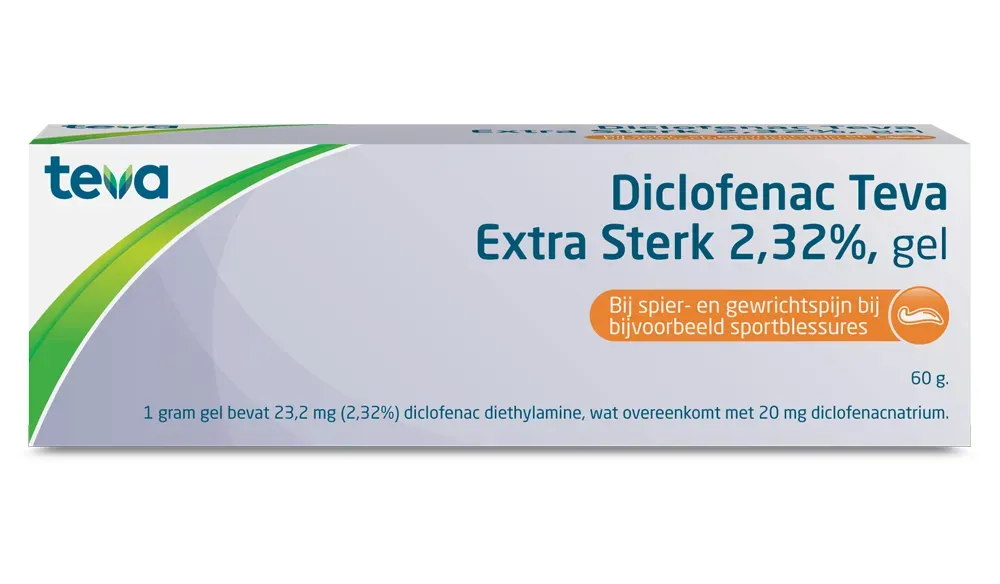
Table of Contents
- Package leaflet: Information for the user
- 1. What Diclofenac diethylamine Teva is and what it is used for
- 2. Important information before using Diclofenac diethylamine Teva
- 3. How to use Diclofenac diethylamine Teva
- 4. Possible adverse reactions
- 5. How to store Diclofenac diethylamine Teva
- 6. Contents of the packaging and other information
Package leaflet: Information for the user
Diclofenac diethylamine Teva, 20 mg/g, gel
Diclofenacum natricum
(in the form of Diclofenacum diethylammonium)
For use in adults and adolescents aged 14 years and older
Please read this leaflet carefully before using the medicine, as it contains
important information for the patient.
This medicine should always be used exactly as described in this patient leaflet or as directed by
your doctor or pharmacist.
- Keep this leaflet, so that you can read it again if necessary.
- If you need advice or further information, please consult your pharmacist.
- If you experience any adverse effects, including any possible side effects not listed in this leaflet, inform your doctor or pharmacist. See section 4.
- If there is no improvement or if you feel worse after 3–5 days, you should contact your doctor.
Contents of the leaflet:
- What Diclofenac diethylamine Teva is and what it is used for
- Important information before using Diclofenac diethylamine Teva
- How to use Diclofenac diethylamine Teva
- Possible side effects
- How to store Diclofenac diethylamine Teva
- Contents of the pack and other information
1. What Diclofenac diethylamine Teva is and what it is used for
Diclofenac diethylamine Teva contains the active substance diclofenac, which belongs to a group of medicines called non-steroidal anti-inflammatory drugs (NSAIDs).
Adults and adolescents aged 14 years and older
Local symptomatic treatment of pain associated with acute strains, sprains or contusions caused by blunt injuries.
In adolescents aged 14 years and older, the medicine is intended for short-term treatment.
2. Important information before using Diclofenac diethylamine Teva
When NOT to use Diclofenac diethylamine Teva
- if the patient is allergic to diclofenac or any of the other ingredients of this medicine (listed in section 6);
- if the patient has ever previously experienced breathing difficulties (asthma, bronchospasm), skin reactions (urticaria), rhinitis, or facial or tongue swelling after taking or applying medicines containing acetylsalicylic acid or other non-steroidal anti-inflammatory drugs (e.g. ibuprofen);
- on open wounds, inflamed or infected skin areas, as well as on skin affected by eczema or on mucous membranes;
- during the last three months of pregnancy; see section "Pregnancy";
- in children and adolescents under 14 years of age.
Warnings and precautions
Before starting treatment with Diclofenac diethylamine Teva, consult your doctor or pharmacist.
Use of this medicine requires special caution in patients who have a higher than average risk of asthma attacks (so-called analgesic intolerance/analgesic-induced asthma), localized skin or mucosal swelling (so-called Quincke's oedema), or urticaria; this includes patients suffering from asthma, hay fever, nasal mucosal swelling (nasal polyps), chronic obstructive pulmonary disease, chronic respiratory tract infections (particularly associated with symptoms typical of hay fever), or hypersensitivity to other painkillers and various anti-rheumatic drugs.
In such patients, Diclofenac diethylamine Teva should only be used with appropriate precautions (prepared for possible acute reactions) and under direct medical supervision. The same applies to patients with allergies to other substances, manifesting as skin reactions, itching, or urticaria.
When Diclofenac diethylamine Teva is applied over large skin areas or for prolonged periods, systemic adverse effects cannot be ruled out. These adverse effects are similar to those that may occur with other medicines containing diclofenac. Therefore, the gel should be used cautiously in patients with impaired kidney, heart, or liver function, as well as in patients with active gastric or duodenal ulcer disease.
Diclofenac diethylamine Teva should only be applied to intact, undamaged, and disease-free skin. Avoid contact of the gel with eyes and mucous membranes. The gel must not be taken orally.
After applying the gel to the skin, a breathable (non-occlusive) dressing may be used, but wait several minutes until the gel has dried on the skin. Do not use with an air-tight (occlusive) dressing.
If symptoms worsen or there is no improvement within 3–5 days of treatment, consult a doctor.
If a skin rash occurs, treatment with Diclofenac diethylamine Teva should be discontinued.
During treatment, photosensitivity may occur, manifesting as skin reactions following exposure to sunlight.
Precautions should be taken to ensure that the gel does not come into contact with a child’s skin.
Children and adolescents
Diclofenac diethylamine Teva is contraindicated in children and adolescents under 14 years of age.
Diclofenac diethylamine Teva and other medicines
Inform your doctor or pharmacist about all medicines you are currently taking, have recently taken, or plan to use.
No interactions have been reported to date with topical use of Diclofenac diethylamine Teva.
Pregnancy and breastfeeding
If you are pregnant or breastfeeding, think you may be pregnant, or are planning to have a baby, consult your doctor or pharmacist before using this medicine.
Pregnancy
Do not use Diclofenac diethylamine Teva during the last trimester of pregnancy, as it may harm the fetus or cause complications during childbirth. During the first and second trimesters of pregnancy, Diclofenac diethylamine Teva should only be used after consultation with a doctor. If treatment is necessary during this period, the lowest effective dose should be used for the shortest possible duration.
Breastfeeding
Diclofenac diethylamine Teva may be used during breastfeeding only on medical advice, as diclofenac passes into breast milk in small amounts. In such cases, the gel should not be applied to the breast area of breastfeeding women, nor to large skin areas, and should not be used for prolonged periods.
Driving and operating machinery
The use of Diclofenac diethylamine Teva has no effect or only a negligible effect on the ability to drive or operate machinery.
Diclofenac diethylamine Teva contains propylene glycol (E1520)
This medicine contains 54 mg of propylene glycol per 1 g of gel.
Diclofenac diethylamine Teva contains butylated hydroxytoluene (E321)
Butylated hydroxytoluene may cause local skin reactions (e.g. contact dermatitis) or irritate the eyes and mucous membranes.
Diclofenac diethylamine Teva contains fragrances
This medicine contains a fragrance blend including benzyl alcohol (0.15 mg/g gel), citral, citronellol, coumarin, eugenol, farnesol, geraniol, d-limonene, and linalool – these substances may cause allergic reactions. In addition, benzyl alcohol may cause mild, local irritation.
3. How to use Diclofenac diethylamine Teva
This medicine should always be used exactly as described in this patient information leaflet or as advised by your doctor or pharmacist. If in doubt, consult your doctor or pharmacist.
Adults and adolescents aged 14 years and older
Apply Diclofenac diethylamine Teva twice daily (preferably in the morning and evening).
Depending on the size of the affected area, apply 1 g to 4 g of gel, corresponding to the size of a cherry up to a walnut.
The maximum daily dose is 8 g of gel.
If symptoms worsen or do not improve within 3–5 days, consult your doctor.
Elderly patients
No special dose adjustment is necessary. Elderly individuals should pay particular attention to possible adverse effects and, if necessary, consult their doctor or pharmacist.
Renal or hepatic impairment
Dose reduction is not required.
Use in children and adolescents (under 14 years of age)
There is insufficient data on the efficacy and safety of Diclofenac diethylamine Teva in children and adolescents under 14 years of age (see section 2, "When not to use Diclofenac diethylamine Teva").
Use in adolescents (aged 14 years and older)
In adolescents aged 14 years and older, if this medicine is needed to relieve pain for longer than 7 days or if symptoms worsen, the patient and (or) the parents should consult a doctor.
How to open for the first time:
- Unscrew the cap from the tube. To remove the protective seal, pierce it with the reverse side of the cap. Do not use scissors or other sharp objects!
- Twist and remove the plastic sealing ring from the tube. Use the gel as described in this leaflet. If the ring is broken, do not use the gel.
How to use the medicine:
Diclofenac diethylamine Teva is for topical use only.
Apply a thin layer of gel to the affected area and gently massage into the skin. Afterwards, wipe your hands with a paper towel and wash them, unless the hands themselves are the treated area. If too much gel has been applied, wipe off the excess with a paper towel. The used paper towel should be disposed of in household waste to prevent unused product from entering the aquatic environment.
Wait several minutes after application to allow the gel to dry before applying a dressing.
Duration of treatment:
The duration of treatment depends on the symptoms and underlying condition. Do not use Diclofenac diethylamine Teva for longer than 1 week without consulting a doctor.
Use of more than the recommended dose of Diclofenac diethylamine Teva
Overdose with Diclofenac diethylamine Teva is unlikely due to its low systemic absorption when used topically.
In case of accidental ingestion of Diclofenac diethylamine Teva, contact your doctor, who will advise on appropriate management.
Missed dose of Diclofenac diethylamine Teva
Do not use a double dose to make up for a missed dose.
If you have any doubts about using this medicine, consult your doctor or pharmacist.
4. Possible adverse reactions
Like all medicines, this medicine can cause adverse reactions, although not everyone will experience them.
Some adverse reactions occurring rarely or very rarely may be serious.
If any of the symptoms listed below occur, which may be signs of hypersensitivity, discontinue use of Diclofenac diethylamine Teva immediately and contact your doctor or pharmacist without delay.
- Skin rash with blisters; urticaria (may occur in up to 1 in 1,000 people).
- Wheezing, shortness of breath, or feeling of tightness in the chest (asthma) (may occur in up to 1 in 10,000 people).
- Swelling of the face, lips, tongue, or throat (may occur in up to 1 in 10,000 people).
Other possible adverse reactions:
Common adverse reactions (may occur in up to 1 in 10 people):
Skin rash, itching, redness, eczema, dermatitis including contact dermatitis.
Uncommon adverse reactions (may occur in up to 1 in 100 people):
Peeling of the skin, skin dryness, swelling.
Very rare adverse reactions (may occur in up to 1 in 10,000 people):
Papular rash, gastrointestinal disturbances, hypersensitivity reactions (including urticaria), photosensitivity with skin reactions following exposure to sunlight.
Frequency not known (frequency cannot be estimated from the available data):
Burning sensation at the site of application, dry skin.
When Diclofenac diethylamine Teva is used over a large area of skin or for prolonged periods, systemic adverse reactions (e.g. adverse effects affecting the gastrointestinal system, liver or kidneys, systemic hypersensitivity reactions) cannot be excluded, which may occur following systemic administration of diclofenac-containing medicines.
Reporting of adverse reactions
If any adverse reactions occur, including any adverse reactions not listed in this leaflet, inform your doctor or pharmacist. Adverse reactions can be reported via the Department of Monitoring Adverse Drug Reactions of the Office for Registration of Medicinal Products, Medical Devices and Biocidal Products, Al. Jerozolimskie 181C, 02-222 Warsaw,
Tel.: +48 22 49 21 301
Fax: +48 22 49 21 309
Website: https://smz.ezdrowie.gov.pl
Adverse reactions can also be reported to the marketing authorization holder.
Reporting adverse reactions helps provide more information on the safety of the medicine.
5. How to store Diclofenac diethylamine Teva
Keep this medicine out of the sight and reach of children.
Do not use this medicine after the expiry date stated on the outer carton and tube
following “Expiry date (EXP)” or “EXP”. The expiry date refers to the last day of the stated month.
Do not store above 25°C.
Store in the original packaging to protect from light.
Medicines should not be disposed of via wastewater or household waste. Ask your
pharmacist how to dispose of medicines no longer required. Such measures help protect
the environment.
6. Contents of the packaging and other information
What Diclofenac diethylamine Teva contains
- The active substance is diclofenac. 1 g contains 23.2 mg of diclofenac diethylamine, equivalent to 20 mg of sodium diclofenac.
- Other ingredients: carbomer, coco-caprylo-caprate, cetostearyl macrogol ether, liquid paraffin, diethanolamine, isopropyl alcohol, propylene glycol (E 1520), oleic acid (E570), butylhydroxytoluene (E 321), fragrance (containing benzyl alcohol, citral, citronellol, coumarin, eugenol, farnesol, geraniol, d-limonene and linalool), purified water.
What Diclofenac diethylamine Teva looks like and contents of the pack
Diclofenac diethylamine Teva is a homogeneous gel, white to almost white in colour, packed in laminated aluminium tubes with PE sealing rings and PP caps, placed in a cardboard box. Package sizes: tubes of 30 g, 50 g, 60 g, 100 g, 150 g, 180 g.
Not all package sizes may be marketed.
Marketing Authorisation Holder and Manufacturer
Marketing Authorisation Holder
Teva B.V.
Swensweg 5
2031GA Haarlem
The Netherlands
Tel: (22) 345 93 00
Manufacturer
Merckle GmbH
Graf-Arco-Str. 3
89079 Ulm
Germany