Dexamytrex
Poland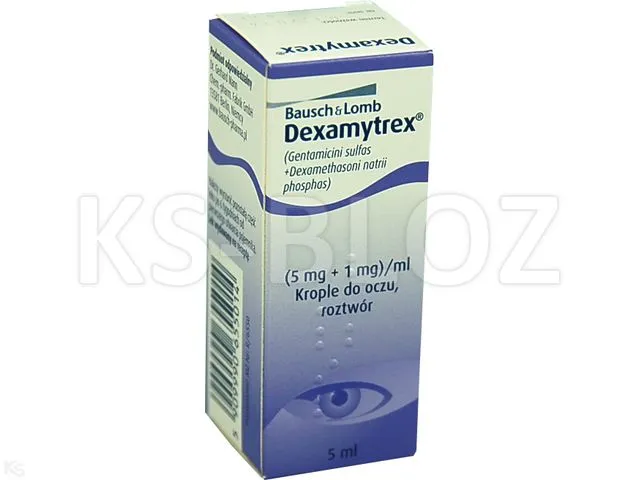
Table of Contents
Package leaflet: Information for the user
Warning! Keep the leaflet, information on the immediate packaging in a foreign language!
Dexamytrex
(5 mg + 1 mg)/ml, eye drops, solution
Gentamicini sulfas + Dexamethasoni natrii phosphas
Please read carefully the entire leaflet before using the medicine, as it contains
important information for the patient.
- Keep this leaflet, so that you can read it again if necessary.
- If you have any doubts, please consult your doctor or pharmacist.
- This medicine has been prescribed for a specific individual. Do not pass it on to others. The medicine may harm another person, even if their symptoms are the same.
- If the patient experiences any adverse effects, including any adverse effects not listed in this leaflet, inform your doctor or pharmacist. See section 4.
Table of contents of the leaflet
- What Dexamytrex is and what it is used for
- Important information before using Dexamytrex
- How to use Dexamytrex
- Possible side effects
- How to store Dexamytrex
- Contents of the pack and other information
1. What Dexamytrex is and what it is used for
Dexamytrex contains the active substances: gentamicin sulfate – an antibiotic from the aminoglycoside group, and dexamethasone sodium phosphate – a glucocorticosteroid.
The medicine is used in infections of the anterior segment of the eye caused by microorganisms sensitive to gentamicin, such as bacterial conjunctivitis, keratitis – without epithelial damage, and eyelid margin inflammation with severe inflammatory symptoms, as well as in secondarily infected allergic conjunctivitis and eyelid margin inflammation.
2. Important information before using Dexamytrex
When not to use Dexamytrex:
- if the patient is allergic to gentamicin, dexamethasone, or any of the other ingredients of this medicine (listed in section 6);
- if the patient has acute, purulent disease of the anterior segment of the eye;
- if the patient has superficial herpetic keratitis or corneal erosions and ulcers;
- if the patient has tuberculous infection of the eyeball;
- if the patient has fungal infection of the eye;
- if the patient has narrow-angle or open-angle glaucoma.
Warnings and precautions
Before starting treatment with Dexamytrex, discuss this with your doctor or pharmacist,
especially if:
- the patient is using other medicines administered locally to the eye;
- the patient wears contact lenses. The use of contact lenses is not recommended during treatment with Dexamytrex.
Seek immediate medical advice if, during treatment with Dexamytrex:
- partial or complete hearing loss or dizziness occurs;
- the amount of purulent discharge, inflammation, or pain increases;
- sudden, severe eye and headache with associated nausea, vomiting, sudden blurred vision, and decreased visual acuity occur. These may be symptoms of increased intraocular pressure;
- blurred vision or other visual disturbances occur;
- hazy vision and difficulty seeing in bright light occur. These may be symptoms of a condition called cataract;
- any other eye problems occur (pain, eye redness, tearing, photophobia). These may be symptoms of damage to parts of the eye.
Consult a doctor if the patient develops swelling and weight gain, particularly noticeable
in the trunk and face, as these are usually the first signs of a condition known as
Cushing's syndrome. Adrenal suppression may occur following discontinuation
of prolonged or intensive treatment with Dexamytrex. Consult a doctor before
deciding to stop treatment. This risk is particularly relevant in children and in patients
receiving ritonavir or cobicistat.
Do not use this medicine for prolonged periods, as resistant bacteria may develop
or secondary eye infections (bacterial, fungal, or viral) may occur.
Children and adolescents
The safety and efficacy in children have not been established.
Dexamytrex and other medicines
Tell your doctor about all medicines the patient is currently taking or
has recently taken, including those obtained without a prescription.
Especially inform the doctor if the patient is using:
- amphotericin B, heparin, sulfadiazine, cephalothin, or cloxacillin, administered locally to the eye. Concurrent administration of Dexamytrex with any of these medicines may lead to the formation of visible precipitates in the conjunctival sac;
- other eye drops or ointments. If Dexamytrex is used together with other eye drops or ointments, a 15-minute interval should be maintained between applications. Eye ointments should always be applied last.
- ritonavir or cobicistat, as these medicines may increase blood levels of dexamethasone.
Pregnancy and breastfeeding
If the patient is pregnant or breastfeeding, suspects she may be pregnant, or is planning to become
pregnant, she should consult a doctor or pharmacist before using this medicine.
Dexamytrex should not be used during pregnancy and while breastfeeding.
Driving and operating machinery
Even when used as directed, Dexamytrex may temporarily impair vision after
administration; therefore, until these symptoms have completely resolved, the patient should not drive
or operate machinery.
Dexamytrex contains disodium phosphate dodecahydrate and potassium dihydrogen phosphate
The medicine contains 0.20 mg of phosphates per drop, equivalent to 6.52 mg/ml.
In patients with severe damage to the transparent, anterior part of the eye (cornea), phosphates
may very rarely cause corneal clouding due to calcium deposition during treatment.
3. How to use Dexamytrex
This medicine should always be used as directed by a physician. If in doubt, consult a doctor or pharmacist.
Recommended dose
Unless otherwise prescribed, apply 1 drop into the conjunctival sac of the affected eye 4–6 times daily.
Pull the lower eyelid downward and instill 1 drop into the conjunctival sac.
The duration of treatment should not exceed 2 weeks.
Caution!
Instructions for administration
Wash hands thoroughly before instilling the drops.
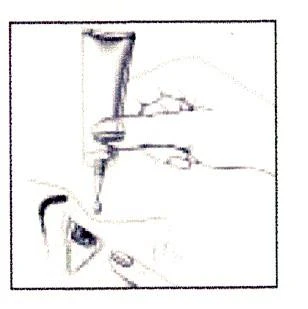
Tilt the head backward and gently pull down the lower eyelid with the index finger.
With the other hand, hold the bottle vertically above the eye and instill one drop into the conjunctival sac by gently squeezing the bottle wall, taking care not to touch the eye with the dropper tip.
Keep the eye open and move it gently to ensure even distribution of the solution.
After instillation, gently press with a finger on the inner corner of the eye (near the nose) for about 2 minutes. This helps reduce systemic absorption of the medicine.
Dexamytrex eye drops are sterile. To avoid contamination, do not touch the dropper tip with fingers or allow it to contact the eye surface or any other surface. Using contaminated drops may lead to serious eye damage, including loss of vision.
After use, replace and tightly close the protective cap on the bottle.
If you feel the effect of Dexamytrex is too strong or too weak, consult your doctor or pharmacist.
Note:
If Dexamytrex is used together with other eye drops or eye ointments, a 15-minute interval should be maintained between the applications. Eye ointments should always be used last.
Use of a higher than recommended dose of Dexamytrex
Since this medicine is administered to the eye, overdose is not expected.
Missed dose of Dexamytrex
Apply the missed dose as soon as possible. Do not use a double dose to make up for a missed dose. If several doses have been missed, inform your doctor and follow their instructions.
4. Possible adverse effects
Like all medicines, this medicine can cause adverse effects, although not everyone will experience them.
The frequency of possible adverse effects is defined as follows:
Very common – occurs in more than 1 in 10 patients
Common – occurs in 1 to 10 in 100 patients
Uncommon – occurs in 1 to 10 in 1,000 patients
Rare – occurs in 1 to 10 in 10,000 patients
Very rare – occurs in fewer than 1 in 10,000 patients
Frequency not known – cannot be estimated based on available data
Possible adverse effects:
Rare:
mild, transient and short-term visual disturbances.
Very rare:
dilation of the pupil in the treated eye.
Frequency not known:
Impaired wound healing (if the medicine is used following corneal injury), cataract (after prolonged use), glaucoma (after prolonged use), eye irritation, corneal deposits, hypersensitivity (including eyelid and conjunctival swelling, itching, conjunctival hyperemia, contact dermatitis).
Fungal corneal infections, which may develop particularly easily as secondary infections during prolonged local use of corticosteroid-containing medicines. Fungal infection should always be considered after corticosteroid use if persistent corneal ulceration occurs.
Bacterial eye infections.
Secondary infections by pathogens: bacterial, viral (including herpes simplex virus).
Increased intraocular pressure (which may lead to optic nerve damage, worsening of visual acuity, and visual field defects). Posterior subcapsular cataract.
Perforation (puncturing) of the membrane on the surface of the eye.
Hormonal disorders: increased body hair growth (especially in women), muscle weakness and loss of muscle mass, purple skin striae, increased blood pressure, irregular menstruation or absence of menstruation, changes in protein and calcium levels in the body, growth suppression in children and adolescents, and edema and increased body weight, particularly noticeable in the trunk and face (a condition known as Cushing's syndrome) (see section 2 "Warnings and precautions"). Blurred vision.
Other adverse effects reported with the use of eye drops containing phosphates:
In patients with severe damage to the transparent front part of the eye (cornea), phosphates may, in very rare cases, cause corneal calcification and clouding during treatment.
Reporting of adverse effects
If any adverse effects occur, including any not listed in this leaflet, inform your doctor or pharmacist. Adverse effects can be reported directly to the Department of Monitoring Adverse Drug Reactions, Office for Registration of Medicinal Products, Medical Devices and Biocidal Products, Al. Jerozolimskie 181 C, 02-222 Warsaw, Tel.: +48 22 49 21 301, Fax: +48 22 49 21 309, Website: https://smz.ezdrowie.gov.pl
Reporting adverse effects helps to provide more information on the safety of the medicine.
5. How to store Dexamytrex
Keep this medicine out of sight and reach of children.
Do not use this medicine after the expiry date stated on the packaging.
Do not store above 25°C. Store in the outer packaging to protect from light.
Discard any remaining drops 30 days after first opening the container.
Medicines must not be disposed of via wastewater or household waste. Ask your pharmacist how to dispose of medicines no longer required. This helps protect the environment.
6. Contents of the package and other information
What Dexamytrex contains
- The active substances in this medicine are: gentamicin (in the form of gentamicin sulfate) and dexamethasone (in the form of dexamethasone sodium phosphate). 1 ml of eye drops contains 5 mg of gentamicin sulfate and 1 mg of dexamethasone sodium phosphate.
- Other ingredients are: cetrimide, disodium phosphate dodecahydrate, potassium dihydrogen phosphate, sodium metabisulfite, glycerol 85%, povidone, hypromellose, disodium edetate, water for injections.
What Dexamytrex looks like and contents of the pack
Dexamytrex is available as eye drops, solution.
It is supplied in a dropper bottle within a cardboard box. Pack size: 5 ml.
For further information, please contact the Marketing Authorisation Holder or Parallel Importer.
Marketing Authorisation Holder in Greece, the country of export:
Bausch + Lomb Ireland Limited
3013 Lake Drive
Citywest Business Campus 24
Dublin, Ireland
Manufacturer:
Dr. Gerhard Mann Chem. Pharma Fabrik GmbH
Brunsbutteler Damm 165-173
13581 Berlin
Germany
Parallel Importer:
Medezin Sp. z o.o.
ul. Zbąszyńska 3
91-342 Łódź
Poland
Repackaged in:
Medezin Sp. z o.o.
ul. Zbąszyńska 3
91-342 Łódź
Poland
Marketing Authorisation number in Greece, the country of export: 75842/24-12-2015
Parallel Import Licence Number: 207/25