Dexafree
Poland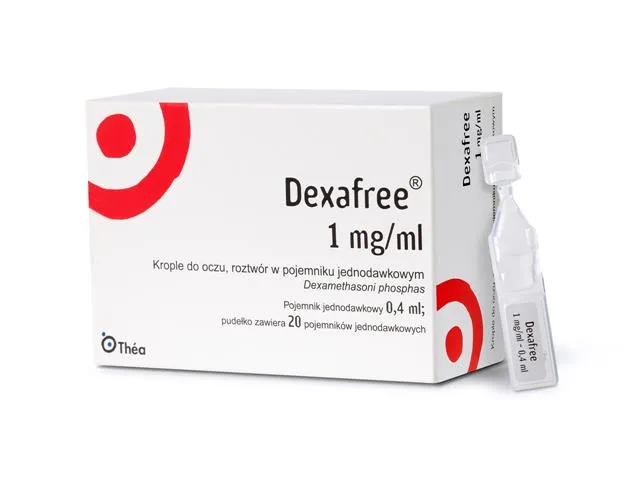
Table of Contents
PACKAGE LEAFLET: INFORMATION FOR THE USER
Warning! Keep the leaflet, information on the immediate packaging in a foreign language!
Dexafree
1 mg/ml, eye drops, solution
Dexamethasoni phosphas
Please read the entire leaflet carefully before using the medicine, as it contains
important information for the patient.
- Keep this leaflet for future reference.
- If you have any questions, consult your doctor or pharmacist.
- This medicine has been prescribed for a specific individual. Do not share it with others. The medicine may harm someone else, even if their symptoms are similar.
- If you experience any adverse reactions, including those not listed in this leaflet, inform your doctor or pharmacist. See section 4.
Table of contents
- What Dexafree is and what it is used for
- Important information before using Dexafree
- How to use Dexafree
- Possible side effects
- How to store Dexafree
- Contents of the pack and other information
1. WHAT DEXAFREE IS AND WHAT IT IS USED FOR
Dexafree is an eye drop solution in single-dose containers containing a substance called dexamethasone. This substance is a corticosteroid that suppresses inflammatory symptoms.
Dexafree is indicated for the treatment of inflammatory conditions of the eye(s).
The eye should not be infected (redness of the eye, discharge, tearing, etc.); otherwise, appropriate anti-infective treatment must be administered concurrently (see section 2).
2. IMPORTANT INFORMATION BEFORE USING DEXAFREE
When NOT to use Dexafree
- If the patient has an eye infection, which may be bacterial (acute purulent infection), fungal, viral (herpes simplex virus, vaccinia virus (VACV), varicella-zoster virus (VZV)) or caused by amoebae,
- If the patient has corneal damage (perforation, ulceration or pathological changes associated with incomplete healing (regeneration)),
- If the patient has been diagnosed with steroid-induced ocular hypertension (glucocorticoids being a group of corticosteroids),
- If the patient is allergic (hypersensitive) to dexamethasone sodium phosphate or any of the other ingredients of Dexafree.
Warnings and precautions
Before starting treatment with Dexafree, discuss this with your doctor or pharmacist.
DO NOT INJECT, DO NOT SWALLOW
Do not touch the eye or eyelids with the dropper tip.
- Strict ophthalmological monitoring is required in all cases during treatment with Dexafree, especially:
- in children and elderly patients. More frequent detailed ophthalmological examinations are recommended,
- if the patient has an eye infection. Dexafree may only be used if anti-infective treatment is administered concomitantly,
- if the patient has corneal ulcer. Local treatment with dexamethasone or Dexafree should not be used unless inflammation is the main cause of delayed healing,
- if the patient has elevated intraocular pressure. If the patient previously experienced adverse effects leading to increased intraocular pressure during topical steroid therapy, there is a risk of elevated intraocular pressure occurring when using Dexafree,
- if the patient has glaucoma.
- Children: prolonged, continuous use should be avoided.
- Acute allergic conjunctivitis: if the patient has acute allergic conjunctivitis and standard therapy is ineffective, Dexafree may be used only for a short period.
- Diabetic patients: if the patient has diabetes, they should inform their ophthalmologist.
- Red eye: if the patient has a red eye and the cause of symptoms is unknown, Dexafree should not be used.
- Contact lenses: wearing contact lenses should be avoided during treatment with Dexafree.
Seek medical advice if the patient develops swelling and weight gain, particularly noticeable on the trunk and face, as these are usually the first signs of a condition known as Cushing's syndrome. Adrenal suppression may occur following discontinuation of prolonged or intensive treatment with Dexafree. Consult a doctor before deciding to stop treatment. This risk is particularly relevant in children and in patients treated with ritonavir or cobicistat.
If the patient experiences blurred vision or other visual disturbances, they should contact a doctor.
Dexafree and other medicines
If other eye medications are required, wait 15 minutes before administering the next medication.
Inform the doctor if the patient is taking ritonavir or cobicistat, as these drugs may increase blood levels of dexamethasone.
Precipitation of calcium phosphate on the corneal surface has been observed when corticosteroids and beta-adrenergic receptor blocking agents are used concomitantly.
Inform your doctor or pharmacist about all medicines the patient is currently taking or has recently taken, as well as any medicines the patient plans to use.
Pregnancy and breastfeeding
- There is insufficient data on the use of Dexafree in pregnant women. The potential risk to humans is unknown. Therefore, the use of Dexafree during pregnancy is not recommended.
- It is not known whether the drug is excreted in breast milk. However, the total dose of dexamethasone is low. Therefore, Dexafree may be used during breastfeeding.
If the patient is pregnant or breastfeeding, suspects she may be pregnant, or is planning to have a child, she should consult her doctor or pharmacist before using this medicine.
Driving and operating machinery
As with all eye drops, transient blurred vision or other visual disturbances may affect the ability to drive or operate machinery. Do not drive or operate machinery until normal vision returns.
Dexafree contains phosphates
The medicine contains 80 micrograms of phosphates per drop.
3. HOW TO USE THE MEDICINAL PRODUCT DEXAFREE
Dosage
This medicinal product should always be used as prescribed by a physician. In case of doubt, consult
your doctor or pharmacist.
The recommended dose is 1 drop into the affected eye 4 to 6 times daily. In severe cases, treatment may
be initiated with 1 drop every hour, and after improvement is observed, the dose should be reduced to
1 drop every 4 hours. Gradual reduction of the dose is recommended to prevent relapse.
- In elderly patients: dosage adjustment is not required.
- In children: prolonged, continuous treatment should be avoided.
Administration method
Ocular administration: this medicinal product is intended for ophthalmic use only.
① Before application, hands should be thoroughly washed.
② Look upward and gently pull down the lower eyelid with a finger, then instill one drop into the eye
requiring treatment.
③ Immediately after instillation, gently press with a finger on the inner corner of the treated eye for
several minutes (to reduce the risk of systemic reactions and enhance penetration of the active
substance into the eye).
④ After use, the single-dose container should be discarded. Do not store for later use.
Frequency of administration
4 to 6 times daily.
Duration of treatment
Treatment duration usually ranges from several days up to a maximum of 14 days.
Overdose of Dexafree
In case of excessive dose administered to the eye and prolonged irritation occurs, rinse the eye with
sterile water.
Immediately contact your treating physician or pharmacist.
Missed dose of Dexafree
Do not administer a double dose to make up for a missed dose.
Discontinuation of Dexafree
Do not abruptly stop treatment. Always consult your doctor if the patient considers discontinuing
treatment.
If you have any further questions regarding the use of this medicinal product, consult your doctor or
pharmacist.
4. POSSIBLE ADVERSE REACTIONS
Like all medicines, this medicine can cause adverse reactions, although not everyone will experience them.
Endocrine disorders:
Unknown: frequency cannot be determined from the available data
- Excessive growth of body hair (especially in women), muscle weakness and loss of muscle mass, purple stretch marks on the skin, increased blood pressure, irregular menstruation or absence of menstruation, changes in protein and calcium levels in the body, growth suppression in children and adolescents, and swelling with weight gain, particularly noticeable in the trunk and face (a condition known as Cushing's syndrome) (see section 2 "Warnings and precautions").
Eye disorders:
Very common: (occurs in more than 1 in 10 people):
- Elevated intraocular pressure, after 2 weeks of treatment.
Common: (occurs in 1 to 10 people in 100):
- Discomfort, irritation, burning, stinging, itching, and visual disturbances after instillation. These symptoms are usually transient and mild in nature.
Uncommon: (occurs in 1 to 10 people in 1,000):
- Allergic reactions or hypersensitivity symptoms to one of the ingredients of the eye drops,
- Delayed healing,
- Clouding of the lens (cataract),
- Inflammatory conditions,
- Glaucoma.
Very rare (occurs in less than 1 in 10,000 people):
- Conjunctivitis,
- Pupil dilation (mydriasis),
- Facial swelling,
- Drooping of the eyelids,
- Iritis (inflammation of the uvea),
- Corneal calcification,
- Corneal inflammation (crystalline keratopathy),
- Changes in corneal thickness,
- Corneal edema,
- Corneal ulceration,
- Corneal perforation.
In patients with severe damage to the transparent, front part of the eye (cornea), phosphates may very rarely cause corneal clouding due to calcium accumulation during treatment.
Reporting of adverse reactions
If any adverse reactions occur, including any adverse reactions not listed in this leaflet, inform your doctor or pharmacist. Adverse reactions can be reported directly to the Department of Monitoring of Adverse Drug Reactions of the Office for Registration of Medicinal Products, Medical Devices and Biocidal Products:
Al. Jerozolimskie 181C, 02-222 Warsaw, phone: 22 49-21-301, fax: 22 49-21-309,
website: https://smz.ezdrowie.gov.pl
Reporting adverse reactions helps to provide more information on the safety of the medicine.
5. HOW TO STORE DEXAFREE
Keep this medicine out of the sight and reach of children.
Do not use Dexafree after the expiry date stated on the packaging.
The expiry date refers to the last day of the stated month.
After opening the sachet: use the contents of the single-dose containers within 15 days.
After opening a single-dose container: use immediately and discard the single-dose container after use.
Store the single-dose containers in the sachet to protect them from light.
Medicines should not be disposed of via wastewater or household waste. Ask your pharmacist
how to dispose of medicines no longer required. This will help protect the environment.
6. CONTENTS OF THE PACKAGE AND OTHER INFORMATION
What Dexafree contains
- The active substance is dexamethasone sodium phosphate. One millilitre of solution contains 1 mg of dexamethasone phosphate (as dexamethasone sodium phosphate).
- Other components of the medicine are: disodium edetate, disodium phosphate dodecahydrate, sodium chloride and water for injections.
What Dexafree looks like and contents of the pack
Dexafree is a clear, colourless to slightly brown solution for eye drops available in single-dose containers.
Each single-dose container made of low-density polyethylene contains 0.4 ml of solution.
The cardboard box contains 20 single-dose containers packed in sachets.
For further information, please contact the Marketing Authorisation Holder or Parallel Importer.
Marketing Authorisation Holder in France, the country of export:
Laboratoires Thea
12, Rue Louis Blériot
63017 Clermont Ferrand-Cedex 2
France
Manufacturer:
Excelvision
Rue de la Lombardiere
07100 Annonay, France
Laboratoires UNITHER
1 Rue de L’arquerie
50200 Coutances
France
Parallel Importer:
Medezin Sp. z o.o.
ul. Zbąszyńska 3
91-342 Łódź
Poland
Repackaged in:
Medezin Sp. z o.o.
ul. Zbąszyńska 3
91-342 Łódź
Poland
Marketing Authorisation numbers in France, the country of export:
34009 374 776 8 0
374 776-8
34009 374 774 5 1
374 774-5
34009 374 775 1 2
374 775-1
34009 374 777 4 1
374 777-4
34009 569 031 1 5
569 031-1
Parallel Import Licence number: 378/19
This medicinal product is authorised in the European Economic Area countries under the following names:
Bulgaria, Cyprus, France, Greece, Ireland, Poland, Portugal, DEXAFREE
Spain and United Kingdom
Belgium, Luxembourg and the Netherlands MONOFREE DEXAMETHASON
Austria and Germany MONODEX
Italy and Slovenia DEXAMONO
Denmark, Finland and Norway MONOPEX