Dexadent
Poland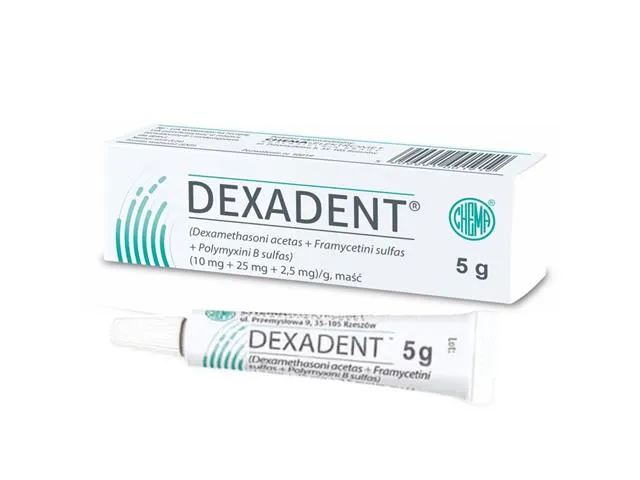
Table of Contents
Package leaflet: Information for the user
DEXADENT, (10 mg + 25 mg + 2.5 mg)/g, ointment
(Dexamethasone acetate + Framycetin sulfate + Polymyxin B sulfate)
Please read the entire leaflet carefully before using the medicine, as it contains
important information for the patient.
- Keep this leaflet, so that you can read it again if necessary.
- If you have any doubts, please consult your doctor, pharmacist, or nurse.
- This medicine has been prescribed for a specific individual. Do not pass it on to others. The medicine may harm another person, even if their symptoms are the same.
- If you experience any adverse reactions, including any adverse reactions not listed in this leaflet, inform your doctor, pharmacist, or nurse. See section 4.
Table of contents
- What Dexadent is and what it is used for
- Important information before using Dexadent
- How to use Dexadent
- Possible side effects
- How to store Dexadent
- Contents of the pack and other information
1. What Dexadent is and what it is used for
Dexadent is an ointment intended for dental use, applied into the tooth cavity.
DEXADENT is indicated in the treatment of dental pulp diseases and periapical tissues.
Pulp diseases: deep caries without pulp symptoms, pulp hyperaemia, acute partial serous pulpitis.
Periapical tissue diseases: acute and chronic exacerbated forms.
Pharmacotherapeutic group: Alimentary tract and metabolism, dental preparations, local oral preparations, others, ATC code: A01AD.
Pharmacodynamic properties
Dexadent ointment contains active substances with different, mutually complementary mechanisms of action. This combination of ointment components provides anti-inflammatory, anti-infective, and anti-allergic effects, resulting in a beneficial strong analgesic action.
Dexadent ointment exhibits combined bactericidal activity of polymyxin B (mainly against Gram-negative bacteria, especially Pseudomonas aeruginosa and Enterobacteriaceae) and framycetin (against Staphylococcus spp., Enterobacteriaceae, Mycobacterium tuberculosis), while dexamethasone exerts anti-inflammatory, anti-exudative, and anti-allergic effects.
Polymyxin B acts bactericidally on Gram-negative microorganisms dozens of times more strongly than on Gram-positive bacteria. It has no effect on fungi. The mechanism of action of polymyxin B involves damaging the bacterial cytoplasmic membrane.
Framycetin (neomycin B) belongs to the aminoglycoside group, antibiotics with a broad spectrum of activity. It acts antibacterially primarily against Gram-negative microorganisms, less effectively against Gram-positive ones. Sensitive organisms include Escherichia coli, Klebsiella, Enterobacter, Proteus, Pseudomonas aeruginosa, Brucella, Neisseria, Pasteurella, and to a lesser extent actinomycetes, spirochetes, protozoa, and some fungi. It has no effect on anaerobes. At lower concentrations, it acts bacteriostatically; at higher concentrations, bactericidally. The mechanism of action of aminoglycosides involves inhibition of protein and nucleic acid biosynthesis.
Dexamethasone is a synthetic glucocorticoid with very strong and prolonged anti-inflammatory action, 30 times stronger than hydrocortisone. Additionally, glucocorticoids inhibit hyaluronidase, an enzyme that reduces the viscosity of connective tissue. Inhibition of hyaluronidase activity reduces the permeability of the ground substance of connective tissue, effectively sealing off and isolating the inflammatory focus from the body. This limits the absorption of bacterial toxins from the inflammatory site, thus preventing systemic inflammatory symptoms, such as fever. Glucocorticoids also inhibit the reaction between allergens and antibodies, thereby preventing allergic reactions.
Pharmacokinetic properties
Polymyxin sulfate, like other antibiotics in the polymyxin group, is not absorbed from the gastrointestinal tract, mucosal surfaces, or when applied onto mucous membranes, inflamed skin, or burned skin. Polymyxin B is primarily excreted by the kidneys; up to 60% of the dose is excreted in urine, but this occurs with a delay of 12 to 24 hours.
Framycetin is not absorbed following topical application to the skin, but may be absorbed when applied into body cavities.
Neither framycetin nor polymyxin undergoes metabolic transformation in the body.
Dexamethasone is partially metabolized in the liver to 6-hydroxydexamethasone and dexamethasone glucuronide.
Dexamethasone acetate is readily absorbed from the gastrointestinal tract following oral administration. In addition to good absorption after oral administration, glucocorticoids are also well absorbed at the site of application when administered locally.
Most glucocorticoids present in the blood remain bound to plasma proteins, primarily to globulins, and to a lesser extent to albumins. Glucocorticoids are metabolized mainly in the liver, but also in other tissues; urinary excretion predominates in the elimination of glucocorticoids.
2. Important information before using Dexadent
When not to use Dexadent
- if the patient is allergic to dexamethasone acetate, framycetin sulfate, polymyxin B sulfate, or any of the other components of this medicine (listed in section 6);
- in children under 4 years of age.
Warnings and precautions
Dexadent should not remain in the cavity for longer than 3 to 4 days, as it may lead to pulp degeneration.
Dexadent should not remain in the canal for longer than 3 to 4 days, as it may impair healing of periodontal lesions.
Consult a doctor if the patient develops swelling and increased body weight, particularly noticeable in the trunk and face, as these are usually the first signs of a condition called Cushing's syndrome. Adrenal suppression may occur following discontinuation of prolonged or intensive treatment with Dexadent. Consult a doctor before deciding to stop treatment. This risk is particularly significant in children and in patients treated with ritonavir or cobicistat.
Use of a higher than recommended dose of Dexadent
No cases of overdose have been reported.
Dexadent with other medicines
Tell the doctor about all medicines the patient is currently taking or has recently taken, as well as any medicines the patient plans to take.
Inform the doctor if the patient is taking ritonavir or cobicistat, as these medicines may increase blood levels of dexamethasone.
Pregnancy and breastfeeding
If the patient is pregnant or breastfeeding, suspects she may be pregnant, or is planning to have a child, she should consult a doctor before using this medicine.
There is a lack of data on the safety of use in pregnant women; therefore, this medicine should not be used during pregnancy unless considered necessary after careful assessment of benefit versus risk.
The safety of use in breastfeeding women has not been established.
Driving and operating machinery
Dexadent has no effect or has a negligible effect on the ability to drive and operate machinery.
3. How to use Dexadent
- In cases of pulp inflammation: after cleaning the carious cavity, apply a small amount of the ointment to the bottom of the cavity using an instrument such as a probe or a small ball-ended plugger. Cover with a dry cotton pellet. Seal the cavity tightly with a suitable temporary material for a maximum of 3 to 4 days, or until acute inflammatory symptoms subside.
- In root canal treatment: after thorough mechanical preparation of the root canal (removal of necrotic or detritus material, maximal enlargement of the canal, irrigation with a preparation intended for root canal irrigation, and drying the canal), introduce the ointment into the canal using a Lentulo spiral needle and tightly seal for 3 to 4 days. Pain symptoms should resolve after a single application; if symptoms persist or worsen, repeat the root canal preparation.
Do not use more than the amount of ointment obtained by squeezing out a strip 1 cm in length from the tube at one time.
4. Possible adverse reactions
Like all medicines, this medicine can cause adverse reactions, although not everybody will experience them.
In very rare cases, during treatment of teeth with pulp diseases and deep caries,
pain in the treated tooth may occur immediately after application of the ointment. This usually subsides within
several minutes to two hours. If spontaneous pain persists (which, in case of diagnosed reversible pulpititis, may indicate incorrect diagnosis), the patient should consult a doctor
for implementation of an alternative treatment method.
The following adverse reactions may occur after use of Dexadent:
Frequency unknown (cannot be estimated based on available data):
Endocrine disorders: excessive body hair growth (especially in women), muscle weakness
and loss of muscle mass, purple skin striae, increased blood pressure, irregular menstruation or absence of menstruation, changes in protein and calcium levels in the body, growth suppression in children and adolescents, as well as swelling and increased body weight, particularly noticeable on the trunk and face
(a condition known as Cushing's syndrome) (see section 2 "Warnings and precautions").
Reporting of adverse reactions
If any adverse effects occur, including any adverse effects not listed
in this leaflet, inform your doctor, pharmacist, or nurse. Adverse reactions
can be reported directly to the Department of Monitoring of Adverse Drug Reactions of the Office for Registration of Medicinal Products, Medical Devices and Biocidal Products
Al. Jerozolimskie 181C
02-222 Warsaw
Phone: +48 22 49 21 301
Fax: +48 22 49 21 309
Website: https://smz.ezdrowie.gov.pl
Adverse reactions can also be reported to the marketing authorization holder.
By reporting adverse reactions, more information on the safety of the medicine can be collected.
5. How to store Dexadent
Keep the tube tightly closed. Store in the refrigerator (2°C − 8°C). Do not freeze.
Keep the medicine out of the sight and reach of children.
Take care to check the expiry date of the medicine.
Do not use this medicine after the expiry date stated on the packaging. The expiry date refers to the last day of the stated month.
Medicines must not be disposed of via the sewage system or in household waste. Ask your pharmacist how to dispose of medicines no longer required. This will help protect the environment.
6. Contents of the package and other information
What Dexadent contains
The active substances are dexamethasone acetate, framycetin sulfate, polymyxin B sulfate.
1 g of ointment contains: 10 mg dexamethasone acetate, 25 mg (16,500 IU) framycetin sulfate,
2.5 mg (20,000 IU) polymyxin B sulfate.
Other ingredients: macrogol 400 and macrogol 4000.
What Dexadent looks like and contents of the pack
Dexadent is a homogeneous white mass with a cream-grey tint.
The tube contains 5 g of ointment. The tube, together with the leaflet, is placed in a cardboard box.
Marketing Authorisation Holder and Manufacturer
CHEMA-ELEKTROMET
Labour Cooperative
ul. Przemysłowa 9
35-105 Rzeszów
tel. 17 862 05 90
e-mail: [email protected]