Devipasta
Poland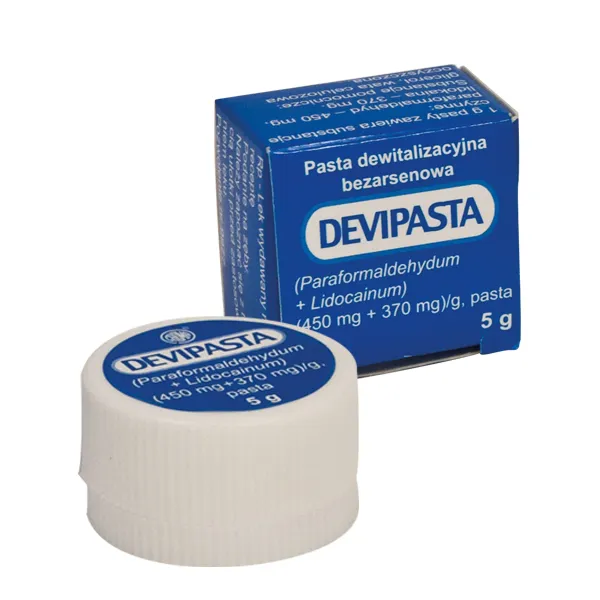
Table of Contents
Patient leaflet: information for the user
DEVIPASTA, (450 mg + 370 mg)/g, paste
(Paraformaldehyde + Lidocaine)
Table of contents of the leaflet:
- What Devipasta is and what it is used for
- Important information before using Devipasta
- How to use Devipasta
- Possible side effects
- How to store Devipasta
- Contents of the pack and other information
1. What Devipasta is and what it is used for
Devipasta is an arsenic-free paste used in endodontics for devitalization of dental pulp in vital methods of treatment of irreversible pulpitis.
Pharmacotherapeutic group: Alimentary tract and metabolism; dental preparations; other locally acting oral preparations; ATC code: A01AD11
Pharmacodynamic properties
Paraformaldehyde, a polymerization product of formaldehyde, undergoes slow depolymerization within the pulp chamber, resulting in gradual release of formaldehyde molecules into the pulp tissue. This leads to complete pulp necrosis after 6–8 days. Living tissue exposed to formaldehyde first undergoes irritation, followed by necrosis and mummification. The action develops slowly and gently due to gradual depolymerization of paraformaldehyde within the pulp chamber, thereby reducing the likelihood of periodontal irritation.
Thus, in addition to its devitalizing effect, paraformaldehyde mummifies the pulp and creates a demarcation line at the dentin–periodontium interface. Therefore, using this agent shortens treatment by eliminating the need for a separate visit intended for placement of a mummifying agent. A disadvantage of paraformaldehyde is the occurrence of pain episodes during its use; however, due to the presence of a potent local anesthetic—lidocaine—which also acts synergistically with paraformaldehyde in pulp devitalization—the product does not cause pain after application.
Lidocaine is a local anesthetic (local analgesic) from the amide derivative group with a short duration of action. It causes reversible blockade of nerve conduction by inhibiting the sodium–potassium pump and reducing membrane permeability to ions.
The remaining components of the medicinal product are excipients that provide the paste with the required consistency.
Pharmacokinetic properties
After placement of Devipasta into the open pulp chamber and sealing the chamber with dental cement, formaldehyde is slowly released from paraformaldehyde and acts denaturingly on blood vessels and destroys the nerve endings of the tooth. The formed demarcation line of denatured dentin prevents absorption of paraformaldehyde into the systemic circulation and also prevents absorption of lidocaine, which acts only locally. Lidocaine in its base form is water-insoluble, and once the demarcation line is formed by paraformaldehyde, it is not absorbed into the systemic circulation.
After placement of Devipasta into the pulp chamber, paraformaldehyde contained in the product acts denaturingly on the dental pulp and odontoblasts and does not distribute to other tissues of the body. Likewise, lidocaine used together with paraformaldehyde is not absorbed from the pulp chamber into surrounding tissues.
2. Important information before using Devipasta
When not to use Devipasta:
- if the patient is allergic to paraformaldehyde or lidocaine, as well as to other local anaesthetics of amide structure, or to any of the other ingredients of this medicine (listed in section 6);
- in children under 4 years of age;
- if biological treatment of pulp inflammation by vital pulpotomy or pulpectomy is possible.
Warnings and precautions
Particular attention should be paid to the expiry date of the medicine. Do not use this medicine after the expiry date.
Overdose
Cases of overdose have not been reported.
Pregnancy and breastfeeding
There is insufficient evidence regarding the safety of using Devipasta in pregnant women; therefore, the medicine should not be used during pregnancy.
The safety of using Devipasta in breastfeeding women has not been established.
Driving and operating machinery
Devipasta has no effect on the ability to drive and operate machinery.
3. How to use Devipasta
Perform pulp chamber trepanation.
If a thick layer of dentin separates the cavity floor, anesthesia may be administered; tissue drilling will then be painless. In cases where this layer is thin or affected by caries, exposure can be performed without anesthesia, as the pain is short-lived. In every case, access to the pulp chamber should be sufficiently large to allow exudate to escape, ensuring that no painful symptoms occur after dressing placement.
Apply approximately 2 to 4 mg of the paste (a small ball with a diameter of 1.5 to 2 mm, depending on tooth size) directly onto the exposed pulp (at the trepanation site) using a probe, gently and without pressure. Although overdose is not a concern, the paste should still be applied to the exposed area in an amount of 2 to 4 mg.
Immediately place a small cotton pellet directly on top of the paste, taking care not to push the devitalizing agent into the tooth cavity. Then, apply a tight temporary dressing without pressure, e.g., using glass-ionomer cement. The filling must be sealed tightly to prevent leakage of the devitalizing agent toward the marginal periodontium.
The dressing should remain in the tooth for 10 to 14 days. After 6–8 days, the product induces pulp necrosis; mumification of the pulp occurs within the following 2–6 days.
The medicinal product may be reapplied if the pulp has not been fully devitalized, but it must never be used within the root canal.
The medicinal product should be used exclusively when treatment of pulp inflammation by vital pulp amputation or extirpation is not possible.
4. Possible adverse reactions
Like all medicines, this product may cause adverse reactions, although not everyone experiences them.
Transient pain after application of the paste may occur.
Rarely, hypersensitivity to paraformaldehyde may occur.
Reporting of adverse reactions
If any adverse effects occur, including any adverse effects not listed in the leaflet, inform a doctor, pharmacist, or nurse. Adverse reactions can be reported directly to the Department of Monitoring Adverse Reactions to Medicinal Products, Office for Registration of Medicinal Products, Medical Devices and Biocidal Products
Al. Jerozolimskie 181C
02-222 Warsaw
Phone: +48 22 49 21 301
Fax: +48 22 49 21 309
e-mail: [email protected]
Adverse reactions can also be reported to the marketing authorization holder.
Reporting adverse reactions helps provide more information on the safety of the medicine.
5. How to store Devipasta
Store in a refrigerator (2 °C – 8 °C). Do not freeze.
Keep the container tightly closed.
Keep Devipasta out of sight and reach of children.
Pay attention to the expiry date of the medicinal product.
Do not use Devipasta after the expiry date stated on the packaging. The expiry date refers to the last day of the specified month.
6. Contents of the pack and other information
What Devipasta contains
- The active substances in the medicine are paraformaldehyde and lidocaine. 1 g of paste contains 450 mg of paraformaldehyde and 370 mg of lidocaine.
- Other ingredients are: purified cellulose wool, glycerol.
What Devipasta looks like and contents of the pack
Devipasta is a white, homogeneous, hard mass with a characteristic odour of paraformaldehyde.
The immediate packaging consists of a PP container with a PP screw cap and a polypropylene seal,
containing 5 g of paste, placed together with the leaflet in a cardboard box.
Marketing Authorisation Holder and Manufacturer
CHEMA-ELEKTROMET
Workers' Cooperative
Przemysłowa 9 Street
35-105 Rzeszów
tel. 17 862 05 90
e-mail: [email protected]