Detriol
Poland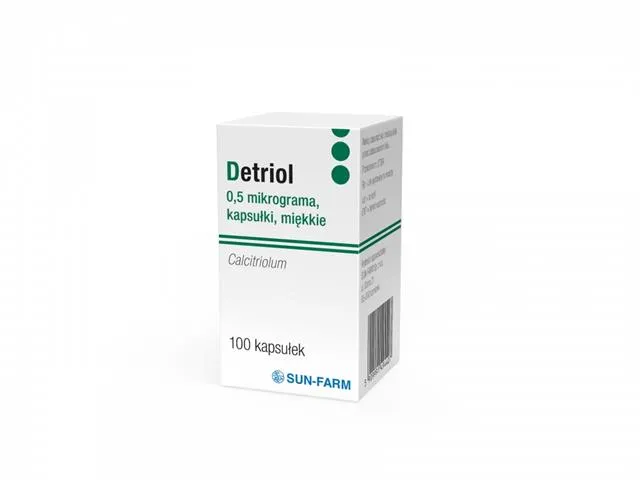
Table of Contents
Package leaflet: Information for the patient
Detriol, 0.25 micrograms, soft capsules
Calcitriol
For use in adults
Please read this leaflet carefully before taking this medicine, as it contains
important information for you.
- Keep this leaflet, as you may need to read it again.
- If you have any further questions, please ask your doctor or pharmacist.
- This medicine has been prescribed for a specific individual. Do not pass it on to others. It may harm someone else, even if their symptoms are the same.
- If you experience any adverse reactions, including any not listed in this leaflet, tell your doctor or pharmacist. See section 4.
Table of contents
- What Detriol is and what it is used for
- Important information before taking Detriol
- How to take Detriol
- Possible side effects
- How to store Detriol
- Contents of the pack and other information
1. What Detriol is and what it is used for
Calcitriol, the active substance in Detriol, is a metabolite of vitamin D. It is the biologically active
form of vitamin D, also known as the D hormone (calcium metabolism regulator).
Detriol is used to treat adult patients with:
˗ severe or progressive secondary hyperparathyroidism (overactivity of the parathyroid glands)
leading to renal osteodystrophy (bone disorders) associated with moderate or severe chronic
kidney failure.
˗ hypocalcemia (low calcium levels) due to hypoparathyroidism.
Hypoparathyroidism may occur:
˗ after surgery (postoperative hypoparathyroidism),
˗ without an identifiable cause (idiopathic hypoparathyroidism), or
˗ due to disorders of phosphate metabolism (pseudohypoparathyroidism).
˗ hereditary (or familial) hypophosphatemic rickets [HPDR], a form of rickets unresponsive to
vitamin D.
2. Important information before taking Detriol
When not to take Detriol
- if the patient is allergic to calcitriol, other substances from the same class (vitamin D or its
metabolites), peanuts, soy or any of the other ingredients of this medicine
(listed in section 6), - if the patient has any disorder associated with increased calcium levels
in blood or urine (hypercalcemia or hypercalciuria), - if the patient has familial hypophosphatemic rickets associated with increased
urinary calcium excretion, - if the patient is suspected of vitamin D intoxication (hypervitaminosis D),
- if the patient has metastatic calcification (tissue calcification),
- if the patient has nephrocalcinosis (calcification of the kidneys) or kidney stones (nephrolithiasis).
Warnings and precautions
Before starting treatment with Detriol, discuss this with your doctor or pharmacist.
Treatment with Detriol may lead to increased calcium levels in blood (hypercalcemia).
The effect of Detriol is closely related to diet, especially calcium intake. For
example, elevated blood calcium levels may also result from changes in dietary
habits (increased consumption of dairy products) or uncontrolled use of
calcium supplements.
Therefore, it is essential to strictly follow the diet prescribed by your doctor and take calcium
supplements only as directed by your physician.
Since the active substance in Detriol is the most active metabolite of vitamin D, you should not take
any other vitamin D supplements during treatment with Detriol (including analogs or metabolites of vitamin D) or vitamin D–fortified foods, as this may lead to vitamin D overdose
and elevated calcium levels in blood.
During treatment with Detriol, serum calcium levels will be monitored regularly to
avoid incorrect dosing and elevated calcium levels in blood (hypercalcemia) or
in urine (hypercalciuria) (see section 3 “How to take Detriol”).
Regular laboratory tests should also include measurement of serum phosphate, magnesium, alkaline phosphatase, and urinary phosphate levels.
- Special caution is required when treating patients with thiazide diuretics (certain medicines used to increase urine output), in cases of sarcoidosis, history of kidney stones, or immobilization (e.g. after surgery), as there is an increased risk of elevated calcium levels in blood (hypercalcemia) or in urine (hypercalciuria).
- Chronic hypercalcemia may lead to generalized calcification of blood vessels, kidney calcification, and other soft tissue calcifications; therefore, treatment must be discontinued.
- Calcitriol increases serum inorganic phosphate levels. While this is beneficial in patients with low blood phosphate levels (hypophosphatemia), caution is advised in patients with chronic kidney disease due to the risk of ectopic calcifications. In such cases, serum phosphate levels should be maintained within normal limits through oral phosphate binders and a low-phosphate diet.
- In patients with both familial hypophosphatemic rickets and low blood phosphate levels, oral phosphate therapy should be continued. However, the need for oral phosphate supplements may be reduced, as Detriol also enhances intestinal absorption of phosphates into the bloodstream.
- When switching from ergocalciferol (vitamin D) to calcitriol therapy, it may take several months for ergocalciferol blood levels to return to baseline.
- If kidney function is normal, ensure adequate fluid intake during treatment with Detriol.
Early diagnosis and treatment of magnesium imbalance should be considered due to
its significant role in regulating calcium levels in blood and urine.
Children and adolescents
Detriol is not recommended for use in children and adolescents.
Interaction of Detriol with other medicines
Inform your doctor or pharmacist about all medicines you are currently taking, have recently taken, or plan to take.
- There is a risk of increased calcium levels in blood (hypercalcemia) in patients also taking thiazide diuretics (certain medicines used to increase urine output).
- In patients also taking cardiac glycosides (medicines affecting heart function), Detriol should be administered with caution, as elevated calcium levels may cause cardiac arrhythmias.
- Concomitant use with glucocorticoids may reduce the effectiveness of Detriol. Glucocorticoids inhibit calcium absorption.
- If the patient is undergoing kidney dialysis, they should not take any medicines containing magnesium (e.g. acid-neutralizing agents known as antacids) during treatment with Detriol, as this may lead to increased magnesium levels in blood.
- If the patient is also taking phosphate binders (e.g. medicines containing aluminium hydroxide or aluminium carbonate), dosage should be adjusted based on serum phosphate levels.
- If the patient is also taking enzyme inducers such as phenobarbital (active substance in medicines used to aid sleep) or phenytoin (a medicine used to treat seizures), the effect of Detriol may be reduced. Enzyme inducers accelerate the breakdown of calcitriol, so higher doses of Detriol may be required.
- Detriol may be less effective if taken simultaneously with substances that form complexes with bile acids, such as cholestyramine or sevelamer. These may limit absorption of fat-soluble vitamins from the intestine and impair calcitriol absorption.
- If the patient is taking orlistat (a medicine used to treat obesity), or products containing liquid paraffin or cholestyramine (a medicine used to lower high cholesterol levels), absorption of vitamin D from the gastrointestinal tract may be reduced.
Detriol with food and drink
Always adhere to the recommended calcium intake in your diet. Avoid sudden increases in
calcium supply due to changes in dietary habits (e.g. increased consumption of dairy
products) or uncontrolled use of calcium supplements.
Pregnancy and breastfeeding
If the patient is pregnant, breastfeeding, suspects she may be pregnant, or is planning to become pregnant, she should consult her doctor or pharmacist before using this medicine.
There is no experience with the use of calcitriol during pregnancy and breastfeeding.
Pregnancy
Calcitriol should be used during pregnancy only on clear medical indication.
Overdose of calcitriol may harm the unborn child (risk of physical and mental impairment, as well as heart and eye disorders).
Serum calcium levels should be closely monitored in pregnant women treated with Detriol, and monitoring should continue into the postpartum period (see section 3 “How to take Detriol”).
Breastfeeding
Calcitriol is expected to pass into breast milk. During treatment with Detriol in breastfeeding women, serum calcium levels should be regularly monitored in both the mother and the infant.
Driving and operating machinery
Detriol has no effect or negligible effect on the ability to drive and operate machinery. No studies have been conducted.
Detriol contains alcohol and sorbitol
This medicine contains 0.869 mg of alcohol (ethanol) per capsule. The amount of alcohol in 1 capsule is equivalent to less than 1 mL of beer or 1 mL of wine. The small amount of alcohol in this medicine will not cause noticeable effects.
Detriol contains 6 mg of sorbitol per dose, which corresponds to 2 mg of fructose in the body.
Detriol contains peanut oil (from peanuts)
Do not use if hypersensitivity to peanuts or soy has been diagnosed.
3. How to take Detriol
This medicine should always be taken as advised by your doctor or pharmacist. If in doubt,
consult your doctor or pharmacist.
Note:
The optimal daily dose of Detriol is carefully determined individually for each patient
depending on serum calcium levels. If necessary, Detriol treatment may be supplemented
with calcium supplements. To avoid elevated calcium levels in the blood, always follow your
doctor's instructions regarding supplemental calcium dosing.
Treatment should always be initiated at the lowest possible dose (0.25 µg), and increased only
if accompanied by strict monitoring of serum and urinary calcium levels. If elevated calcium
levels in the blood (hypercalcemia) or in urine (hypercalciuria) occur, Detriol should be discontinued
immediately until calcium levels return to normal. A reduction in dietary calcium intake should also
be considered.
Secondary hyperparathyroidism (overactivity of the parathyroid glands), leading to renal
osteodystrophy (bone disorders) associated with moderate to severe chronic kidney failure
Initial treatment dose is one soft capsule of Detriol 0.25 microgram daily.
For patients with normal or only slightly reduced serum calcium levels, one soft capsule of Detriol
0.25 microgram every other day may be sufficient.
If no satisfactory clinical and biochemical response is observed within 2 to 4 weeks, the dose may
be increased by 0.25 micrograms of calcitriol (one soft capsule of Detriol) daily, at intervals of
2 to 4 weeks.
Most patients respond to a daily dose ranging from 0.5 micrograms to 1.0 microgram of calcitriol.
The maximum weekly dose of 12 micrograms must not be exceeded.
Hypocalcemia (low calcium levels) due to hypoparathyroidism
The recommended initial dose is one soft capsule of Detriol 0.25 microgram daily.
If there is no improvement in clinical symptoms and laboratory findings, the dose may be increased
by 0.25 micrograms of calcitriol every 2 to 4 weeks.
Hereditary (or familial) hypophosphatemic rickets (HPDR)
Treatment should be initiated at 0.25 micrograms of calcitriol daily and must be closely monitored.
Elderly patients
No dose adjustment is required in elderly patients.
Liver function disorders
No data available.
Use in children and adolescents
Use in children and adolescents under 18 years of age is not recommended. The safety and efficacy
of calcitriol capsules have not been sufficiently studied to allow dosing recommendations. In children
under 6 years of age, there is a risk of choking due to the pharmaceutical form (capsule).
Method of administration
Oral use.
Soft capsules should be swallowed whole (do not chew), with a small amount of liquid, in the morning
with breakfast. Patients requiring higher doses should take the total daily dose divided into 2 to 3
individual doses, all taken with meals.
Duration of treatment
The duration of treatment depends on disease symptoms and laboratory parameters. Therefore, it
must be determined individually for each patient by the treating physician.
Accidental overdose of Detriol
No cases of acute poisoning with Detriol have been reported to date. Based on theoretical
considerations, a single overdose is unlikely to cause any clinical symptoms.
If symptoms of overdose occur (see section 4 "Possible side effects"), consult your doctor immediately.
Missed dose of Detriol
Do not take a double dose to make up for a missed dose. Continue taking the medicine as directed.
Stopping Detriol treatment
Do not stop or discontinue treatment without consulting your doctor.
If you have any further questions about the use of this medicine, consult your doctor or pharmacist.
4. Possible adverse reactions
Like all medicines, this medicine can cause adverse reactions, although not everyone will experience them.
The most commonly reported adverse reaction was increased calcium levels in the blood (hypercalcemia).
Very common (may affect more than 1 in 10 treated patients):
Increased calcium levels in the blood (hypercalcemia).
Common (may affect up to 1 in 10 treated patients):
Headache, abdominal pain, nausea, rash, urinary tract infections.
Uncommon (may affect up to 1 in 100 treated patients):
Decreased appetite, vomiting, increased blood creatinine levels.
Rare (may affect up to 1 in 1,000 treated patients):
Severe allergic reactions caused by arachis oil.
Frequency not known (frequency cannot be estimated from available data):
Hypersensitivity, urticaria, increased thirst, dehydration, weight loss, apathy,
psychiatric disorders, muscle weakness, sensory disturbances, somnolence, cardiac arrhythmias,
constipation, intestinal obstruction due to paralysis of intestinal muscles (paralytic ileus),
skin redness (erythema), itching, delayed growth, increased urine volume,
nocturnal urination, pathological calcium salt deposits in the skin and internal organs (calcification),
fever, thirst.
Since calcitriol has vitamin D-like activity, the possible adverse reactions are comparable to symptoms of vitamin D overdose, i.e. various symptoms of elevated calcium levels in the blood (hypercalcemia syndrome) or calcium poisoning (depending on the severity and duration of elevated blood calcium levels).
Due to the short biological half-life of calcitriol, pharmacokinetic studies have shown normalization of elevated serum calcium levels within a few days after discontinuation or dose reduction—significantly faster than with vitamin D supplementation.
Chronic adverse reactions may include: muscle weakness, weight loss, sensory disturbances, fever, thirst or increased sensation of thirst, increased urine volume, dehydration, apathy, delayed growth, and urinary tract infections.
Concomitant elevation of calcium and phosphate levels in the blood may lead to soft tissue calcification visible on X-ray imaging.
Allergic reactions (itching, rash, urticaria) may occur in sensitive patients, and very rarely, serious skin disorders associated with redness.
In patients with normal kidney function, persistent elevation of calcium levels in the blood (chronic hypercalcemia) may be associated with increased serum creatinine levels.
No clinically significant differences in the type of adverse reactions are expected in specific patient groups, e.g. elderly patients.
Reporting of adverse reactions
If any adverse reactions occur, including any adverse reactions not listed in this leaflet, inform your doctor or pharmacist. Adverse reactions can be reported directly to the Department of Monitoring Adverse Drug Reactions at the Office for Registration of Medicinal Products, Medical Devices and Biocidal Products:
Al. Jerozolimskie 181C
02-222 Warsaw
Tel.: +48 22 49 21 301
Fax: +48 22 49 21 309
Website: https://smz.ezdrowie.gov.pl
Adverse reactions can also be reported to the marketing authorization holder.
Reporting adverse reactions helps to provide more information on the safety of the medicine.
5. How to store the medicine Detriol
Keep the medicine out of the sight and reach of children.
Do not use this medicine after the expiry date stated on the box and bottle after:
"EXP". The expiry date refers to the last day of the stated month.
Do not store above 25°C.
Keep the bottle tightly closed and in the outer packaging to protect from light.
Period of use after first opening of the bottle: 4 months.
6. Contents of the package and other information
What Detriol contains
- The active substance is: calcitriol
- The other components are: Capsule contents: Arachis oil (peanut oil), purified, butylated hydroxyanisole, butylated hydroxytoluene, anhydrous ethanol.
Capsule shell:
Gelatin, glycerol 85%, sorbitol 70%, non-crystallizing, iron oxide red (E 172), titanium
dioxide (E 171).
Detriol, soft capsules, 0.25 microgram contains arachis oil (peanut oil),
sorbitol and alcohol (ethanol) (see section 2).
What Detriol looks like and contents of the pack
Detriol, soft capsules, 0.25 microgram are opaque, pink, oval, soft capsules.
Detriol is available in packs of 90 or 100 soft capsules.
Not all pack sizes may be marketed.
Marketing Authorisation Holder
SUN-FARM Sp. z o.o.
ul. Dolna 21
05-092 Łomianki
tel. +48 22 350 66 69
Manufacturer
mibe GmbH Arzneimittel
Münchener Straße 15
06796 Brehna
Germany