Desferal
Poland
Table of Contents
Package leaflet: Information for the patient
Warning! Keep this leaflet. The information on the immediate packaging is in a foreign language.
Desferal (Десферал), 500 mg (0.5 g), powder for solution for injection
Deferoxamine mesylate
Desferal and Десферал are trade names of the same medicinal product written in Polish and Bulgarian.
Please read carefully the entire leaflet before using the medicine, as it contains
important information for the patient
- Keep this leaflet, as you may need to read it again.
- If you have any questions, consult your doctor or pharmacist.
- This medicine has been prescribed for a specific individual. Do not give it to others. The medicine may harm another person, even if their symptoms are the same.
- If you experience any adverse reactions, including any not listed in this leaflet, inform your doctor, pharmacist, or nurse. See section 4.
Table of contents of the leaflet:
- What Desferal is and what it is used for
- Important information before using Desferal
- How to use Desferal
- Possible side effects
- How to store Desferal
- Contents of the pack and other information
1. What Desferal is and what it is used for
What Desferal is
Desferal contains the active substance deferoxamine mesylate, known as a "chelating agent". The medicine removes excess iron or aluminium from the body.
What Desferal is used for
Desferal is used in the treatment of chronic iron overload, for example:
- in patients treated for various types of anaemia, such as thalassaemia, sideroblastic anaemia, autoimmune haemolytic anaemia, or other chronic forms of anaemia, who require multiple blood transfusions. Repeated transfusions may lead to excessive iron accumulation in the body;
- in patients with idiopathic (primary) haemochromatosis;
- in patients with late-stage porphyria cutanea tarda. Desferal may be used in adults, adolescents, and children.
It may also be used for:
- treatment of acute iron poisoning;
- treatment of chronic aluminium overload in patients with end-stage renal failure requiring regular dialysis. In certain situations, dialysis may lead to excessive aluminium accumulation in the body;
- diagnosis of excessive iron or aluminium accumulation in the body.
Always strictly follow your doctor's instructions. They may differ from the general information contained in this leaflet.
2. Important information before using Desferal
When not to use Desferal
- if the patient is allergic to deferoxamine mesylate – the active substance in Desferal, except in cases where a successful desensitization procedure has been completed, allowing administration of Desferal.
Warnings and precautions
Before starting treatment with Desferal, discuss this with your doctor or pharmacist.
Before using Desferal, inform your doctor if:
- the patient suspects being allergic to Desferal;
- allergic reactions (skin rash, shortness of breath, or breathing difficulties) occurred after previous use of Desferal;
- the patient has any kidney function disorders.
Tell the doctor immediately if any of the following symptoms occur during treatment with Desferal:
- high fever, sore throat, shortness of breath, abdominal pain, severe diarrhea, or general feeling of discomfort (symptoms of fungal or bacterial infections);
- significantly reduced urine output (a sign of kidney function disorders);
- disturbances in vision or hearing;
- dizziness, feeling of emptiness in the head (symptoms of low blood pressure), shortness of breath – these may occur if Desferal is administered too rapidly by intravenous infusion. See also section 3, "Use of a higher than recommended dose of Desferal";
- cardiac function disorders – possible symptoms that may occur in patients taking Desferal and simultaneously receiving high doses of vitamin C. If the doctor additionally recommends vitamin C supplementation, ensure that Desferal has been used regularly for at least one month prior to starting vitamin C. Strictly adhere to the recommended doses of vitamin C. Do not exceed a daily dose of 200 mg of vitamin C.
Monitoring the patient's health during treatment with Desferal
- Certain blood and urine tests may be required before and during treatment.
- In patients with iron overload, serum ferritin levels will be monitored to assess the effectiveness of Desferal treatment. Regular eye and hearing examinations will also be performed. In children and adolescents, growth and body weight will be monitored regularly. The doctor will consider the results of these tests when determining the appropriate dose of Desferal for the patient.
- If the patient is taking vitamin C during treatment with Desferal, the doctor will also assess heart function. During treatment with Desferal, urine may turn red-brown due to iron complex excretion. This is usually not a cause for concern, but if the change in urine color causes concern, contact your doctor or nurse.
Contact your doctor if you have any questions regarding the action of Desferal
or the reasons why this medicine was prescribed.
Children and adolescents
Inform the doctor if a slowdown in the growth rate of a child treated with Desferal is observed.
Desferal and other medicines
Tell your doctor or pharmacist about all medicines currently or recently used by the patient, as well as any medicines the patient plans to use. This particularly includes the following medicines:
- medicines containing prochlorperazine (a neuroleptic used in the treatment of neurological disorders);
- vitamin C. Do not take vitamin C in doses exceeding 200 mg per day (see section "Warnings and precautions" above);
- gallium isotope (Ga), administered before imaging procedures (scintigraphy) used in diagnosing certain diseases. A dose adjustment or even discontinuation of one of the medicines may be necessary.
Pregnancy, breastfeeding, and fertility
If the patient is pregnant, breastfeeding, suspects she may be pregnant, or is planning to have a child, she should consult her doctor before using this medicine.
Pregnancy
Desferal should not be used during pregnancy unless the doctor decides that its use is necessary. The doctor will inform the patient about the risks associated with using Desferal during pregnancy.
Breastfeeding
Desferal should not be used during breastfeeding. The doctor will decide whether to discontinue breastfeeding or stop treatment with Desferal, taking into account the importance of the medicine for the mother.
Fertility
There is lack of data on the effect of deferoxamine on fertility; however, animal studies have shown that Desferal may harm the unborn child. Sexually active women of childbearing potential are advised to use effective contraception during treatment with Desferal and for 1 month after stopping treatment.
Driving and operating machinery
Treatment with Desferal may cause disturbances in vision and hearing, as well as dizziness or other nervous system disorders. Do not drive or operate machinery until these symptoms have resolved.
3. How to use Desferal
This medicine should always be used exactly as directed by the doctor. If in doubt, consult your
doctor.
Dosage and method of administration
The doctor will determine the appropriate dose and route of administration individually for each
patient. Depending on the patient's response to treatment, the doctor may reduce or increase the
dose of the medicine.
Desferal is intended for injection (injections) as an aqueous solution. The powder must be
dissolved in water for injections. The resulting solution at the recommended concentration of 95
mg/ml (for subcutaneous and intravenous administration) should be clear, colourless to slightly
yellow. Only clear solutions should be used. Do not use opalescent or cloudy solutions.
The Desferal solution at a concentration of 95 mg/ml may be diluted with fluids routinely used for
infusion (0.9% NaCl solution, 5% glucose solution, Ringer's solution, Ringer's lactate solution,
peritoneal dialysis fluids such as: Dianeal 137 Glucose 2.27%, Dianeal PD4 Glucose 2.27% and
CAPD/DPCA 2 Glucose 1.5%).
Treatment of chronic iron overload
The dose is determined by the doctor, depending on the individual patient's condition. For most
patients, a dose of 20 mg to 60 mg per kilogram of body weight per day is sufficient.
Desferal may be administered by slow subcutaneous infusion (subcutaneous injection using an
infusion pump), by intravenous infusion, or as intramuscular injections.
The doctor or nurse may prepare the ready-to-use solution for the patient or instruct the patient
how to prepare the solution independently. In long-term treatment of patients with iron overload,
administration of Desferal by slow subcutaneous infusion lasting from 8 to 12 hours (e.g. at night)
is very practical and convenient. For this purpose, a lightweight, portable infusion pump is used.
Using the pump, Desferal is usually administered 5 to 7 times per week. The pump should be used
carefully under sterile conditions.
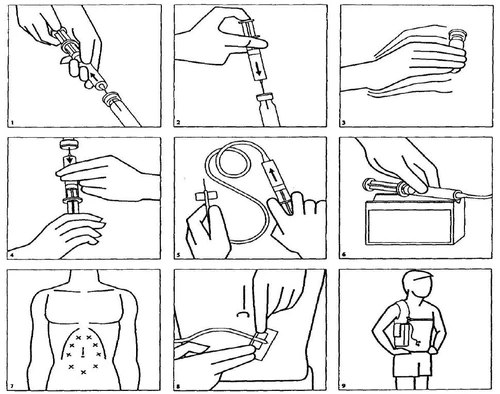
Below is the method for preparing the solution for subcutaneous infusion:
- Draw up water for injections into a syringe.
- After wiping the rubber stopper of the Desferal vial with alcohol, inject the contents of the syringe into the vial.
- Shake the vial thoroughly until the powder is completely dissolved.
- Draw up the resulting solution into a syringe.
- Attach the tubing connector to the syringe, connect it to a special butterfly-type needle, and inject the medicine into the empty tubing.
- Place the syringe into the pump.
- The butterfly needle can be inserted subcutaneously into the abdomen, arm, or upper thigh. The skin should be thoroughly cleaned with alcohol before inserting the needle. Then, with one hand, form a skin fold, and with the other, insert the needle up to the "wings". The tip of the needle should move freely under the skin. If the tip does not move freely, this may indicate that it is placed too superficially. In such a case, try inserting the needle at a new site after cleaning the skin with alcohol.
- Secure the needle with a plaster.
- The pump is usually worn on the body with a belt or in a special pouch attached to the arm. Many patients find administering the medicine at night most convenient.
Elderly patients
Desferal may be used in elderly patients. The doctor will select the appropriate dose for elderly
patients, usually starting at the lowest end of the dose range, due to the higher likelihood of
impaired liver, kidney, or heart function, as well as coexisting diseases and concomitant
medications.
Concomitant use of vitamin C
At least one month after starting regular Desferal treatment, the doctor may recommend
concomitant administration of vitamin C. The maximum daily dose of vitamin C for adults is 200
mg, divided into smaller doses taken throughout the day. For children under 10 years of age, a
daily dose of 50 mg of vitamin C is usually appropriate, while for older children, a dose of 100 mg
is recommended.
Treatment of acute iron poisoning
- Desferal may be used in cases of iron compound poisoning.
Treatment of chronic aluminium overload in patients with end-stage renal failure
- Depending on the patient's blood aluminium concentration, Desferal is usually administered once weekly by slow intravenous infusion during the last 60 minutes of dialysis or 5 hours before the start of dialysis.
- In patients undergoing continuous ambulatory peritoneal dialysis or continuous cyclic peritoneal dialysis, Desferal should be administered before the last dialysate exchange of the day.
- The dose of Desferal is 5 mg per kilogram of body weight.
- The duration of treatment depends on test results as recommended by the doctor.
Test for iron and aluminium overload
- In the test for iron overload, Desferal 500 mg is administered intramuscularly. Urine should be collected over 6 hours, and iron content in the urine is then measured.
- In patients requiring assessment of aluminium overload, Desferal is administered by slow intravenous infusion during dialysis at a dose of 5 mg/kg body weight. Aluminium levels are measured in blood samples taken immediately before the dialysis session and immediately before the next dialysis session.
How long to use Desferal
The medicine should be used regularly and strictly according to the doctor's instructions. This will
ensure the best results and reduce the risk of adverse effects. If you have any questions or doubts
regarding treatment, contact your doctor.
If you have any questions about how long to use Desferal, consult your doctor.
Use of a higher than recommended dose of Desferal
Do not use a higher dose or concentration of the medicine than prescribed by the doctor, as this
may cause local adverse reactions at the injection site and other systemic symptoms such as
dizziness, feeling of emptiness in the head (symptoms of low blood pressure), accelerated or slowed
heart rate, gastrointestinal disturbances (nausea), markedly reduced urine output (sign of acute
renal failure), nervous system disturbances (e.g. restlessness, loss of speech ability, headaches),
shortness of breath (sign of impaired lung function), visual and hearing disturbances. If a higher
dose of Desferal than recommended has been administered, contact your doctor or hospital
staff immediately. Appropriate treatment may be necessary.
Missed dose of Desferal
If a dose is missed, inform your doctor immediately.
Stopping Desferal treatment
Do not stop using Desferal unless instructed by your doctor. If the patient stops treatment, the
ability to remove excess iron from the body will be lost (see section "How long to use Desferal").
4. Possible adverse effects
Like all medicines, this medicine can cause adverse effects, although not everyone will experience them.
Too rapid intravenous administration of Desferal may cause an adverse reaction, even leading to shock. If adverse effects occur, medical help may be required. Some adverse effects may be severe.
You should inform the doctor immediately if the patient experiences any of the following
unwanted effects:
hearing disturbances, visual disturbances, acute diarrhoea, abdominal pain, dizziness, feeling faint (symptoms of hypotension), rapid heartbeat, shock (occurring when the medicine is administered too quickly), bleeding, fever, sore throat or mouth ulcers, rash, itching, urticaria, difficulty breathing or swallowing, feeling of tightness in the chest with wheezing or coughing, swelling, mainly of the face, tongue and throat, nervous system disorders, significantly reduced urine output, seizures.
If any of the following adverse effects occur, you should tell the doctor.
Very common (these adverse effects may affect more than 1 in 10 people):
Joint pain, muscle pain, reactions at the injection site, including pain, swelling, pallor, redness, itching, scab.
Common (these adverse effects may affect less than 1 in 10 people):
Headache, nausea, urticaria, growth retardation, skeletal disorders (epiphyseal dysplasia), fever.
Uncommon (these adverse effects may affect less than 1 in 100 people):
Deafness (sensorineural deafness), tinnitus, asthma, vomiting, abdominal pain, reactions at the injection site, including blisters, swelling, burning sensation.
Rare (these adverse effects may affect less than 1 in 1 000 people):
Fungal infections (mucormycosis/zygomycosis), loss of vision, eye disorders (visual field defects, retinal degeneration, optic neuritis, cataract, reduced visual acuity, blurred vision, night blindness, visual field disturbances, visual disturbance involving colourless perception of objects (chromatopsia), corneal opacity), hypotension, rapid heartbeat (tachycardia) and shock (occurring when the medicine is administered too quickly).
Very rare (these adverse effects may affect less than 1 in 10 000 people):
Gastroenteritis (caused by Yersinia bacteria), blood disorders (including low platelet count (thrombocytopenia), low white blood cell count (leukopenia)), severe allergic reactions such as anaphylactic shock, anaphylactic reaction, angioedema (symptoms may include rash, itching, urticaria, difficulty breathing or swallowing; feeling of tightness in the chest with wheezing or coughing; dizziness; swelling, mainly of the face, tongue and throat), neurological disorders (including dizziness, brain cell damage (encephalopathy), nerve damage (peripheral neuropathy), tingling and numbness (paraesthesiae)), dyspnoea, pulmonary infiltrates, diarrhoea, generalised rash.
Frequency not known (frequency cannot be estimated from the available data):
Seizures, muscle spasms, acute renal failure (significantly reduced urine output), kidney function disorders, increased blood creatinine levels.
At the injection site, pain, swelling, infiltration, redness, itching and scab are very common, while blisters, local swelling and burning sensation are uncommon reactions. Local reactions may be associated with general reactions such as joint pain or muscle pain (very common), headache (common), urticaria (common), nausea (common), fever (common), vomiting (uncommon), abdominal pain (uncommon) or asthma (uncommon).
Rare cases of increased aminotransferase activity have been reported in patients treated with Desferal. The use of Desferal in the treatment of aluminium overload may reduce serum calcium levels and exacerbate hyperparathyroidism.
Reporting of adverse effects
If any adverse effects occur, including any adverse effects not listed in this leaflet, you should inform your doctor, pharmacist or nurse. Adverse effects can be reported directly to the Department of Monitoring Adverse Effects of Medicinal Products at the Office for Registration of Medicinal Products, Medical Devices and Biocidal Products,
Al. Jerozolimskie 181 C, 02-222 Warsaw
Tel.: + 48 22 49 21 301
Fax: + 48 22 49 21 309
Website: https://smz.ezdrowie.gov.pl
By reporting adverse effects, more information on the safety of this medicine can be collected.
5. How to store Desferal
Do not use this medicine after the expiry date stated on the packaging.
Do not store above 25°C.
Each vial is for single use only. The solution should be used immediately after preparation, i.e. administration should be started within 3 hours. If the solution has been prepared under validated sterile conditions, it may be stored at room temperature for a maximum of 24 hours prior to administration. Do not use solutions that are opalescent or cloudy.
Keep the medicine out of the sight and reach of children.
Remember to return any unused vials to a pharmacy.
Medicines must not be disposed of via wastewater or household waste. Ask your pharmacist how to dispose of medicines no longer required. This will help protect the environment.
6. Contents of the pack and other information
What Desferal contains
The active substance is deferoxamine mesylate.
Each vial contains 500 mg of deferoxamine mesylate.
What Desferal looks like and contents of the pack
Desferal is available as a powder in vials.
The pack contains 10 vials in a cardboard box.
For further information, please contact the marketing authorisation holder or the parallel importer.
Marketing Authorisation Holder in Bulgaria, country of export:
Novartis Pharma GmbH, Roonstrasse 25, 90429 Nuremberg, Germany
Manufacturer:
Novartis Pharma GmbH, Roonstrasse 25, 90429 Nuremberg, Germany
Novartis Farmacéutica SA, Gran Via de les Corts Catalanes, 764, 08013 Barcelona, Spain
Parallel Importer:
Delfarma Sp. z o.o., ul. Św. Teresy od Dzieciątka Jezus 111, 91-222 Łódź, Poland
Repackaged in:
Delfarma Sp. z o.o., ul. Św. Teresy od Dzieciątka Jezus 111, 91-222 Łódź, Poland
Marketing Authorisation Number in Bulgaria, country of export: 9800063
Parallel Import Licence Number: 41/25