Dermovate
Poland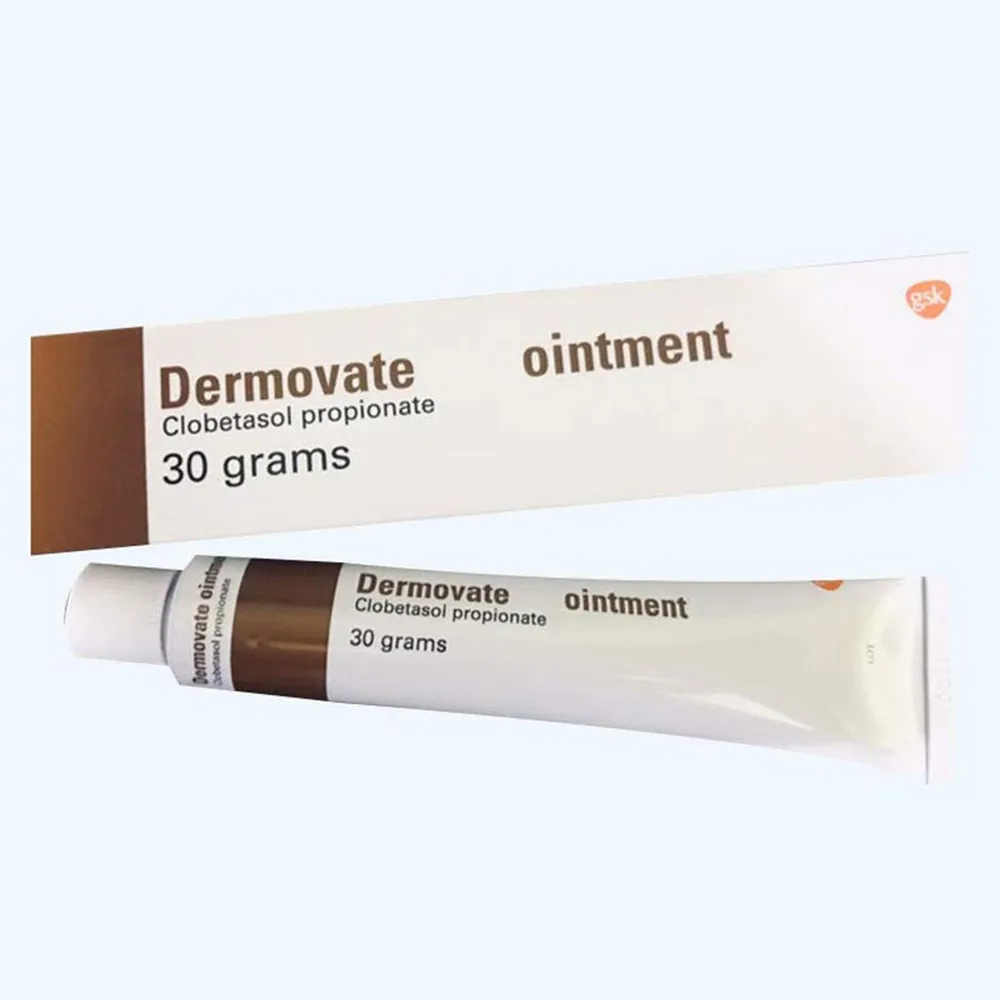
Table of Contents
- Package leaflet: Information for the user
- 1. What Dermovate ointment is and what it is used for
- 2. Important information before using Dermovate ointment
- 3. How to use Dermovate ointment
- 4. Possible adverse reactions
- 5. How to store Dermovate ointment
- 6. Contents of the packaging and other information
Package leaflet: Information for the user
Warning! Keep the leaflet. Information on the immediate packaging is in a foreign language.
Dermovate
0.5 mg/g, ointment
Clobetasol propionate
Please read the following information carefully before using the medicine, as it contains
important information for the patient.
- Keep this leaflet, so that you can read it again if necessary.
- If you have any questions, please consult your doctor, pharmacist, or nurse.
- This medicine has been prescribed for a specific individual. Do not give it to others. The medicine may harm another person, even if their symptoms are the same.
- If the patient experiences any adverse reactions, including any not listed in this leaflet, inform your doctor, pharmacist, or nurse. See section 4.
Table of contents
- What Dermovate ointment is and what it is used for
- Important information before using Dermovate ointment
- How to use Dermovate ointment
- Possible side effects
- How to store Dermovate ointment
- Contents of the pack and other information
1. What Dermovate ointment is and what it is used for
The active substance in Dermovate ointment is clobetasol propionate, a corticosteroid with very potent anti-inflammatory activity. Dermovate ointment is intended for topical application to the skin.
Dermovate ointment is indicated in adults and adolescents aged 12 years and older for the local treatment of skin diseases that respond to corticosteroid therapy, such as:
- Psoriasis (excluding generalized forms),
- Lichen planus,
- Discoid lupus erythematosus,
- Recurrent eczema,
- Difficult-to-treat skin disorders that have not responded adequately to treatment with less potent corticosteroids.
2. Important information before using Dermovate ointment
When not to use Dermovate ointment
Do not use Dermovate ointment if the patient has:
- untreated skin infections,
- rosacea,
- acne vulgaris,
- perioral dermatitis,
- itching without inflammatory changes,
- itching of the anogenital area,
- children under 12 years of age.
Warnings and precautions
Before starting treatment with Dermovate, consult a doctor or pharmacist if:
Page 1 of 7
- during treatment with Dermovate for the first time, the patient experiences bone pain or worsening of pre-existing bone symptoms, especially if the patient has been using Dermovate for a prolonged or repeated period.
- the patient is taking orally or topically other medicines containing corticosteroids or medicines used to regulate immune system function (e.g. in autoimmune diseases or after organ transplantation). Concurrent use of Dermovate with these medicines may lead to severe infections.
Dermovate ointment should be used with caution in patients with hypersensitivity to topically applied corticosteroids or to any of the excipients of the medicine.
In some patients, increased systemic absorption of topically applied corticosteroids may lead to symptoms of hypercortisolism (Cushing's syndrome, manifested, among others, by moon face – i.e. accumulation of fatty tissue in the face – or abdominal obesity) and reversible suppression of the hypothalamic-pituitary-adrenal (HPA) axis, leading to glucocorticoid deficiency. If such symptoms occur, the doctor will recommend gradual discontinuation of the medicine by reducing the frequency of application or switching to a corticosteroid with lower potency. Abrupt discontinuation of treatment may lead to glucocorticoid deficiency (see section 4).
Factors increasing the risk of systemic adverse effects
- potency and formulation of topically applied corticosteroids,
- duration of exposure,
- application over large body surface areas,
- application to tightly covered skin areas (e.g. skin folds or under occlusive dressings),
- increased hydration of the stratum corneum,
- application to areas with thin skin – e.g. facial skin,
- application to damaged skin or in other situations where the skin barrier may be impaired,
- compared to adults, children may absorb proportionally larger amounts of topically applied corticosteroids and thus may be more susceptible to systemic adverse effects. This is due to the fact that children have an immature skin barrier and a higher surface area-to-body weight ratio than adults.
Children
Prolonged use of topical corticosteroids in children should be avoided due to the risk of suppression of the hypothalamic-pituitary-adrenal (HPA) axis.
Children are more susceptible to developing skin atrophy during topical corticosteroid treatment. If treatment with clobetasol propionate is necessary in a child, the duration of treatment should be limited to a few days, and the patient's condition should be evaluated weekly.
Risk of bacterial infections under occlusive dressings
If Dermovate must be used under occlusive dressings, the skin should be cleaned before applying the dressing, as warmth and moisture associated with occlusive dressings promote the development of bacterial infections.
Psoriasis
Caution should be exercised when using topical corticosteroids in the treatment of psoriasis due to the observed risks: development of tolerance to the medicine, rebound phenomenon (worsening of lesions) after discontinuation of treatment, development of generalized pustular psoriasis, and occurrence of local or systemic corticosteroid adverse effects due to excessive absorption through damaged skin. If Dermovate is used in psoriasis, medical supervision is required.
Concomitant infections
Page 2 of 7
In case of secondary infection within inflammatory lesions, appropriate antimicrobial treatment should be initiated. If the infection spreads, topical corticosteroid treatment should be discontinued and appropriate antimicrobial therapy should be administered.
Leg ulcers
Topical corticosteroids are sometimes used to treat skin inflammation around chronic leg ulcers. In such cases, there may be an increased risk of local hypersensitivity reactions and a higher risk of local infections.
Use on facial skin
Application of corticosteroids to facial skin may more frequently than on other body areas lead to skin atrophy.
Use on facial skin should be limited to a few days.
Use around the eyelids
When applying the medicine around the eyelids, care should be taken to avoid contact with the eye, as repeated exposure may lead to glaucoma and cataracts.
Visual disturbances
If the patient experiences blurred vision or other visual disturbances, medical advice should be sought.
Dermovate and other medicines
Inform the doctor or pharmacist about all medicines currently used or recently used, as well as any medicines planned for future use.
Dermovate ointment may interact with drugs that inhibit the activity of CYP3A4 (an enzyme important for the function of, among others, the liver and adrenal cortex), such as:
- ritonavir (a medicine used in the treatment of HIV infection)
- itraconazole (a medicine used in the treatment of infections caused by fungi of the genus Candida)
Inform the doctor if any of the above medicines are being taken.
Pregnancy and breastfeeding
If the patient is pregnant, breastfeeding, suspects she may be pregnant, or is planning to have a baby, she should consult a doctor before using this medicine.
The doctor will assess whether the patient may use Dermovate ointment. The use of Dermovate ointment during pregnancy or breastfeeding should only be considered if the expected benefits to the mother outweigh the risks to the fetus or infant. The smallest effective amount should be used for the shortest possible duration.
During breastfeeding, Dermovate ointment should not be applied to the skin of the breasts to avoid accidental ingestion by the infant.
Driving and operating machinery
It is unlikely that potential adverse effects associated with the use of Dermovate ointment will affect the ability to drive or operate machinery.
Dermovate ointment contains propylene glycol and paraffin.
The medicine contains 50 mg of propylene glycol per gram of ointment. Propylene glycol may cause skin irritation.
Dermovate ointment contains paraffin. While using Dermovate, smoking and exposure to open flames should be avoided due to the risk of severe burns. Materials (clothing, bed linen, garments, dressings, etc.) that have been in contact with this medicine are more flammable and pose a serious fire hazard. Washing clothes and bed linen may reduce the amount of medicine present, but will not completely remove it.
Page 3 of 7
3. How to use Dermovate ointment
This medicine should always be used exactly as directed by your doctor or pharmacist. If in doubt,
you should consult your doctor or pharmacist.
Dermovate ointment is intended for topical application to the skin, particularly for dry, lichenified,
scaly skin lesions.
Affected areas should be covered with a thin layer of the ointment once or twice daily, in the morning
and evening. Apply a thin layer of ointment, gently rubbing it in, using the smallest amount sufficient
to cover the affected areas. After applying the medicine, hands should be washed (unless the hands
are the treated area).
Treatment should continue until improvement is observed, but not longer than 4 weeks. Thereafter,
the frequency of application should be reduced or a less potent medicine should be used. Before
applying an emollient (a skin moisturizing preparation), wait until the ointment has been absorbed
into the skin.
Your doctor may recommend re-initiating treatment with Dermovate ointment for a short period
during disease flare-ups.
In treatment-resistant conditions (e.g. psoriatic lesions on elbows and knees), your doctor may
recommend using an occlusive dressing (e.g. polyethylene film). Usually, applying an occlusive
dressing only overnight leads to noticeable improvement, which can then be maintained by
continuing treatment without an occlusive dressing.
If the patient's condition worsens or fails to improve within 2 to 4 weeks, your doctor will re-evaluate
the indication for continued use of the medicine.
Treatment should not continue for longer than 4 weeks. If prolonged treatment is required, a less
potent medicine should be used.
The dose should not exceed 50 grams of ointment per week.
Atopic dermatitis
During treatment of atopic dermatitis, once improvement has been achieved, Dermovate should
be gradually discontinued and an emollient used for maintenance therapy. Abrupt discontinuation
of clobetasol propionate may lead to disease recurrence.
Patients with frequent relapses
After resolution of an acute episode treated with continuous topical corticosteroid therapy,
intermittent treatment (twice weekly, once daily, without occlusive dressing) may be considered.
This approach has been shown to reduce the frequency of relapses.
The medicine should be applied to all areas previously affected by disease or to areas where
relapse is expected. Emollients should also be used daily. The patient's condition, as well as the
benefits and risks of continuing treatment, should be regularly assessed.
Children
Use of Dermovate in children under 12 years of age is contraindicated.
In children, there is a higher risk of local and systemic adverse effects from topical corticosteroids.
Moreover, treatment duration is usually shorter and less potent corticosteroids are required compared
to adults.
Page 4 of 7
Caution should be exercised when treating with Dermovate, and the medicine should be used in the
smallest amount necessary to achieve therapeutic benefit.
Elderly patients
Clinical studies have not shown significant differences in treatment response between elderly and
younger patients. However, the higher prevalence of impaired liver or kidney function in elderly
patients may result in slower elimination of the drug in the event of systemic absorption. Therefore,
Dermovate should be used in the smallest possible amount and for the shortest duration necessary
to achieve the desired clinical benefit.
Impaired kidney and/or liver function
In the case of systemic absorption (when the medicine is applied over a large surface area for a
prolonged period), metabolism and elimination may be slowed, thereby increasing the risk of
systemic toxicity. Therefore, Dermovate should be used in the smallest possible amount and for the
shortest duration necessary to achieve the desired clinical benefit.
Use of more than the recommended dose of Dermovate ointment
With prolonged, excessive dosing or misuse of the medicine, symptoms of hypercortisolism may
occur. In such cases, consult your doctor.
Missed dose of Dermovate ointment
Do not use a double dose to make up for a missed dose. Apply the medicine as soon as possible,
following the recommended dosing schedule.
4. Possible adverse reactions
Like all medicines, this medicine can cause adverse reactions, although not everyone experiences them.
Dermovate ointment should be used according to the doctor's instructions. If in doubt, consult your
doctor or pharmacist. To help prevent adverse reactions, the doctor should ensure that the patient uses the lowest dose that provides therapeutic effect.
Below are the adverse reactions observed in patients using
Dermovate ointment.
Common adverse reactions (in 1 to 10 of 100 patients using the medicine):
- Itching, local burning/pain of the skin.
Uncommon adverse reactions (in 1 to 10 of 1,000 patients using the medicine):
- Local skin atrophy, striae.
- Dilation of superficial blood vessels (telangiectasia).
Very rare adverse reactions (in less than 1 of 10,000 patients using the
medicine):
- Local hypersensitivity.
- Suppression of hypothalamic-pituitary-adrenal (HPA) axis function, Cushing's syndrome symptoms: (e.g. moon face, central obesity), delayed weight gain/delayed skeletal growth in children, osteoporosis, hyperglycaemia (high blood sugar levels)/glucosuria (sugar in urine), hypertension, weight gain/obesity, decreased concentration of endogenous cortisol, alopecia, brittle hair.
- Opportunistic infections.
- Skin thinning, skin wrinkling, skin dryness, pigmentation changes, excessive hair growth, exacerbation of symptoms of the underlying disease, allergic contact dermatitis/dermatitis, pustular psoriasis, erythema, rash, urticaria, acne.
- Skin irritation or pain at the application site.
- Clouding of the eye lens (cataract).
- Increased intraocular pressure (glaucoma).
Page 5 of 7
Adverse reactions with unknown frequency (frequency cannot be estimated from the available data):
- Visual disturbances due to retinal detachment (central serous chorioretinopathy, CSCR).
- Blurred vision.
Reporting of adverse reactions
If any adverse reactions occur, including those not listed in this leaflet, inform your doctor, pharmacist or nurse.
Adverse reactions can be reported directly to the Department of Monitoring Adverse Drug Reactions of the Office for Registration of Medicinal Products, Medical Devices and Biocidal Products:
Al. Jerozolimskie 181C
02-222 Warsaw
Tel.: + 48 22 49 21 301
Fax: + 48 22 49 21 309
Website: https://smz.ezdrowie.gov.pl
Reporting adverse reactions helps to provide more information on the safety of the medicine.
5. How to store Dermovate ointment
Store below 30°C in the original packaging.
Keep the medicine out of sight and reach of children.
Do not use this medicine after the expiry date stated on the packaging.
The expiry date refers to the last day of the stated month.
Medicines should not be disposed of via wastewater or household waste. Ask your pharmacist how to dispose of medicines no longer in use. Such measures help protect the environment.
6. Contents of the packaging and other information
What Dermovate ointment contains
- The active substance is clobetasol propionate (0.5 mg/g);
- The other ingredients are: propylene glycol, sorbitan sesquioleate, white soft paraffin.
What Dermovate ointment looks like and contents of the pack
An aluminium tube containing 25 g of ointment, placed in a cardboard carton.
For more detailed information, please contact the responsible party or the parallel importer.
Responsible entity in Romania, country of export:
GlaxoSmithKline (Ireland) Limited, 12 Riverwalk, Citywest Business Campus, Dublin 24, Ireland
Manufacturer:
GlaxoSmithKline Pharmaceuticals S.A., Grunwaldzka 189, 60-322 Poznań, Poland
Parallel importer:
Delfarma Sp. z o.o., Św. Teresy od Dzieciątka Jezus 111, 91-222 Łódź
Page 6 of 7
Repackaged in:
Delfarma Sp. z o.o., Św. Teresy od Dzieciątka Jezus 111, 91-222 Łódź
Authorisation number in Romania, country of export: 2230/2009/01
Parallel import authorisation number: 273/24
Page 7 of 7