Davercin
Poland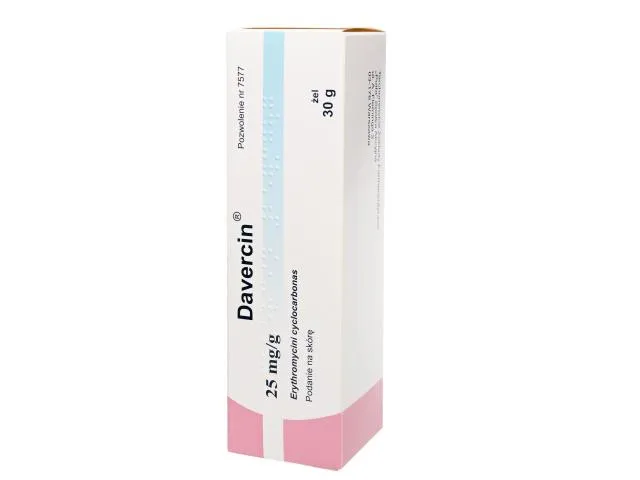
Table of Contents
Package leaflet: Information for the patient
Warning! Keep this leaflet! The information on the immediate packaging is in a foreign language.
Davercin (DAVERCIN)
25 mg/g, gel
Erythromycini cyclocarbonas
Davercin and ДАВЕРЦИН are the same brand names of the same medicinal product written in
Polish and Bulgarian, respectively.
Please read this leaflet carefully before using the medicine, as it contains
important information for the patient.
- Keep this leaflet, so that you can read it again if necessary.
- If you have any questions, consult your doctor or nurse.
- This medicine has been prescribed for a specific individual. Do not pass it on to others. The medicine may harm others, even if their symptoms are the same.
- If you experience any adverse reactions, including those not listed in this leaflet, inform your doctor or pharmacist. See section 4.
Table of contents of the leaflet:
- What Davercin is and what it is used for
- Important information before using Davercin
- How to use Davercin
- Possible side effects
- How to store Davercin
- Contents of the pack and other information
1. What Davercin is and what it is used for
Davercin gel contains, as the active substance, erythromycin A cyclic 11,12-carbonate,
which belongs to the macrolide antibiotics.
Erythromycin A cyclic 11,12-carbonate acts against certain Gram-negative bacteria and many Gram-positive bacteria, including the anaerobic Gram-positive bacillus Propionibacterium acnes, which is a pathogenic factor in acne.
Davercin, when applied to intact skin, acts locally and is practically not absorbed into the body.
Indications
Topical treatment of acne vulgaris.
2. Important information before using Davercin
When not to use Davercin
- if the patient is allergic to erythromycin or any of the other ingredients of this medicine (listed in section 6).
Warnings and precautions
- Davercin gel is intended for topical use on the skin only.
- In case of accidental contact with eyes or mucous membranes, rinse thoroughly with lukewarm water.
- If skin irritation occurs at the application site, inform the doctor. The doctor will decide whether the treatment should be discontinued.
- Do not apply the medicine on damaged skin (abrasions, open, oozing wounds).
- Cross-resistance with other macrolide antibiotics may occur.
- Safety and efficacy of Davercin in children have not been established.
Davercin and other medicines
Inform your doctor or pharmacist about all medicines you are currently using, have recently used, or plan to use.
Concomitant topical use of other medicinal products, especially exfoliating or abrasive agents, is not recommended. When other topical medicines are used simultaneously, skin irritation and dryness may occur more frequently.
If combined topical treatment is necessary, another topical medicine should be applied several hours apart from Davercin.
Pregnancy and breastfeeding
Consult a doctor or pharmacist before using any medicine.
If the patient is pregnant or suspects she might be pregnant
Avoid using Davercin during pregnancy unless considered necessary by a doctor.
If the patient is breastfeeding
The decision on using Davercin gel in breastfeeding women should be made by a doctor.
Driving and operating machinery
There is no data available regarding the effect of this medicine on the ability to drive or operate machinery.
Davercin contains propylene glycol
This medicine contains 20 mg of propylene glycol in each gram of gel.
Propylene glycol may cause skin irritation.
Davercin contains dimethyl sulfoxide
This medicine may cause skin irritation.
Davercin contains 96% ethanol
This medicine contains 640 mg of alcohol (ethanol) in each gram of gel.
Due to its ethanol content, this medicine may cause stinging on damaged skin.
3. How to use Davercin
Davercin is intended for topical use only.
Davercin gel should be applied in a thin layer to affected areas twice daily – in the morning and evening.
The gel should be applied to clean, dry skin.
After each application, hands should be thoroughly washed.
The average duration of treatment is 6 to 8 weeks.
If you feel the effect of the medicine is too strong or too weak, consult your doctor.
Use of more than the recommended dose of Davercin
Excessive use of the medicine may cause skin irritation, which usually resolves after discontinuation of the medicine.
Seek immediate medical advice if the medicine is accidentally swallowed.
Davercin is intended for cutaneous use only, not for oral administration. In case of accidental ingestion, a doctor may recommend appropriate gastric evacuation methods. Bring the medicine in its original packaging so that medical personnel can clearly identify which medicine was taken.
If a dose of Davercin is missed
If a dose is missed at the usual scheduled time, apply the medicine as soon as possible, then continue with the regular dosing schedule.
Do not use a double dose to make up for a missed dose.
4. Possible adverse reactions
Like all medicines, Davercin can cause adverse reactions, although not everyone experiences them.
If the patient develops a severe skin reaction: red, scaly rash with bumps under the skin and blisters (erythema multiforme), contact a doctor immediately. The frequency of these adverse effects is unknown (cannot be determined from available data).
The following adverse reactions have been reported rarely (less than 1 in 1,000 patients) with the use of Davercin gel.
During prolonged or repeated treatment with erythromycin, development of drug-resistant bacteria may occur.
Eye irritation has been reported during application of the medicine to facial skin.
At the site of application, burning, drying of the stratum corneum, itching, scaling, erythema, and seborrhoea may occur.
Reporting of adverse reactions
If any adverse reactions occur, including any adverse reactions not listed in this leaflet, inform a doctor or pharmacist. Adverse reactions can be reported directly to the Department of Monitoring Adverse Drug Reactions at the Office for Registration of Medicinal Products, Medical Devices and Biocidal Products:
Al. Jerozolimskie 181C, 02-222 Warsaw, tel.: +48 22 49 21 301, fax: +48 22 49 21 309,
website: https://smz.ezdrowie.gov.pl.
Reporting adverse reactions helps to provide more information on the safety of the medicine.
5. How to store Davercin
Keep this medicine out of sight and reach of children.
Store below 25°C.
Do not use this medicine after the expiry date stated on the packaging.
The expiry date refers to the last day of the stated month.
Medicines must not be disposed of via wastewater or household waste. Ask your pharmacist how to dispose of medicines no longer required. Such measures will help protect the environment.
6. Contents of the pack and other information
What Davercin contains
The active substance is erythromycin A cyclic 11,12-carbonate.
Each 1 g of gel contains 25 mg of erythromycin A cyclic 11,12-carbonate.
Other components of the medicinal product are: dimethyl sulfoxide, propylene glycol, isopropyl alcohol, ethanol 96%, hydroxypropyl cellulose.
What Davercin looks like and contents of the pack
Colourless or straw-coloured, transparent gel.
Pack size: 30 g gel
For further information, please contact the responsible party or the parallel importer.
Marketing Authorisation Holder in Bulgaria, country of export:
Tarchomin Pharmaceutical Works "Polfa" S.A.
A. Fleminga Street 2
03-176 Warsaw, Poland
Manufacturer:
Tarchomin Pharmaceutical Works "Polfa" S.A.
A. Fleminga Street 2
03-176 Warsaw, Poland
Parallel Importer:
InPharm Sp. z o.o.
Strumykowa Street 28/11
03-138 Warsaw, Poland
Repackaged in:
InPharm Sp. z o.o. Services sp. k.
Chełmżyńska Street 249
04-458 Warsaw, Poland
Marketing Authorisation Number in Bulgaria, country of export: 20050504
Parallel Import Authorisation Number: 172/22