Daktarin
Poland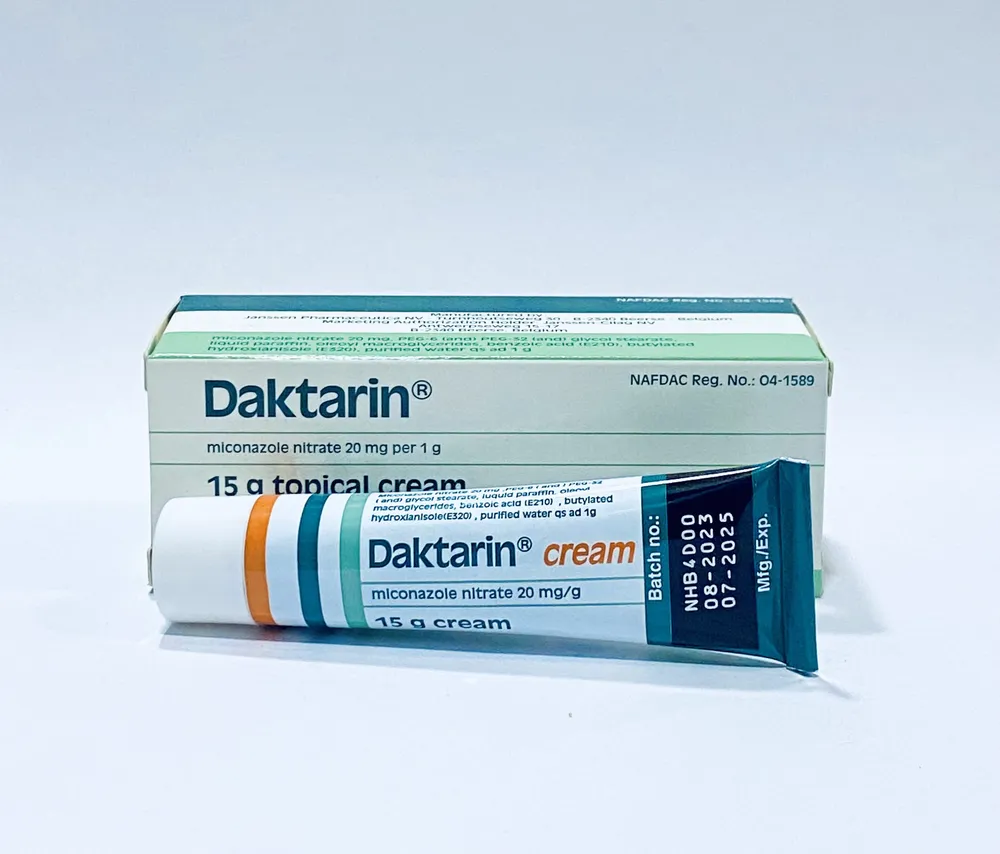
Table of Contents
Package leaflet: Information for the user
Warning! Keep the leaflet, information on the immediate packaging in a foreign language!
Daktarin (Daktarin 2%-Creme)
20 mg/g (2%), cream
Miconazoli nitras
Daktarin and Daktarin 2%-Creme are different trade names for the same medicinal product.
Please read this leaflet carefully before using the medicine, as it contains
important information for the patient.
This medicine should always be used exactly as described in this patient leaflet or as directed by
the doctor or pharmacist.
- Keep this leaflet for future reference.
- If you need advice or further information, please consult your doctor, pharmacist, or nurse.
- If you experience any adverse reactions, including any not listed in this leaflet, inform your doctor, pharmacist, or nurse. See section 4.
- If there is no improvement or if you feel worse, contact your doctor.
Table of contents
- What Daktarin cream is and what it is used for
- Important information before using Daktarin cream
- How to use Daktarin cream
- Possible side effects
- How to store Daktarin cream
- Contents of the pack and other information
1. What Daktarin cream is and what it is used for
Daktarin cream contains the active substance miconazole. Miconazole has antifungal activity against dermatophytes and yeasts, and antibacterial activity against Gram-positive bacilli and cocci.
Miconazole is also used in the treatment of secondarily infected fungal infections.
Miconazole usually relieves skin itching, which often accompanies infections caused by dermatophytes and yeasts. Itching subsides before other signs of healing appear.
Indications
Daktarin cream is indicated for the treatment of fungal skin infections caused by dermatophytes, yeasts, and other fungi, such as: tinea capitis, tinea of the trunk, hands, tinea cruris (jock itch), and interdigital tinea pedis (athlete's foot).
Due to its antibacterial properties, Daktarin cream may also be used in fungal infections secondarily infected by bacteria (e.g. diaper dermatitis).
2. Information before using Daktarin cream
When not to use Daktarin cream:
- if the patient is allergic to miconazole, other similar antifungal medicines, or any of the other ingredients of this medicine (listed in section 6),
- for the treatment of fungal infections of the scalp, mucous membranes, nails, or broken skin.
Warnings and precautions
Before starting treatment with Daktarin cream, consult your doctor or pharmacist.
If symptoms of allergy or skin irritation occur, treatment should be discontinued and medical advice sought.
Avoid contact of Daktarin cream with the eyes.
Daktarin cream and other medicines
Inform your doctor about all medicines currently used or recently used, as well as any medicines planned for future use.
In patients taking oral anticoagulants such as warfarin, monitoring of anticoagulant effect is necessary. The effects and adverse reactions associated with the use of certain other medicines (e.g. oral blood glucose-lowering agents and phenytoin) may be intensified when used concomitantly with Daktarin cream.
Caution is advised when using other medicines simultaneously.
Pregnancy and breastfeeding
If the patient is pregnant or breastfeeding, suspects she may be pregnant, or is planning to become pregnant, she should consult a doctor or pharmacist before using this medicine.
The doctor will assess the potential risk of using the medicine against the expected therapeutic benefits. It has not been established whether the active substance of the medicine – miconazole – passes into breast milk. Therefore, Daktarin cream should only be used during breastfeeding on medical advice.
Driving and operating machinery
No effects of the medicine on the ability to drive or operate machinery have been observed.
Daktarin cream contains 2 mg of benzoic acid per g of cream
Benzoic acid may cause local irritation. Benzoic acid may increase the risk of jaundice (yellowing of the skin and whites of the eyes) in newborns (up to 4 weeks of age).
Daktarin cream contains butylated hydroxyanisole
This medicine may cause a local skin reaction (e.g. contact dermatitis) or irritation of the eyes and mucous membranes.
3. How to use Daktarin cream
This medicine should always be used exactly as described in this patient information leaflet, or as directed by your doctor or pharmacist. If in doubt, consult your doctor or pharmacist.
Dosage
Daktarin cream should be applied to affected areas of skin, usually twice daily.
If Daktarin cream is being used at the same time as Daktarin medicated powder, it is recommended to use both forms of the medicine once daily.
The duration of treatment ranges from 2 to 6 weeks, depending on the location and severity of the lesions.
After all symptoms and skin lesions have resolved, treatment should be continued for at least 1 additional week.
If you feel the effect of the medicine is too strong or too weak, consult your doctor.
Use of more than the recommended dose of Daktarin cream
Overuse of the medicine may cause skin irritation, which usually resolves after discontinuation of the medicine.
Seek immediate medical advice in case of accidental ingestion.
Daktarin cream is for external use on the skin only; it is not for oral use.
Missed dose of Daktarin cream
Do not apply a double dose to make up for a missed dose.
Stopping Daktarin cream
If you have any further questions about the use of this medicine, consult your doctor or pharmacist.
4. Possible adverse reactions
Like all medicines, Daktarin cream may cause adverse reactions, although not everyone will experience them.
The frequency of possible adverse reactions listed below is defined as follows:
very rare (occurring in fewer than 1 in 10,000 patients).
Since the medicine has been marketed, very rare cases have been observed of: hypersensitivity reactions, including severe reactions such as anaphylactic reactions and angioedema, urticaria, contact dermatitis, rash, erythema, pruritus, dermatitis, skin depigmentation, burning sensation on the skin, local reactions at the application site including irritation, burning, itching, and sensation of warmth at the site of Daktarin cream application.
Reporting of adverse reactions
If any adverse reactions occur, including any adverse reactions not listed in this leaflet, inform your doctor, pharmacist, or nurse. Adverse reactions can also be reported directly to the Department for Monitoring Adverse Drug Reactions of the Office for Registration of Medicinal Products, Medical Devices and Biocidal Products
Al. Jerozolimskie 181C, 02-222 Warsaw
Tel.: +48 22 49 21 301
Fax: +48 22 49 21 309
Website: https://smz.ezdrowie.gov.pl
Reporting adverse reactions helps to provide more information on the safety of the medicine.
5. How to store Daktarin cream
Do not store above 25°C.
Keep the medicine out of the sight and reach of children.
Do not use Daktarin cream after the expiry date stated on the packaging.
The expiry date refers to the last day of the stated month. Period of use after first opening: 3
months.
Medicines must not be disposed of via the sewage system or in household waste. Ask your pharmacist how to dispose of medicines no longer required. This will help protect the environment.
6. Contents of the package and other information
What Daktarin cream contains
- The active substance is miconazole nitrate. 1 g of cream contains 20 mg of miconazole nitrate.
- The other ingredients are butylhydroxyanisole (E 320), benzoic acid (E 210), liquid paraffin, macrogol glyceryl oleates, macrogol 6 and macrogol 32 stearate, purified water.
What Daktarin cream looks like and contents of the pack
The medicinal product is packed in an aluminium tube with an internal coating and a cap made of polypropylene, placed in a cardboard box.
For more detailed information, please contact the marketing authorisation holder or the parallel importer.
Marketing authorisation holder in Austria, the country of export:
Johnson & Johnson GmbH
Leopold Ungar Platz 2
1190 Vienna
Austria
Manufacturer:
Janssen Pharmaceutica N.V.
Turnhoutseweg 30
2340 Beerse
Belgium
Parallel importer:
Medezin Sp. z o.o.
Zbąszyńska 3 Street
91-342 Łódź
Repackaged in:
Medezin Sp. z o.o.
Zbąszyńska 3 Street
91-342 Łódź
Marketing authorisation number in Austria, the country of export: 15.307
Parallel import authorisation number: 111/25