Cyrdanax
Poland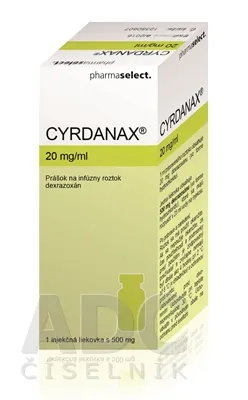
Table of Contents
- Patient Information Leaflet
- 1. What Cyrdanax is and what it is used for
- 2. Important information before using Cyrdanax
- 3. How to use Cyrdanax
- 4. Possible adverse reactions
- 5. How to store Cyrdanax
- 6. Contents of the pack and other information
- The following information is intended for healthcare professionals only
Patient Information Leaflet
Cyrdanax 20 mg/ml, powder for solution for infusion
(Dexrazoxanum)
Please read all of this leaflet carefully before using this medicine, as it contains
important information for you.
- Keep this leaflet, as you may need to read it again.
- If you have any further questions, please ask your doctor or pharmacist.
- If you experience any side effects, including any not listed in this leaflet, tell your doctor or pharmacist. See section 4.
Leaflet Contents
- What Cyrdanax is and what it is used for
- What you need to know before using Cyrdanax
- How to use Cyrdanax
- Possible side effects
- How to store Cyrdanax
- Contents of the pack and other information
1. What Cyrdanax is and what it is used for
Cyrdanax contains an active substance called dexrazoxane. This substance belongs to a group of medicines known as cardioprotective agents (heart-protecting medicines).
Cyrdanax is used to prevent heart damage in adult patients with breast cancer who are being treated with doxorubicin or epirubicin.
2. Important information before using Cyrdanax
When not to use Cyrdanax:
- if the patient is under 18 years of age and the planned dose of anthracycline is considered low – discuss this with the doctor;
- if the patient is allergic (hypersensitive) to dexrazoxane;
- if the patient is breastfeeding (see also "Pregnancy and breastfeeding");
- if the patient has received a yellow fever vaccine.
If any of these situations apply, the patient must not receive this medicine.
Warnings and precautions
Before starting treatment with Cyrdanax, discuss the following with the doctor:
- if the patient has or has previously had liver or kidney disease;
- if the patient has or has previously had a heart attack, heart failure, untreated chest pain (angina), or heart valve disorders;
- if the patient is pregnant or planning to become pregnant (see also "Pregnancy and breastfeeding");
- if the patient is allergic to dexrazoxane.
Please be aware that:
- the treating doctor may order tests before or during treatment with Cyrdanax to monitor treatment effectiveness and the function of certain organs such as the heart, kidneys, or liver;
- the treating doctor may order blood tests during treatment with Cyrdanax to monitor bone marrow function. If the patient is receiving high-dose anticancer therapy (e.g. chemotherapy or radiotherapy), and also taking high doses of Cyrdanax, bone marrow function may be impaired. This condition may affect the production of red blood cells, white blood cells, and platelets;
- Cyrdanax may increase the risk of developing leukaemia (a blood cancer);
- during treatment with Cyrdanax, women of childbearing potential and men should use effective contraception. Men should continue using contraception to prevent fathering a child for at least six months after completing treatment with Cyrdanax (see also "Pregnancy and breastfeeding");
- combined treatment with Cyrdanax and anticancer medicines may increase the risk of blood clots;
- if Cyrdanax powder or solution comes into contact with the skin, inform the doctor immediately. The patient or doctor should immediately wash the affected area thoroughly with water.
Children and adolescents
The long-term benefits and risks of using this medicine in children and adolescents are not yet clear. The doctor will inform the patient about the benefits and risks associated with using this medicine.
Elderly patients (over 65 years of age)
The doctor may adjust treatment with Cyrdanax depending on the patient's health status (in case of heart, liver, or kidney disease).
Cyrdanax and other medicines
Tell the doctor or pharmacist about all medicines the patient is currently taking or has recently taken, as well as any medicines the patient plans to take. Do not take any other medicines without first discussing with the treating doctor, due to the potential for interactions between Cyrdanax and other medicines:
- vaccines: do not use Cyrdanax if a yellow fever vaccine is to be administered; the use of Cyrdanax is also not recommended if a vaccine containing live virus particles is to be given;
- phenytoin, an antiepileptic medicine;
- cyclosporine or tacrolimus, immunosuppressive medicines used to prevent organ transplant rejection;
- myelosuppressive medicines, which reduce the production of red blood cells, white blood cells, and platelets.
Pregnancy and breastfeeding
- If the patient is pregnant or breastfeeding, suspects she may be pregnant, or is planning to have a child, she should consult her doctor or pharmacist before using this medicine.
- Pregnant patients or those planning to become pregnant will not receive Cyrdanax unless the doctor decides it is necessary.
- Women of childbearing potential and men should use effective contraception during treatment with Cyrdanax and for at least six months after treatment with Cyrdanax has ended.
- Breastfeeding must be discontinued during treatment with Cyrdanax.
Driving and operating machinery
Fatigue has been reported during treatment with Cyrdanax. Therefore, if the patient feels tired or drowsy, he or she should not drive or operate machinery.
3. How to use Cyrdanax
How Cyrdanax is administered to the patient
This medicine will be prepared and then administered to the patient by a doctor or another healthcare professional. The dose to be given to the patient is determined by the doctor.
Cyrdanax is administered as an intravenous infusion lasting approximately 15 minutes.
This infusion is started approximately 30 minutes before administration of the anticancer drug [doxorubicin and (or) epirubicin].
Possible overdose of Cyrdanax
If the patient receives more Cyrdanax than recommended, inform the doctor or nurse immediately. In such a case, some of the adverse reactions listed in section 4, “Possible side effects”, may occur.
4. Possible adverse reactions
Like all medicines, this medicine can cause adverse reactions, although not everyone will experience them.
Some adverse reactions may be serious and require immediate medical attention:
Very common (affects more than 1 in 10 patients):
- Frequent infections, fever, sore throat, unexpected bruising and bleeding (symptoms of blood disorders such as low red blood cell count, low white blood cell count, low platelet count and low granulocyte count. However, blood picture may return to normal after each treatment cycle)
Common (affects less than 1 in 10 patients): - Swelling and redness of the vein
Uncommon (affects less than 1 in 100 patients): - Leukemia (blood cancer)
- Sudden loss of consciousness
- Swelling and pain in one part of the body, which may be caused by a blood clot in a vein
- Swelling of limb tissues
Unknown: - Allergic reactions, including itching, rash, facial and (or) throat swelling, wheezing, shortness of breath or difficulty breathing, changes in consciousness, hypotension
- Sudden attack of breathlessness, coughing up blood and chest pain (symptoms of pulmonary embolism)
If any of the above symptoms occur, you must immediately inform your doctor or go to the emergency department of the nearest hospital.
Other adverse reactions include:
Very common (affects more than 1 in 10 patients):
- Hair loss
- Vomiting, oral ulceration, nausea
- Weakness
Common (affects less than 1 in 10 patients): - Diarrhea, abdominal pain, constipation, feeling of stomach fullness and loss of appetite
- Impaired heart muscle function, rapid heartbeat
- Pain, redness and swelling of the moist lining of internal passages such as airways or esophagus
- Nail disorders such as blackening
- Skin reaction such as swelling, redness, pain, burning sensation, itching at the site of drug administration
- Tingling and numbness of hands or feet, dizziness, headache
- Feeling of fatigue, general malaise
- Slight increase in body temperature, chest pain, increased/increased heart rate, shortness of breath or sudden gasping for air
- Abnormal liver function test results
Uncommon (affects less than 1 in 100 patients): - Increase in blood cell count
- Dizziness, ear infections
- Bleeding, tenderness or enlargement of gums, thrush
- Thirst
- Redness, excessive warmth and tenderness due to subcutaneous inflammation
Reporting of adverse reactions
If any adverse reactions occur, including any adverse reactions not listed in this leaflet, inform your doctor or pharmacist. Adverse reactions can be reported directly to the Department of Monitoring Adverse Drug Reactions of the Office for Registration of Medicinal Products, Medical Devices and Biocidal Products
Al. Jerozolimskie 181C, 02-222 Warsaw
Tel.: + 48 22 49 21 301
Fax: + 48 22 49 21 309
e-mail: [email protected]
Adverse reactions can also be reported to the marketing authorization holder.
By reporting adverse reactions, additional information on the safety of the medicine can be collected.
5. How to store Cyrdanax
Keep this medicine out of sight and reach of children.
Do not use this medicine after the expiry date stated on the vial and carton. The expiry date refers to the last day of the stated month.
Before opening the vial:
- Do not store above 30°C.
- Store in the original packaging to protect from light. After reconstitution and dilution: The solution should be used immediately. If not used immediately, the user is responsible for storage conditions and duration – do not store for longer than 4 hours at a temperature of 2°C to 8°C (in the refrigerator) and protect from light.
6. Contents of the pack and other information
What Cyrdanax contains
The active substance is dexrazoxane (as hydrochloride).
1 ml of prepared solution contains 20 mg of dexrazoxane (as hydrochloride).
250 mg vial: Each vial contains 250 mg of dexrazoxane (as hydrochloride) for the preparation of a solution in 12.5 ml of water for injections.
500 mg vial: Each vial contains 500 mg of dexrazoxane (as hydrochloride) for the preparation of a solution in 25 ml of water for injections.
The medicine does not contain any other ingredients.
What Cyrdanax looks like and contents of the pack
This medicine is a white or almost white powder for solution for infusion.
It is supplied in packs of 1 or 4 vials made of brown glass containing 250 mg or 500 mg of dexrazoxane.
Not all pack sizes may be marketed.
Marketing Authorisation Holder
Pharmaselect International Beteiligungs GmbH
Ernst-Melchior-Gasse 20
1020 Vienna, Austria
Manufacturer
BAG Health Care GmbH
Amtsgerichtsstrasse 1-5,
35423 Lich,
Germany
This medicine is authorised in the following countries of the European Economic Area under the following names:
Austria, Czech Republic, France, Germany, Hungary, Poland, Romania, Slovakia: Cyrdanax
The following information is intended for healthcare professionals only
Preparation of the intravenous infusion solution
Reconstitution: The contents of each 500 mg vial should be dissolved in 25 mL of water for injections. The contents dissolve within a few minutes with gentle shaking. The resulting solution has a pH of approximately 1.8. The solution must be diluted prior to administration to the patient.
The contents of each 250 mg vial should be dissolved in 12.5 mL of water for injections. The contents dissolve within a few minutes with gentle shaking. The resulting solution has a pH of approximately 1.8. The solution must be diluted prior to administration to the patient.
Dilution: To avoid the risk of thrombophlebitis at the site of administration, Cyrdanax must be diluted before infusion using one of the infusion fluids listed in the table below. The use of solutions with higher pH is recommended. The final volume of the infusion fluid is proportional to the number of Cyrdanax vials used and the volume of diluent, which ranges from 12.5 mL to 100 mL per vial.
The table below summarizes the final volume and approximate pH of the reconstituted and diluted Cyrdanax solution for one and four vials. The minimum and maximum volumes of infusion fluids to be used per vial are provided below.
500 mg vials:
| Infusion solution used for dilution | Volume of diluent used to dilute 1 vial of reconstituted Cyrdanax drug | Final volume of 1 vial | Final volume of 4 vials | pH (approximate) |
| Lactated Ringer's solution | 25 ml | 50 ml | 200 ml | 2.4 |
| 100 ml | 125 ml | 500 ml | 3.5 | |
| 0.16 M sodium lactate* | 25 ml | 50 ml | 200 ml | 3.9 |
| 100 ml | 125 ml | 500 ml | 4.6 | |
| To increase the pH of the solution, using a larger volume of diluent is generally recommended (up to 100 ml of diluent per 25 ml of reconstituted Cyrdanax). If necessary and justified by the patient's hemodynamic status, smaller volumes of diluent may be used (minimum 25 ml of diluent per 25 ml of reconstituted Cyrdanax). | ||||
Vials 250 mg:
Infusion solution Volume of diluent Final volume Final volume pH
used for used for 1 vial 4 vials (approximately)
dilution dilution
1 vial
of dissolved
Cyrdanax medicinal product
Ringer's lactate 12.5 ml 25 ml 100 ml 2.4
solution 50 ml 62.5 ml 250 ml 3.5
0.16 M sodium 12.5 ml 25 ml 100 ml 3.9
lactate* 50 ml 62.5 ml 250 ml 4.6
To increase the pH of the solution, it is generally recommended to use a larger volume of diluent
(up to a maximum of 100 ml of additional diluent per 12.5 ml of dissolved Cyrdanax medicinal product).
If clinically necessary and the patient's hemodynamic status allows, smaller volumes of diluent may be
used (minimum 12.5 ml of additional diluent per 12.5 ml of dissolved Cyrdanax medicinal product).
* Sodium lactate 11.2% should be diluted 1:6 to obtain a 0.16 M concentration.
Medicinal products intended for parenteral administration should be visually inspected for the presence
of foreign particles. The Cyrdanax solution is colorless to yellow immediately after reconstitution; however,
color changes may occur over time, which does not indicate loss of potency if the product has been stored
correctly. However, if after reconstitution the solution has a color other than colorless to yellow, it should
be discarded.
Dosage: Cyrdanax is administered as a short intravenous infusion (15 minutes), approximately 30 minutes
before anthracycline administration, at a dose 10 times higher than the dose of doxorubicin and 10 times higher
than the dose of epirubicin.
The recommended dose of Cyrdanax is 500 mg/m², whereas the usual dosing regimen for doxorubicin is
50 mg/m² or 600 mg/m², and the commonly used epirubicin dosing regimen is 60 mg/m².
Children and adolescents: The safety and efficacy of Cyrdanax medicinal product have not been established
in children aged 0 to 18 years. Cyrdanax medicinal product is contraindicated in children aged 0 to 18 years
who are planned to receive a cumulative doxorubicin dose of less than 300 mg/m² or an equivalent cumulative
dose of another anthracycline.
Renal impairment: In patients with moderate to severe renal impairment (creatinine clearance < 40 ml/min),
the dose of dexrazoxane should be reduced by 50%.
Hepatic impairment: Dose proportions should be maintained; for example, if the anthracycline dose is
reduced, the dexrazoxane dose should be reduced accordingly.
Elderly (over 65 years of age): Dose adjustment may be considered when treating with Cyrdanax depending
on the patient's health status (in case of heart, liver, or kidney problems).
Overdose: Symptoms of overdose include leukopenia, thrombocytopenia, nausea, vomiting, diarrhea, skin
reactions, and alopecia. There is no specific antidote; symptomatic treatment should be administered.
Treatment should include infection prophylaxis and management, fluid replacement, and nutritional support.
Incompatibilities: Dexrazoxane may increase hematological toxicity caused by chemotherapy or
radiotherapy, therefore close monitoring of hematological parameters is required during the first two
treatment cycles.
Interaction studies involving dexrazoxane are limited. Effects on CYP450 enzymes or drug transporters have
not been studied.
Cyrdanax must not be mixed in the same infusion with other medicinal products.
Storage instructions
Before opening the vial: Do not store above 30°C. Store in the original packaging to protect from light.
After reconstitution and dilution: Chemical and physical stability is maintained for 8 hours at 4°C.
From a microbiological standpoint, the product should be used immediately.
If not used immediately, the user is responsible for storage conditions and duration—do not store longer
than 4 hours at 2°C to 8°C (in the refrigerator) and protect from light.