Cuprenil
Poland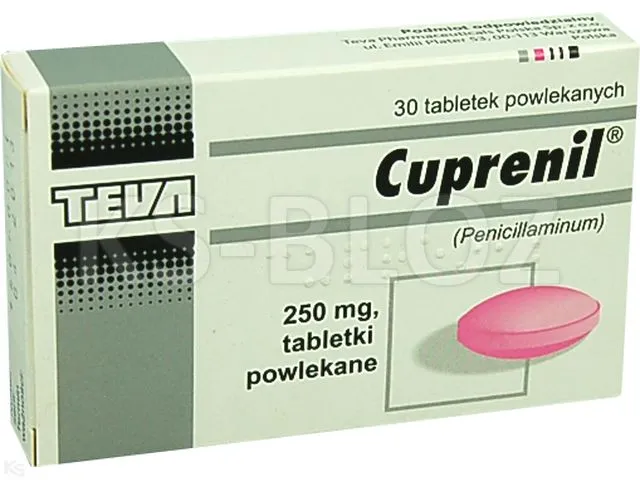
Table of Contents
Package leaflet: Information for the user
CUPRENIL, 250 mg, coated tablets
(Penicillaminum)
Please read this leaflet carefully before taking this medicine, as it contains
important information for the patient.
- Keep this leaflet, so that you can read it again if necessary.
- Consult your doctor or pharmacist if you have any doubts.
- This medicine has been prescribed for a specific individual. Do not pass it on to others. This medicine may harm someone else, even if their symptoms are the same.
- If any adverse reactions occur, including any possible adverse reactions not listed in this leaflet, inform your doctor or pharmacist.
Table of contents of the leaflet
- What is Cuprenil and what is it used for
- Important information before taking Cuprenil
- How to take Cuprenil
- Possible side effects
- How to store Cuprenil
- Contents of the pack and other information
1. What is Cuprenil and what is it used for
Cuprenil is a highly active metal-chelating agent. The drug acts by binding metals, primarily copper, mercury, lead, iron, and other heavy metals, forming stable, water-soluble complexes that are excreted in urine.
It is the drug of choice in Wilson's disease (hepatolenticular degeneration) – a disorder characterized by abnormal copper metabolism in the body, leading to copper accumulation in various organs such as kidneys, brain, liver, and eyeballs.
Cuprenil is also used in the treatment of rheumatoid arthritis. The mechanism of action has not been fully elucidated, but it most likely reduces the titer of rheumatoid factor and the concentration of immunoglobulin complexes in serum and synovial fluid.
Cuprenil is also used in the treatment and prophylaxis of cystinuria, in which penicillamine forms a disulfide bond with cystine – penicillamine-cysteine disulfide. This compound is more soluble than cystine and is easily excreted in urine.
Cuprenil is also used in the treatment of lead poisoning and in chronic active hepatitis.
2. Important information before using Cuprenil
When not to use Cuprenil
- If the patient is allergic to the active substance (penicillamine) or to any of the other ingredients of this medicine (listed in section 6).
- If the patient has systemic lupus erythematosus.
- If the patient previously treated with penicillamine developed aplastic anemia or agranulocytosis.
- Due to the potential harmful effect on the kidneys, penicillamine should not be used in patients with rheumatoid arthritis who currently or previously had impaired kidney function.
- If lead-containing material is visible in the gastrointestinal tract on X-ray in a patient with chronic lead poisoning. Treatment with the medicine may be started only after removal of lead-containing substances from the gastrointestinal tract.
- If the patient is being treated with gold preparations, antimalarial drugs, cytostatics, oxyphenylbutazone or phenylbutazone.
Warnings and precautions
In some patients treated with penicillamine, the following disorders have been observed:
aplastic anemia (a condition of bone marrow failure), agranulocytosis (deficiency of one type of white blood cells – neutrophils), thrombocytopenia (low platelet count), Goodpasture’s syndrome, and myasthenia gravis (a disease characterized by skeletal muscle weakness).
During treatment, the following tests should be performed every 2 weeks during the first 6 months and then monthly:
urinalysis, complete blood count with blood smear, and platelet count.
During treatment, symptoms such as fever, sore throat, chills, petechiae (small red spots caused by bleeding), or bleeding may occur. These may indicate the development of blood disorders such as granulocytopenia and/or thrombocytopenia.
If any of the above symptoms occur, the doctor should be informed immediately and the tests listed above should be repeated.
Proteinuria (presence of protein in urine) and/or hematuria (presence of red blood cells in urine) may occur during treatment, which may be an early warning sign of developing glomerulonephritis. This disorder may lead to nephrotic syndrome associated with excessive loss of protein in urine. The doctor should be informed about these symptoms.
In some patients, the sign of glomerulonephritis (proteinuria) may resolve during treatment, whereas in others proteinuria persists and in such cases penicillamine treatment should be discontinued. When proteinuria and hematuria occur, the doctor must determine whether the signs of glomerular damage are related to treatment.
In patients with Wilson’s disease or cystinuria treated with penicillamine, if urinary abnormalities occur, the doctor should consider discontinuing the medicine.
During penicillamine treatment in patients with cystinuria, an annual X-ray examination of the urinary tract is recommended to detect kidney stones as early as possible. Cystine stones may form rapidly, sometimes within 6 months.
Despite limited data on liver disorders such as intrahepatic cholestasis and toxic hepatitis, the doctor should recommend liver function tests every 6 months during Cuprenil treatment.
Immediately inform the doctor if symptoms such as exertional dyspnea (shortness of breath), unexplained cough, or wheezing occur. The doctor should consider performing lung function tests.
Cases of myasthenic syndrome have been reported, sometimes leading to the development of myasthenia gravis. Ptosis (drooping eyelids), diplopia (double vision), and weakness of the eye muscles are often early signs of myasthenia gravis. In most cases, symptoms resolve after discontinuation of penicillamine.
If bullae (blister formation on the skin) occur, penicillamine treatment must be stopped immediately.
Patients who discontinued gold therapy due to serious adverse reactions may be at increased risk of adverse reactions during penicillamine treatment.
If treatment has been interrupted for any reason, reinitiation of therapy should begin with low doses, gradually increasing until the effective therapeutic dose is reached.
Precautions
Fever may occur in some patients usually during the second or third week after starting penicillamine treatment. Fever may often be accompanied by skin rash.
An early-type allergic reaction presenting as rash usually resolves within a few days after discontinuation of the drug and rarely recurs when treatment is restarted with small doses.
If itching and rash occur, the doctor may prescribe antihistamines. Reintroduction of the drug should begin with low doses.
A late-type allergic reaction in the form of rash, occurring much less frequently and usually after 6 months or later, may require discontinuation of the drug.
Drug-induced rash with fever, joint pain, lymphadenopathy (swollen lymph nodes), and other allergic symptoms usually necessitates discontinuation of the drug.
Patients hypersensitive to penicillin may also be allergic to penicillamine (cross-sensitivity). The risk of adverse reactions due to penicillamine contamination with trace amounts of penicillin during manufacturing has been eliminated, as penicillamine is now produced synthetically rather than by degradation of penicillin.
Before planned surgical procedures, due to the effect of penicillamine on collagen and elastin, the doctor should reduce the daily dose to 250 mg. Treatment with higher doses may be resumed only after complete healing of surgical wounds.
Children and adolescents
Due to the tablet strength being available only as 250 mg, this product is not suitable for use in younger children under 12 years of age.
Other medicines and Cuprenil
Inform the doctor about all medicines currently taken, including those available without a prescription.
Cuprenil increases the body’s requirement for vitamin B6. Vitamin B6 deficiency may contribute to the development of anemia or peripheral neuropathy.
The drug chelates metals; therefore, when taking iron-containing medicines, a 2-hour interval should be maintained between administration of these medicines and Cuprenil.
The drug should not be used concomitantly with drugs that suppress bone marrow function, such as gold-containing drugs, drugs used in malaria, cancer, or those containing oxyphenylbutazone or phenylbutazone.
The information contained in this leaflet may also apply to medicines previously used or those to be used in the future.
Taking Cuprenil with food and drink
The medicine should be taken on an empty stomach, at least 30 minutes before a meal (1 hour before a meal in children with Wilson’s disease or cystinuria), with water.
Pregnancy and breastfeeding
Pregnancy
During pregnancy, while breastfeeding, or if pregnancy is suspected or planned, consult a doctor or pharmacist before using this medicine.
The safety of using this medicine in pregnant women has not been established. Animal studies have shown that when administered to rats at doses six times higher than the maximum recommended human doses, penicillamine causes congenital skeletal malformations and cleft palate in the fetus.
The use of Cuprenil in pregnant women depends on the indication:
- Rheumatoid arthritis – the medicine should not be used.
- Cystinuria – use of the medicine is not recommended.
- Wilson’s disease – daily doses should be reduced to 1000 mg. Before planned caesarean section, the daily dose should be reduced to 250 mg during the last 6 weeks of pregnancy and until complete wound healing.
Breastfeeding
Before taking any medicine, consult a doctor or pharmacist.
There are no data on whether the drug passes into breast milk; therefore, use of Cuprenil is not recommended in breastfeeding women.
Driving and operating machinery
The medicine is considered safe and does not impair psycho-physical abilities required for driving vehicles or operating machinery.
Cuprenil contains monohydrate lactose and lac azorubine (E 122). For this reason, if the patient has previously been diagnosed with intolerance to certain sugars, the patient should consult a doctor before taking the medicine. Due to the presence of lac azorubine (E 122), Cuprenil may cause allergic reactions.
3. How to use Cuprenil
Cuprenil must always be used as directed by the physician. If in doubt, consult your doctor or pharmacist.
The dose depends on the indication. In children, the dose may depend on body weight. Due to the dosage, the medicine may not be suitable for use in very young children.
Rheumatoid arthritis, including juvenile rheumatoid arthritis
- Adults: 125 to 250 mg daily during the first month of treatment. The dose should then be increased every 4 to 12 weeks by 125 to 250 mg until symptoms subside. Afterwards, your doctor will recommend using the lowest effective dose that controls disease symptoms. If no improvement occurs after 12 months of treatment, your doctor may recommend discontinuing the medicine. The usual maintenance dose is 500 to 750 mg daily. A dose greater than 1500 mg daily should not be used. After 6 months of symptom remission, your doctor will recommend gradually reducing the dose by 125 to 250 mg every 12 weeks.
- Elderly patients: The initial dose should not exceed 125 mg daily during the first month of treatment. The dose may then be increased by the doctor every 4 to 12 weeks by 125 mg until symptoms subside. A dose greater than 1000 mg daily should not be used.
- Children: The usual dose is 15 to 20 mg/kg body weight daily. The initial dose should be lower (2.5 to 5.0 mg/kg body weight daily) and may be gradually increased every 4 weeks over a period of 3 to 6 months.
Wilson's disease
- Adults: 1500 mg to 2000 mg daily in divided doses. After symptoms have subsided, your doctor may recommend reducing the dose to 750 mg or 1000 mg daily. Patients with adequate copper levels (negative copper balance) should use the lowest effective dose. A dose of 2000 mg daily should not be used for longer than 1 year.
- Elderly patients: The usual dose is 20 mg/kg body weight daily in divided doses. The dose should be adjusted to achieve symptom remission and maintain a negative copper balance.
- Children: The usual dose is 20 mg/kg body weight daily, given in two or three divided doses, taken one hour before meals. For older children (over 12 years of age), the usual dose is 0.75 g to 1 g daily.
Cystinuria
Your doctor will determine the lowest effective dose based on urinary amino acid levels.
-
Dissolving cystine stones
- Adults: 1000 to 3000 mg daily in divided doses. Cystine concentration in urine should be maintained below 200 mg/L.
-
Prevention of cystine stone formation
- Adults: The usual dose is 500 to 1000 mg daily until urinary cystine concentration falls below 300 mg/L.
- Elderly patients: Your doctor will recommend the minimum dose required to achieve a urinary cystine concentration below 200 mg/L.
- Children: 20 to 30 mg/kg body weight daily in two or three divided doses, taken one hour before meals, adjusted to achieve a urinary cystine concentration below 200 mg/L.
Note
During treatment, it is recommended to drink large amounts of fluids—no less than 3 liters daily. The patient should drink 500 mL of water before bedtime and another 500 mL at night, when urine is more concentrated and acidic than during the day. Generally, the more fluids the patient drinks, the lower the need for Cuprenil.
Your doctor should also recommend a diet low in the amino acid methionine to minimize cystine production. Such a diet is not recommended for children during growth periods or for pregnant women due to its low protein content.
Lead poisoning
- Adults: The usual dose is 1000 to 1500 mg daily in divided doses until urinary lead excretion reaches approximately 0.5 mg per day.
- Elderly patients: The usual dose is 20 mg/kg body weight daily in divided doses until urinary lead excretion reaches approximately 0.5 mg per day.
- Children: The medicine should only be used when blood lead concentration is less than 45 µg/dL. The total daily dose should be 15 to 20 mg/kg body weight in 2–3 divided doses.
Chronic active hepatitis
- Adults: The initial dose is 500 mg daily in divided doses. The dose may then be gradually increased every 3 months up to a maximum of 1250 mg daily. During treatment with Cuprenil, corticosteroid medicines should not be used. Your doctor will recommend periodic liver function tests to monitor liver performance.
- Children: The safety and efficacy of Cuprenil in children under 18 years of age with chronic active hepatitis have not been established. No data are available.
If you feel the medicine's effect is too strong or too weak, consult your doctor.
Use of more than the recommended dose of Cuprenil
In case of overdose, inform your doctor, who will recommend appropriate treatment.
If a patient has taken more medicine than prescribed, or if someone else has taken it, inform the doctor or pharmacist immediately.
Missed dose of Cuprenil
If a dose of Cuprenil is missed, take the next dose at the usual time. Do not take a double dose to make up for the missed dose.
If you have any doubts about how to use this medicine, consult your doctor or pharmacist.
4. Possible adverse reactions
Like all medicines, this medicine can cause adverse reactions, although not everyone will experience them.
Frequency scale of adverse reactions:
- very common – more than 1 in 10 people
- common – more than 1 in 100 people, but less than 1 in 10 people
- uncommon – more than 1 in 1,000 people, but less than 1 in 100 people
- rare – more than 1 in 10,000 people, but less than 1 in 1,000 people
- very rare – less than 1 in 10,000 people, unknown (frequency cannot be estimated from available data)
Common:
Hypersensitivity reactions (allergic), thrombocytopenia (low platelet count), lymphadenopathy (swollen lymph nodes), fever, joint pain, glomerular kidney damage, urinary tract infection, urticaria, erythema, pruritus (itching), oral inflammation.
Uncommon:
Agranulocytosis (lack of granulocytes, a type of white blood cells), aplastic anemia (bone marrow failure), hemolytic anemia (reduced red blood cells and hemoglobin), leukopenia (low white blood cell count).
Rare:
Myasthenia gravis (a disease characterized by skeletal muscle weakness), lupus-like syndrome (skin rash, urticaria, pruritus), Goodpasture’s syndrome (breathing disorders, pulmonary hemorrhage, weakness and fatigue), exfoliative dermatitis (fever, red, thickened and peeling skin, lymph node tenderness and swelling, nonspecific petechiae), toxic epidermal necrolysis (Lyell’s syndrome) (red, tight, itchy, burning and peeling skin, sore throat, fever and/or chills, redness and irritation of the eyeballs), bullous eruption (formation of blisters on the skin), cholestatic jaundice due to bile stasis (dark urine, pruritus, pale stools, yellowing of the skin and/or eyes), optic neuritis, tinnitus, chronic bronchitis, pancreatitis, recurrence of peptic ulcer disease.
Reporting of adverse reactions
If any adverse reactions occur, including any possible adverse reactions not listed in this leaflet, inform your doctor or pharmacist. Adverse reactions can be reported directly to the Department of Monitoring Adverse Drug Reactions at the Office for Registration of Medicinal Products, Medical Devices and Biocidal Products, Al. Jerozolimskie 181 C, 02-222 Warsaw, Tel.: +48 22 49 21 301, Fax: +48 22 49 21 309, website: https://smz.ezdrowie.gov.pl
Adverse reactions can also be reported to the marketing authorization holder. Reporting adverse reactions helps to provide more information on the safety of the medicine.
5. How to store Cuprenil
Store below 25°C.
Keep the medicine out of the sight and reach of children.
Do not use the medicine after the expiry date stated on the packaging. The expiry date refers to the last day of the stated month.
Medicines must not be disposed of via wastewater or household waste. Ask your pharmacist what to do with medicines no longer required. This will help protect the environment.
6. Contents of the pack and other information
What Cuprenil contains
The active substance is penicillamine.
- 1 tablet contains 250 mg of penicillamine
- Other components: potato starch, lactose monohydrate, povidone, talc, magnesium stearate. Coating ingredients: hypromellose, macrogol 4000, titanium dioxide (E 171), azorubine lake (E 122).
What the medicine looks like and contents of the pack
Violet-pink, round, biconvex coated tablets with a uniform surface, free from spots and defects.
2 blisters of 15 tablets (30 tablets) in a cardboard box.
1 bottle containing 100 tablets.
Marketing Authorisation Holder
Teva Pharmaceuticals Polska Sp. z o.o.
Emilii Plater 53
00-113 Warsaw
Poland
tel.: (22) 345 93 00
Manufacturer
Teva Operations Poland Sp. z o.o.
Mogilska 80
31-546 Kraków