Cosmofer
Poland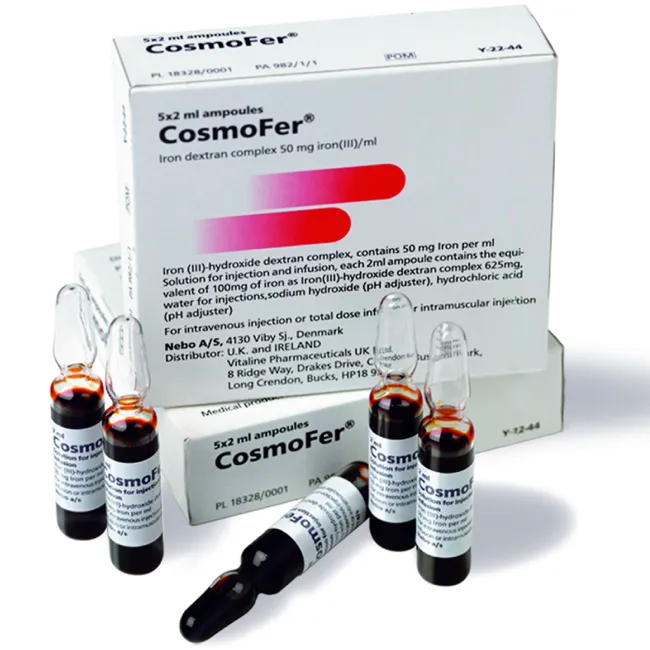
Instructions for Use
Table of Contents
Patient Information Leaflet
CosmoFer 50 mg Fe(III)/ml, solution for injection and infusion
Ferri hydroxidum dextranum
Please read carefully the entire leaflet before using the medicine, as it contains
important information for the patient.
- Keep this leaflet for future reference.
- If you have any questions, please consult your doctor or nurse.
- If you experience any adverse reactions, including any not listed in this leaflet, inform your doctor or nurse. See section 4.
Table of Contents
- What CosmoFer is and what it is used for
- Important information before receiving CosmoFer
- How to use CosmoFer
- Possible side effects
- How to store CosmoFer
- Contents of the pack and other information
1. What CosmoFer is and what it is used for
CosmoFer contains iron in the form of a dextran complex (a long-chain sugar molecule), which acts in the body as an analogue of the physiological form of iron, ferritin. This medicine allows iron to be administered by injection in high doses.
CosmoFer is indicated for the treatment of iron deficiency in the following cases:
When oral iron preparations cannot be used, for example due to intolerance, or when oral iron therapy fails to correct iron deficiency.
When there is a clinical need for rapid replenishment of iron stores in the body.
2. Important information before taking CosmoFer
When not to take CosmoFer
in case of allergy (hypersensitivity) to the product or any of the other ingredients
of this medicine (listed in section 6);
in case of serious allergic reactions (hypersensitivity) to other injectable
iron-containing preparations;
if the patient has anemia due to causes other than iron deficiency, such as hemolytic anemia;
if the patient has iron overload or disorders in iron utilization;
if the patient has liver cirrhosis or hepatitis (which are severe liver diseases);
if the patient has acute or chronic infection;
if the patient has acute kidney failure.
Warnings and precautions
Before starting treatment with CosmoFer, discuss with your doctor or nurse:
if the patient has previously experienced allergies to medicines;
if the patient has systemic lupus erythematosus;
if the patient has rheumatoid arthritis;
if the patient has asthma, eczema, or other atopic allergies.
Children
CosmoFer is indicated only for adults. This medicine should not be used in children under 14 years of age.
CosmoFer and other medicines
You must tell your doctor, pharmacist, or nurse about all medicines the patient is currently taking or has recently taken, including over-the-counter and herbal medicines, because CosmoFer may affect the way some medicines work.
Likewise, some other medicines may affect the action of CosmoFer.
In particular, tell your doctor or nurse if the patient is taking any of the following medicines:
- Vitamins and minerals
- Oral iron-containing medicines. Oral iron therapy should not be started earlier than 5 days after the last injection of CosmoFer.
Pregnancy and breastfeeding
CosmoFer has not been studied for use in pregnant women. CosmoFer should not be used during pregnancy. It is important to inform your doctor if you are pregnant, suspect you may be pregnant, or are planning to become pregnant.
If you become pregnant while being treated with CosmoFer, consult your doctor, who will decide whether treatment should be continued.
If you are breastfeeding, consult your doctor before taking CosmoFer.
Driving and operating machinery
Ask your doctor whether you may drive and operate machinery after receiving CosmoFer.
Blood tests during CosmoFer therapy
CosmoFer may affect blood test results for "bilirubin" and calcium. You should inform your doctor if any blood tests were performed during treatment with CosmoFer.
3. How to use CosmoFer
CosmoFer is administered by a doctor or nurse as an intravenous injection; CosmoFer must be administered only in facilities equipped to provide immediate and appropriate medical assistance in case of hypersensitivity reactions.
After each administration, the patient should remain under medical supervision by a doctor or nurse for at least 30 minutes to monitor for adverse reactions.
Administration of a higher than recommended dose of CosmoFer
CosmoFer will be administered by appropriately trained medical personnel. It is unlikely that a patient would receive too high a dose. Dosing will be supervised, thus preventing excessive accumulation of iron in the patient.
If there is suspicion that an overdose of CosmoFer has been accidentally administered, medical personnel should be informed immediately.
4. Possible adverse reactions
Like all medicines, this medicine can cause adverse reactions, although not everyone will experience them.
Below are listed the adverse reactions that may occur with the use of this medicine:
Allergic reactions
Inform the doctor immediately if the patient experiences any of the symptoms listed below, which may indicate a severe allergic reaction: shortness of breath, urticaria, rash (facial skin redness), itching, nausea and chills, and chest pain, which may be symptoms of a sometimes severe allergic reaction called Kounis syndrome.
Acute, severe allergic reactions may occur within the first few minutes after administration of CosmoFer (occurring less frequently than 1 in 10,000 people). Symptoms that may occur include:
- sudden difficulty in breathing
- cardiovascular collapse (impaired heart and circulatory function)
- death.
Delayed reactions have also been reported, with symptoms appearing from several hours up to four days after administration of CosmoFer. These are characterized by symptoms such as:
- joint or muscle pain
- sometimes high body temperature (fever). If such reactions occur, contact a doctor.
Other adverse reactions:
Uncommon (occur less frequently than 1 in 100 people):
- abdominal pain, nausea, vomiting
- blurred vision
- dyspnoea (shortness of breath)
- flushing (sensation of warmth)
- itching, rash
- sensation of heat
- cramps
- numbness
- pseudoallergic reactions (symptoms: dyspnoea, urticaria, rash, itching, nausea and chills).
Rare (occur less frequently than 1 in 1,000 people):
- loss of consciousness
- seizures (convulsions)
- dizziness
- anxiety
- altered mental state
- tremor
- fatigue
- pain and brown pigmentation at the injection site
- low blood pressure
- angioedema (a type of severe allergic reaction, symptoms may include swelling)
- muscle pain
- irregular heartbeat (arrhythmia)
- increased heart rate (tachycardia)
- chest pain
- diarrhoea
- excessive sweating.
Very rare (occur less frequently than 1 in 10,000 people):
- decreased level of red blood cells (visible in certain blood tests)
- headache
- tingling sensation
- increased blood pressure
- transient deafness
- palpitations
- acute and severe pseudoallergic reaction (sudden breathing difficulties and/or cardiovascular collapse)
- in pregnancy, fetal heart rate may be reduced.
Frequency not known
- influenza-like symptoms may occur within several hours to several days after injection; typical symptoms include high body temperature and muscle and joint pain.
Other adverse reactions have also been observed. Exacerbation of joint pain in rheumatoid arthritis may occur.
Possible adverse reactions after intravenous administration
After intravenous administration, local reactions such as pain and swelling (inflammation) at or near the injection site may occur. Local phlebitis has also been reported.
Possible adverse reactions after intramuscular administration
After intramuscular administration, local reactions at the injection site may occur, such as: skin discoloration, bleeding, formation of sterile abscesses, tissue necrosis or atrophy, and pain.
Reporting of adverse reactions
If any adverse symptoms occur, including any adverse reactions not listed in this leaflet, inform a doctor, pharmacist, or nurse. Adverse reactions can be reported directly to the Department of Monitoring of Adverse Drug Reactions of the Office for Registration of Medicinal Products, Medical Devices and Biocidal Products, Al. Jerozolimskie 181C, 02-222 Warsaw, tel.: 22 49 21 301, fax: 22 49 21 309, website: https://smz.ezdrowie.gov.pl.
Adverse reactions can also be reported to the marketing authorization holder.
Reporting adverse reactions helps to provide more information on the safety of the medicine.
5. How to store CosmoFer
No special storage instructions are required. Do not freeze.
Inspect the ampoule before use to check whether the solution contains any precipitate and whether the ampoule is damaged.
Only use ampoules in which the solution is homogeneous and free from precipitate.
Keep the medicine out of sight and reach of children.
Do not use this medicine after the expiry date stated on the ampoule and carton. "EXP" refers to the expiry date. The expiry date indicates the last day of the stated month.
6. Contents of the packaging and other information
What CosmoFer contains
The active substance is iron(III) hydroxide dextran complex. Each 2 ml ampoule contains 100 mg of iron(III), each 10 ml ampoule contains 500 mg of iron(III).
Other components: water for injections, sodium hydroxide (10%), hydrochloric acid (10%).
What CosmoFer looks like and contents of the pack
CosmoFer is packed in dark glass ampoules.
Pack sizes: 5 x 2 ml, 10 x 2 ml, 2 x 10 ml.
Not all pack sizes may be marketed.
Marketing Authorisation Holder and Manufacturer
Pharmacosmos A/S
Roervangsvej 30
DK-4300 Holbaek
Denmark
For further information, please contact the local representative of the Marketing Authorisation Holder:
Ewopharma AG Sp. z o.o.
01-192 Warsaw
Leszno 14
Tel. 22 620-11-71
Information intended exclusively for healthcare professionals:
Patients must be carefully monitored for subjective and objective signs of hypersensitivity reactions during and after each administration of the medicinal product CosmoFer. If hypersensitivity reactions occur, administration of the drug must be discontinued immediately.
The medicinal product CosmoFer must be administered only under the direct supervision of medical personnel trained in the assessment and treatment of anaphylactic reactions, and in a setting fully equipped with resuscitation equipment. Patients should be observed for adverse reactions for at least 30 minutes after each administration of CosmoFer.
Route of administration
CosmoFer solution for injection can be administered as an intravenous infusion (drip) or intravenous injection (intravenous bolus). Intravenous infusion is the preferred route of administration, as it reduces the risk of hypotensive episodes. However, CosmoFer may also be administered intramuscularly as an undiluted solution.
Adults and elderly patients
The cumulative total dose of CosmoFer is determined based on hemoglobin levels and body weight. The dose and dosing regimen of CosmoFer must be individually tailored for each patient according to the calculated total iron deficit.
Children (under 14 years of age)
CosmoFer should not be used in children. There are no data available on the efficacy and safety of this medicinal product in this population.
Dosing
The standard recommended dosing regimen consists of 100–200 mg of iron (equivalent to 2–4 mL), administered two or three times weekly, depending on hemoglobin levels. However, if clinical circumstances require rapid replenishment of iron stores, CosmoFer may be administered as a single total dose infusion, up to a maximum replacement dose of 20 mg/kg body weight.
Concomitant administration of CosmoFer with oral iron preparations should be avoided, as it may impair the absorption of orally administered iron.
Intravenous infusion (drip)
CosmoFer must be diluted only in 0.9% sodium chloride solution (normal saline) or 5% glucose solution. A dose of 100–200 mg of iron (2–4 mL) may be diluted in 100 mL of diluent. The first 25 mg of iron should be infused over 15 minutes. If no adverse reactions occur during this time, the remainder of the solution may be administered at a rate not exceeding 100 mL over 30 minutes.
Intravenous injections (bolus)
CosmoFer may be administered at a dose of 100–200 mg iron (2–4 mL) by slow intravenous injection (0.2 mL/min), preferably diluted in 10–20 mL of 0.9% sodium chloride solution or 5% glucose solution. Prior to initiating the full dose, 25 mg of iron should be injected over 1 to 2 minutes. If no adverse reaction occurs within the subsequent 15 minutes, the remaining dose may be administered.
Total dose infusion
Immediately before administration, the required total dose of CosmoFer, as determined from the dosing table or calculated, should be aseptically added to the appropriate volume—typically 500 mL—of sterile normal saline or 5% glucose solution. The total dose of CosmoFer (up to 20 mg/kg body weight) should be administered as an intravenous infusion over 4 to 6 hours. The first 25 mg of iron should be infused over 15 minutes, during which time the patient must be closely monitored. If no adverse reactions occur, the remainder of the solution may be administered. The infusion rate may be gradually increased up to 45–60 drops per minute. The patient must be monitored throughout the infusion and for at least 30 minutes after completion.
Total dose infusion is associated with an increased frequency of adverse reactions, particularly delayed hypersensitivity reactions. Administration of CosmoFer as a total dose infusion should be restricted to hospital settings only.
Injections into the dialysis circuit
CosmoFer may be administered during hemodialysis directly into the venous limb of the dialysis circuit, following the procedure described for intravenous administration.
Intramuscular injections
The required total dose of CosmoFer is either obtained from the dosing table or calculated individually. The drug is administered as a series of undiluted intramuscular injections, each containing up to 100 mg of iron (2.0 mL), with the number and frequency of injections adjusted according to the patient's body weight. In moderately active patients, injections may be given daily, alternating between gluteal sites. In inactive or bedridden patients, the frequency should be reduced to once or twice weekly.
To minimize the risk of subcutaneous discoloration, CosmoFer must be administered by deep intramuscular injection. It should be injected exclusively into the upper outer quadrant of the gluteal muscle, never into the arm or other exposed body areas. For normally developed adults, a 20–21 gauge needle of at least 50 mm in length should be used. For obese patients, an 80–100 mm needle is recommended. For small-statured adults, a shorter and thinner needle (23 gauge x 32 mm) should be used.
The patient should lie on their side with the injection side uppermost, or stand with weight shifted to the opposite leg. To avoid leakage of the drug into subcutaneous tissue, the "Z-track" technique (lateral displacement of the skin prior to injection) is recommended. CosmoFer should be injected slowly and smoothly. It is important to wait several seconds before withdrawing the needle to allow the muscle to accommodate the injected volume. To minimize leakage through the needle track, patients should be advised not to rub the injection site.
Dose calculation
a) Iron repletion in patients with iron deficiency anemia
The appropriate formula components are provided below. The required dose must be individually adjusted based on the total iron deficit calculated using the following formula. Hemoglobin values are expressed in grams per liter (g/L) or millimoles per liter (mmol/L).
Total dose (mg Fe) – Hb in g/L:
(Body weight (kg) × (target Hb – actual Hb) (g/L) × 0.24) + body iron stores (mg)
The factor 0.24 is derived from the following assumptions:
a) Blood volume: 70 mL/kg ≈ 7% of body weight
b) Iron content in hemoglobin: 0.34%
Factor 0.24 = 0.0034 × 0.07 × 1000 (conversion from grams to milligrams)
Total dose (mg Fe) – Hb in mmol/L:
Body weight (kg) × (target Hb (mmol/L) – actual Hb (mmol/L)) × 3.84 + body iron stores (mg)
The factor 3.84 is derived from the following assumptions:
a) Blood volume: 70 mL/kg ≈ 7% of body weight
b) Iron content in hemoglobin: 0.34%
c) Conversion factor from Hb in g/L to mmol/L: 0.06205
Factor 3.84 = 0.0034 × 0.07 × 1000 / 0.06205
b) Iron replacement due to blood loss:
Iron therapy in patients with blood loss should aim to replace the amount of iron equivalent to that lost with blood. The formula and table described above are not applicable for routine iron supplementation. Quantitative assessment of periodic blood loss and hematocrit levels during bleeding provides a suitable method for calculating the required iron dose.
The required dose of CosmoFer to compensate for iron deficiency is calculated using the following formulas:
-
If the volume of blood lost is known: intravenous administration of 200 mg CosmoFer (4 mL of CosmoFer) increases hemoglobin equivalent to one unit of blood (= 400 mL containing 150 g/L Hb or 9.3 mmol Hb/L – equivalent to 0.34% of 0.4 × 150 or 204 mg iron).
Iron to be replaced (mg) = number of blood units lost × 200
Required volume of CosmoFer (mL) = number of blood units lost × 4 -
In case of low Hb levels: use the previously mentioned formula, but without including iron stores (i.e., assume no need to replenish stored iron).
Iron to be replaced (mg) = body weight (kg) × 0.24 × (target Hb (g/L) – actual Hb (g/L))
or
Iron to be replaced (mg) = body weight (kg) × 3.84 × (target Hb (mmol/L) – actual Hb (mmol/L))
Example: for a body weight of 60 kg, Hb deficit = 10 g/L or 0.62 mmol/L:
Iron to be replaced = 60 × 0.24 × 10 = 60 × 3.84 × 0.62 = 143 mg (~3 mL of CosmoFer)
Similar Medications
-
Ferrinemia
Form: solution for injection and infusion
Active substance Dosage Ferric hydroxide saccharide 20 mg/ml Manufacturer: Propius Single Member P.C.
-
Venofer
Form: solution for injection and infusion
Active substance Dosage Ferric hydroxide saccharide 20 mg Fe 3+/ml Manufacturer: Vifor France
This page has been machine-translated and may contain inaccuracies. The original data is available in the manufacturing country's language.
Last data check: June 04, 2026 · Data source: Rejestr Produktów Leczniczych (URPL)